
Resources
Explore a wide range of valuable resources on GCED to deepen your understanding and enhance your research, advocacy, teaching, and learning.
8,370 Results found
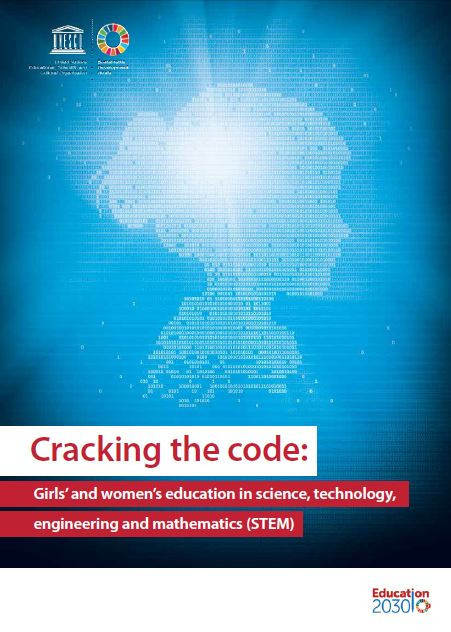 Cracking The Code: Girls’ and Women’s Education in Science, Technology, Engineering and Mathematics (STEM) Year of publication: 2017 Corporate author: UNESCO Despite significant improvements in recent decades, education is not universally available and gender inequalities persist. A major concern in many countriesis not only limited numbers of girls going to school, but also limited educational pathways for those that step into the classroom. This includes, more specifically,how to address the lower participation and learning achievement of girls in science, technology, engineering and mathematics (STEM) education. STEM underpins the 2030 Agenda for Sustainable Development, and STEM education can provide learners with the knowledge, skills, attitudes and behavioursrequired for inclusive and sustainable societies. Leaving out girls and women in STEM education and careers is a loss for all. This report aims to ‘crack the code’, or to decipher the factors that hinder or facilitate girls’ and women’s participation, achievement and continuation in STEMeducation, and what can be done by the education sector to promote girls’ and women’s interest in, and engagement with, STEM.
 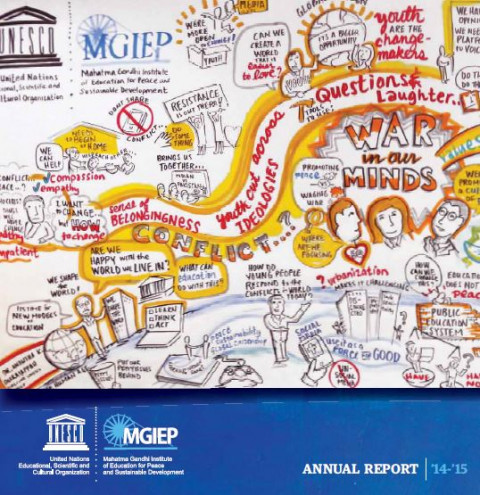 MGIEP Annual Report '14-'15 Year of publication: 2016 Corporate author: Mahatma Gandhi Institute of Education for Peace and Sustainable Development (MGIEP) The Mahatma Gandhi Institute of Education for Peace and Sustainable Development (MGIEP) is UNESCO’s first Category I institute in the Asia-Pacific region, established with the generous support of the Government of India. UNESCO MGIEP focuses on transforming current education policies and practices by developing innovative teaching and learning methods.Their objective is to build generations of young people equipped to create peaceful and sustainable societies. This annual report describes MGIEP’s main works and various educational programmes for peace and sustainable development.
  Greening Technical and Vocational Education and Training: A Practical Guide for Institutions Year of publication: 2017 Corporate author: UNESCO International Centre for Technical and Vocational Education and Training (UNEVOC) This Guide describes the macro need for TVET reform in conformity with the Sustainable Development Goals, the Global Action Programme (GAP) on Education for Sustainable Development (ESD), and other United Nations, UNESCO and national initiatives. The Guide also provides specific practical help for institutional greening transition teams to plan and carry out the changes that are deemed necessary. It is essential that all such greening undertakings have a clear vision, are known to all those concerned, follow a strategic plan, set targets and milestones, and include a monitoring/assessment tool. The concept of shared vision and team reformation combined with the support of senior leaders is evident throughout this Guide. A major goal is that greening will grow into an ongoing process which is eventually infused into the culture of each institution.
  Teaching Two Lessons about UNESCO and Other Writings on Human Rights Year of publication: 2017 Author: Fernando Reimers This book presents two lessons for use in college or high school, to educate students on the mission and work of UNESCO as it relates to the advancement of Human Rights. It includes also a series of a short essays on Human Rights, the Right to Education, Teaching Human Rights and the role of Teachers and Universities in Teaching Human Rights which will be useful to educators interested in educating their students to advance the values of freedom and justice. For more information about this book, please visit the link below.URL: https://www.amazon.com/Teaching-Lessons-Unesco-writings-Rights/dp/1978367996#reader_1978367996 The lessons(Two Lessons About UNESCO) are designed to help high school and college students understand the mission of UNESCO, the reason the organization was created, the work it does, how it is structured and funded, and how its work relates to the Universal Declaration of Human Rights. The lessons can be taught at the High School or College level. They can be taught in a variety of courses including social studies, history, humanities, and can be integrated in courses in other disciplines. For more information, please visit the link below.URL: https://medium.com/@fernandomreimers/teaching-two-lessons-about-unesco-7531c5fe9395
 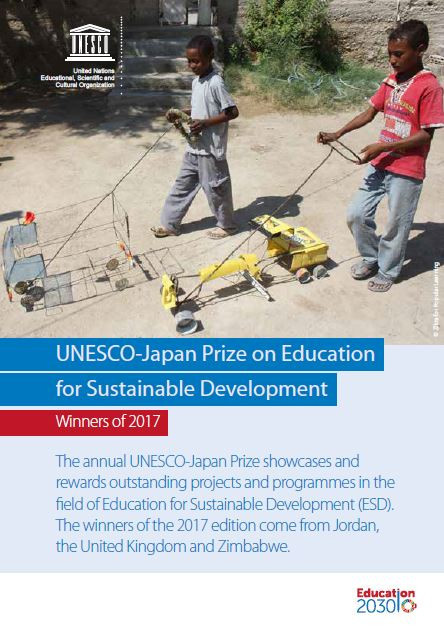 UNESCO-Japan Prize on Education for Sustainable Development: Winners of 2017 Year of publication: 2017 Corporate author: UNESCO The annual UNESCO-Japan Prize showcases and rewards outstanding projects and programmes in the field of Education for Sustainable Development (ESD).The winners of the 2017 edition come from Jordan, the United Kingdom and Zimbabwe.Among this year’s winners are a school, business and a non-profit organization, promoting ESD, respectively, at the local, regional and global level: Sihlengeni Primary School from the Republic of Zimbabwe; the social enterprise Zikra from the Hashemite Kingdom of Jordan; and the Hard Rain Project from the United Kingdom of Great Britain and Northern Ireland. Each of them will receive an award of USD 50,000.The Director-General of UNESCO and the Japanese Minister of Education will award the Prize to the three laureates in a ceremony at UNESCO Headquarters in Paris on 3 November 2017, during the 39th session of the General Conference.
  A Review of Education for Sustainable Development and Global Citizenship Education in Teacher Education Year of publication: 2017 Author: Douglas Bourn, Frances Hunt, Phil Bamber Corporate author: University College London. Institute of Education This paper has been produced to inform UNESCO in its preparation for the 2017 Global Education Monitoring Report (GEM) Report. Its purpose is to examine the current preparation of teachers in Education for Sustainable Development (ESD) and Global Citizenship Education (GCED) as outlined in the Sustainable Development Goal (SDG) target 4.7.The literature for this study is based on looking not only at material that makes direct reference to ESD and GCED, but also broader themes that have a potential bearing on these areas such as a sense of global, social and environmental responsibility and a commitment to social justice.In this paper teacher education includes the initial and in-service continuing professional development (CPD) of teachers.
 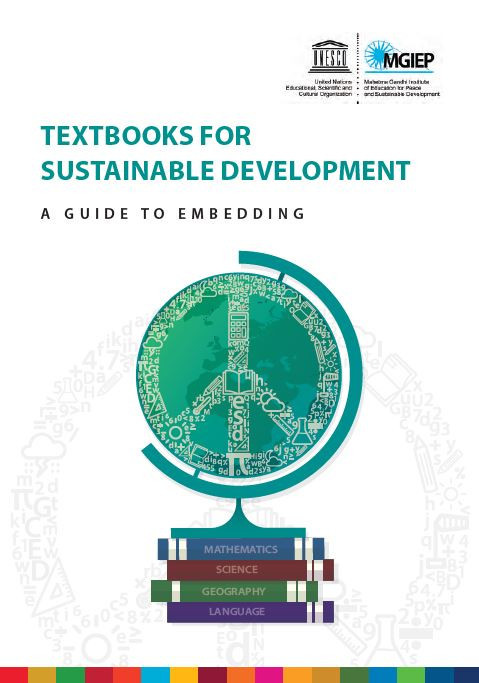 Textbooks for Sustainable Development: A Guide to Embedding Year of publication: 2017 Corporate author: UNESCO | Mahatma Gandhi Institute of Education for Peace and Sustainable Development (MGIEP) This guidebook introduces the approach of embedding education for sustainable development into core subjects, building on the German initiative as well as consolidating other existing efforts. This ambitious work began when the UNESCO Mahatma Gandhi Institute of Education for Peace and Sustainable Development (MGIEP), with support from Engagement Global gGmbH, brought together 30 international experts in mathematics, sciences, languages, geography and education for sustainable development in Bangalore, India, in June 2016. These experts co-drafted this guidebook. This publication is designed as a guide for stakeholders in textbook development – education ministries, national curriculum authorities, textbook writers and publishers – to help them produce a new generation of textbooks. Such textbooks will make a clear departure from the mechanistic transmission of information and procedural knowledge devoid of meaning and contextual relevance. They will also advocate a new vision of learning and contribute to fostering young people’s competencies and capabilities to shape more peaceful and sustainable societies. Competencies such as critical and systemic thinking, appreciation of diversity, empathy and commitment to change are the key goals of this ambitious publication.
  Address by Irina Bokova, Director-General of UNESCO, on the occasion of the Honorary Graduate Degree from King's College London Year of publication: 2017 Corporate author: UNESCO. Director-General, 2009-2017 (Bokova, I.G.) This address was delivered by Irina Bokova, Director-General of UNESCO, on the occasion of the Honorary Graduate Degree from King's College London on 25 October 2017.
 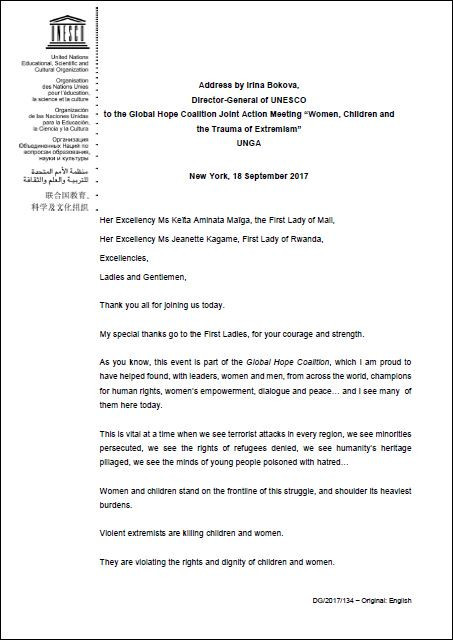 Address by Irina Bokova, Director-General of UNESCO, to the Global Hope Coalition Joint Action Meeting: Women, Children and the Trauma of Extremism Year of publication: 2017 Corporate author: UNESCO. Director-General, 2009-2017 (Bokova, I.G.) This address was delivered by Irina Bokova, Director-General of UNESCO, to the Global Hope Coalition Joint Action Meeting: Women, Children and the Trauma of Extremism; UNGA, New York, 18 September 2017.
 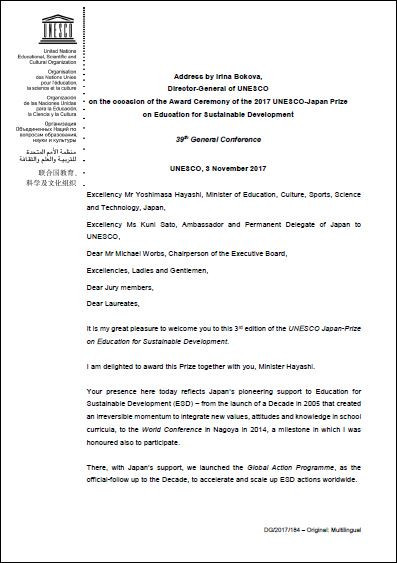 Address by Irina Bokova, Director-General of UNESCO, on the occasion of the Award Ceremony of the 2017 UNESCO-Japan Prize on Education for Sustainable Development, 39th General Conference; UNESCO, 3 November 2017 Year of publication: 2017 Corporate author: UNESCO. Director-General, 2009-2017 (Bokova, I.G.) This address was delivered by Irina Bokova, Director-General of UNESCO, on the occasion of the Award Ceremony of the 2017 UNESCO-Japan Prize on Education for Sustainable Development at UNESCO Headquarters in Paris, on 3 November.