
Resources
Explore a wide range of valuable resources on GCED to deepen your understanding and enhance your research, advocacy, teaching, and learning.
8,364 Results found
 The Extent to which the Students of Qassim University Posses the Dialogue Culture and Its Role in Promoting Tolerance Year of publication: 2017 Author: الصمادي، هند سمعان Corporate author: International Group for Consulting and Training (IGCT) The current study aimed to identify the extent to which the students of Qassim University possess the dialogue culture and its role in promoting tolerance from their point of view. To achieve the aim of the study, the researcher developed a questionnaire which was applied on a stratified study sample.The researcher adopted the analytical descriptive approach. The outcomes showed that the degree of possessing the culture of dialogue among the students was average with an arithmetic mean،and there were no statistically significant differences attributed to gender variable. In addition, the findings detected that there were statistically significant differences attributed to study year and to the discipline variable and that the role of dialogue culture in promoting tolerance was average with an arithmetic mean.The intellectual tolerance had the highest mean, whereas the social tolerance had the lowest mean. Furthermore, the results revealed that there were no statistically significant differences attributed to gender variable, and that there were statistically significant differences attributed to the study year variable. The researcher recommends that more studies should be conducted in the domain of social tolerance.
  Forgiveness, Revenge and their Relationship with Personality Traits among Sample of University Students Year of publication: 2017 Author: نوره، سعد Corporate author: Islamic University of Gaza The current study aims to determine the relationship between forgiveness, revenge and personality traits among university students, and the differences regarding forgiveness and vengeance among males and females. The Study Sample consisted of (324) of university students (160 males, 164 female). The researcher used the forgiveness trait scale, vengeance scale and the big five factors of personality inventory.The results showed that there is significant negative correlation between forgiveness and revenge, and positive correlation between forgiveness, agreeableness, openness to experience, extroversion and conscientiousness, and they showed negative correlation with neuroticism. There is a significant negative coloration between revenge and agreeableness, openness to experience, extroversion and conscientiousness, and positive corrolation with neuroticism. The results indicated that there is a significant different between males and females regarding forgiveness and revenge.
  The Unified History Textbook: The Possible and the Impossible Year of publication: 2012 Author: ضو، أنور Corporate author: Lebanese Association for Educational Studies (LAES) The freedom to educate, guaranteed by the (Lebanese) constitution, has led to an educational pluralism which has not helped in promoting our social cohesion. Indeed, sectarianism has permeated our efforts for nation building ever since the Millet system of the Ottomans and until the Taef Accord. There was thus an urgent necessity to unite the historical memory of the citizenry in order to advance the elements which join together and fill in the chasm separating the Lebanese.The members of parliament meeting in Taef took the decision: Both the textbooks of history and civics must be unified! Following continual meetings and great efforts of historians and educators, the aims and curricula of the history program were set and were published as decree number 3175 in the Official Gazette number 27 dated June 22, 2000. The books for the first cycle were subsequently published, but they were not implemented, though the reasons for that were not substantial. The matter remained stalled until Dr. Hasan Mneimneh became minister of national education and restarted the work on the new curriculum.The committee charged with the task completed the curriculum for the elementary and intermediate levels but this has not yet been adopted by the council of ministers. The aims set for the history school program and published in decree number 3175/2000 are appropriate, in my opinion, for all the Lebanese, whatever their affiliation.They remained above sectarianism and confessionalism and Lebanese chauvinism, and were at home in the wide expanses of the Lebanese and Arab perspectives, as well as open to all humanity. They emphasized diversity in unity rather than pluralism which suggested division.They also emphasized seeking historical accuracy, and that is why I believe that the unified history textbook is possible and not impossible. Unifying this book will be the start of a long process which will lead to strengthening the sense of belonging to one state, and will eliminate sectarianism. This is because it was established on principles which I believe are important, and which I have detailed in this paper.
  Teaching Lebanese-Oriental Economic and Social History: Promoting a Societal Unity Which Acknowledges and Values Diversity Year of publication: 2012 Author: لبكي، بطرس Corporate author: Lebanese Association for Educational Studies (LAES) Teaching the economic and social history of the Lebanon and the Orient contributes towards the cooling down of sectarian tensions in the minds of learners and clears up common prejudices. Economic transactions connect everyone within a given area: Buying and selling, production and distribution of resources are operations in which everyone cooperates, regardless what their religious, confessional or ethnic affiliation might be. Economic and social history informs about the economic and political organization of society: in rural areas taxed farmers, governors and the Sultan; in the cities guilds (corporations) and the sheikhs of the guilds/corporations. Indeed, teaching the economic and social history of Lebanon and the Orient contributes to a societal unity which acknowledges and values diversity because this aspect of history highlights the longstanding cooperation among the people in the production, distribution or use of resources, no matter what their religious, ethnic or tribal affiliation might be. It also highlights the organization of these activities in society and their relation to the political system. This aspect of history also points to the fact that the intervals of conflict between the sectarian communities were short, whereas the intervals of peacefully living together were the rule. Besides, this aspect of history highlights the cultural unity and its diversity in all domains and the fact that all are shaped in their lives by this same experience of unity in diversity which comes from: religions, languages, regions, societal organization (guilds/corporations in the cities, clans in rural areas) or adjacent cultures: Turkish, Persian, Greek and Indian. It allows us to see how our ancestors lived this diversity within the unity of the Arab-Oriental culture.
  The Image of the Other in Moroccan Educational Programs between Ambitious Objectives and Limited Efficiency Year of publication: 2014 Author: حميد، عبد الإله Corporate author: International Group for Consulting and Training (IGCT) This study aims to shed light on the image of ‘the Other’ in Moroccan schools’ curricula, at the secondary and preparatory levels, including teachers. The study addresses the image of the Other in of history books and school programs. It attempts to diagnose the nature of the image of the Other in history books using content analysis techniques that is based on the extraction of relevant signs and phrases and classifying them into thematic categories in order to draw a general picture of the Other.The study used a questionnaire to monitor a sample of among history teachers regarding their representations of the Other. The study tried to provide a set of recommendations and practical suggestions that aim to correct distortions and problems that characterize the current programs. The study advocates a new approach to teaching history that is based on the principles of education on cultural diversity and “tolerance” which should be the regulating framework for values and measures of the educational system in a multicultural society such as the Moroccan society.
  Palestinian Civic Education Curriculum and its Role in Democratic Upbringing of Basic Stage Students in Palestine: Case Study, Nablus Governorate 1994-2006 Year of publication: 2007 Author: حسين، نذير أحمد مصطفى Corporate author: An-Najah National University This study aims to investigate the role of Civic Education in the democratic upbringing of students in the basic education classes, in Palestine. Civic Education can play a major role if its topics are in line with the relevant ongoing comprehensive development plans of which political developments occupies the front seat. Civic Education is seen as a Palestinian societal necessity towards democratic transition in the unique Palestinian situation...and within the framewoork of an effective educational system that is comprehensive, systematic, and modern, where it takes into consideration the structure and nature of the Palestinian society and its Arab-Islamic roots in the aspired state of Palestine. Since its launch as an independent course in Palestinian schools, Civic Education has been suffering from two obstacles vague philosophical and conceptual framework (which leads to lack of harmony between the educator and the teaching material thus reflecting itself on the students),and the dominant social climate (which is affected by the Israeli occupation and the political situation in Palestine). those are obstacle to the democratic upbringing which might otherwise satisfy the needs of the nation. Democracy in civic education here is offered from the standpoint that it is a quest to catch up with the contemporary needs. The democratic concepts in the curriculum are parallel to those in the West, without identifying the Arab-Islamic thought in the Palestinian society. this is expected to generate conflict due to the differences between two totally different societies (religion, culture, civilization, history, ideology, regime, and others). This study concludes that Palestinian civic education should take into consideration the fact that democracy is not a ready-made model that can be applied blindly in Palestine. In other words, democratic upbringing in Palestine should adopt only what rhymes with Palestinian values, laws, history and the peculiar circumstances.
  Teaching American Values: The Role of Social Studies Texbooks in the U.S. Year of publication: 2005 Author: بيدرسون، باتريشيا Corporate author: Lebanese Association for Educational Studies (LAES) The study addresses the role of social studies textbooks in the U.S. in teaching values to students. Although there is no unified curriculum for social studies in the U.S., individual U.S. states, or groups of states, might opt to use the same textbook. American social studies books emphasize the values of good citizenship, cooperation, mutual dependence and tolerance in a country characterized by wide ethnic, religious, and cultural diversity. Textbooks also emphasize information-seeking skills, which are necessary in any active democratic situation. Social studies textbooks undertake the mission of teaching the components of the American national identity, and this allows to view values and beliefs prevalent in American society. On the other hand, the study addresses the development of American social concepts and values from the white racist era to the current era of cultural pluralism, a concept built around freedom, separation between religion and the State, individualism, authority of the law and human rights. The study discusses five groups of standards, issued in the 1990’s, that are used in teaching social studies. They constitute a platform for developing social studies curricula in different U.S. states and for assessing students achievement in this subject. American textbook publishers, thus, have at their disposal standards that traditionally present the U.S. as a constantly forward-looking country, and one in which every individual can achieve success.
  The Role of the Palestinian Political Organizations in Developing the Political Awareness of University Students in Gaza Strip Year of publication: 2010 Author: الضاني، شيرين حربي جميل Corporate author: Al-Azhar University (Gaza) The purpose of this study is to investigate the role of the Palestinian political organizations in developing the political awareness of university students in the Gaza Strip using a field study on a sample of university students (Al-Azhar University, The Islamic University, Al- Aqsa University, and Al-Quds Open University). The students answered some questions that explored their political awareness and knowledge of some public issues, events and political figures, as well their relation to the national identity, political organizations, the concepts of democracy, tolerance, pluralism, political participation and the role of regulatory activities at universities in promoting political awareness of their students. The study used two methods of research and analysis: 1) historical research method.. and 2) a descriptive analytical method... A questionnaire was used... (plus) statistical methods to discuss and analyze the results... The population of study (60 male, 112 female) were bachelor students at the main universities in the Gaza Strip. The study sample was 600 of the study population... Main findings of the study: 1) Low level of public political awareness. 2) High level of political awareness by female students compared to male students. 3) High percentage of public political knowledge by students between 28-32 years compared to other age groups. 4) Students at in The Islamic and Al-Quds Open Universities have a higher level of public political knowledge... 5) Students at arts colleges have higher public political knowledge... but education college students showed lower public political knowledge... 12) National affiliation showed a low level and the political organizations showed a decline in promoting political awareness and national affiliation and in developing the national identity.
  The History Textbook Crisis: A Historical Background Year of publication: 2012 Author: جابر، منذر محمود Corporate author: Lebanese Association for Educational Studies (LAES) The cultural dialogue in Lebanon brings into play attempts to build up sectarian identities, by seeking arguments in support of the claims of each sect whether in terms of origin, language, culture or past events that stretch back in history. This study tries to: 1) Explore the beginnings of the development of history as an independent subject in the curricula of schools throughout the regions of “Lebanon”, whether Ottoman state schools or private schools, missionary or local. It also looks into the connections between these curricula and the aims of the foreign missions working in the field, and the fierce inter-fighting among them on one hand, and the connections with the local political power balance at both the local and the extended Ottoman level, on the other. 2) Take stock of the importance and development of the history subject in the school curricula after the creation of Greater Lebanon in 1920, and analyze the attempts made to change or revise it.
 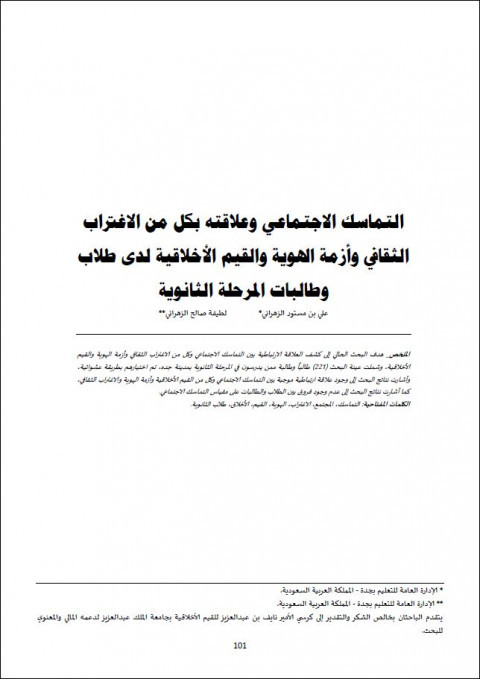 The Relationship Between Social Cohesion and Cultural Alienation and Identity Crisis and Moral Values among High School Students Year of publication: 2017 Author: الزهراني، علي بن مستور Corporate author: International Group for Consulting and Training (IGCT) The current research aimed to detect the relationship between social cohesion, on one hand, and cultural alienation, the identity crisis and moral values among high school's students, on the other. The participants of this research were (221) students from high school in Jeddah city. The results showed a positive correlation between social cohesion, cultural alienation, identity crisis and moral values. The study's results also pointed that there were no differences between male and female students on the social cohesion scale.