
Resources
Explore a wide range of valuable resources on GCED to deepen your understanding and enhance your research, advocacy, teaching, and learning.
8,364 Results found
 Fostering Digital Citizenship through Safe and Responsible Use of ICT: A Review of Current Status in Asia and the Pacific as of December 2014 Year of publication: 2015 Corporate author: UNESCO Bangkok The publication examines various interventions to address issues concerning cybersafety, rights, and wellness. It provides a synthesis of various policy responses, programmes, and initiatives implemented by governments, international organizations, civil society, and the private sector.The report ends with a preliminary set of recommendations with regards to policy, research, education, and partnerships. It is hoped that the report can provide an insight into the current status of digital citizenship in the region and consequently highlight the importance of maintaining a conscious balance of opportunities and risks when dealing with ICT.
  Beyond Access: Toolkit for Integrating Gender-based Violent Prevention and Response into Education Projects Year of publication: 2015 Corporate author: United States Agency for International Development (USAID) This toolkit was developed to support implementation of the U.S. Strategy to Prevent and Respond to Gender-based Violence Globally. It provides guidance and resources for USAID technical and program officers working on education to increase understanding of GBV in the education context and strengthen integration of a gender-based violence (GBV) response into projects and activities. Because reducing school-related GBV is a high priority for USAID in all school systems globally, this toolkit includes school-related GBV, but the overall focus is GBV in the education context broadly.The Toolkit provides:The United States government definition of GBV and USAID’s definition of school-related GBVExplanation for why integrating GBV prevention and response improves education outcomes, and the evidence on the prevalence of GBV in the education sectorGuiding principles to ensure the well-being of those at risk for, and survivors of, GBVIllustrative GBV prevention and response activities by the USAID Education Strategy GoalsGuidance on how to integrate GBV prevention and response throughout theUSAID Program Cycle to be able to monitor, evaluate, learn, and adapt education projects and activities accordingly, and it includes illustrative indicators for measuringGBV prevention and response for each of the USAID Education Strategy goals.
 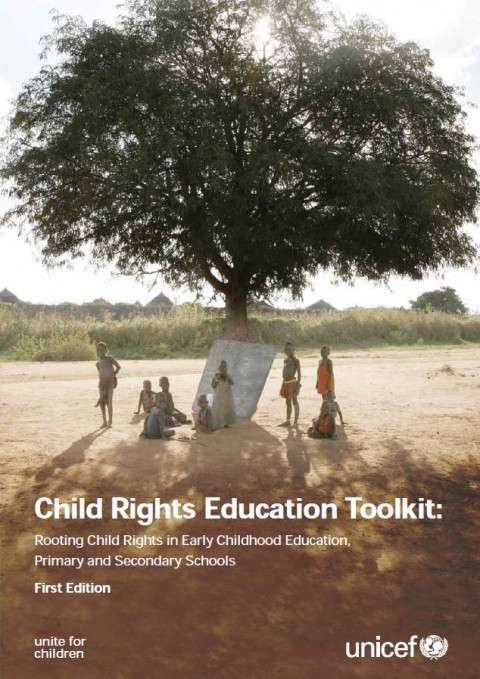 Child Rights Education Toolkit: Rooting Child Rights in Early Childhood Education, Primary and Secondary Schools Year of publication: 2014 Corporate author: United Nations Children's Fund (UNICEF) This toolkit, developed by UNICEF, defines what is meant by child rights education and the child rights approach. It explains the relevance of child rights education to UNICEF’s mission and the ways in which education can take place in a range of contexts--including with professionals, caregivers, the corporate sector, the media, and children’s groups. The audience of this toolkit is therefore intended to be UNICEF National Committees, UNICEF country offices, UN agencies working on child rights education (CRE), governments, and other civil society organisations, NGOs, and academic institutions.Although this Toolkit focuses on child rights education in the formal learning environment (early childhood education settings, primary and secondary schools), it is hoped that it will also be useful for those working to promote child rights education through other channels, such as in the media, with children’s organizations and through children’s involvement in advocacy.For more information check the UNICEF webpage.
  Media and Information Literacy Curriculum for Teachers Year of publication: 2011 Author: Carolyn Wilson | Alton Grizzle | Ramon Tuazon | Kwame Akyempong | Chi Kim Cheung Corporate author: UNESCO We live in a world where the quality of information we receive largely determines our choices and actions, including our capacity to enjoy fundamental freedoms and the ability for self-determination and development. This Media and Information Literacy Curriculum for Teachers is an important resource for UNESCO Member States and a pioneering publication.First, it is forward looking, drawing on present trends toward the convergence of radio, television, Internet, newspapers, books, digital archives and libraries into one platform. Second, it is specifically designed for integration into the formal teacher education system.UNESCO believes that, ultimately, this curriculum will contribute to innovation and improvement in all levels of education.
  All Together Now!: A Whole School Approach to Anti-bullying Practice Year of publication: 2010 Corporate author: Save the Children All Together Now! provides learning and examples of good practice for teachers and school management teams, in order to encourage a culture in which bullying is less likely to occur. In particular, this report recognises the benefits of two strategies to instil an anti-bullying culture within any school. First, it describes a whole school approach to tackling bullying and promoting positive behaviour, with children and young people participating in their school’s decision-making processes. Positive changes in school anti-bullying policy, together with the ongoing development of better professional practice and peer support, are more likely if everyone connected to the school is informed and offered the opportunity to play a part. Second, All Together Now! demonstrates how creating an effective anti-bullying ethos is dependent upon creating a ‘telling environment’. To achieve this, pupils, staff, and parents and carers need to be consulted and involved.
  The Education We Want: Workshop Facilitator Guide For the Advocacy Toolkit Year of publication: 2014 Author: Daniel Smith | James Edleston | Tom Burke | Emily Laurie Corporate author: A World at School | UN Global Education First Initiative - Youth Advocacy Group (YAG) | Plan International This guide is intended as a resource to accompany the ‘Education we want: An Advocacy’. It aims to provide a wide range of workshop activities for those who intend to Understand, Plan or Do their education advocacy using workshop based approaches.Workshops are an effective way of involving others in advocacy. They can support you in carrying out research, drafting a plan and building skills for action.The successful delivery of workshops relies on effective preparation, good facilitation skills and a commitment to support people’s learning and development.
  The Education We Want: An Advocacy Toolkit Year of publication: 2014 Author: James Edleston | Dan Smith | Sumaya Saluja | David Crone | Chernor Bah | Emily Laurie Corporate author: A World at School | UN Global Education First Initiative - Youth Advocacy Group (YAG) | Plan International Developed by Plan International, A World at School and the Youth Advocacy Group of the Global Education First Initiative, this toolkit was made for and by young people to advocate for quality education.Packed full of ideas, tools and inspiring stories, it helps children and youth to effectively carry out their own advocacy campaign.Although this advocacy toolkit focuses on education, its tips and ideas are applicable to young people advocating for a variety of development and rights issues.
 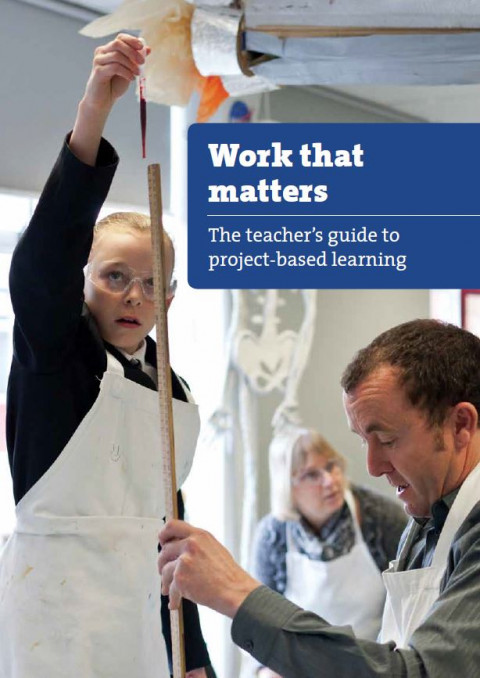 Work that Matters: The Teacher’s Guide to Project-Based Learning Year of publication: 2012 Corporate author: Paul Hamlyn Foundation A guide on project-based learning and advice for teachers, published by the Learning Futures Special Initiative in partnership with the Innovation Unit.Developed by the Learning Futures project in partnership with High Tech High, this guide offers step-by-step advice on planning and managing extended, interdisciplinary projects, as well as useful protocols for critique sessions, templates for important documents such as project plans, and examples of high-impact projects.
 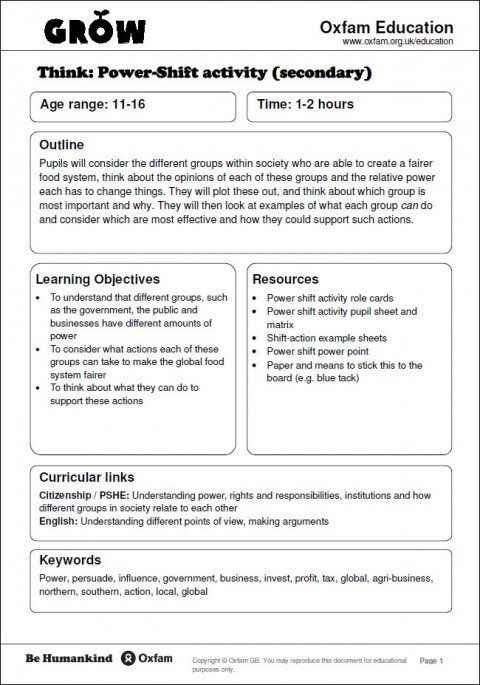 Think: Power-Shift Activity Teachers Guide for Secondary Schools Corporate author: Oxfam GB Linked to Oxfam's GROW campaign, the Food for Thought school resources get young people learning, thinking and taking action for a fairer food system.Through this activity pupils will consider the different groups within society who are able to create a fairer food system, think about the opinions of each of these groups and the relative power each has to change things. They will plot these out, and think about which group is most important and why. They will then look at examples of what each group can do and consider which are most effective and how they could support such actions.
 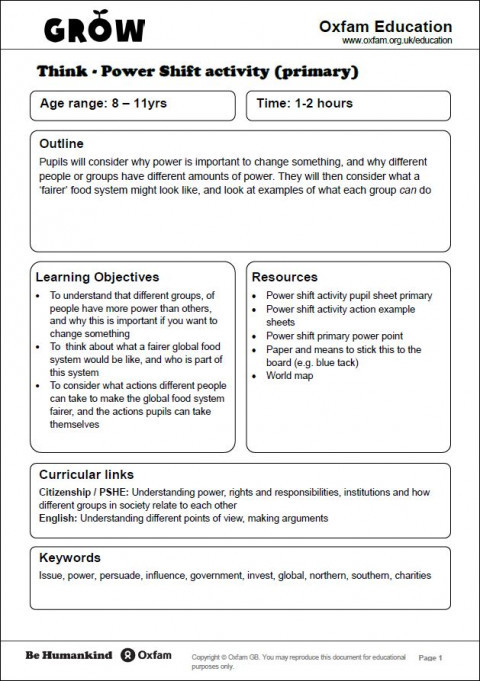 Think: Power-Shift Activity Teachers Guide for Primary Schools Corporate author: Oxfam GB Linked to Oxfam's GROW campaign, the Food for Thought school resources get young people learning, thinking and taking action for a fairer food system.Through this activity pupils will consider why power is important to change something, and why different people or groups have different amounts of power. They will then consider what a ‘fairer’ food system might look like, and look at examples of what each group can do.