
Resources
Explore a wide range of valuable resources on GCED to deepen your understanding and enhance your research, advocacy, teaching, and learning.
8,364 Results found
 The Write for Rights: A Human Rights Education Pack Year of publication: 2015 Corporate author: Amnesty International This education pack contains five activities on human rights for young people. It can be used as an introduction to human rights, to global solidarity, to campaigning and activism, and to the wider work of Amnesty International. The activities provide a broad perspective on these issues and others.They are useful in opening young people’s minds to global concerns and involving them in actions which can have a real impact on people’s lives.The activities can be run at any time, but will be most effective either before or during the time of Amnesty International’s ‘Write for Rights’ campaign, which this year runs from 4 to 17 December. By working on these cases and taking part in the campaign, young people will know that they are part of a massive global movement of people. They – and you – can bring about a real improvement in the lives of the people featured in the following pages.
  Achieving Gender Equality in Education: Don't Forget the Boys (Policy Paper 35) Year of publication: 2018 Corporate author: UNESCO Achieving gender equality in and through education is central to meeting the targets of the 2030 Agenda for Sustainable Development. While the emphasis tends to be on the effects of gender norms on girls, this paper puts the spotlight on the less recognized effects of these norms on boys’ schooling, particularly at the secondary level and amongst those from the poorest families. It argues that addressing boys’ disadvantage and disengagement in education is an essential part of a response to the challenge of gender inequality, in education and beyond.
  One in Five Children, Adolescents and Youth is Out of School (UIS Fact Sheet No. 48) Year of publication: 2018 Corporate author: UNESCO Institute for Statistics (UIS) This fact sheet presents the latest UIS data on education available as of February 2018.Three years after the adoption of Sustainable Development Goal 4 (SDG 4) and the promise to provide universal primary and secondary education, there has been no progress in reducing the global number of out-of-school children, adolescents and youth. As the SDG 4–Education 2030 Steering Committee meets in Paris, the UNESCO Institute for Statistics (UIS) has released this fact sheet, highlighting trends at the global and regional levels, to inform discussions and provide stakeholders with the data needed to target policies, strategies and resources to get all children, adolescents and youth in school and learning.
 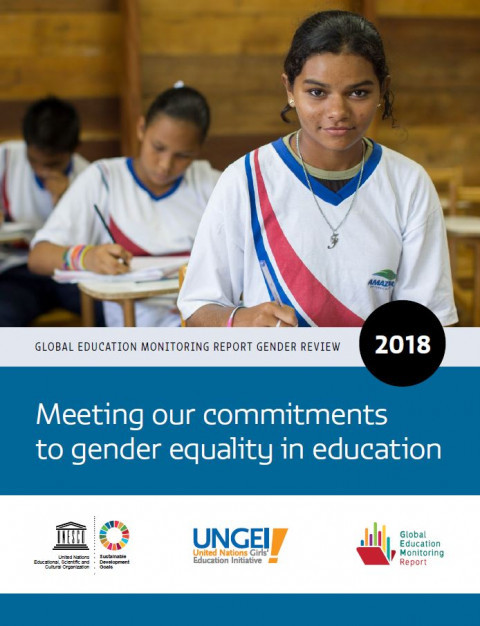 Meeting Our Commitments to Gender Equality in Education: Global Education Monitoring Report Gender Review 2018 Year of publication: 2018 Corporate author: UNESCO The Education 2030 Framework for Action, a tool aimed at helping the international community achieve SDG 4 on education, explicitly recognizes gender equality as a guiding principle linked to the realization of the right to education. It states clearly that girls and boys, women and men, must be equally empowered ‘in and through education’.In this sixth Gender Review, in a series that began in 2011, the Global Education Monitoring Report team maintains the focus on a broad conception of gender equality that extends beyond counting boys and girls in classrooms. The review’s first part examines disparities in participation and skills, in education and political leadership positions, and in selected aspects of infrastructure and curricula. It also examines gender issues in professional development by exploring the role of education in three other SDGs: those concerning agriculture, health, and water and sanitation.The second part of the review analyses institutions, laws and policies to explore ways to determine and enforce accountability for gender equality in education.
  Issues and Trends in Education for Sustainable Development Year of publication: 2018 Author: Alexander Leicht | Julia Heiss | Wonjung Byun Corporate author: UNESCO Education for Sustainable Development (ESD) is globally acknowledged as a powerful driver of change, empowering learners to take the decisions and actions needed to build a just and economically viable society respectful of both the environment and cultural diversity.This publication comes at a moment of heightened global interest in addressing sustainability challenges through education in order to achieve the targets of the 2030 Sustainable Development Agenda. ESD is not only recognized as a key enabler of sustainable development but an integral element of all quality education. By exploring key issues related to ESD policy and practice, UNESCO aims to help accelerate the reorientation of education towards achieving a sustainable and resilient world.
  Content, Comprehensiveness and Coherence in Policies for Early Childhood: How the Curriculum Can Contribute Year of publication: 2016 Author: María Isabel Díaz Corporate author: UNESCO International Bureau of Education (IBE) In the context of international agreements and commitments concerning early childhood, the purpose of this document is to review and renew the challenges that are involved in forging educational and curriculum policies for the first level of education. In the light of early childhood being increasingly included in the public agenda, countries are making sustained efforts to increase equity and quality in the design and implementation of policies for the early years.These are policies that are in the process of changing by including quality and participation criteria; fine-tuning monitoring and assessment mechanisms; going beyond the lack of sectoral and territorial coordination, among other limitations; moving from a needs-based approach to a rights-based approach; and adopting a comprehensive view. The document analyses, from a long-term public policy perspective, some of the challenges that second-generation policies face, positioning the curriculum as the articulating factor for the development of comprehensive policies for early childhood.
  How Does Education About the Holocaust Advance Global Citizenship Education? Year of publication: 2018 Author: E. Doyle Stevick Corporate author: UNESCO Can education about past genocides shape our understanding of how violence occur in today’s world? Can it foster a sense of belonging to a common humanity and empower young people to become active citizens who work globally for peace and human rights? How does learning about such crimes, which profoundly affect the core dignity of human beings, support the objectives of Global Citizenship Education (GCED), a priority of the 2030 Education Agenda?This paper, commissioned by UNESCO, offers an overview of empirical research on teaching and learning about the Holocaust and how such education may impact leaners’ cognitive, socio-emotional and behavioural skills and competencies. It provides insights for educators on how effective lessons about the Holocaust can meet some of the key expected outcomes of Global Citizenship Education (GCED), such as critical thinking skills, attitudes of empathy and solidarity, and motivation to take action to prevent human rights abuses.
  What Makes a Quality Curriculum?: In-Progress Reflection No.2 on Current and Critical Issues in Curriculum and Learning Year of publication: 2016 Author: Philip Stabback Corporate author: UNESCO International Bureau of Education (IBE) Sustainable Development Goal Four has to do with education in the post-2015 development agenda. It aims to “ensure inclusive and equitable quality education and promote lifelong learning opportunities for all”.Given the essential role of curriculum in enabling quality learning and in articulating and supporting education that is relevant to holistic development, our purpose in this paper is to identify what makes a quality curriculum, so as to support curricular innovation in UNESCO Member States to the end of the realization of Sustainable Development Goal Four.In this we are assuming that curriculum, given its essential role in the provision of quality learning for all children and young people, and in articulating and supporting education that is relevant to holistic development, is critical in the realization of SDG 4. It is the curriculum that determines to a large extent whether education is inclusive, thus playing a significant role in ensuring that provision is equitable. It is the curriculum that provides the structure for the provision of quality learning, especially where teachers might be under-qualified and inexperienced, their classrooms under-resourced, and their students lacking the prior frameworks within which to situate their learning. And it is the curriculum that articulates both the competencies necessary for lifelong learning and the competencies needed for holistic development.We thus argue that curriculum lies at the crossroads of these four key aspects of SDG 4: that education should be (1) inclusive and equitable, (2) characterized by quality learning, (3) promoting lifelong learning, and (4) relevant to holistic development. Curriculum, in other words, provides the bridge between education and development – and it is the competencies associated with lifelong learning and aligned with development needs, in the broadest, holistic sense of the term, that span that bridge.
 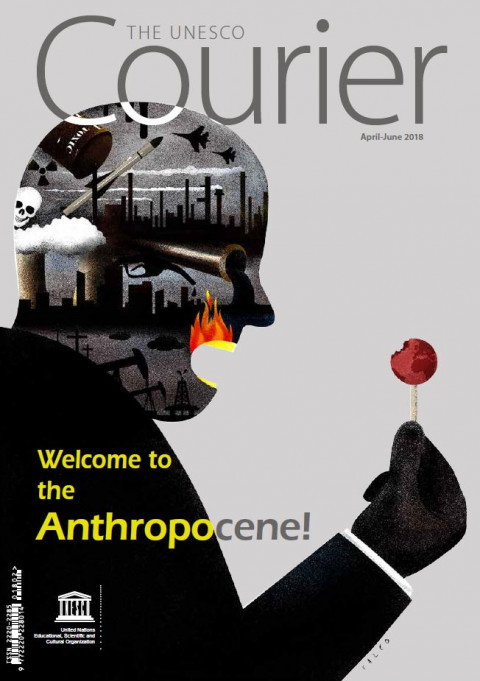 Welcome to the Anthropocene! (The UNESCO Courier no. 2, April-June 2018) Year of publication: 2018 Corporate author: UNESCO In the Ideas section of this issue, three internationally celebrated academics consider the notion of diversity – Mireille Delmas-Marty, a member of the Institut de France; Souleymane Bachir Diagne, Senegalese philosopher; and Abdourahman Waberi, novelist and diarist from Djibouti. With these articles, the Courier marks the celebrations of the World Day for Cultural Diversity for Dialogue and Development (21 May) and the International Day for Biological Diversity (22 May).Our Guest for this issue is Bibi Russell, a fashion designer from Bangladesh. A former top model in London, she quit the catwalk to devote herself to using fashion for development. She is currently working in India, helping young women, some of whom were trafficked as children, to find their bearings and start a new life.To mark UNESCO’s Africa Week in May, we focus on youth in the West and the South of the continent, in our Current Affairs section. After visiting Athens, World Book Capital 2018, we travel to Canada’s Northwest territories, on the other side of the world, to discover the people of Great Bear Lake, in the Tsá Tué biosphere reserve – established and looked after by the indigenous community that lives there.Finally, Zoom invites us to follow an ordinary day in the life of Qello, a 13-year old girl in Ethiopia, hour by hour.The UNESCO Courier celebrates its 70th birthday in 2018. Each issue this year will feature an article that looks back at this extraordinary adventure. In this issue, Roberto Markarian, Rector of the University of the Republic, Uruguay, recounts the story of the role the Courier has played in his life.
 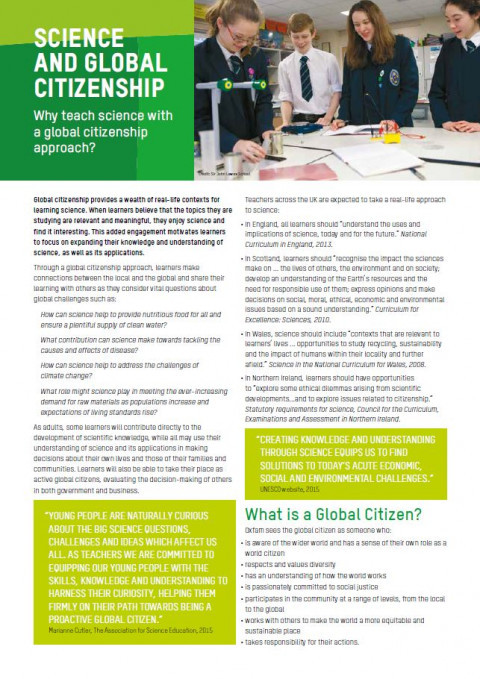 Science and Global Citizenship Corporate author: Oxfam GB Nurturing global scientists is key to the creation of a clean and fairer world for the future. A global citizenship approach enables learners to appreciate the relevance of science and investigate how it can be used to answer vital questions to global challenges.This guide includes practical advice for embedding global citizenship in topic areas like health and disease, water and climate change. It also has handy links to teaching resources which can be used in your lessons.