
Resources
Explore a wide range of valuable resources on GCED to deepen your understanding and enhance your research, advocacy, teaching, and learning.
8,364 Results found
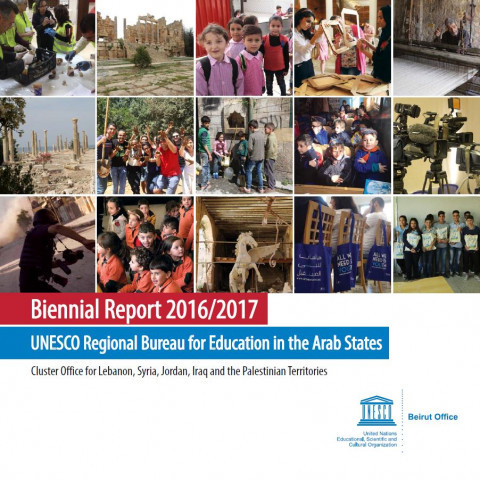 Biennial Report 2016/2017: UNESCO Regional Bureau for Education in the Arab States Year of publication: 2018 Corporate author: UNESCO Beirut As Regional Bureau for Education, UNESCO Beirut is the lead coordinator for SDG 4 in the Arab Region. We strive to provide tangible support for each Member State in the region, taking into account national needs and priorities, thereby employing nationally relevant approaches. More specifically, our work aims to address both the humanitarian and development aspects brought about by the protracted crisis in Syria through bridging the learning gaps for the youth, both for Syrian refugees and vulnerable youth in host communities. Our response also targets teachers, mentors and facilitators as well as Ministries’ technical officials. The crisis in Syria has created a need for specific support in education in emergencies and quality education to which we actively engage from both, upstream analytical and capacity building and downstream operational levels. UNESCO Beirut has also strengthened its leadership to respond to the deliberate destruction of cultural heritage, illicit trafficking, and attacks against individuals on religious or cultural grounds. We raise the alarm to protect heritage in danger, assessing damages to World Heritage sites in conflict. We also raise awareness among the public about the values of cultural heritage and the need to protect it for future generations. In today’s diverse societies, the Organization’s fundamental humanist mission guides us to support people, especially the youth, in understanding each other and working together to build lasting peace and enables people to create and use knowledge for just and inclusive societies. We continue to advocate free, independent and pluralistic media in print, broadcast and online to enhance freedom of expression as a contributor to peace, sustainability, poverty eradication and human rights. This biennial report summarizes the work and achievements accomplished between 2016 and 2017 by our office.
 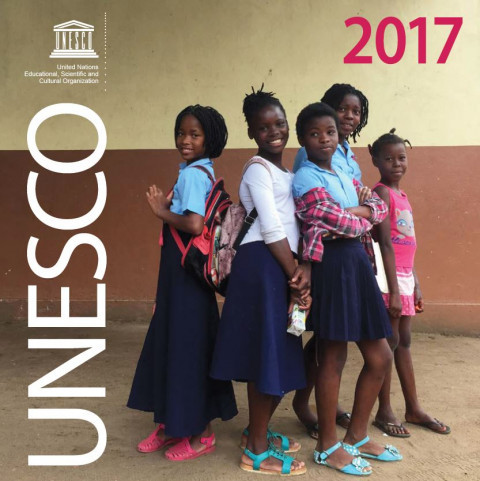 UNESCO 2017: Annual Report 2017 Year of publication: 2018 Corporate author: UNESCO This Annual Report takes stock of these actions and many others, undertaken during the mandate of the former Director-General, Irina Bokova, to whom I wish to pay tribute. The Report also reflects the professionalism and expertise of the Organization’s staff working across the world, and translating the 2030 Agenda for Sustainable Development’s Goals into action. The Report features UNESCO’s commitment to provide a world of justice, peace and sustainable development.Guided by the ideals of peace and progress, UNESCO represents a powerful force for transformation in the face of today’s challenges. It is also well-placed to share our wide-ranging experience and formulate the innovative ideas that the world currently needs, bearing in mind specific conditions on the ground and the need to respect local history and culture.
  Dakar Office: Annual Report 2017 Year of publication: 2018 Corporate author: UNESCO Dakar Across the globe, the 2030 Agenda remains the unifying tool of the international community in the construction of a prosperous, peaceful, and sustainable world for all. The 17 Sustainable Development Goals are the expression of a shared global and transformative vision to change the world and improve the well-being of all peoples. UNESCO plays a transformative role in the implementation of this agenda, thanks to its education, culture, sciences and communication and information programmes.This annual report underlines the drive and spirit of our team in promoting innovation to uphold the 2030 and 2063 Agendas. It is a resounding testament to the unwavering forts of our team in 2017, and the depth of their commitment to advance the ideals and objectives of UNESCO.The 2017 Annual Report of the UNESCO Regional Office covers seven countries in the region: Burkina Faso, Cabo Verde, Guinea-Bissau, Niger, Senegal, The Gambia as well as Mali, supported by the national office in Bamako.
 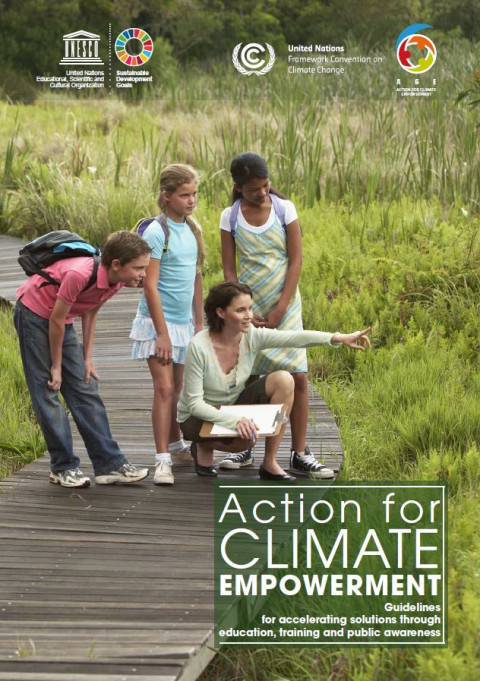 Action for Climate Empowerment: Guidelines for Accelerating Solutions through Education, Training and Public Awareness Year of publication: 2016 Author: Leslie Paas Corporate author: UNESCO | United Nations Framework Convention on Climate Change Secretariat (UNFCCC) Action for Climate Empowerment (ACE) is the popular term adopted by the United Nations Framework Convention on Climate Change (UNFCCC) for its Article 6, pertaining to education, training, public awareness, access to information and participation, and international cooperation.Country-driven implementation of these interrelated elements is increasingly recognized as crucial for meeting the objectives of the Convention, and for achieving sustainable development in general.This publication is designed to help national decision-makers better understand the components of ACE and how they can be bolstered by the principles and methods of Education for Sustainable Development (ESD). It also aims to provide guidance on engaging with a wide variety of stakeholders, establishing cross-sector partnerships, and mobilizing technical and financial support for ACE implementation.
  Addressing Anti-semitism through Education: Guidelines for Policymakers Year of publication: 2018 Corporate author: OSCE. Office for Democratic Institutions and Human Rights (ODIHR) A new UNESCO and OSCE co-publication takes up the challenge of educating learners to resist contemporary anti-Semitism at a time when the issue is becoming ever more crucial around the world. It suggests concrete ways to address anti-Semitism, counter prejudice and promote tolerance through education, by designing programmes based on a human rights framework, global citizenship education, inclusiveness and gender equality.It also provides policymakers with tools and guidance to ensure that education systems build the resilience of young people to anti-Semitic ideas and ideologies, violent extremism and all forms of intolerance and discrimination, through critical thinking and respect for others.
  Suwon-Osan CONFINTEA VI Mid-Term Review Statement: The Power of Adult Learning and Education; A Vision Towards 2030 Year of publication: 2018 Corporate author: UNESCO Institute for Lifelong Learning (UIL) The Sixth International Conference on Adult Education (CONFINTEA VI), held in Brazil in December 2009, closed with the adoption of the Belém Framework for Action, which recorded the commitments of Member States and presented a strategic guide for the global development of adult learning and education from a lifelong learning perspective. The third Global Report on Adult Learning and Education (GRALE III), published in 2016, drew on survey data to evaluate progress made by countries in fulfilling the commitments made in Brazil, while also highlighting some of the contributions adult learning and education can make to the 2030 Agenda for Sustainable Development. The CONFINTEA VI Mid-Term Review, held in Suwon, Republic of Korea, in October 2017, took stock of progress made by Member States in the past eight years, looking ahead to GRALE IV in 2019. This statement represents the overall perspective of delegates and their recommendations for the future.
  Ocean Literacy for All: A Toolkit (IOC Manuals and Guides, 80) Year of publication: 2017 Author: Francesca Santoro | Selvaggia Santin | Gail Scowcroft | Géraldine Fauville | Peter Tuddenham Corporate author: UNESCO Venice Ocean literacy programs and projects, until now, have been mainly focusing on developing resources, lesson plans and activities targeting Science, Technology, Engineering and Mathematics (STEM) education. Currently, and in particular after the adoption of the Sustainable Development Goal (SDG) 14, we have assisted to a shift in the focus towards the inclusion of approaches closer to those developed under the UNESCO framework of Education for Sustainable Development (ESD).ESD aims to improve access to quality education on sustainable development at all levels and in all social contexts, to transform society by reorienting education and help people develop knowledge, skills, values and behaviors needed for sustainable development. Individuals are encouraged to be responsible actors who resolve challenges, respect cultural diversity and contribute to creating a more sustainable world. This publication is made of two parts. The first part presents the history of ocean literacy, and describes its framework made of 7 essential principles, and connects them to international ocean science programs that contributes to enhancing ocean knowledge and observations. Moreover, marine scientists and educators were interviewed to share their professional experiences on ocean literacy as well as their views on its future. The last chapter of part 1 describes the existing challenges to marine education, as well as the path for the development of successful ocean literacy activities in the context of the 2030 Agenda. One of the most important factors identified is related to the creation of multi-sector partnerships among the education, government, and private sector that have jointly built ocean literacy programs for all formal educational levels from the primary school to the university level as well as for non-formal learners. Worldwide examples of such programs are presented. The second part, after introducing the methodological approach based on the multi-perspective framework for ESD developed by UNESCO, presents 14 activities that could provide tested examples and support for the implementation of marine education initiatives. The aim is not to provide a one size-fits-all ready to use collection, but rather to offer support and examples of what could be then adapted for different geographical and cultural contexts. The resources are designed to be relevant for all learners of all ages worldwide and to find their application in many learning settings, while in their concrete implementation they will, naturally, have to be adapted to the national or local context.
  Action: Guidelines for Prevention of Violent Extremism Year of publication: 2018 Author: Carolyn Nash | Yulia Nesterova | Kenneth Primrose | Wing Yu Alice Chan | Raul A. Rios | María José Velásquez Flores | Aniqah Zowmi Corporate author: Mahatma Gandhi Institute of Education for Peace and Sustainable Development (MGIEP) The UNESCO MGIEP #YouthWagingPeace guidebook was launched by Director General of UNESCO at its 39th General Conference, 2017. The guidebook was a culmination of reaching out to 2000+ youth, and integrating 130+ submissions from 57 countries.After analysing these voices and experiences, and supplemented by the literature, the guide put forth a set of tangible action guidelines for education stakeholders.In this abridged version, stakeholders will find a curated set of critical ideas and lessons gleaned from the full guide, designed to be as accessible as possible. The hope is that teachers, parents, mentors, school administrators, policymakers, and anyone else committed to realizing positive change will find these Action Guidelines an effective resource for guiding immediate and effective actions in their communities.The Action Guidelines for Prevention of Violent Extremism is designed to identify engagement opportunities for all stakeholders. Some require time, preparation, and resources. Others are small steps that will help create safer societies and stronger communities. No action is too small to contribute to building a more resilient and just world.
 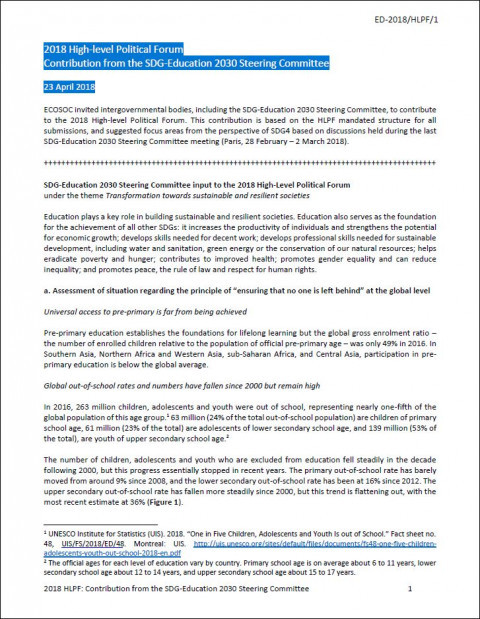 2018 High-level Political Forum: Contribution from the SDG-Education 2030 Steering Committee Year of publication: 2018 Corporate author: SDG-Education 2030 Steering Committee ECOSOC invited intergovernmental bodies, including the SDG-Education 2030 Steering Committee, to contribute to the 2018 High-level Political Forum. This contribution is based on the HLPF mandated structure for all submissions, and suggested focus areas from the perspective of SDG4 based on discussions held during the last SDG-Education 2030 Steering Committee meeting (Paris, 28 February – 2 March 2018).
  Citizenship Education at School in Europe, 2017: Eurydice Report Year of publication: 2017 Corporate author: European Commission | Education, Audiovisual and Culture Executive Agency (EACEA) | Eurydice The Eurydice Citizenship Education at School in Europe – 2017 report provides a comparative overview of national policies in the area of citizenship education across Europe, at a time when increasing demands are being made on education and training systems to promote this area of learning. It focuses on the curriculum content and organisation, the teaching and learning methods in and outside the classroom, the assessment of students, and the training and support for teachers. These issues are addressed in the four chapters, each of which is complemented by a case study on a recent policy initiative. The report is primarily based on qualitative data and covers 42 education systems. It draws on the existing regulations and recommendations regarding citizenship education in public sector schools and includes general education and school-based initial vocational education training programmes.