
Resources
Explore a wide range of valuable resources on GCED to deepen your understanding and enhance your research, advocacy, teaching, and learning.
8,364 Results found
 Diversity, Dialogue and Sharing: Online Resources for a More Resourceful World Year of publication: 2017 Author: Francine Saillant Corporate author: UNESCO The different societies and regions of the world are developing original perspectives on diversity, cultural rapprochement and intercultural dialogue. These perspectives arise through the complex interactions between regional structures, governmental bodies, civil society and cultural institutions. The tools available to these actors are easily identifiable on a global scale, particularly those regularly produced by UNESCO. However, other tools exist - intercultural universities, virtual libraries, training programs for urban policies, MOOCS, video conferences, virtual exhibitions, online archives, to name but a few - their visibility limited by their fragmented distribution. It is through these resources that countries and regions succeed in producing responses in support and promotion of diversity adapted to their context specific problems.This book provides a reinterpretation of the concept of intercultural dialogue rooted in regional perspectives on diversity, giving a broad panorama of the shared theoretical, practical and technical tools and online resources available.This book comprises three parts. Part 1 examines the perspectives selected for our inquiry from a conceptual and reflective standpoint. Topics covered will include the notions of diversity and dialogue, an examination of these notions, and finally our methodology. Part 2 introduces the regions (in the sense established by UNESCO), their diversity-related characteristics and issues, and the regional strategies adopted in order to promote not only diversity but also rapprochement and dialogue. Finally, Part 3 details the various actions that embody the regions’ strategies and broad orientations, with each action being presented based on its underlying aims. Parts 2 and 3 represent two different ways of approaching the shared and shareable resources in question, of which we hope to present the most promising aspects.
  Transforming Lives through Education Year of publication: 2018 Author: Anne Müller | Cristina Stanca-Mustea Corporate author: UNESCO 1945-2018: This book invites the reader on a fascinating photographic journey that highlights UNESCO’s work in promoting education across the world for more than seven decades. Above all, it testifies to the power of education to transform lives, build self-confidence, contribute to economic and social progress, and promote intercultural understanding.Through this book, the reader will discover the history of UNESCO’s work in education from its foundation to its current role as global leader for the coordination of Goal 4 of the United Nations 2030 Agenda for Sustainable Development, dedicated to education.The publication highlights the important milestones, normative advances, innovations and outstanding projects in our history, which bear witness to our humanistic vision of education. Drawing on a rich archive of photographs, some of them little known, this book illustrates the scale and diversity of UNESCO’s education programme across the globe.
  Media and Information Literacy for the Sustainable Development Goals (The MILID Yearbook 2015) Year of publication: 2015 Author: Jagtar Singh | Alton Grizzle | Sin Joan Yee | Sherri Hope Culver Corporate author: International Clearinghouse on Children, Youth and Media (Sweden) In the year 2000, governments and development partners all over the world agreed on eight global development targets called the Millennium Development Goals (MDGs). The year 2015 is a pivotal year as it marks the end of the period during which the MDGs were to be reached and the year in which new global development targets are to be set. These new targets are referred to as the Post-2015 Sustainable Development Goals (SDGs). This process is in its highest gear with ongoing debates and consultative meetings/initiatives globally both online and offline. While much progress has been made, achievement of the MDGs has been mixed across countries. The centrality of information and communication to development is irrefutable. The MILID Yearbook provides a case for media and information literacy (MIL) as a tool for open and inclusive sustainable development.The 2015 edition of the MILID Yearbook displays how media and information literacy can be helpful in facilitating progress and achievement of the sustainable development goals. It is sincerely hoped that the articles in this yearbook will go a long way to sensitize the stakeholders about the role and value of MIL in sustainable development of one and all across frontiers.
 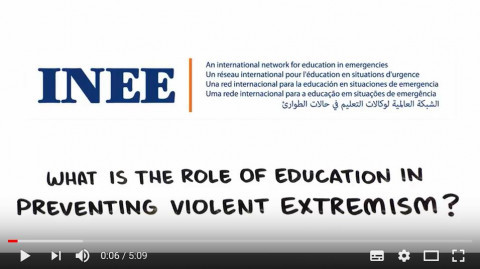 [Video] Preventing Violent Extremism (English w/subtitles) Year of publication: 2017 Corporate author: Inter-agency Network for Education in Emergencies (INEE) The number of violent extremist attacks committed across the world has increased sharply in recent years. And there are more attacks on schools and students than ever before. So, why is this happening and what can be done to change this pattern?The Inter-Agency Network for Education in Emergencies (INEE) has developed a whiteboard video to illustrate education’s role in preventing violent extremism (PVE). The 5-minute video -- available in English, Arabic, French, Spanish, and Portuguese -- looks at some definitions of PVE and education’s role in fostering inclusive and equitable environments, encouraging critical thinking, promoting tolerance and respect for diversity, and thereby contributing to wider social cohesion and the reduction of violence in all forms.For further information on education and PVE, please visit the INEE website (www.ineesite.org/preventing-violent-extremism), where you can find key activities and resources, including a curated catalogue of PVE resources.
 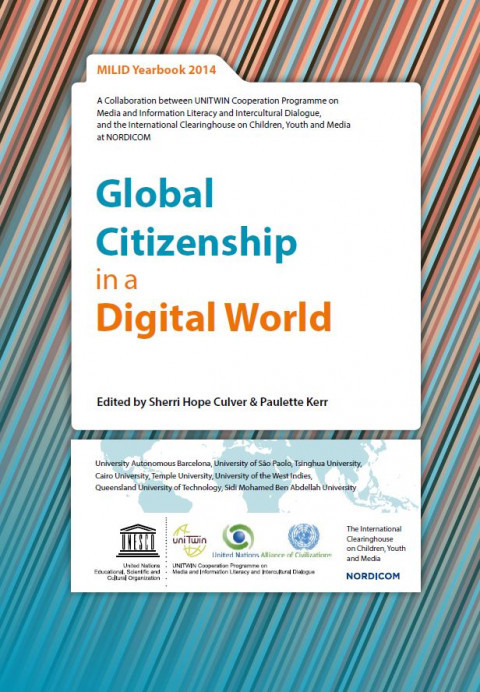 Global Citizenship in a Digital World (The MILID Yearbook, 2014) Year of publication: 2014 Author: Sherri Hope Culver | Paulette Kerr Corporate author: International Clearinghouse on Children, Youth and Media (Sweden) | NORDICOM | University of Gothenburg The theme of the 2014 Yearbook is Global Citizenship in a Digital World. Global citizenship assumes ease of participation in global spaces in which persons are media and information literate and are equipped with competencies and attitudes to deal with the multi-faceted nature of a mediated world in which information is no longer bound by space or time. The unprecedented access to and use of media and Internet technologies for communication and collaboration especially among youth, suggest that effective strategies must be found to enable active critical inquiry and effective media production. The proliferation of mediated spaces throughout education environments, as well as personal and professional environments, does not in itself guarantee that citizens will consider their role as global citizens as they create and consume media. This awareness must be cultivated, encouraged and taught.The 2014 MILID Yearbook brings together a range of reviewed articles, which articulate the theme of global citizenship from varied perspectives and regions of the world. The articles represent different expressions on media and information literacy from researchers and practitioners who offer bold new strategies, share research findings and best practices, and share musings and reflections.
 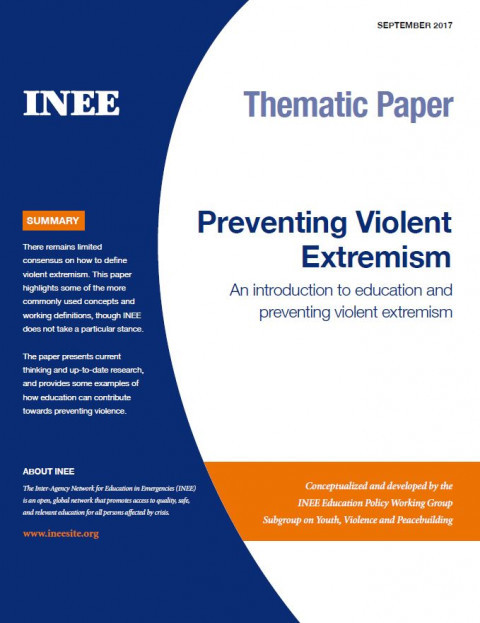 INEE Thematic Paper: An Introduction to Education and Preventing Violent Extremism Year of publication: 2017 Corporate author: Inter-agency Network for Education in Emergencies (INEE) This paper was conceptualized and developed by the INEE Education Policy Working Group subgroup on Youth, Violence and Peacebuilding. Though there remains limited consensus on how to define violent extremism, this paper highlights some of the more commonly used concepts and working definitions, presents current thinking and up-to-date research, and provides some examples of how education can contribute to preventing violent extremism. INEE does not take a particular stance.The paper is the most recent addition to the INEE’s work gathering resources on education and preventing violent extremism (PVE) from around the world, which may help policy-makers, teachers, principals, trainers, and researchers understand better the link between education and violent extremism and promote the positive ‘face’ of education.
 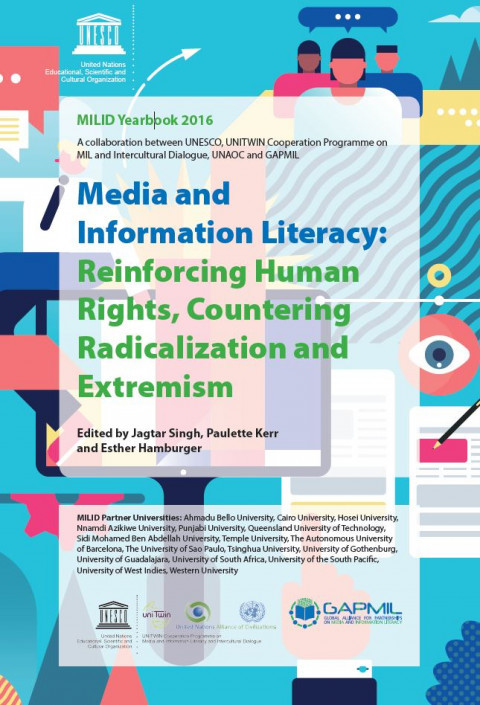 Media and Information Literacy: Reinforcing Human Rights, Countering Radicalization and Extremism (The MILID Yearbook, 2016) Year of publication: 2016 Author: Jagtar Singh | Paulette Kerr | Esther Hamburger Corporate author: UNESCO | Alliance of Civilizations Media and Information Literacy (MIL) is a strong tool, cutting across educational, cultural and social contexts. It can help overcome disinformation, stereotypes and intolerance conveyed through some media and in online spaces. Here, stimulating critical empathy is one of the vital components and there are many stakeholders that have a role to play in this dimension of MIL.This year’s edition is focused on a highly relevant theme of “Media and Information Literacy: Reinforcing Human Rights, Countering Radicalization and Extremism”. It is a relevant reference point to initiate discussion and offer perspectives to stakeholders seeking to apply MIL as a tool to counter violent extremism. There is evident need for evidence-based research, assessment and evaluation that can provide insight into the impact of media and information literacy on societies. UNESCO trusts that this publication will contribute to ongoing scholarship and debate on these key topics.For media and other information providers to serve their purpose, we need critical minds in the public, which means to develop MIL programmes at the national, regional and international levels.
  Review of Curricula and Curricular Frameworks: Report to Inform the Update of the UNESCO International Technical Guidance on Sexuality Education Year of publication: 2018 Author: Nicole Cheetham | Nora Gelperin Corporate author: Advocates for Youth In 2009, UNESCO published the International Technical Guidance on Sexuality Education (ITGSE): An evidence-informed approach for schools, teachers and health educators. The purpose of the ITGSE is to assist education, health and other relevant authorities in the development and implementation of school-based sexuality education programmes and materials (UNESCO, 2009). The publication was released in two volumes: Volume I, which focuses on the rationale for sexuality education and provides sound technical advice on the characteristics of effective programmes; and Volume II, which focuses on the topics and learning objectives to be covered in a ‘basic minimum package’ on sexuality education for children and young people from 5 to 18+ years of age, and includes a bibliography of useful resources.In 2016, UNESCO began a process to update the ITGSE, consisting of a literature review of the evidence and lessons learned since the release of the original publication; a stakeholder consultation on sexuality education held in October of 2016; an online user survey; and an expert, Comprehensive Sexuality Education (CSE) Advisory Group established to inform the process and its findings.This report summarizes evidence-informed conclusions, expert recommendations and current practice for curriculum-based sexuality education for ages 5-18+ and provides preliminary, overarching changes to Volume II of the ITGSE for consideration by the UNESCO CSE Advisory Group.
  Review of the Evidence on Sexuality Education: Report to Inform the Update of the UNESCO International Technical Guidance on Sexuality Education Year of publication: 2018 Author: Paul Montgomery | Wendy Knerr Corporate author: UNESCO UNESCO published the International Technical Guidance on Sexuality Education (ITGSE): An evidence-informed approach for schools, teachers and health educators, in 2009. It put forward the rationale for sexuality education, technical advice on characteristics of effective programmes, and topics and learning objectives to be covered in a ‘basic minimum package’ of sexuality education for children and young people aged 5–18+. Since the publication, UNESCO, several UNAIDS cosponsors and other international partners have advocated for ‘comprehensive sexuality education’ (CSE) for all adolescents and youth, and as an essential component of quality education.With the passage of time and the expanded understanding of the role of CSE, UNESCO sought to review the ITGSE with the aim of updating its content to reflect the evidence and lessons learned from implementing sexuality education programmes since 2009. UNESCO sought the technical services of a consultant team to conduct an evidence review to inform the update.This review would involve research on new evidence and good practice in sexuality education including evidence on the effectiveness of CSE and lessons documented through the implementation of sexuality education programmes to highlight benchmarks of quality CSE content and modalities of delivery. The research was also intended to make recommendations as to the: adequacy of existing content; presence of any gaps in this content; and evidence-based recommendations on how such content gaps can be addressed in the updated ITGSE.
  Global Citizenship Education Tools and Piloting Experiences of Four Countries: Cambodia, Colombia, Mongolia and Uganda Year of publication: 2018 Author: Opertti Renato | Hyekyung Kang | Magni Giorgia Corporate author: UNESCO International Bureau of Education (IBE) | APCEIU This report analyses the progresses made by Cambodia, Colombia, Mongolia and Uganda in the development and piloting of GCED tools, designed within the framework of UNESCO Asia-Pacific Centre of Education for International Understanding (APCEIU)’s and International Bureau of Education (IBE)’s three-year cooperation project, “Global Citizenship Education Curriculum Development and Integration”. Based on the needs identified through the situational analyses carried out during Phase I, the four countries have developed tailored tools to mainstream GCED in their own context and piloted them during Phase II. Through an in-depth analysis of the tools as well as of their piloting processes, this report aims at understanding the extent to which GCED concepts are embedded and integrated into these tools and the way in which these tools contribute to the overall GCED teaching and learning practices in each context. What results from the findings is that the four countries, despite some setbacks due mainly to the strict timeline, have made significant progress in developing innovative strategies to integrate GCED principles into their education policies and practices. Finally, this report concludes with the suggestions for these tools to be effectively implemented during Phase III, particularly for this project, and for any further initiative around GCED areas.