
Resources
Explore a wide range of valuable resources on GCED to deepen your understanding and enhance your research, advocacy, teaching, and learning.
8,364 Results found
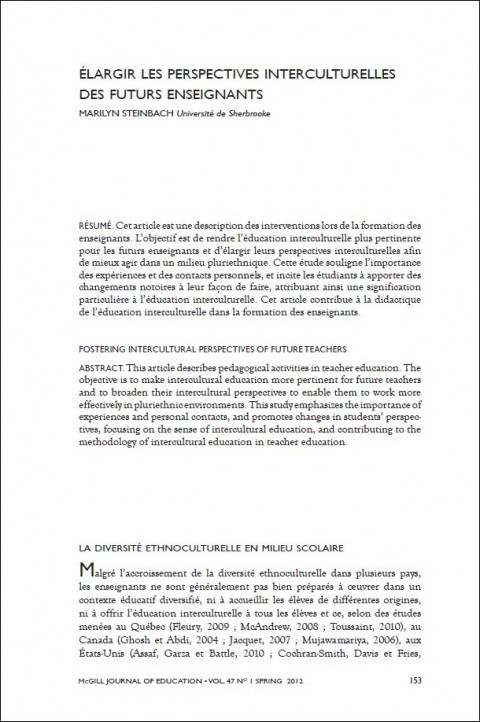 Fostering Intercultural Perspectives of Future Teachers Year of publication: 2012 Author: Marilyn Steinbach Corporate author: McGill University. Faculty of Education This article describes pedagogical activities in teacher education. The objective is to make intercultural education more pertinent for future teachers and to broaden their intercultural perspectives to enable them to work more effectively in pluriethnic environments. This study emphasizes the importance of experiences and personal contacts, and promotes changes in students’ perspectives, focusing on the sense of intercultural education, and contributing to the methodology of intercultural education in teacher education.
 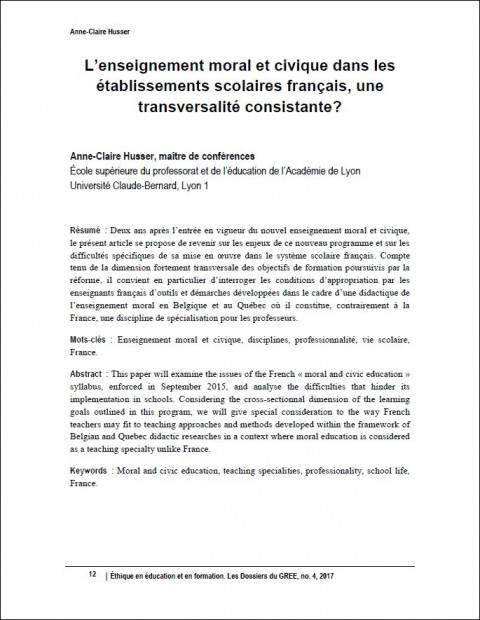 Moral and Civic Teaching in French Schools, a Consistant Transversality? Year of publication: 2017 Author: Anne-Claire Husser Corporate author: Éthique en éducation et en formation This paper will examine the issues of the French « moral and civic education » syllabus, enforced in September 2015, and analyse the difficulties that hinder its implementation in schools. Considering the cross-sectionnal dimension of the learning goals outlined in this program, we will give special consideration to the way French teachers may fit to teaching approaches and methods developed within the framework of Belgian and Quebec didactic researches in a context where moral education is considered as a teaching specialty unlike France.
 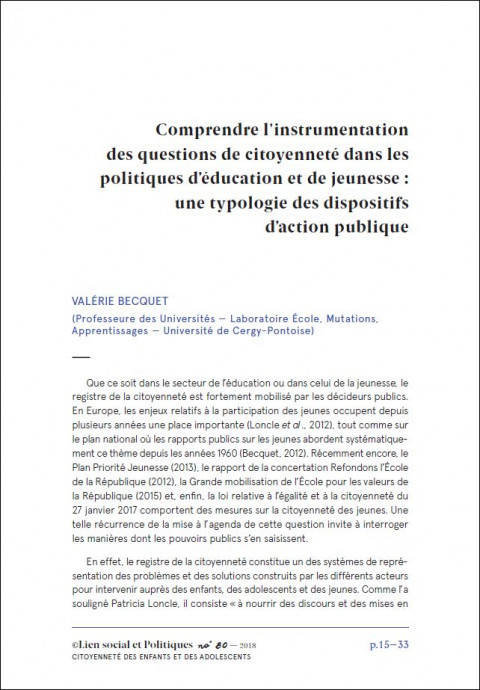 Understanding Policy Instrument Choice Concerning Citizenship in Education and Youth Policies: A Typology of Public Tools Year of publication: 2018 Author: Valérie Becquet Corporate author: Lien social et Politiques Whether at European or at national level, issues relating to the citizenship of young people are present in public debates and give to the implementation of specific tools. The past and the recurrence of setting up this issue on the agenda invites to reflect on the dynamics of public action. This article presents a typology of the tools gradually developed in two public sectors that concern young people: education and youth. Based on a policy instrument choice approach, it highlights that the choices made by public decision-makers to deal with citizenship issues lead to a multiplication and a diversification of the tools. This proliferation introduces suppose to reflect on the legibility of public action: if those mechanisms can be seen as complementary and as an opportunity for young people, they can also enter into tension. In a context of generational renewal of the electorate, it also calls for reflection on the consequences for young people’s practices and on the building of the perception of citizenship.
 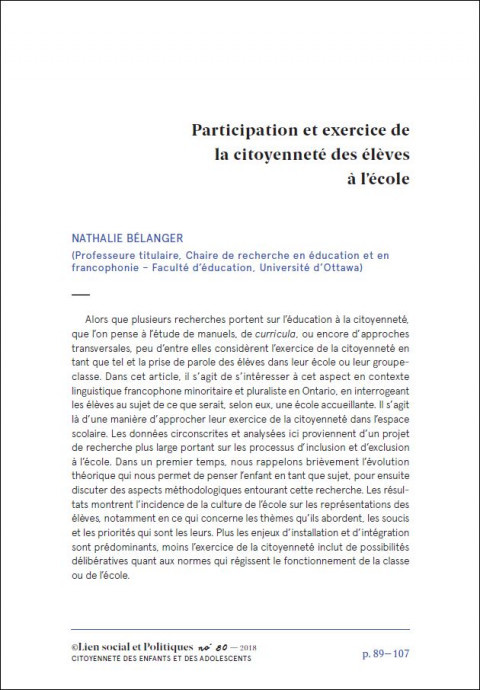 Participation and Exercising Pupils’ Citizenship at French-Language Elementary School in Ontario Year of publication: 2018 Author: Nathalie Bélanger Corporate author: Lien social et Politiques This article first describes the evolution which allowed the child to be considered as an actor. In this vein, citizenship education programs at school are discussed, although they do not often take into account exercising citizenship in the school context and children’s voice. Research results from a broader project on how students represent their school experience in French-language schools in Ontario are analyzed specifically with respect to what a welcoming school means for them. The methodology uses an inductive approach and the data were gathered from administering a questionnaire designed for children, observation and semi-directed interviews. The results show the impact of school culture and school form on the exercise of students' citizenship, the topics they address, their concerns and priorities. The greater the predominance of settlement and integration issues are, the less the exercise of citizenship includes deliberative opportunities regarding school functioning.
  The Social Representations of Democracy: Reflexivity, Efferevescence and Conflict Year of publication: 2008 Author: Anne-Marie Gingras | Adriana Dudas | Magali Paquin | Marc Foisy Corporate author: Politique et Sociétés (Canada) This paper deals with “democracy within society” that appears predominantly in our research on social representations of democracy. We have interviewed 110 persons who have a regular access to the public sphere to perceive their understanding of democracy, its many dimensions, and its main stakes. Democracy within society, or democracy as a state of society, is opposed to institutional democracy (that is, political practices and Rule of law) toward which critics abound. Democracy within society is twofold: on the one hand, emphasis on effervescence and reflexivity that crystallize in collective organisations and in debate and communication and, on the other hand, assimilation of democracy to conflict, considered in terms of normality and processes. Moreover, democracy within society needs an actor, the citizen, who does not respond to the call of democracy, as shown in the many social sciences studies of the last decades.
  The Democratic Enigma Year of publication: 2014 Author: Philip Pettit Corporate author: Philosophiques Democracy means popular control, by almost all accounts. And by almost all accounts democracy entails legitimacy. But popular control, at least as that is understood in many discussions, does not entail legitimacy. So something has got to give. Democratic theories divide on what this is, so that the question prompts a taxonomy of approaches. The most appealing answer, so the paper suggests, involves a reinterpretation of the notion of popular control.
  Global Citizenship Education: Taking It Local Year of publication: 2018 Corporate author: UNESCO UNESCO is leading global efforts on Global Citizenship Education (GCED), which is at the core of Target 4.7 of Sustainable Development Goal 4 on Education. To address the perception that the concept of GCED is concerned mainly with global matters and maybe dissociated from local needs and realities, UNESCO has identified local/national/traditional precepts and concepts that are similar to the UNESCO understanding of global citizenship.As culturally relevant expressions of GCED and to contribute to building peace through the implementation of GCED, the concepts identified here can serve as entry-points to teach and learn about GCED in more locally relevant ways.
  Making Democracy an Ethic and a Pedagogy Year of publication: 2017 Author: Christophe Point Corporate author: Éthique en éducation et en formation This article presents the argument that an ethics of democracy in the school requires an appropriate pedagogy. This pedagogy cannot be limited to theoretical content or to an assortment of civic actions because democracy is not composed either of a particular set of facts, concepts or dates, or of an undetermined social behaviour. According to the approach of John Dewey, who places inquiry at the center of his definition of democracy, we wish to demonstrate a double benefit from pragmatist thinking. For ethics, in defining democracy as a habit of collective thinking, we wish to construct values that can be shared by all participants in the school environment. For pedagogy, this habit of inquiry can lend itself to all subjects taught at school without limiting itself to a particular discipline. Finally, we will propose a modeling of this democratic education for a step-by-step didactic progression.
 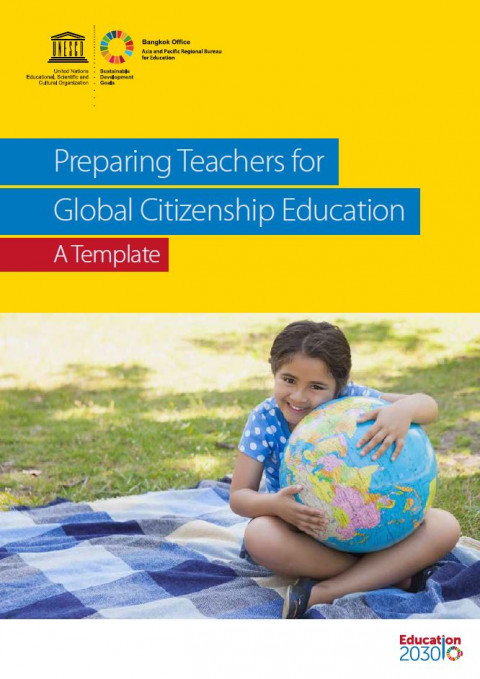 Preparing Teachers for Global Citizenship Education: A Template Year of publication: 2018 Corporate author: UNESCO Bangkok The UNESCO Asia-Pacific Regional Bureau for Education in Bangkok, Thailand, has taken up the task to promote GCED through a project that focuses on teachers who are key players in transferring appropriate values, knowledge and skills to their students. With support from the Korean Funds-in-Trust, one output of the project is this guide: Preparing Teachers for Global Citizenship Education: A Template.This publication provides useful information on integrating GCED concepts, principles and activities into curricula and teaching practices covering a broad spectrum of issues and pedagogies. It contains exemplars illustrating how GCED can be integrated into various subject areas. Diverse resources and materials listed in the document also offer readers a wide range of references. Underscoring the pragmatic objective of this work is the need for teachers to become global citizens themselves.
 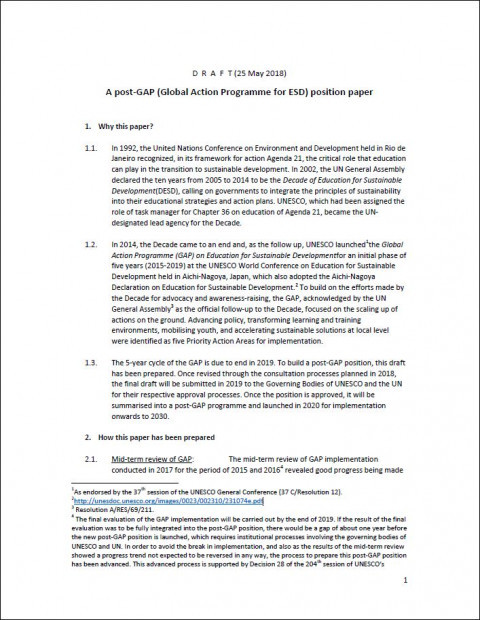 A Post-GAP (Global Action Programme for ESD) Position Paper Year of publication: 2018 Corporate author: UNESCO The 5-year cycle of the GAP is due to end in 2019. To build a post-GAP position, this draft position paper has been prepared. Once revised through the consultation processes planned in 2018, the final draft will be submitted in 2019 to the Governing Bodies of UNESCO and the UN for their respective approval processes. Once the position is approved, it will be summarised into a post-GAP programme and launched in 2020 for implementation onwards to 2030.