
Resources
Explore a wide range of valuable resources on GCED to deepen your understanding and enhance your research, advocacy, teaching, and learning.
8,364 Results found
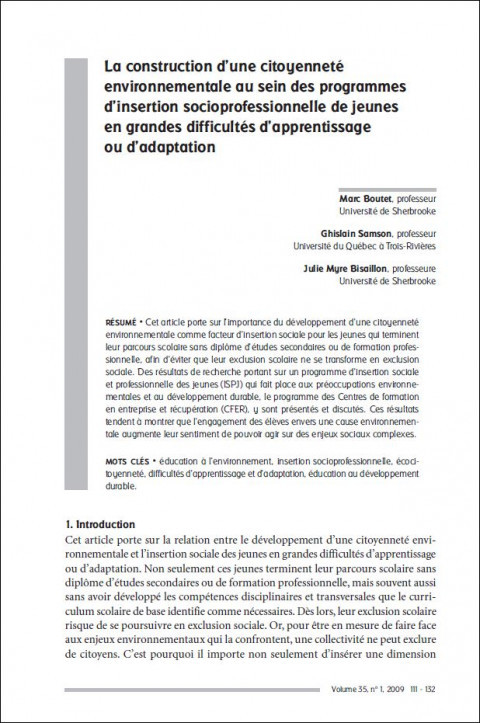 Constructing Environmental Citizenship through Socio-professional Insertion Programs for Youth with Severe Learning and Adaptation Difficulties Year of publication: 2009 Author: Marc Boutet | Ghislain Samson | Julie Myre Bisaillon Corporate author: Revue des sciences de l’éducation This article is about the importance of environmental citizenship as a factor of socio-professional insertion for students who terminate their schooling without a secondary or professional training diploma, in order to prevent that their school exclusion leads to a social exclusion. Results of a research on a socio-professional insertion program for youth that integrates environmental and sustainable development issues and the Corporate Training and Recuperation Centres Network (CFER) are presented and discussed. Those results tend to demonstrate that the students’ involvement in an environmental cause increases their empowerment towards complex social issues.
 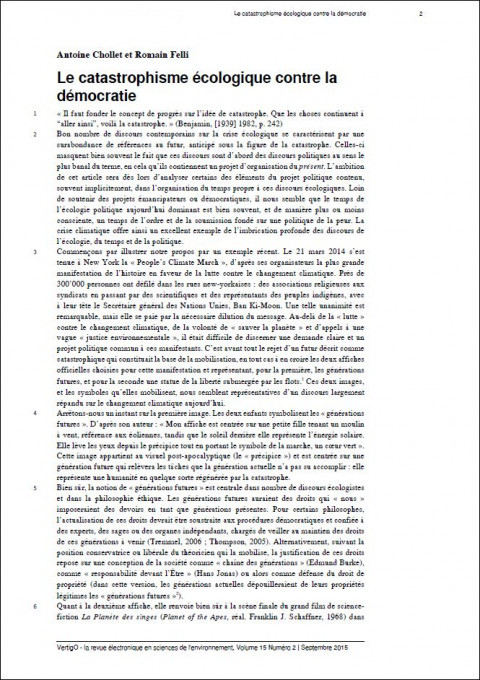 The Ecological Catastrophe Facing Democracy Year of publication: 2015 Author: Antoine Chollet | Romain Fell Corporate author: Université du Québec à Montréal (UQAM) | Éditions en environnement VertigO In this article we aim to analyze the specific temporal regimes associated with the discourses of environmental – and especially, climatic – catastrophe. By empirically describing and analyzing the images of the future used in catastrophist discourses, we seek to demonstrate that these discourses lead to anti-democratic political positions. Hence, we normatively argue for the replacement of these discourses by another understanding of the future, of temporality, and of time itself, and we theoretically define the lineaments of such an understanding. Finally, our aim is not to challenge the severity of the current ecological crises but rather, by way of reframing these crises in a present setting, and by pointing to their contradictory multiplicity, to contribute to a serious assessment of their nature. Only thus, is it possible to acknowledge the possibility of a democratic politics of socio-ecological relations.
 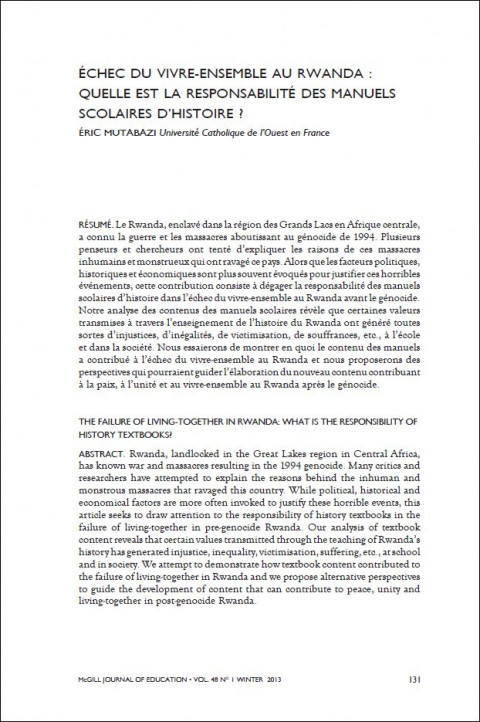 The Failure of Living-Together in Rwanda: What is the Responsibility of History Textbooks? Year of publication: 2013 Author: Éric Mutabazi Corporate author: McGill University. Faculty of Education Rwanda, landlocked in the Great Lakes region in Central Africa, has known war and massacres resulting in the 1994 genocide. Many critics and researchers have attempted to explain the reasons behind the inhuman and monstrous massacres that ravaged this country. While political, historical and economical factors are more often invoked to justify these horrible events, this article seeks to draw attention to the responsibility of history textbooks in the failure of living-together in pre-genocide Rwanda. Our analysis of textbook content reveals that certain values transmitted through the teaching of Rwanda’s history has generated injustice, inequality, victimisation, suffering, etc., at school and in society. We attempt to demonstrate how textbook content contributed to the failure of living-together in Rwanda and we propose alternative perspectives to guide the development of content that can contribute to peace, unity and living-together in post-genocide Rwanda.
 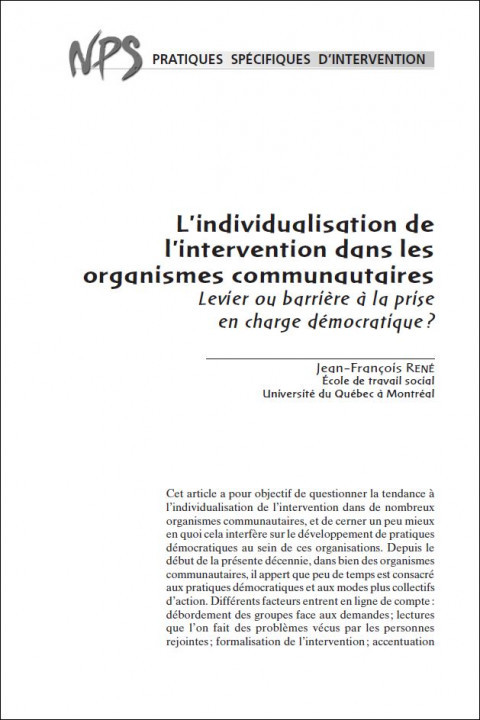 The Individualization of Intervention in Community Organizations: Openings or Barriers in Relation to Democracy? Year of publication: 2009 Author: Jean-François René Corporate author: Nouvelles pratiques sociales This paper questions the fact that in some community-based organisations the level of intervention is often the individual rather than the community. This trend interferes with the internal participatory democratic practices within these organisations. To explain this relatively recent situation (beginning of the present decade) in many community-based organisations, various factors are taken into account : the large number of requests received by these groups ; the way we solve problems that people face ; the institutionalization of community intervention ; the pressure on organisations to integrate state services agendas. In this context, what actions are needed to stimulate the internal democratic practices within these groups ?
 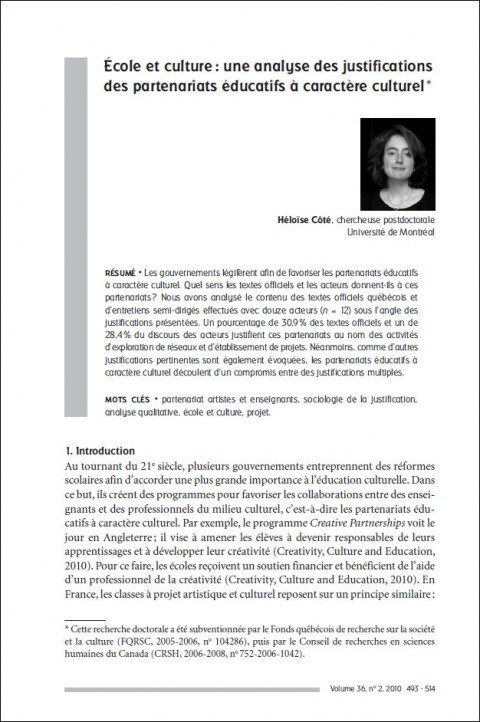 School and Culture: An Analysis of Justifications for Educational-Cultural Partnerships Year of publication: 2010 Author: Héloïse Côté Corporate author: Revue des sciences de l’éducation Governments legislate to favour cultural partnerships. What meaning do official texts and actors give to these partnerships ? We analysed the content of Québec official texts and of semi-structured interviews conducted with twelve actors (n = 12) from the perspective of the justifications they presented. The author found that 30,9 % of the official texts and 28,4 % of the actors’ discourse justify cultural partnerships on the basis of the exploration of networks and the elaboration of projects. Nonetheless, since other adequate justifications are also mentioned, cultural partnerships stem from a compromise between several justifications.
 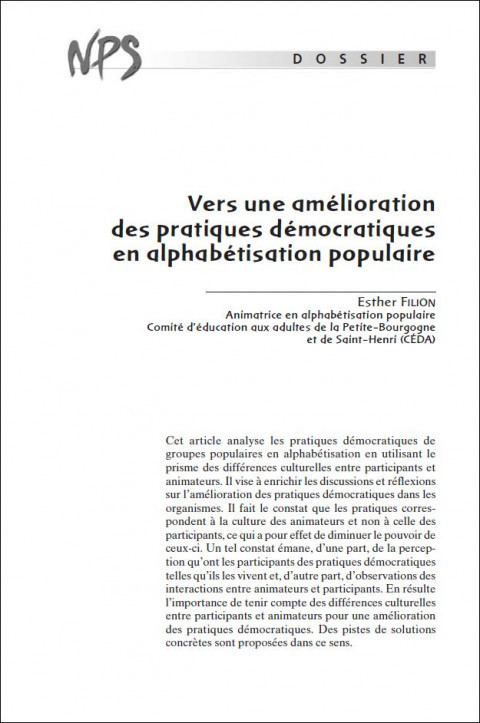 Aiming to Improve Democractic Practices in Relation to Literacy Year of publication: 2011 Author: Esther Filion Corporate author: Nouvelles pratiques sociales The article analyses the democratic practices in place within community literacy groups, through the prism of cultural differences existing between participants and facilitators. Its objective is to enrich discussions and research relative to the improvement of democratic practices within such organizations. It states that the practices are usually modeled on the facilitators’ own culture rather than on that of the participants, thus reducing their power. This assessment is based on the participants’ perception of their group’s democratic practices, and on the interactions observed between facilitators and participants. It is therefore essential to take into account cultural differences residing between facilitators and participants to ensure the improvement of democratic practices in place. Several practical solutions are also put forward.
 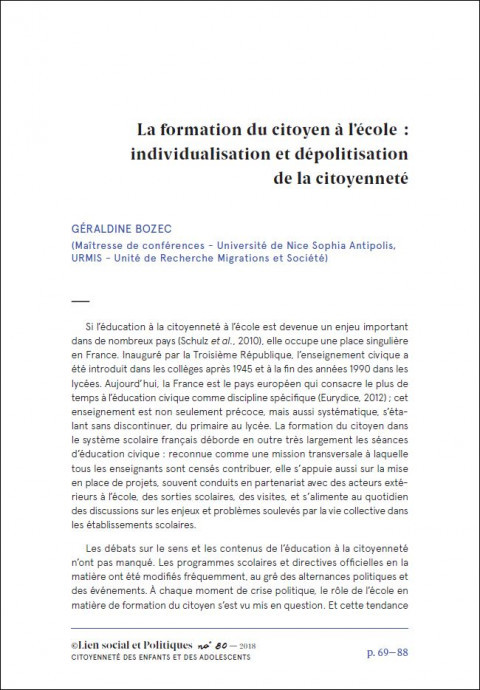 Educating Citizens at School: Individualization and Depoliticization of Citizenship Year of publication: 2018 Author: Géraldine Bozec Corporate author: Lien social et Politiques This text analyzes the features and the figures of the legitimate citizen in the sphere of school, through both official guidelines and school staff’s conceptions and practices. Data from two qualitative fieldwork surveys in French schools are used. The analysis focuses on the political dimension of citizenship: the relationship between individuals and power and their agency in collective and political life. Overall, citizens’ participation is a secondary dimension in school citizenship education, which rather emphasizes the intellectual autonomy of the critical citizen. The school hardly offers tools enabling students to understand political life, its issues, its actors and its concrete processes. The avoidance of political issues that is observed in classrooms is related to a particular conception of school political neutrality, but still more to the objective of cohesion officially attributed to school and recognized by teachers as legitimate. In other respects, citizenship is increasingly intended to be translated into the school life itself, whose modes of organization must move closer to those of adult political democracy. The article shows the limitations of such an analogy between the school and political society and identifies several obstacles that hinder the implementation of this “democratic school”. Lastly, it highlights the gap between the emphasis on the figure of individual citizen in the school space and the relationship to groups entailed by the actual practice of citizenship.
 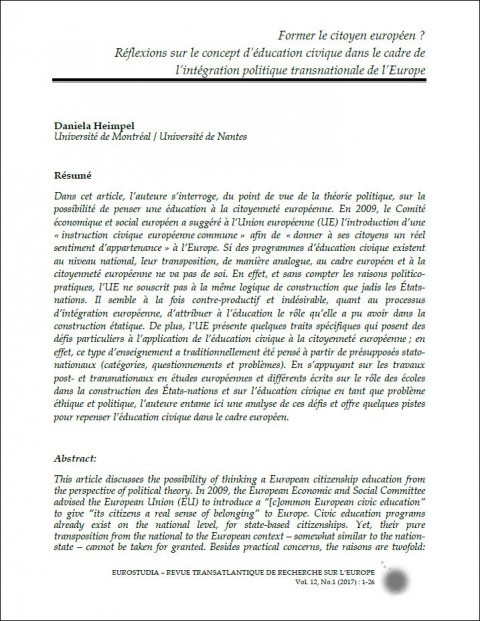 Training the European Citizen? Reflections on the Concept of Civic Education within the Framework of the European Transnational Integration Policy Year of publication: 2017 Author: Daniela Heimpel Corporate author: Eurostudia This article discusses the possibility of thinking a European citizenship education from the perspective of political theory. In 2009, the European Economic and Social Committee advised the European Union (EU) to introduce a “[c]ommon European civic education” to give “its citizens a real sense of belonging” to Europe. Civic education programs already exist on the national level, for state-based citizenships. Yet, their pure transposition from the national to the European context – somewhat similar to the nation-state – cannot be taken for granted. Besides practical concerns, the raisons are twofold: first, the EU does not follow the same logic of construction which once characterized the nation-state. It seems thus neither productive nor desirable to attribute education in the European integration process the same role it played in nation-building. Secondly, the EU has some specific features which pose challenges when civic education is applied to European citizenship; indeed, the concept of civic education has traditionally been thought on nation-state assumptions (categories, issues, problems). In this article, the author proposes an analysis of these challenges and indicates routes for re-thinking civic education in the framework of the EU. To do this, she relies on post- and transnational writings in European studies as well as on different studies on the role of schools in nation-state construction and research on civic education as a political and ethical problem.
  Experience and Project: Dewey thought Translated into Pedagogical Action Year of publication: 2016 Author: Marc Boutet Corporate author: Phronesis John Dewey talks about child as an «agency of doing» which, by its action, strives to create meaning. From this view, Dewey offers new teaching principles focusing on learning in a context of free activity rather than in a context of restrictive discipline. The child is no longer just invited to represent the phenomenon to understand, it is somehow invited to meet it, to experience it, experience being defined as a transaction between the human being and physical and social environment. Dewey also said that the lack of continuity in the experience marks the beginning of the learning process, he called inquiry, no longer described as essentially individualistic, which bases his epistemic perception of democracy. After briefly describing our meeting with Dewey’s educational thought, we will try to establish, from his conception of action, inquiry and democracy, how his thought can be considered as a foundation for a major innovation educational innovation symbolizing education reform in Quebec of the 2000s: the project approach.
  Religion, “Community” and Citizenship: The Case of Steiner, Muslim and Jewish Schools in Montreal Year of publication: 2012 Author: Stéphanie Tremblay Corporate author: Diversité urbaine Drawing on ethnographic fieldwork in Montreal, this article explores the conception of citizenship in three private schools belonging to different minority groups (Waldorf, Muslim and Jewish). After a short overview of the main critiques circulating with regards to faith-based schools in current social and political debates, I look at the theoretical concepts of school community and citizenship. These considerations help us analyze how teachers in such schools try to develop, by simultaneously different and convergent strategies, a training in citizenship as a form of “universal particularism” (Riedel 2008). These three schools attempt to transmit an open attitude toward religious and cultural diversity, and they promote the participation of their students in the wider society through a religious or spiritual particularism, which appears to be a sort of sacred ground for civic values.