
Resources
Explore a wide range of valuable resources on GCED to deepen your understanding and enhance your research, advocacy, teaching, and learning.
8,364 Results found
 The Role of Teachers in Education and Democracy: The Impact of a Research Project on Preservice Teacher Perceptions Year of publication: 2015 Author: Gina Thésée | Paul R. Carr | Franck Potwora Corporate author: McGill University. Faculty of Education This article presents reflections on a survey questionnaire related to the connection between education and democracy. A sample of 157 teacher-education students in Montreal completed a follow-up questionnaire after having participated in a research questionnaire (first study) concerning their perception and experience of the linkage between education and democracy. The first study underscored a weak democratic experience as well as an educational journey without a strong linkage to democracy, which concurs with our previous findings. However, the results of the follow-up survey indicate that participation in this inquiry generated socio-educational, epistemological, pedagogical, and methodological reflections, which could have significant implications for the perception of the role of educators.
  The Concept of Citizenship for Immigrants and Members of the Host Society within the Minority Francophone Context: A Lexical Analyse Year of publication: 2014 Author: Aïcha Benimmas | Sylvia Kasparian Corporate author: Revue de l’Université de Moncton Given the changes and constant mutations which occur in societies at the social, political, economic, technological, and educational levels, the concept of citizenship must be continually redefined. While French-speaking citizens, immigrants and members of the host society can find common ground thanks to the French language, they can also find differences because of other characteristics linked to their identity, such as culture, ethnic background, religion, and history. This is why we must analyze the meaning that these groups give to the concepts of citizenship and citizen participation, interpreting the differences and similarities that surface in their discourse regarding these two concepts. The use of computerized tools and statistics has enabled us to find through a constant comparison between qualitative and quantitative analyses-the perceptions, similarities, and divergences in the discourse of four groups of participants involved in our study: immigrant youth, immigrant parents, host society youth, and host society parents.
  Does the Concept of ‘Global Citizenship’ Have the Potential to Input in Multicultural Education? Year of publication: 2013 Author: Sobhi Tawil Corporate author: Revue internationale d’éducation de Sèvres One of the three priorities of the Global Education First Initiative launched in 2012 by the United Nations is fostering global citizenship. However, this concept remains vague if left unchallenged, and as a result is difficult to implement in the field of education. It may be true that the growing globalisation and multiculturalism of contemporary societies is gradually transforming the concept and traditional role of citizenship, the legal reality of citizenship and its practises, but they still remain largely rooted in the idea of Nation-State. This article attempts to clarify the concept of global citizenship, its possible application in the field of citizenship education and its potential contribution to the enrichment of multicultural education.
  The Migrant Community Building Active Citizenship in No Man’s Land Year of publication: 2015 Author: Elmer Romero Corporate author: Éducation des Adultes et Développement This is a story about the difficulties facing the migrant community in the United States and the potential of active citizen participation by migrants. How organisations and people work in education with the transformation of the traditional system of education into active learning that promotes critical thinking is also shown. Finally, a methodological approach which aims to create citizen transformers of reality is presented.
  Mission Impossible? Creating a Monitoring Framework for Education for Global Citizenship Year of publication: 2015 Author: Amy Skinner Corporate author: Éducation des Adultes et Développement Global Citizenship Education (GCED) must be understood as a complex and multilayered process. It can be a force for transformation on the personal, local and system level. It would be a great help to be able to monitor the impact of GCED taking this complexity into account. The article presents some research results on monitoring and explains the challenges in setting up a monitoring framework.
  Global Citizenship in Sub-Saharan Africa Year of publication: 2015 Author: Akemi Yonemura Corporate author: Éducation des Adultes et Développement Learners today are required to develop a comprehensive understanding of local, national and global challenges, so that they can influence the political, social, cultural, economic and environmental development both in their societies and their personal lives. UNESCO has been promoting education for peace and sustainable development as the overarching goal of its education programme, focusing on transformative education through Global Citizenship Education (GCED). This paper discusses GCED in Sub-Saharan Africa in the context of the post-2015 education agenda, with a particular focus on adult education.
  How Networking Can Help Build Global Citizenship in Japan Year of publication: 2015 Author: Hideki Maruyama Corporate author: Éducation des Adultes et Développement The article explains and outlines some of the challenges facing schools in Japan when teaching about sustainable development. These challenges are many and diverse. Concrete examples are given, and some proposals for action are presented.
  Education for Global Citizenship in a Postcolony: Lessons from Cameroon Year of publication: 2015 Author: Michael Foaleng Corporate author: Éducation des Adultes et Développement Global citizenship is only possible where individuals are able to engage locally in the identification and solution of their basic problems. The postcolonial education system of Cameroon, with its outdated teaching methods, produces poor scholars, who identify with the adult world through attitudes of hesitancy. We have not yet learned to be a citizen here. This is why citizenship education is currently recognised as a necessity. But its effectiveness presupposes that it is addressed not only to young people but to adults as well. One of the major challenges is to create an appropriate pedagogy for this purpose.
 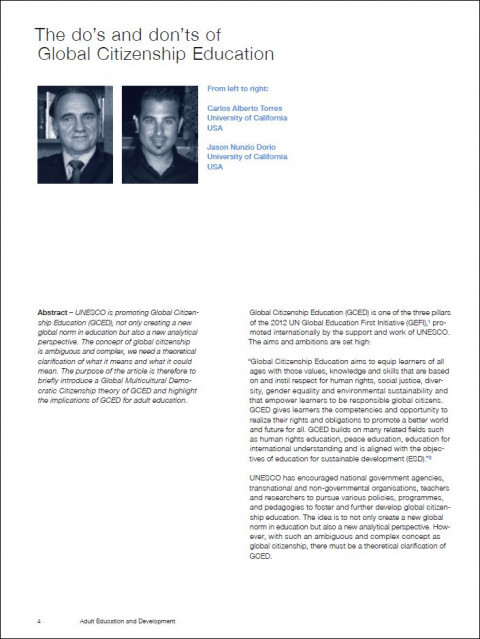 The Do's and Don’ts of Global Citizenship Education Year of publication: 2015 Author: Carlos Alberto Torres | Jason Nunzio Dorio Corporate author: Éducation des Adultes et Développement UNESCO is promoting Global Citizenship Education (GCED), not only creating a new global norm in education but also a new analytical perspective. The concept of global citizenship is ambiguous and complex, we need a theoretical clarification of what it means and what it could mean. The purpose of the article is therefore to briefly introduce a Global Multicultural Democratic Citizenship theory of GCED and highlight the implications of GCED for adult education.
  Citizenship Education at School Year of publication: 2012 Author: Jacques Racine Corporate author: Relations Special Issue of Relations intitled "Our democracy (23 articles)