
Resources
Explore a wide range of valuable resources on GCED to deepen your understanding and enhance your research, advocacy, teaching, and learning.
8,364 Results found
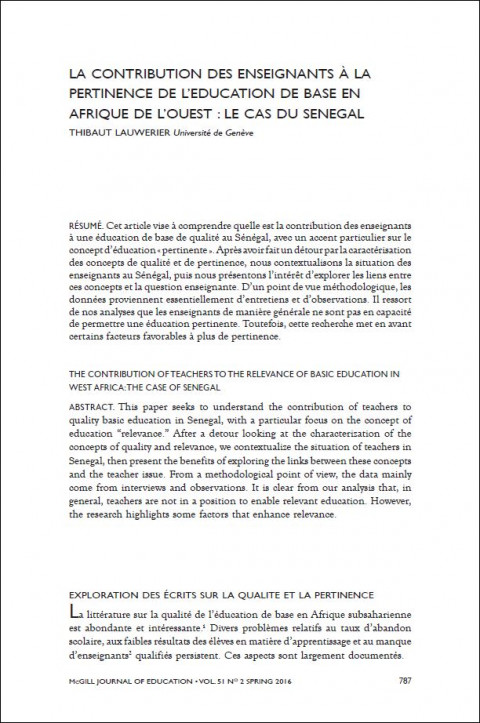 The Contribution of Teachers to the Relevance of Basic Education in West Africa: The Case of Senegal Year of publication: 2016 Author: Thibaut Lauwerier Corporate author: McGill University. Faculty of Education This paper seeks to understand the contribution of teachers to quality basic education in Senegal, with a particular focus on the concept of education “relevance.” After a detour looking at the characterization of the concepts of quality and relevance, we contextualize the situation of teachers in Senegal, then present the benefits of exploring the links between these concepts and the teacher issue. From a methodological point of view, the data mainly come from interviews and observations. It is clear from our analysis that, in general, teachers are not in a position to enable relevant education. However, the research highlights some factors that enhance relevance.
 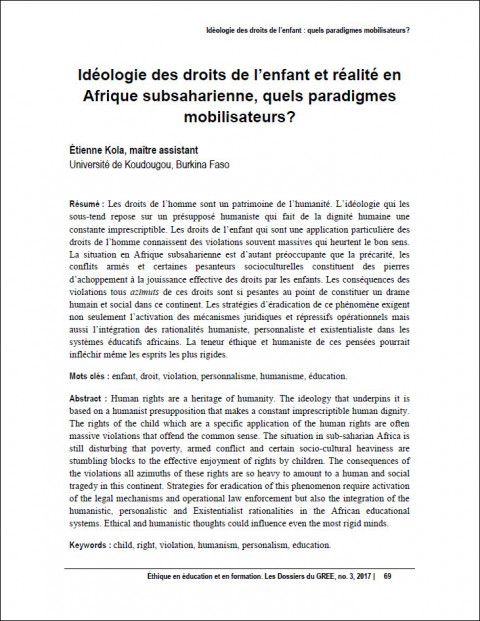 The Ideology of the Rights of Children and the Reality in Sub-Saharan Africa: What Are the Mobilizing Paradigms? Year of publication: 2017 Author: Étienne Kola Corporate author: Éthique en éducation et en formation Human rights are a heritage of humanity. The ideology that underpins it is based on a humanist presupposition that makes a constant imprescriptible human dignity. The rights of the child which are a specific application of the human rights are often massive violations that offend the common sense. The situation in sub-saharian Africa is still disturbing that poverty, armed conflict and certain socio-cultural heaviness are stumbling blocks to the effective enjoyment of rights by children. The consequences of the violations all azimuths of these rights are so heavy to amount to a human and social tragedy in this continent. Strategies for eradication of this phenomenon require activation of the legal mechanisms and operational law enforcement but also the integration of the humanistic, personalistic and Existentialist rationalities in the African educational systems. Ethical and humanistic thoughts could influence even the most rigid minds.
 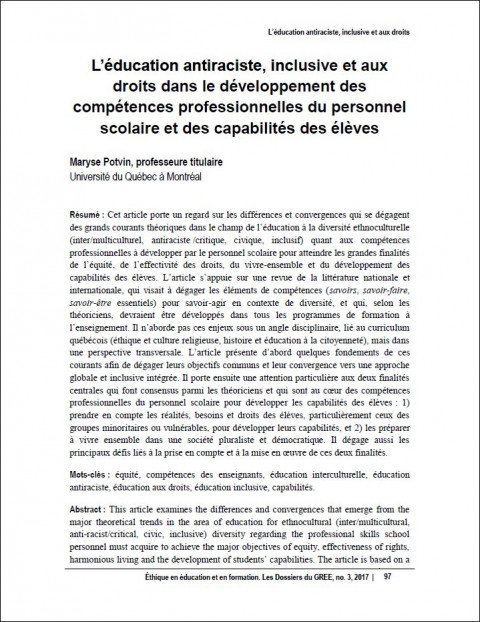 Anti-racist, Inclusive and Human Rights Education in the Development of Professional Competencies for School Personnel and Student Capabilities Year of publication: 2017 Author: Maryse Potvin Corporate author: Éthique en éducation et en formation This article examines the differences and convergences that emerge from the major theoretical trends in the area of education for ethnocultural (inter/multicultural, anti-racist/critical, civic, inclusive) diversity regarding the professional skills school personnel must acquire to achieve the major objectives of equity, effectiveness of rights, harmonious living and the development of students’ capabilities. The article is based on a review of the national and international literature, which aimed to identify the skills (knowledge, expertise, soft skills) that are essential for knowing how to act in the context of diversity and that, according to theoreticians, should be developed in all teacher training programs. These issues are discussed from a crosscutting perspective rather than from a disciplinary angle related to the Quebec curriculum (ethics and religious culture, history and education for citizenship). The article begins by providing some background on these trends in order to identify their common objectives and convergence toward an integrated and inclusive global approach. It then examines two objectives supported by all theoreticians in terms of the core professional skills needed by school personnel for developing students’ capabilities: 1) taking into account the realities, needs and rights of students, particularly those in minority or vulnerable groups, and 2) preparing students to live together in a pluralistic and democratic society. As well, it identifies the key challenges involved in the consideration and implementation of these two goals.
 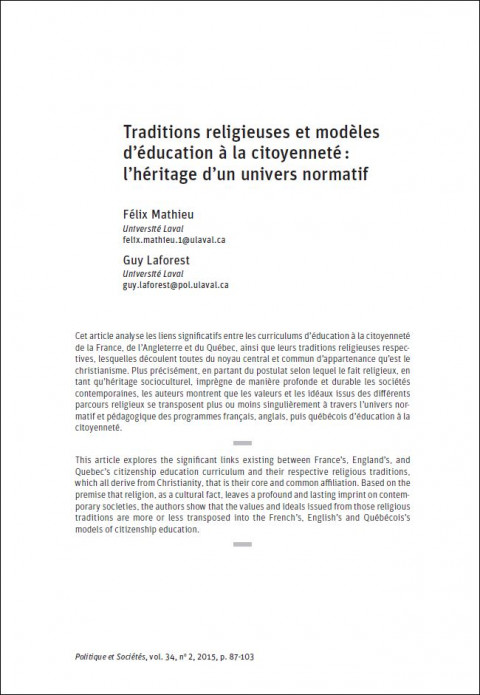 Religious Traditions and Models of Citizenship Education: The Heritage of a Normative Universe Year of publication: 2015 Author: Félix Mathieu | Guy Laforest Corporate author: Politique et Sociétés (Canada) This article explores the significant links existing between France’s, England’s, and Quebec’s citizenship education curriculum and their respective religious traditions, which all derive from Christianity, that is their core and common affiliation. Based on the premise that religion, as a cultural fact, leaves a profound and lasting imprint on contemporary societies, the authors show that the values and ideals issued from those religious traditions are more or less transposed into the French’s, English’s and Québécois’s models of citizenship education.
  Concept-Based Learning of History and Citizenship Education in the First Year of Secondary School Year of publication: 2013 Author: Félix Bouvier | Sandra Chiasson Desjardins Corporate author: McGill University. Faculty of Education This article examines the perceptions of first year secondary school students towards their History and Citizenship Education course in general, as well as its specific objective to teach citizenship skills and its concepts. A qualitative analysis of interviews conducted with forty students shows that students generally fail to make connections between history and citizenship education. This article also finds that citizenship concepts are learned according to the context in which they are studied.
  Citizenship and Citizenship Education: Gabonese Secondary School Teachers’ Point of Views Year of publication: 2013 Author: René Casimir Zoo Eyindanga Corporate author: McGill University. Faculty of Education The purpose of this paper is to identify the meanings that secondary school teachers (male and female) in Gabon give to citizenship and citizenship education. Sixty teachers, many of whom teach citizenship education, were surveyed. Set against a background of new social demands, the context of democracy is discussed, the latter requiring a renewed critical look at citizenship education in schools. The points of view expressed by the teachers taking part in the study echo their personal and professional experiences. Although open to participation, they reflect a normative conceptualization of citizenship education as well as an obligation to ensure a stronger citizenship education despite social and educational obstacles.
  Teachers of History and the History and Citizenship Education Program: From the Transmission of a Memory to an Open and Subjective Citizenship Year of publication: 2013 Author: Louis LeVasseur | Sabrina Moisan | Jean-François Cardin Corporate author: Phronesis The current program «History and Citizenship Education» for the second cycle of secondary education, on the Quebec history, raised many comments in intellectual circles because of its content since 2006. Some argue that the transmission of major historical events that shape the collective or national memory is non-existent, others argue that it should promote the development of critical thinking and citizenship skills, thus the autonomy of the student facing the memory collective or national. What position secondary teachers do they have in this debate? It’s findable out through the teachers perceptions about program and its three skills.
  Between Colonial Heritage and Political Autonomy. Comparing the Experience of Australian, American and Canadian Aboriginal Peoples in the Turmoil of Welfare State Reform Year of publication: 2016 Author: Martin Papillon Corporate author: Lien social et Politiques Long excluded, then victims of forced assimilation, aboriginal peoples are now evaluating the conditions of their belonging to and participation in citizenship regimes in these three former colonies. The processes of welfare state restructuring may influence the dynamic of identity claims of aboriginal peoples, by modifying the parameters of social citizenship and the relations that aboriginal peoples have with the state. These reforms lean, on the one hand, towards integrated policy with targeted programmes and, on the other hand, towards greater local autonomy in programme management. The post-war citizenship regime in contrast favoured a uniform relationship between citizens and the state, thereby setting up a contradiction between the terms of the citizenship regime and maintenance of a distinct legal regime for aboriginal peoples. The current model seems less likely to constitute a block to recognition of multiplicity and differentiation.
  Citizenry, Governance and Ethno‐cultural and Religious Minorities: A Model of Integration Under Stress Year of publication: 2011 Author: François Rocher Corporate author: Revue Gouvernance Using citizenship as a lens, this article aims to determine the conditions that result in the inclusion or exclusion of ethno-cultural and religious minorities in Quebec. It is also interested in models of governance that examine how the type of governance practiced by the state is reflected in the policies put forward and the consequences on the participation of ethno-cultural and religious minorities in the public realm. This research is innovative since it proposes to examine the positions put forward by ethno-cultural and religious minorities, a perspective that has been, for the most part, overlooked in the literature. In Quebec, numerous events concerning the accommodation of ethnocultural and religious differences have marked the social and political climate. The creation, by the Quebec government in February 2007, of the Bouchard-Taylor Commission, culminated in a society-wide re-evaluation of the models of integration, of citizenship and of the role of ethno-cultural and religious minorities in Quebec society. This article seeks to illustrate the variety of positions put forward by ethno-cultural and religious minorities, and the challenges vis-à-vis various models of governance.
  Together in Citizenship Education: Intervention Principles to Support the Social Participation of People with Intellectual Disabilities Year of publication: 2016 Author: Raphaëlle Beaudoin | Émilie Raymond Corporate author: Service social This article presents the outcomes of an intervention’s evaluation that was intended to contribute to the renewal of practices in favour of greater social participation of people with intellectual disabilities (ID). Although much has been achieved for the social integration of this population since deinstitutionalization, these citizens still frequently see their rights and their independence questioned, presenting obstacles to the full achievement of life habits. To address these challenges, this intervention project took the form of a citizenship education group led by adults with ID. This intervention project aimed to highlight the prospects of intervention, inspired by an empowerment approach, the most likely to support these people to lead a participatory and self-determined life. Based on the Disability Creation Process model (DCP), this project involved both personal and environmental factors, which are recognized as key elements for social participation. In doing so, it stands out from most intervention programs created to date, which tend to focus on the individual experiences of people, omitting the influence of structural conditions. Yet, the results of this intervention support the relevance of focusing on the interaction between these factors, illustrated through three promising intervention principles: to build on an active learning process, to create a new distribution of power and to seek a balance between support and freedom. This approach asks social professionals to consider the impact of their intervention on self-determination in attaining social participation. It also aims to better equip these professionals to avoid reproducing the dynamics of oppression and to become true facilitators of the social participation of people with ID.