
Resources
Explore a wide range of valuable resources on GCED to deepen your understanding and enhance your research, advocacy, teaching, and learning.
8,364 Results found
 Learning Cities and the SDGs: A Guide to Action Year of publication: 2017 Corporate author: UNESCO Institute for Lifelong Learning (UIL) This document is a Guide to Action for mainstreaming lifelong learning as a key driver to achieve the 17 Sustainable Development Goals (SDGs). The document seeks to facilitate the process of transforming global goals into local actions by showing concrete steps, which members of the UNESCO Global Network of Learning Cities (GNLC) have taken to promote green and healthy environments, equity and inclusion as well as decent work and entrepreneurship. This Guide to Action is closely linked to the Cork Call to Action for Learning Cities, adopted by the participants of the third International Conference on Learning Cities, which took place from 18–20 September 2017 in Cork, Ireland.
  [DIALOG #13] Information and methodological bulletin on multilingual and multicultural education in Central Asia Year of publication: 2017 Corporate author: Организация по безопасности и сотрудничеству в Европе (ОБСЕ) | United Nations Children's Fund (UNICEF) The website and the informational and methodological bulletin "Dialogue" was created in order to assist educational organizations of the countries of Central Asia in the implementation of multilingual education programs. The website is supported by the Central Asian Education Program of the OSCE HCNM, the UN Children's Fund UNICEF and the Center for Social Integration.The bulletin is addressed to teachers and school leaders, representatives of education authorities, researchers and experts in the field of education. The bulletin is intended to quarterly inform about initiatives and significant events in the field of multilingual and multicultural education in Central Asia and around the world. In each issue of the bulletin you can find a variety of materials: interviews with experts, a review of the experience of multilingual schools, methodological articles and lesson development, announcements of events and publications, links to Internet resources.
  [DIALOG #14] Information and methodological bulletin on multilingual and multicultural education in Central Asia Year of publication: 2017 Corporate author: Организация по безопасности и сотрудничеству в Европе (ОБСЕ) | United Nations Children's Fund (UNICEF) The website and the informational and methodological bulletin "Dialogue" was created in order to assist educational organizations of the countries of Central Asia in the implementation of multilingual education programs. The website is supported by the Central Asian Education Program of the OSCE HCNM, the UN Children's Fund UNICEF and the Center for Social Integration.The bulletin is addressed to teachers and school leaders, representatives of education authorities, researchers and experts in the field of education. The bulletin is intended to quarterly inform about initiatives and significant events in the field of multilingual and multicultural education in Central Asia and around the world. In each issue of the bulletin you can find a variety of materials: interviews with experts, a review of the experience of multilingual schools, methodological articles and lesson development, announcements of events and publications, links to Internet resources.
  [DIALOG #15] Information and methodological bulletin on multilingual and multicultural education in Central Asia Year of publication: 2018 Corporate author: United Nations Children's Fund (UNICEF) | Organization for Security and Co-operation in Europe (OSCE) The website and the informational and methodological bulletin "Dialogue" was created in order to assist educational organizations of the countries of Central Asia in the implementation of multilingual education programs. The website is supported by the Central Asian Education Program of the OSCE HCNM, the UN Children's Fund UNICEF and the Center for Social Integration.The bulletin is addressed to teachers and school leaders, representatives of education authorities, researchers and experts in the field of education. The bulletin is intended to quarterly inform about initiatives and significant events in the field of multilingual and multicultural education in Central Asia and around the world. In each issue of the bulletin you can find a variety of materials: interviews with experts, a review of the experience of multilingual schools, methodological articles and lesson development, announcements of events and publications, links to Internet resources.
  [DIALOG #16] Information and methodological bulletin on multilingual and multicultural education in Central Asia Year of publication: 2018 Corporate author: United Nations Children's Fund (UNICEF) | Organization for Security and Co-operation in Europe (OSCE) The website and the informational and methodological bulletin "Dialogue" was created in order to assist educational organizations of the countries of Central Asia in the implementation of multilingual education programs. The website is supported by the Central Asian Education Program of the OSCE HCNM, the UN Children's Fund UNICEF and the Center for Social Integration.The bulletin is addressed to teachers and school leaders, representatives of education authorities, researchers and experts in the field of education. The bulletin is intended to quarterly inform about initiatives and significant events in the field of multilingual and multicultural education in Central Asia and around the world. In each issue of the bulletin you can find a variety of materials: interviews with experts, a review of the experience of multilingual schools, methodological articles and lesson development, announcements of events and publications, links to Internet resources.
 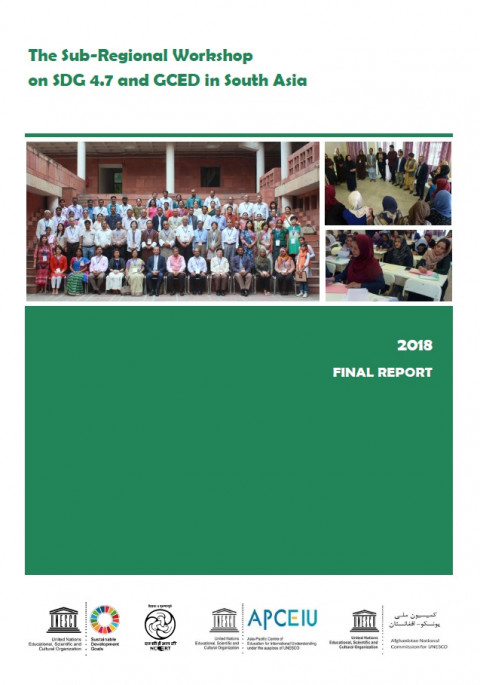 Final Report: 2018 Sub-regional Workshop on SDG 4.7 and GCED Year of publication: 2018 Corporate author: APCEIU This report is the summary of the Sub-regional Workshop on SDG 4.7 and GCED in South Asia. Implemented by two occasions, the Workshop has offered the platform for the key educators from the South Asian region to discuss GCED in the regional context of achieving SDG 4.7. The report provides the overview of the two workshops held in India and Afghanistan in 2018.
  Final Report: 18th Asia-Pacific Training Workshop on EIU Year of publication: 2018 Corporate author: APCEIU This report is the summary of the 18th Asia-Pacific Workshop on EIU (APTW) held in the Republic of Korea from 20 to 28 July 2018. Designed as TOT (Training of Trainers), the Workshop has invited 31 teacher educators/trainers from the Asia-Pacific region, strengthening their capacities to carry out Global Citizenship Education in their respective institutions and countries.
  Youth Advocacy Kit on Global Citizenship Education Year of publication: 2018 Corporate author: APCEIU APCEIU has published the Youth Advocacy Kit on Global Citizenship Education (GCED) in order to provide youth leaders a guideline on advocacy for GCED. Targeting youth activists who currently participate in GCED programmes around the world, the kit offers the overview of GCED and advocacy as well as tips and tools to effectively implement advocacy campaign for GCED in local and global context. Furthermore, by sharing cases of youth advocacy in diverse fields, this kit also provides the real life examples which can be easily referred by youth interested in GCED advocacy. <Table of Contents> Youth Advocacy Kit on GCEDChapter 1 - What is Global Citizenship Education (GCED)?Chapter 2 - What is GCED Advocacy?Chapter 3 - Youth as an Active Agent for GCEDChapter 4 - Sharing Cases of Youth AdvocacyChapter 5 - Youth Initiatives on GCED
  Green Pack Year of publication: 2013 Corporate author: Regional Environmental Center for Central and Eastern Europe Inspired by the political process “Environment for Europe”, in 2000 the Regional Environmental Center for Central and Eastern Europe (REC) launched a programme on education for sustainable development (ESD), sponsored by Toyota. This included the development and introduction of an innovative multimedia educational kit, the Green Pack, for school teachers and their students in Central and EasternEurope. Other ESD tools similar to the Green Pack have been developed and introduced in recent years to address different target groups. Currently, the main group of REC ESD tools includes:Green Pack, aimed at children aged between 11 and 15 and their teachersGreen Pack Junior, aimed at children aged between 7 and 10 and their teachersGreen Steps, aimed at citizens and families After 14 years of project implementation, REC ESD materials have been introduced in 19 countries in Europe and Asia. Since the Green Pack launch in 2001, around 40,000 teachers and over 4.5 million students have been educated, fundamentally changing the way in which the teaching of sustainability is approached. Each project has been developed in cooperation with businesses, governments, professional organisations and NGOs in order to foster community support across a broad spectrum of society. Many donors from the international, governmental, business and private communities have supported this process. URL:http://www.greenpackonline.org/english/menu.html
  Human Rights: Back to the Future (The UNESCO Courier no. 4, October-December 2018) Year of publication: 2018 Corporate author: UNESCO Benedetto Croce, Aldous Huxley, Humayun Kabir, Harold J. Laski, Lo Chung-Shu, Salvador de Madariaga, Jacques Maritain, F.S.C. Northrop, Arnold Schoenberg, Pierre Teilhard de Chardin – these are some of the contributors to this issue of the Courier. To mark the seventieth anniversary of the Universal Declaration on Human Rights, adopted on 10 December 1948, we decided to take a detour into the past to enable us to better orient ourselves in the future. This explains the title of this issue: “Back to the Future”. Travelling back to 1946, when the world was grappling with the aftermath of the Second World War, “what kind of moral statement could the international community make that would adequately express its collective outrage and hope, however utopian, for a better future?” Mark Goodale discusses this massive international effort in his introductory article for our Wide Angle section, which he also guest-edited. The series of articles in this section uncovers a hitherto little-known part of the history of the Universal Declaration on Human Rights – the inquiry into the origins and philosophic bases of human rights. This initiative was decided upon during the first UNESCO General Conference (November-December 1946) and launched the following year by the Organization’s first Director-General, Julian Huxley. It was coordinated by the young French philosopher, Jacques Havet. For this project, UNESCO brought together leading intellectual figures of the post-war world, thus making an essential contribution to the reflection on human rights at the time. It remains amazingly relevant today. Equally relevant today are the drawings of Our Guest, the Peruvian artist Fernando Bryce, who derives his inspiration from this historic period “when the idea of progress was genuinely linked to a whole new perspective”. His series, The Book of Needs – which takes pages of the Courier between 1948 and 1954 and transforms them into works of art – is featured as a supplement in this issue.