
Resources
Explore a wide range of valuable resources on GCED to deepen your understanding and enhance your research, advocacy, teaching, and learning.
8,364 Results found
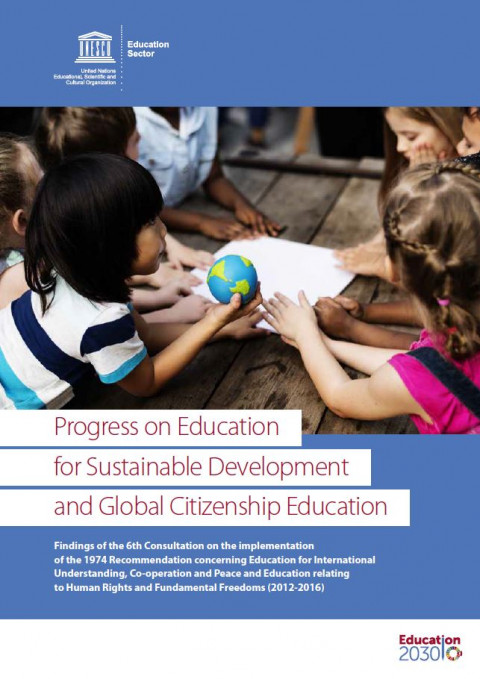 Progress on Education for Sustainable Development and Global Citizenship Education: Findings of the 6th Consultation on the Implementation of the 1974 Recommendation Year of publication: 2018 Corporate author: UNESCO Findings of the 6th Consultation on the implementation of the 1974 Recommendation concerning Education for International Understanding, Co-operation and Peace and Education relating to Human Rights and Fundamental Freedoms (2012-2016) Progress on Education for Sustainable Development and Global Citizenship Education “The Recommendation concerning Education for International Understanding, Co-operation and Peace and Education relating to Human Rights and Fundamental Freedoms” was adopted by UNESCO’s General Conference at its 18th session in 1974. Every four years, Member States report to UNESCO on measures taken to implement the Recommendation in pre-primary, primary, secondary and post-secondary/tertiary education. This document summarizes and analyses the main findings of the 6th Consultation on the implementation of the 1974 Recommendation, covering the period of 2012 to 2016. The findings of the 6th Consultation provide important insight into how Member States are implementing the 1974 Recommendation as well as how they are progressing towards Target 4.7 of Sustainable Development Goal 4 on Education. Target 4.7 concerns Education for Sustainable Development and Global Citizenship Education, which are closely related to the 1974 Recommendation. Supporting Member States in implementing Target 4.7 is a UNESCO priority and essential to progress across the 2030 Agenda for Sustainable Development.
 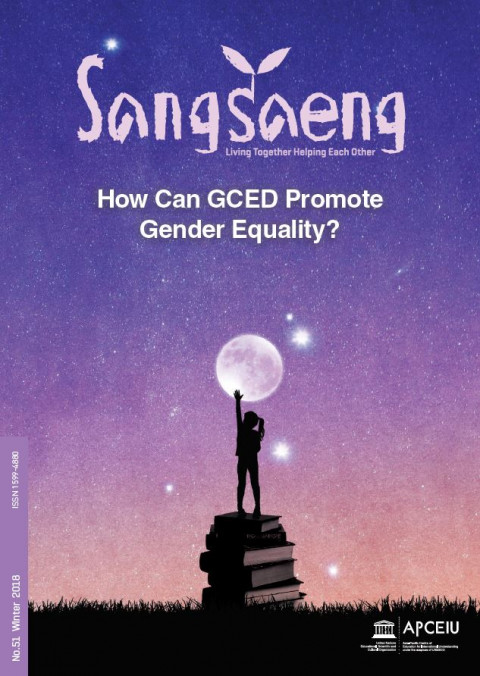 How Can GCED Promote Gender Equality? (SangSaeng no. 51 Winter 2018) Year of publication: 2018 Corporate author: APCEIU The 51th issue of SangSaeng, under the theme of “How Can GCED Promote Gender Equality?,” explores the role of GCED to bolster gender equality. In this issue, readers are reminded that GCED is not an abstract idea- rather, it is connected to real-life issues such as questioning gendered roles, expectations and stereotypes that are prevalent in many societies; and therefore, it can be a vital accelerator in building a more equitable world. 3 Director’s Message 4 Special ColmunTools that Promote Gender Equality 8 Focus : How Can GCED Promote Gender Equality?8 Bringing Gender Equality to Science World12 Women For Better World15 Setting GCED Principles to Promote Girls’ Education in Tado18 Path to Building Next Gen Men 22 Best Practice22 Using GCED to Promote Gender Equality in Senegal26 Adapting GCED into a Specific Learning Environment 29 Special ReportThe 3rd International Conference on GCED 32 InterviewGirls in GCED 35 Youth NetworkGlobal Citizenship Education in Refugee Crisis Relief 38 LetterPoetry - The Sword in Our Sheath 42 Peace In my MemoryBachcha Posh : An Inside Look 46 Understanding the Asia-Pacific RegionGrafting Human Rights Tree in Five ‘Stans’ 50 APCEIU in Action
  [Video] Snapshot on Education - Global & Regional Perspectives on Progress and Current Challenges Year of publication: 2018 Corporate author: UNESCO The video is a snapshot of the reflection on progress and challenges for education. Taking into consideration the global and regional SDG4-Education 2030 consultations throughout 2018. More at https://en.unesco.org/themes/education/globaleducationmeeting2018
  Proposal for a Global Action Programme on Education for Sustainable Development as Follow-up to the United Nations Decade of Education for Sustainable Development (DESD) after 2014 Year of publication: 2013 Corporate author: UNESCO The present document contains the proposal for a Global Action Programme on Education for Sustainable Development (ESD) and the comments and observations of the Executive Board thereon.
 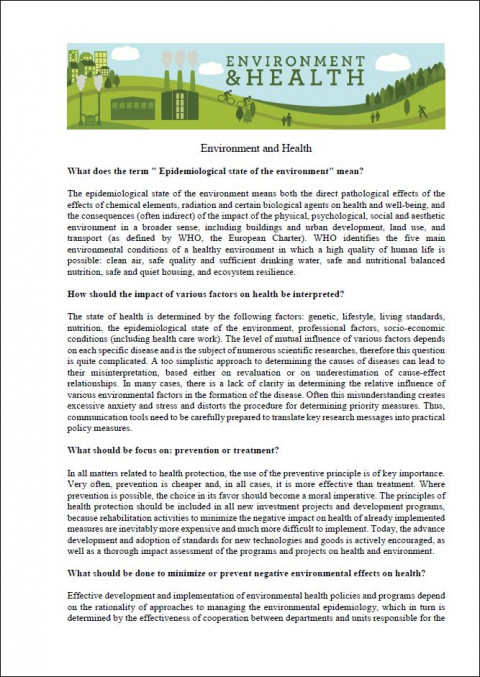 Publications Series within the CAREC Environment and Health Program Year of publication: 2018 Author: Irina Bekmirzaeva Corporate author: Regional Environmental Centre for Central Asia (CAREC) This publication was prepared by CAREC Environment and Health Program which aims to inform and raise awareness and knowledge among interested stakeholders on the interrelationship between environment and medicine. These publications are primarily developed to respond to numerous requests from representatives of Central Asian countries working on environmental and health issues in the region. The narrative style, language and terminology of the information have been designed for a wider audience. All information presented in these publications is based on the CAREC’s expertise and experience, as well as data from World Health Organization (WHO), the United Nations Development Program (UNDP) and the United Nations Environment Program (UNEP) and other international organizations.In the next issues of CAREC Environment and Health Program publications, we will focus on selected environmental health issues, including air quality and health, water and health, waste and health, sustainable development goals (SDGs), etc.
  Education for Sustainable Development in Central Asia: Analysis of Achievements, Challenges and Outlook Year of publication: 2018 Author: Tatiana Shakirova Corporate author: Regional Environmental Centre for Central Asia (CAREC) The article of the manager of the CAREC programme "Education for Sustainable Development" (ESD), Dr of Biology Tatiana Shakirova is devoted to the review of ESD process from 2002 to 2018, analysis of experience, lessons learned and challenges and perspectives for ESD development in Central Asia. Taking into consideration all the global and regional challenges in ESD, today CAREC is reconsidering and rethinking its role in ESD process in Central Asia. The main objective of the ESD Programme today is to provide a regional platform for dialogue, exchange of knowledge, experience, innovations and best educational practices/tools implemented at local/national/regional levels, and support CAREC's inter-program activities on education and capacity building, as well as intersectoral, interagency, interregional cooperation on ESD in the region with the involvement of all stakeholders and international expertise.
  3rd Global Capacity-Building Workshop on GCED: Final Report Year of publication: 2018 Corporate author: APCEIU This report provides an overview of the activities and outcomes of the 3rd Global Capacity-Building Workshop on GCED held in Seoul, Republic of Korea from 29 August - 11 September 2018.APCEIU organized the 3rd Global Capacity-Building Workshop on GCED with the aim of enhancing the capacities of teacher educators in developing countries on utilizing GCED. This 2-week intensive workshop provided participants opportunities to better understand the concept and principles of GCED, while engaging in meaningful dialogues and sharing experiences with educators from different countries, cultures, and contexts, and to develop their own action plans.
  4th Youth Leadership Workshop on GCED: Final Report Year of publication: 2018 Corporate author: APCEIU This report provides an overview of the activities and outcomes of the 4th Youth Leadership Workshop on GCED held in Seoul, Republic of Korea from 20 - 26May 2018.The 4th Youth Leadership Workshop on GCED invited 48 dynamic youth leaders around the world including those from developing countries and representatives of marginalized groups, and focused on developing effective advocacy strategies to maximize youth contribution in achieving SDG 4.7 through promotion of global citizenship.
  Preparing & Supporting Teachers to Meet the Challenges of 21st Century Learning in Asia-Pacific: Transversal Competencies in Education Policies and Practice Year of publication: 2016 Corporate author: Regional Bureau for Education in Asia and the Pacific | UNESCO Bangkok Preparing and supporting teachers to meet the challenges of 21st century learning in Asia-Pacific. Transversal Competencies in Education Policies and Practice. This is a summary of ERI-Net’s Phase III research into transversal competencies in education policy and practice. The regional synthesis report will be published in December 2016.
  Rethinking Water in Central Asia: The Costs of Inaction and Benefits of Water Cooperation Year of publication: 2017 Author: Benjamin Pohl | Annika Kramer | William Hull | Sabine Blumstein | Iskandar Abdullaev | Jusipbek Kazbekov | Tais Reznikova | Ekaterina Strikeleva | Eduard Interwies | Stefan Görlitz Corporate author: adelphi | Central Asia Regional Economic Cooperation (CAREC) A joint study conducted by CAREC and adelphi within the framework of the Switzerland’s Blue Peace Central Asia Initiative is published. The publication demonstrates the cost of inaction and benefits of cooperation in the field of water management between the countries of the region.entral Asia is witnessing intense competition over water resources and their use for irrigation and hydropower generation. Despite general political commitment to cooperation, water policies in Central Asia are largely driven by uncoordinated and partly contradicting national strategies. This limited water cooperation, however, entails significant costs and major risks for the future development of the region.“Rethinking Water in Central Asia” analyses these “costs of inaction” – defined here as the difference between the current, limited cooperation and the benefits that would result from full cooperation. Even if only parts of these costs are taken into account, they amount to more than US$ 4.5 billion per year for the whole region and are significant for each of the five countries studied. Due to deteriorating infrastructure, environmental degradation and demographic and economic pressures, these costs will increase if water management remains as it currently is.By raising awareness of these costs of inaction, and by setting out a variety of pathways towards eliminating them in the future, the present report seeks to encourage and support Central Asian policy-makers in strengthening regional water cooperation and improved water governance. The costs of inaction mirror the potential benefits of water cooperation, and their scale hence demonstrates the scale of the benefits and opportunities that better water management and closer cooperation can deliver for Central Asia.