
Resources
Explore a wide range of valuable resources on GCED to deepen your understanding and enhance your research, advocacy, teaching, and learning.
8,364 Results found
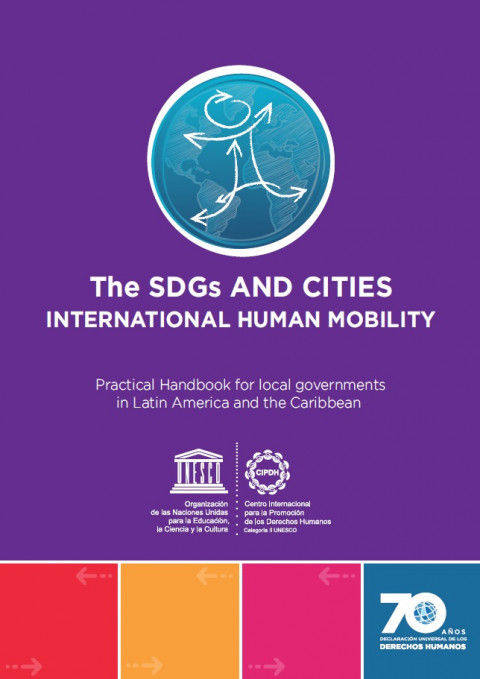 The SDGs AND CITIES INTERNATIONAL HUMAN MOBILITY Year of publication: 2018 Corporate author: International Centre for the Promotion of Human Rights | (ICPHR) The Handbook is to address new situations – and responses to these situations – generated by the global phenomenon of human mobility in urban spaces. Democracies are being threatened by the sustained growth of social gaps and the exclusion of vast sectors of the population from political systems and benefits of development, placing structural limits on the exercise of human rights. In this context, where new tensions and problems have arisen such as massive displacements of the population, the appearance of diverse types of extremism, of wars and conflicts and climate change in turn place these social sectors under conditions of structural inequality, exclusion and discrimination, as the main victims of human rights violations. This Handbook was prepared and published with the support and assistance of the UNESCO Sector for Social and Human Sciences through its Regional Science Bureau in Montevideo and the Latin American and Caribbean Coalition of Cities against Racism, Discrimination and Xenophobia.
  The Lack of Global Citizenship Education in China and Measurements for Improvement Year of publication: 2014 Author: Liu Qihong | Feng Jianjun Education needs to adapt to the needs of globalization and cultivate global citizens of global consciousness. Despite the fact that many countries in the world have attached importance to global citizenship education and China has also carried out related educational activities, there are still many problems in the implementation process according to the survey of middle school teachers. In order to solve these problems, in addition to the effort of front-line teachers, China's global citizenship education also needs the attention of schools, the reform of curriculum, and the policy support from the education administration.
  Multicultural Citizenship Education In America and Implication for National Minority Education in our Country Year of publication: 2016 Author: Wang wenli | Wang Jian Complex multicultural society background has brought many difficulties to the development of America. The education for children from poor immigrant families has become the focus of the citizenship education with elimination racial prejudice as it score objective. To reconstruct the multicultural citizenship Education in America, the relationship between different races should be improved, and ethnic prejudice And discrimination must be eliminated. Meanwhile, students of different gender, from diverse races, and with varied ethnic and language backgrounds should be helped to acquire knowledge, values and skills. So that they can participate actively in individual, social and civic activities to construct a democratic Society of justice and fair, and to build a system of citizenship education evolving from nationalism to Globalism. China, as a multinational and multicultural country, should also expand the connotation of Citizenship education in terms of its education ideas and methods. Citizenship education in our country should also be reformed from its objectives, contents and methods to fit the needs of China in the context of Globalization.
  Focus on Global Common Good:The New International Research Trend on World Citizenship Education Year of publication: 2018 Author: Song Qiang | Rao Congman Globalization has posed challenges for national-states to develop traditional citizenship education. To develop the citizenship education in the world needs to regard education and knowledge as global common good, surpass short- term benefit,and promote learners to be world citizens by 2030. Start with the dialectical logic on global benefit and national benefit,the researches of world citizenship education focus on“human rights protection and joint development”,“from national identity to world identity”,“from global governance to world government”, and “western universal mind vs. multi- civilizations intergrowth”. Chinese citizenship education needs to reinforce the national identity in socialism national citizenship education; cultivateing socialism world citizenship and promoteing international discourse power;seek human common good and build community of common destiny for all mankind.
  The Concept and Practice of Global Citizenship Education under the Background of Globalization Year of publication: 2011 Author: Yang Yong | Yang Xiuyu The age of globalization requires the future citizens not only have international visual field and global consciousness,but also have the ability of participation as citizens in the affairs at all the levels from communities to global. The global citizenship education aims at cultivating children to be global citizens who have global thinking and ability of responsible participation. The probe into the concept connotation,the specific implementation in practice and future development orientation of global citizenship education under the background of globalization can provide some important reference for promoting the development of global citizenship education in China.
  The Theory and Practice of Global Citizenship Education in Korean International School in Beijing Year of publication: 2014 Author: LIU Mei-xian | WANG Lu The purpose of this research is to explore the theory and practice of the global citizenship education of The Korean International School in Beijing. First,I outlined the concept and the theory of the global citizenship education. Second,I inquired the situation of global citizenship education of Korea. Third,I analyzed the curriculum of the elementary course of the Korean International School in Beijing in the viewpoint of global citizenship education. This research comes to the conclusion that the global citizenship education of this school is composed of three dimensions: Beijing citizenship,Korean citizenship and global citizenship in balance.
 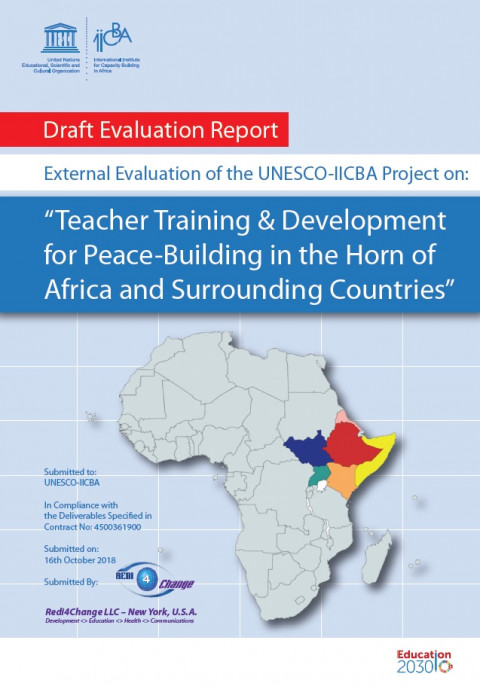 [Draft Evaluation Report] External Evaluation of the UNESCO-IICBA Project on: “Teacher Training & Development for Peace-Building in the Horn of Africa and Surrounding Countries” Year of publication: 2018 Corporate author: UNESCO International Institute for Capacity-Building in Africa (IICBA) The project on “Teacher Training and Development for Peace-Building in the Horn of Africa and Surrounding Countries” was designed by UNESCO-IICBA and financed by the Government of Japan. The project benefitted six conflict-affected countries; Ethiopia, Eritrea, Somalia, Kenya, Uganda, and South Sudan by building on the mandate and niche expertise of UNESCO-IICBA in teacher education, as well as benefiting from the empathetic insights and financing of the Government of Japan.This evaluation report analyses the design, implementation, and consolidation of the project to assess the likelihood that it can facilitate peace education as an effective and integral part of the national education systems. The project’s short timeframe and modest financing mean that the evaluation could not credibly deal with its outcomes and impact; but efforts are made to gauge the uptake and sustainability of this project as a vehicle for promoting peace education and so help to prevent violent conflict and cultivate a culture of peace in the countries concerned.
  The Rising and Development of the Global Citizenship Education Thoughts Year of publication: 2010 Author: Chen Yicang Since the 1980s, especially the 1990s,modern citizenship education theories which are based on nation states have been increasingly challenged with the strengthening of the trend of globalization and the rising of the theory about global interconnectedness. The thought of global citizenship education has been discussed intensely and been partly put into practice in some developed countries,and gradually the ideological trend of global citizenship education has come into being. The establishment of global citizenship education thoughts is not finished overnight,which has experienced three stages of sprouting,establishment and development based on the growth of initial worldwide citizenship education thought factors.
  On Global Citizenship Education in Perspective of “Multiculturalism” Year of publication: 2011 Author: Wang Haiying | WU Minghai Under multicultural circumstances,global citizenship education is identity recognition of ethnic groups by mutual acknowledgment of the states. It is respect for multiculturalism in unity and pursuit of unity under multiculturalism. In global citizenship education, the value of equality,respect,tolerance and understanding should be advocated. The prerequisite to identity of ethnic groups and balance in diversity in China is to preserve national territory integrity and ideological unity.
  Global Citizenship Education in Children's Festivals Year of publication: 2012 Author: zhu jiehong Global citizenship education aims at cultivating modern citizens with an international outlook and global awareness. As an important carrier of culture, festivals play an important role in cultivating children's understanding and respect for multiculturalism. Kindergarten can fully pass the idea of global citizenship education through a series of world festival activities. In addition, global citizenship education of young children should pay attention to the creation of the activity environment, the use of materials in the activity area, and the creation of a multicultural environment.