
Resources
Explore a wide range of valuable resources on GCED to deepen your understanding and enhance your research, advocacy, teaching, and learning.
8,364 Results found
 The Connotation and Implementation of the Teaching Method of the UN Global Citizenship Education Initiative Year of publication: 2017 Corporate author: Eastern Education In response to increasingly complex global challenges and the development of a new generation of future citizens with world values, UNESCO published Global Citizenship Education: Topics and Learning Objectives in 2015. This guide makes a detailed distinction and description of the connotation, teaching objectives, teaching methods, and assessment methods of global civic education according to the age level of the learning objects, and summarizes relevant recommendations after inputting field tests. This article will give a brief introduction and interpretation of this guide, and point out the implications for the development of global citizenship education in China.
  The State of Global Education in Europe 2018 Year of publication: 2018 Corporate author: Global Education Network Europe (GENE) The State of Global Education in Europe reports on policy, strategy and funding for Global Education in European countries, based primarily on information submitted by the ministries, agencies and national coordinating bodies that participate in GENE (Global Education Network Europe). This third edition of the report identifies thematic trends and crosscutting issues and explores funding levels for Global Education across Europe. It also includes a chapter outlining some of the work done on evaluation across GENE, and concludes with a selection of highlights from the network. There are examples of national policy and practice throughout the report. This report on the State of Global Education in Europe has been developed to provide an overview of current key issues, policy priorities, funding trends and activities in Global Education in Europe. It draws on the expertise and information provided by organisations that participate in Global Education Network Europe – GENE. These comprise Ministries of Foreign Affairs, Ministries of Education, and their respective national agencies, and other bodies with responsibility for policymaking, support or coordination of Global Education in European countries.
  [Video] GLOBAL CITIZENSHIP EDUCATIONAL PROGRAM Year of publication: 2018 Corporate author: EducacionBA To build a fairer, more equitable and sustainable future, the "Global Citizenship" educational program is created to promote the Sustainable Development Goals through quality education enhanced by digital technologies and by fostering 21st century skills. Through a digital platform, school contents and monitoring, evaluation and planning tools, children learn by playing, carrying out missions, creating strategies and being protagonists of their learning.It has an extensive potential to reach an ambitious scope of 2.000 teachers and 50.000 students. During 2018 a pilot test was carried out with 6 precursory schools. In the platform, teachers are provided with tools to develop and undertake meaningful and innovative educational projects with their students. Students are offered school contents that challenge and empower them as key players. They are encouraged to learn through play, to carry out missions, to devise strategies, and to lead projects which reinforce learning processes and encourage their creativity and commitment.
  [Summary] SDG 4 Data Digest 2018: Data to Nurture Learning; Executive Summary Year of publication: 2018 Corporate author: UNESCO Institute for Statistics (UIS) The 2018 edition of the SDG 4 Data Digest: Data to Nurture Learning builds on last year’s report, which proposed a conceptual framework and tools to help countries improve the quality of their data and fulfil their reporting requirements. In this report, we present the wide range of national and cross-national learning assessments currently underway and the assessment experiences of practitioners in the field. The report draws on these experiences to present pragmatic approaches that can help countries monitor progress and make the best possible use of data for policymaking purposes.
  SDG 4 Data Digest 2018: Data to Nurture Learning Year of publication: 2018 Corporate author: UNESCO Institute for Statistics (UIS) The world is facing a crisis of learning, with many children leaving school without the basic skills they need for a prosperous and productive adult life. Two-thirds of the estimated 617 million children and adolescents who cannot read a simple sentence or manage a basic mathematics calculation are in the classroom. Too many are waiting for a quality education that never comes.As the 2018 SDG 4 Data Digest shows, it is not enough to hope that they will stay in school and somehow acquire skills in reading and mathematics. It is critical to monitor those skills as children progress through school. That requires comparable data, over time, to ensure that children – and the education systems that serve them – are on track.Given the critical importance of learning for the achievement of all the Sustainable Development Goals (SDGs), from poverty reduction to peaceful societies, this year’s edition of the SDG 4 Data Digest is dedicated to the theme of learning outcomes. It showcases the most comprehensive and up-to-date compilation of work to inform the learning indicators of SDG 4.The Digest discusses learning evidence on early child development, mathematics and reading skills among school-aged children, and digital and work-related skills among youth and adults. It highlights the conceptual frameworks and tools developed by leading authors and institutions to understand, measure, monitor and support learning for all. It also considers the implications of reporting for SDG 4.
  Informative Kit on Global Citizenship Education (GCE) for Policy Makers: Boosting Global Citizenship Education Using Digital Storytelling Year of publication: 2017 Corporate author: European Union (EU) | European Commission This informative kit aims to equip policy makers with all the necessary knowledge about the role that Global Citizenship Education (GCE) can play in contemporary society. This document will summarize GCE, its principles, capabilities and advantages and will provide best cases regarding its application. The goal is to convince policy makers into adopting GCE in the training and education curricula. Furthermore, it presents the Digital Storytelling (DS) method and its benefits as a tool to teach GCE more effectively.
  Global Citizenship Education: How Much Do We Care? Year of publication: 2018 Corporate author: European confederation of Relief and Development NGOs (CONCORD) While Global Citizenship Education is recognised by many as a powerful tool to resolve the current global challenges our world is facing, the level of investment by national governments remains limited. Why is that? To answer this situation, CONCORD launches its new report “Global Citizenship Education – How much do we care?“. Based on a research across all EU Member States (+ Norway), this publication reveals the level of funding dedicated to Global Citizenship Education (GCE) in Europe between 2011 and 2015. Analysing the quantitative sources of investments by national governments as well as the qualitative narrative around GCE (How is GCE named? What is its framework of action?), this report digs into the complex world of GCE and provides a full picture of its current states in Europe. The report is composed of 2 parts:– a general overview and analysis– a comparative part made of an analysis per country of all EU member states (+ Norway), including interesting details on GCE definitions, concepts, funding trends.Strong of these analysis, the report draws conclusions and recommendations on where possible improvements at policy and advocacy level can be made.
  Strengthening the Rule of Law Through Education: A Guide for Policymakers Year of publication: 2019 Corporate author: UN. Office on Drugs and Crime (UNODC) | UNESCO The new joint publication by UNESCO and UNODC Strengthening the Rule of Law through Education: A Guide for Policymakers explores the role that education institutions can play in promoting the rule of law and building new forms of engagement based on global citizenship, human rights and inclusion -- all of which are vital to take forward the Sustainable Development Goal 4 on education, at the heart of the 2030 Agenda for Sustainable Development. Strengthening the Rule of Law through Education: A Guide for Policymakers is intended for education policymakers and other professionals working in the formal education sector, within and outside Ministries of Education, and who are seeking to promote the rule of law and a culture of lawfulness.The guide may also be of interest to professionals working in non-formal education settings or other sectors – namely the justice, social and health sectors - in the area of crime and violence prevention, who are seeking to work more closely with the education sector. In particular, the guide offers:An explanation of key concepts, such as the rule of law and a culture of lawfulness, as well as outlining the role of education in upholding and promoting the rule of law; Guidance on how the education sector is able to strengthen and promote the rule of law, for instance, by speaking to the real learning needs of children and youth, and by ensuring that places of learning “practice what they preach”; A map of the necessary support systems needed to strengthen the rule of law at the school and classroom levels and outside formal education settings, including curricular support, classroom pedagogies, teacher training and development and school-family-community partnerships.
  Training Tools for Curriculum Development: A Resource Pack for Global Citizenship Education (GCED) Year of publication: 2018 Corporate author: UNESCO International Bureau of Education (IBE) | APCEIU The overarching objective of ‘A Resource Pack for Global Citizenship Education (GCED)’ is to share a broader understanding of GCED theory and practice, in order to support its effective development and implementation at the policy, school and classroom levels. The Resource Pack provides comprehensive guidance for national policymakers, curriculum specialists and developers, teacher educators, teachers, school leaders and district level administrators.The key topics covered are:Module 1: IntroductionModule 2: National PoliciesModule 3: CurriculumModule 4: Teaching, Learning and AssessmentModule 5: Teaching and Learning ResourcesModule 6: Whole School ApproachModule 7: Teacher Education and Professional Development
 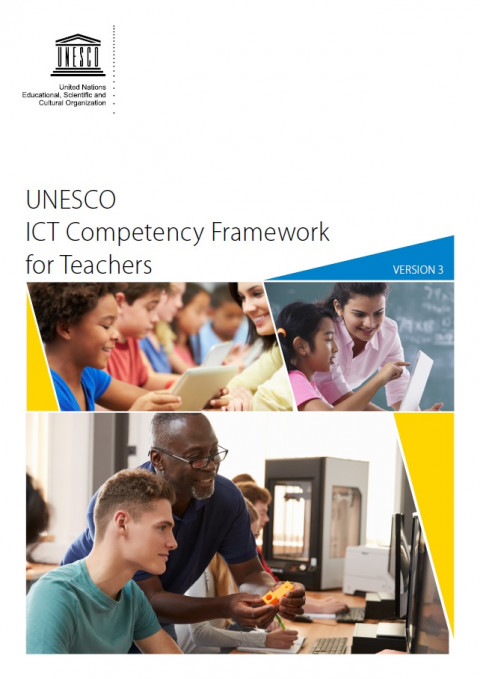 UNESCO ICT Competency Framework for Teachers (ver.3) Year of publication: 2018 Corporate author: UNESCO UNESCO has developed the ICT Competency Framework for Teachers (ICT CFT) as a tool to guide pre- and in-service teacher training on the use of ICTs across the education system. The ICT CFT is intended to be adapted to support national and institutional goals by providing an up-to-date framework for policy development and capacity building in this dynamic area.The ICT Competency Framework for Teachers (ICT CFT) Version 3 is a response to recent technological and pedagogical developments in the field of ICT and Education, and incorporates in its structure inclusive principles of non-discrimination, open and equitable information accessibility and gender equality in the delivery of education supported by technology. It addresses the impacts of recent technological advances on education and learning, such as Artificial Intelligence (AI), Mobile Technologies, the Internet of Things and Open Educational Resources, to support the creation of inclusive Knowledge Societies. The ICT CFT provides a comprehensive set of competencies teachers need to integrate ICT into their professional practice in order to facilitate students’ achievement of curricular objectives. Strong political commitments and sustained investment in teacher education, and concerted actions between pre- and in-service teacher trainings form the foundation of the successful implementation of this Framework as it is contextualized to national and institutional goals. For this reason, this document underlines the importance of steadfast commitment to supporting teachers’ continuous professional development including through ICT, and includes examples to illustrate how ICT CFT could be used to facilitate teachers’ development in diverse contexts. We look forward to strengthening our collaboration with all stakeholders everywhere to leverage ICT to develop the skills required to thrive within the fast-changing inclusive Knowledge Societies.