
Resources
Explore a wide range of valuable resources on GCED to deepen your understanding and enhance your research, advocacy, teaching, and learning.
8,364 Results found
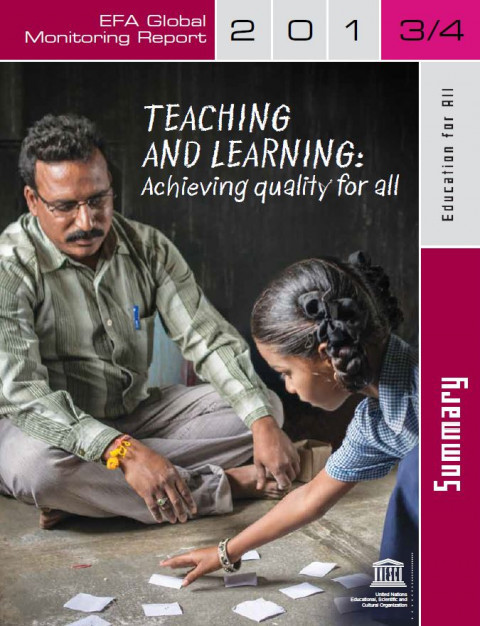 Teaching and Learning: Achieving Quality for All (EFA Global Monitoring Report, 2013-2014; Summary) Year of publication: 2014 Corporate author: UNESCO This Report is an independent publication commissioned by UNESCO on behalf of the international community. It is the product of a collaborative effort involving members of the Report Team and many other people, agencies, institutions and governments. This 11th EFA Global Monitoring Report provides a timely update on progress that countries are making towards the global education goals that were agreed in 2000. It also makes a powerful case for placing education at the heart of the global development agenda after 2015.An education system is only as good as its teachers. Unlocking their potential is essential to enhancing the quality of learning. Evidence shows that education quality improves when teachers are supported – it deteriorates if they are not, contributing to the shocking levels of youth illiteracy captured in this Report. This Report identifies four strategies to provide the best teachers to reach all children with a good quality education. The Report shows also that teachers can only shine in the right context, with well-designed curricula and assessment strategies to improve teaching and learning. This Report’s evidence clearly shows that education provides sustainability to progress against all development goals. Educate mothers, and you empower women and save children’s lives. Educate communities, and you transform societies and grow economies. This is the message of this EFA Global Monitoring Report.
  United Nations Decade on Education for Sustainable Development (2005-2014): Education for Sustainable Development Year of publication: 2005 Corporate author: UNESCO The Declaration of the International Conference on Ecology and Development, held in Rio de Janeiro in 1992, begins with the following words: "People are the main concern for sustainable development. They have the right to a healthy and productive life in harmony with nature. "The Declaration adopted at the World Summit on Sustainable Development, held in Johannesburg in 2002, reflected the commitment of world leaders to "create a humane, equitable and attentive to civil society, recognizing that each member of this society has its own human dignity". Education is the foundation of sustainable development, as discussed in chapter 36 of the Program-21 of the summit that was held in Rio de Janeiro in 1992. This idea was reiterated at the Johannesburg summit. The implementation plan foresees a link between the Millennium Development Goals for universal primary education for both boys and girls, with special attention paid to girls, and the Dakar Plan of Action on Education for All. The creation of a gender-sensitive educational system at all levels and in all types of education - formal, informal and informal - to reach those who are not involved in the educational process is an essential component of education for sustainable development. Education is considered a tool to address such important issues as rural development, health, the prevention of the spread of HIV / AIDS, the environment, as well as broader ethical and legal issues (for example, human values and human rights).There is no universal model of education for sustainable development. Despite the countries' agreement on the overall concept, the approaches to education in each country will differ due to local characteristics and priorities. Each country should define its priorities and actions, as well as goals, accents and processes, based on environmental, social, economic conditions and appropriate ways of solving the problem. Education for sustainable development is equally critical for both developed and developing countries.
  The King Abdullah bin Abdulaziz International Programme for a Culture of Peace and Dialogue: Key Achievements of Phase I Year of publication: 2016 Corporate author: UNESCO The King Abdullah bin Abdulaziz International Programme for a Culture of Peace and Dialogue arose from the institutional framework of UNESCO’s Programme for a Culture of peace and non-violence. More than a concept, the Culture of Peace is a commitment to make peace a tangible reality for all. It denotes “a set of values, attitudes, traditions and modes of behaviour and ways of life based on respect for life, ending of violence and […] adherence to the principles of freedom, justice, democracy, tolerance, solidarity, cooperation, pluralism, cultural diversity, dialogue and understanding at all levels of society and among nations” (Article 1, Declaration and Programme of Action of a Culture of Peace, UNESCO, 1999). UNESCO continue its work to nurture a Culture of Peace, with development considerations, by joining forces with committed stakeholders in education, the sciences, culture, and communication and information.
 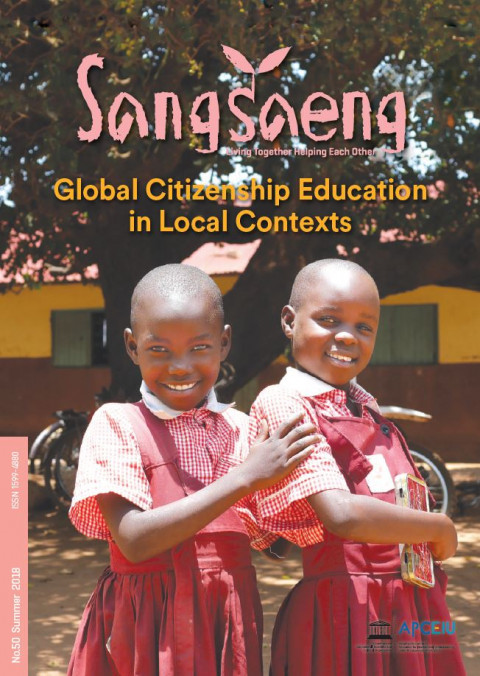 Global Citizenship Education in Local Contexts (SangSaeng no. 50 summer 2018) Year of publication: 2018 Corporate author: APCEIU The 50th issue of SangSaeng has been published with the theme “Global Citizenship Education in Local Contexts.” This edition reviews the divergent efforts to implement Global Citizenship Education(GCED) in the indigenous context of each region. Readers are invited to explore the fields of GCED from national and regional perspectives, as well as in formal, non-formal and informal education. 3 Director’s Message4 Special ColumnEngaging Learners’ Hearts and Minds8 Focus : Global Citizenship Education in Local Context8 Embracing Global Citizenship Education in a Tough Place12 Teaching Teachers to Teach GCED15 GCED Shapes New Cambodian History Curriculum19 Constructing Defences of Peace in the Minds of Future Leaders 22 Special ReportWhy [Use] Comics in School?26 Best Practices26 Beyond Zombie Apocalypse30 Transforming Space into Meaningful Learning Place34 InterviewThrough the Lens, Out of Africa, into Our Hearts and Minds38 LetterTowards a Green, Peaceful and Just World through GCED 40 Youth NetworkYouth for Learning, Exchanging, Growing and Taking Action43 Peace in my MemoryUnwanted Nation Living in Own Land47 Understanding the Asia-Pacific RegionTatau: A Pacific Journey50 APCEIU in Action
 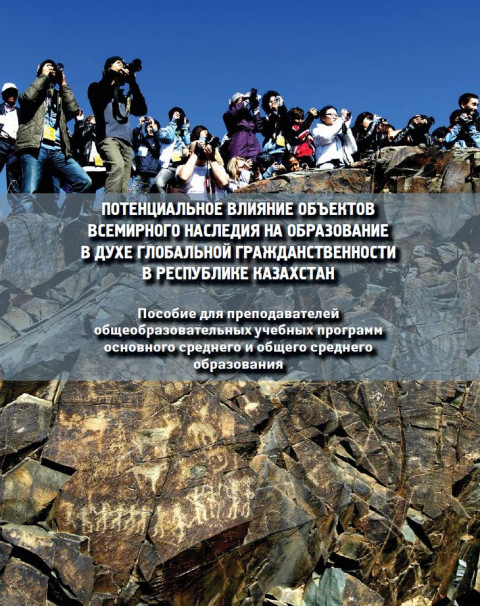 Potential Influence of World Heritage Sites over the Global Citizenship Education in the Republic of Kazakhstan: Manual for Teachers of General Secondary and High school Education Programmes Year of publication: 2017 Author: Baipakov K.M. | Voyakin D.A. | Massanov M.N. | Sarsenova E.A. | Shaigozova Z.N. Corporate author: APCEIU | National World Heritage Committee (Kazakhstan) Present publication is a manual for teachers for of general secondary and high school education programmes of the Republic of Kazakhstan and Central Asia. It aims to raise awareness of teachers and students on the issue of local cultural and natural heritage, and Global Citizenship Education Concept, and to introduce World Heritage and Global Citizenship Education topics to the general secondary and high school education programmes of Kazakhstan. For Kazakhstan and Central Asian, it is a first attempt to understand the potential contribution of UNESCO World Heritage Sites to the Global Citizenship Education.This publication can be separated in three parts. First part presents general description of UNESCO and its cooperation with the Republic of Kazakhstan. It pays particular attention to each Kazakhstan’s site from the UNESCO World Heritage list. Second part covers Global Citizenship Education concept, and main international trends in field of school education in the world. Third part of this publication provides practical guide on the ways that Kazakhstan’s teachers of general secondary and high school education programmes can use World and Intangible Heritage for promotion of global citizenship concept among their students. All three examples of education courses were made as much different from each other as possible in order to provide to Kazakhstan’s teachers a wider choice for preparation of their own classes dedicated to the World Heritage sites and Global Citizenship Education.
 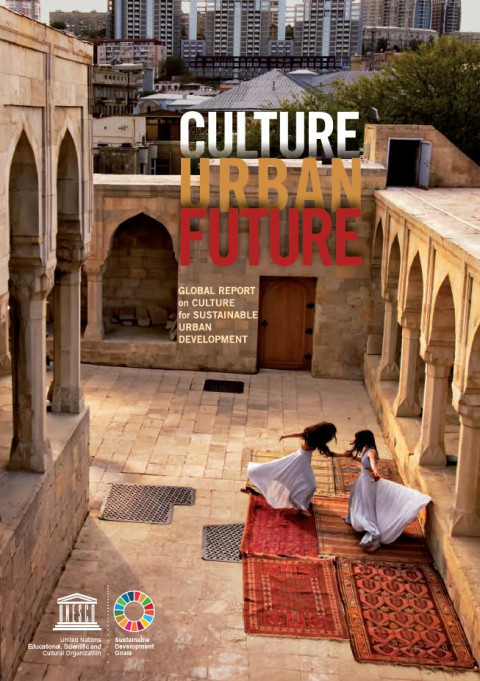 Culture: Urban Future; Global Report on Culture for Sustainable Urban Development Year of publication: 2016 Corporate author: UNESCO As the cornerstone of society, culture must lie at the heart of sustainable policies and strategies. Yet, despite its vital importance, key questions such as: ‘How has culture influenced urban development across the world?’ and ‘How can culture make a difference to our urban future?’ have often remained unexplored.This report, the first of its kind, explores the role of culture for sustainable urban development. It is intended as a policy framework document to support governments in the implementation of the 2030 Agenda for Sustainable Urban Development and the New Urban Agenda.In search of a common thread between the past and the future, the report examines the contribution of culture to urban sustainability from two analytical angles: a global survey implemented with nine regional partners across the world; and key thematic insights. The report thus analyses the situation, trends, threats and existing opportunities in different regional contexts, and presents a global picture of urban heritage safeguarding, conservation and management, as well as the promotion of cultural and creative industries, as resources for sustainable urban development. The report also includes a set of maps and a section on UNESCO’s strategic networks reflecting the Organization’s various fields of competence.Building on the findings of this global research and thematic reflection, the report presents new guidelines and recommendations, rooted in culture, to ensure that the cities of tomorrow are safe, inclusive, resilient and sustainable.
  Agree to Differ Year of publication: 2015 Corporate author: UNESCO Dialogue on the basis of respect, tolerance, human rights and dignity has never been so important. This is the spirit of the International Decade for the Rapprochement of Cultures (2013-2022). The International Decade originates in the United Nations General Assembly Resolution 67/104 adopted in December 2012, co-sponsored by Kazakhstan and designating UNESCO as lead agency. This drew on a Resolution of the UNESCO General Conference and the experience of the 2010 International Year for the Rapprochement of Cultures which UNESCO led forward with activities across the world.The objective of the International Decade is to promote mutual understanding and respect for diversity, rights and equal dignity between peoples, through intercultural dialogue and concrete initiatives. This is essential for all societies today, undergoing deep transformation. The surge of conflict, acts of violence, extremism and intolerance pose a threat to peace, undermining the unity of humanity and calling on us all to redouble our efforts to advance a culture of peace, through dialogue, the safeguarding of cultural heritage, and the promotion of global citizenship education.The International Decade for the Rapprochement of Cultures embodies a commitment to explore new articulations between cultural diversity and universal values. The rapprochement of cultures calls for a commitment to the principles of human dignity and solidarity as the corner stones of living together within and between societies, making the most of all sources of diversity.This publication bears testimony to the urgency of addressing contemporary challenges through intercultural and interreligious dialogue in order to deepen understanding and cooperation for peace. Through concrete examples, including experiences at the community level from across the world, the publication showcases why cultural diversity, intercultural dialogue and responsive democratic governance are vital for the enhancement of mutual understanding, the growth of tolerance, and the building of bridges of mutual respect and dignity.
 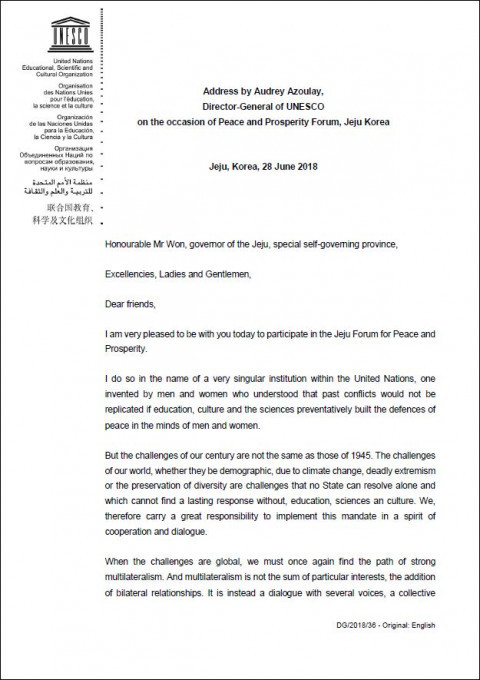 Address by Audrey Azoulay, Director-General of UNESCO, on the occasion of Peace and Prosperity Forum, Jeju Korea Year of publication: 2018 Corporate author: UNESCO. Director-General, 2017-2025 (Azoulay, A.) This address was delivered by Audrey Azoulay, Director-General of UNESCO, on the occasion of Peace and Prosperity Forum Jeju Korea; 28 June 2018.
  17th Asia-Pacific Training Workshop on EIU: Final Report Year of publication: 2017 Author: Yeonwoo Lee | Grace Na Corporate author: APCEIU Since its establishment in 2001, APCEIU has been organizing capacity building training workshops on Education for International Understanding (EIU) for educators to promote a Culture of Peace through education. The critical importance of preparing educators towards building a more peaceful and sustainable world has been reaffirmed by the increased attention to GCED (Global Citizenship Education), with the adoption of the Sustainable Development Goals (SDGs) and Education 2030 Framework for Action in 2015. Fostering global citizenship is in line with EIU’s core values in terms of the promotion of learning to live together to make a more just, peaceful, and inclusive society.The Asia-Pacific Training Workshop on EIU (APTW), APCEIU’s flagship programme, aims to enhance participants’ knowledge, skills, and commitment to EIU and GCED and enable them to competently design and implement EIU/GCED activities in their local and national contexts. Designed as a Training of Trainers (TOT), the APTW not only encompasses key themes and concepts surrounding EIU/GCED, but also has a strong focus on creative methodologies and approaches to teach EIU/GCED. In order to achieve this goal, this intensive 9-day training workshop includes lectures, discussions, workshops, in-depth seminars, field visits, action plan development in small groups where participants can learn from one another and from the experiences they encounter during the workshop. Furthermore, participants are encouraged to plan and carry out their own training workshops to spread the messages of EIU/GCED after their participation in the workshop.This workshop is sponsored by Ministry of Education and partnered with UNESCO Bangkok, supported by Korea Funds-in-Trust. 28 teacher educators/trainers in the Asia-Pacific region participated in the workshop and strengthened their understanding of Global Citizenship Education and discussed pedagogy, and action planning to practice GCED at national and international levels. This report provides an overview, summary, photographs and other information about the 17th Asia-Pacific Workshop on EIU (APTW).
 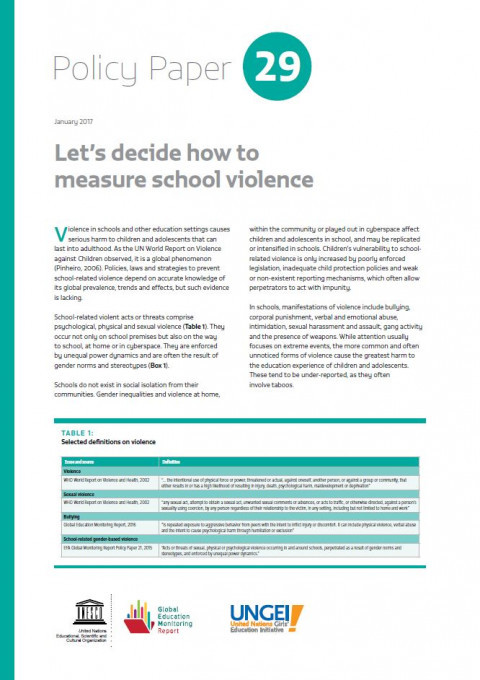 Let's Decide How to Measure School Violence (Policy Paper 29) Year of publication: 2017 Corporate author: UNESCO Violence in schools and other education settings causes serious harm to children and adolescents that can last into adulthood. As the UN World Report on Violence against Children observed, it is a global phenomenon (Pinheiro, 2006). Policies, laws and strategies to prevent school-related violence depend on accurate knowledge of its global prevalence, trends and effects, but such evidence is lacking.In schools, manifestations of violence include bullying, corporal punishment, verbal and emotional abuse, intimidation, sexual harassment and assault, gang activity and the presence of weapons. While attention usually focuses on extreme events, the more common and often unnoticed forms of violence cause the greatest harm to the education experience of children and adolescents. These tend to be under-reported, as they often involve taboos.To collect data on aspects of violence in schools, large-scale, multi-country school-based surveys are increasingly used; some countries also have well-established monitoring mechanisms. Overall, however, consistent evidence on the global prevalence and trends of school-related violence is lacking. To ensure reliable data is gathered, action is needed to bridge differences between the various monitoring methods. This paper, launched to coincide with the International Symposium on School Violence and Bullying: From Evidence to Action, in Seoul, Republic of Korea (January 17–19, 2017), aims to inform the current debate and propose options for the future.