
Resources
Explore a wide range of valuable resources on GCED to deepen your understanding and enhance your research, advocacy, teaching, and learning.
8,364 Results found
 The Critical Thinking Workbook: Games and Activities for Developing Critical Thinking Skills Corporate author: Global Digital Citizen Foundation Critical thinking is clear, rational, logical, and independent thinking. It’s about improving thinking by analyzing, assessing, and reconstructing how we think. It also means thinking in a self-regulated and self-corrective manner. It’s thinking on purpose!The Critical Thinking Workbook helps you and your students develop mindful communication and problem-solving skills with exciting games and activities. It has activities that are adaptable to any grade level you want.The activity pages in the Critical Thinking Workbook are meant to be shared and explored. Use it as an electronic document or as worksheets.You can either print off the pages and use them as activity sheets, or you can edit them directly right in the document on your computer.There are also Answer Keys for the activities that need them provided at the back of the book.
  A Whole School Approach: Involving the School Community in Reducing its Carbon Footprint Year of publication: 2010 Corporate author: Carbon Trust Reducing energy use has many advantages for schools – it saves money, reduces carbon emissions (helping to combat climate change), improves the learning environment and can enhance a school’s reputation.To be really effective, the whole school must be involved in energy saving. This guide outlines an approach to energy management which involves pupils, teachers and other staff. By motivating staff and pupils through lessons, as well as providing practical advice on how to go about saving energy, a whole school approach to energy management can reduce the school’s carbon footprint and provide long-term benefits for the school, its people and the environment.
 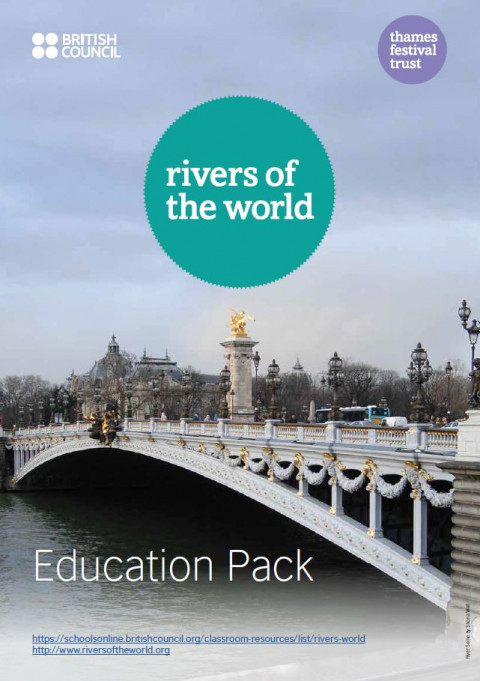 Rivers of the World Education Pack Year of publication: 2015 Author: Alison Willmott Corporate author: British Council This education resource pack extends the project’s reach to a much greater number of schools and provides a wealth of exciting cross-curricular activities for pupils aged 7–14. It is designed to expand knowledge and understanding, help your pupils to develop core skills and encourage them to explore and reflect on local and global issues. It also contains examples of artwork from the project and illustrations of how schools around the world have used the resources with their students.
 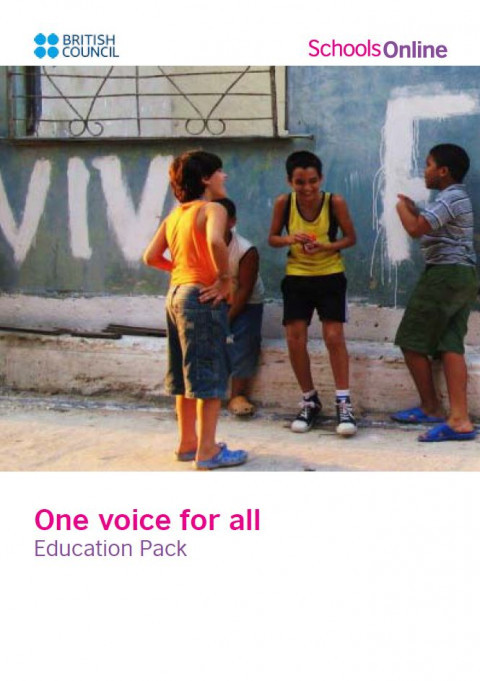 One Voice for All: Education Pack Year of publication: 2013 Corporate author: British Council One Voice for All is a set of resources designed to help teachers work on the Connecting Classrooms themes of Rights and Responsibilities and Fairness and Equality through an exploration of human rights and street children. Its focus is the UN Convention on the Rights of the Child and it aims to allow learners to develop understanding of the key concepts of global citizenship, universal rights and justice.This resource aims to give young people the opportunity to understand the complexity of the wider world in which they live by exploring inequality and steps to address it.
 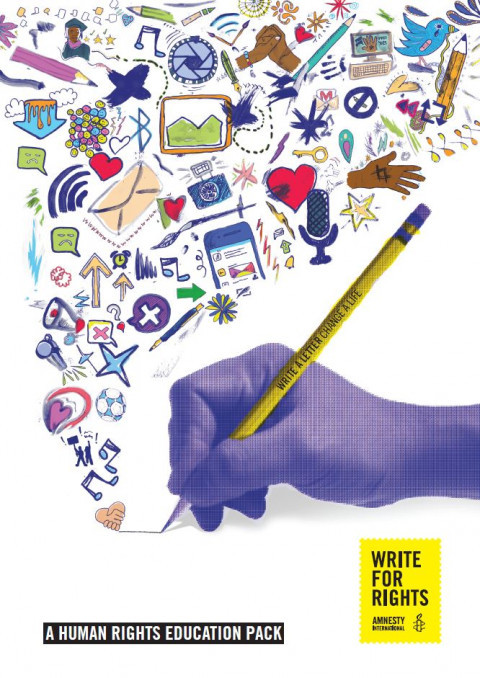 The Write for Rights: A Human Rights Education Pack Year of publication: 2015 Corporate author: Amnesty International This education pack contains five activities on human rights for young people. It can be used as an introduction to human rights, to global solidarity, to campaigning and activism, and to the wider work of Amnesty International. The activities provide a broad perspective on these issues and others.They are useful in opening young people’s minds to global concerns and involving them in actions which can have a real impact on people’s lives.The activities can be run at any time, but will be most effective either before or during the time of Amnesty International’s ‘Write for Rights’ campaign, which this year runs from 4 to 17 December. By working on these cases and taking part in the campaign, young people will know that they are part of a massive global movement of people. They – and you – can bring about a real improvement in the lives of the people featured in the following pages.
 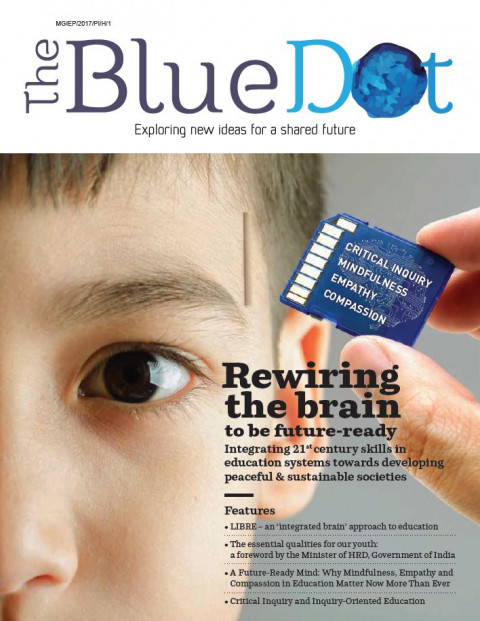 Rewiring the Brain to be Future-ready: Integrating 21st Century Skills in Education Systems Towards Developing Peaceful & Sustainable Societies (The Blue Dot Issue 6, 2017) Year of publication: 2017 Corporate author: Mahatma Gandhi Institute of Education for Peace and Sustainable Development (MGIEP) In the sixth issue of the Blue Dot, we focus on the importance of these 21st century skills for the young. The issue includes a foreword by the Minister of Human Resource Development, Government of India on the importance of inculcating 21st century skills in education systems and our Cover Story, which introduces UNESCO MGIEP’s LIBRE programme that follows an ‘integrated brain’ approach to education.Additionally, we feature opinions by specialists from academia, research and the industry on the lacuna present in existing education systems and the opportunities available to address this gap by introducing socio-emotional skills and inquiry oriented learning into curricula. Amongst various experts, we hear from Ines Kudo and Joan Hartley from The World Bank on the importance of ‘Teaching empathy and compassion in schools’; Prof. K.P. Mohanan on ‘Critical Inquiry and Inquiry oriented education’ and Dr. Marilee Bresciani Ludvik on how mindfulness forms the foundation for cultivating compassion.Further, we present excerpts from a collection of ‘Ask me Anything’ sessions focused on socioemotional skills, hosted on Knowledge Commons, UNESCO MGIEP’s knowledge sharing platform.We have been honoured to have the opportunity to host and learn from experts such as Dr. Richard Davidson, recognised as one of ‘The 100 most influential people in the world’ in 2006 by the Time Magazine and Chade-Meng Tan, currently the Chairman of Search Inside Yourself Leadership Institute and Co-chair of One Billion Acts of Peace, which has been nominated eight times for the Nobel Peace Prize.
 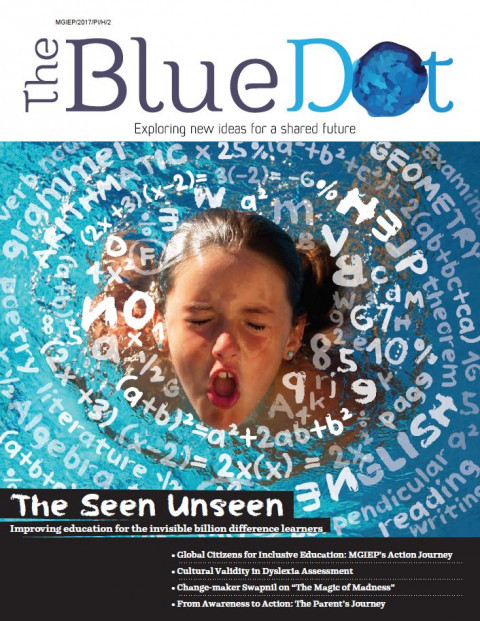 The Seen Unseen: Improving Education for the Invisible Billion Difference Learners (The Blue Dot Issue 5, 2017) Year of publication: 2017 Corporate author: Mahatma Gandhi Institute of Education for Peace and Sustainable Development (MGIEP) MGIEP believes that addressing the needs of children with difference learning offers a unique opportunity to build the competency of understanding, respect and appreciation between the children and the rest of their peers in school.It provides the Institute favorable conditions to put in practice how inclusive education is a necessary condition for building peaceful and sustainable societies. Many of the Information Technology pedagogical tools developed by the Institute lend themselves to children with difference learning.Transforming the education system in such a manner will allow mainstream schools to provide a learning platform that breaks down barriers across learning types and provide the equitable access to education that is a fundamental Sustainable Development Goal.We are, in this issue of The Blue Dot, privileged to read from some of the world’s best experts on the subject describing the challenges at hand and suggesting ways and means of addressing the lacuna present in curricula and policy. As always, we dedicate a special section to reflecting the voices of young people in our discussion. I am especially honoured and delighted to present a foreword from a young entrepreneur who has not allowed his neurobiological dyslexic condition to prevent him from pursuing his dreams to help others.
 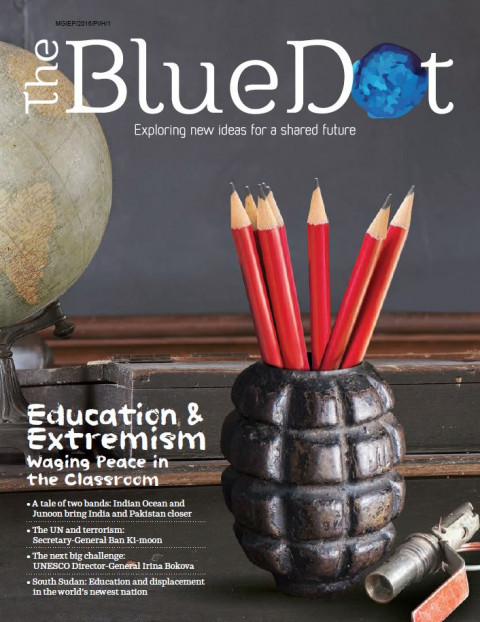 Education & Extremism: Waging Peace in the Classroom (The Blue Dot Issue 4, 2016) Year of publication: 2016 Corporate author: Mahatma Gandhi Institute of Education for Peace and Sustainable Development (MGIEP) In this fourth issue of The Blue Dot, we have decided to focus on education as a tool for both preventing violent extremism and—sometimes—even propagating extremist ideologies. This issue reflects UNESCO MGIEP’s commitment to advancing the fundamental role of education as a means to changing mindsets and, ultimately, bringing about more peaceful societies.From an interview with award-winning social entrepreneur Prof. Sugata Mitra on the role of technology in revolutionizing education, to a foreword by Secretary-General Ban Ki-moon on the UN’s response to violent extremism, our contributors come from a host of different countries and backgrounds. What brings them together, however, is a call for changing current education systems. This is espoused even more clearly in a piece by Prof. K.P. Mohanan, who uses inquiry-driven approaches to prompt youth to question blind faith in any form of ideology or indoctrination.In this issue we also discuss UNESCO MGIEP’s activities in raising awareness of the strong link between education and radicalization and violent extremism, including our flagship Talking Across Generations (TAG) event which brought together policymakers and young people in an open discussion in Delhi this February. The outcome was a statement calling for greater inclusiveness and more space for young people to shape the policies that ultimately affect them.Just like our events, The Blue Dot is a platform for individuals from different backgrounds and walks of life who might have divergent ideologies, beliefs, and values, all of which may have prevented them from coming together to debate some of the most pressing issues of our time—including the global concern surrounding the rise in violent extremism. When individuals feel free to discuss, share ideas and question their beliefs, they can begin to think creatively and critically about the world and their surrounding environment. The challenge is to avoid lecturing or preaching to young people, but to provide youth with a safe space to discuss contentious issues in an open, inclusive and transparent manner.An open dialogue on violent extremism is a step towards providing young people with opportunities to ask questions and to reflect on their own beliefs, assumptions, and values, including animosities, prejudices, hatred and intolerance. At UNESCO MGIEP we believe that individuals who feel connected to others across political, religious or cultural divides also share a sense of responsibility for the world in which they live.
 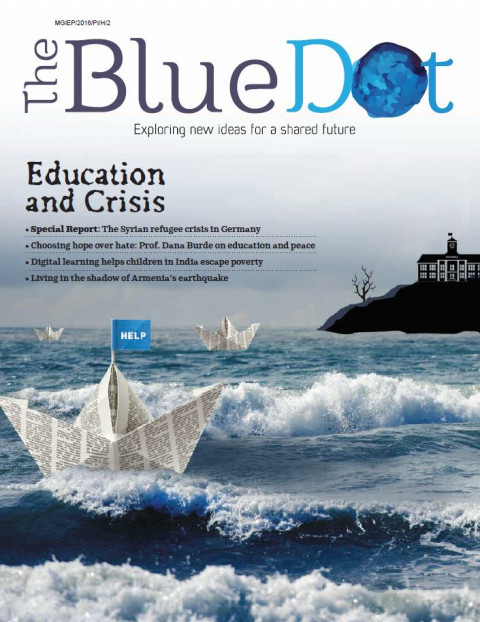 Education and Crisis (The Blue Dot Issue 3, 2016) Year of publication: 2016 Corporate author: Mahatma Gandhi Institute of Education for Peace and Sustainable Development (MGIEP) In this third issue of The Blue Dot, we have chosen to focus on the often forgotten aspect of education in the context of crises. While relief efforts tend to focus on emergency responses such as providing food and shelter, more often than not rebuilding schools and ensuring that students continue to attend their classes are not considered priorities. At UNESCO MGIEP, we believe that when education is relegated to the side-lines, there is little hope for a country and its citizens to recover.In this issue, we have brought together expert contributors from academia and the field—from countries such as Afghanistan, Nepal and South Sudan—and have dedicated a large section to the ongoing civil conflict in Syria, which will soon enter its fifth year. With almost half of Syria’s population living as refugees or as internally displaced persons, an entire generation of young people risks losing out on stability and a better future. Our Syria Section explores how these young people, with a particular focus on those who have sought refuge in Germany, are faring and what their hopes are for the future.In other parts of the magazine, we focus on technology and on how modern information and communications technologies (ICTs) can help students access a better education. From impoverished communities in Calcutta using Skype to connect with teachers around the world, to new interactive platforms built for young people to discuss global issues, we hope the stories and experiences we have collected for our readers will give a new and fresh perspective on what it means for education when a crisis hits. We also hope that you enjoy our photo contest, which drew more than 100 entries from young people around the world on what “education and crisis” means to them.
  Report of the Sub-Saharan Africa Regional GCED Network Meeting: Perspectives, Strategies and Actions for GCED Year of publication: 2017 Author: Gertie Steukers | Carolyn Medel-Añonuevo | Abdoul Wahab Coulibaly Corporate author: UNESCO Harare | APCEIU An increasingly globalized world has raised questions about what constitutes meaningful citizenship as well as about its global dimensions. Global Citizenship Education (GCED) aims to empower learners to assume active roles to face and resolve global challenges and to become proactive contributors to a more peaceful, tolerant, inclusive and secure world.Education is the most important tool for equipping young people, our future generation of leaders, with the knowledge, skills and attitudes to tackle prejudice and hostility, and to build more peaceful, tolerant and equitable societies. While there are different understandings and manifestations of GCED in different countries, GCED in its various forms is fast becoming an important and necessary component of education systems in sub-Saharan Africa and across the world.The commitment of actors around the world to promoting GCED has contributed highly to the development of GCED, including raising awareness and catalysing action. Furthermore, this has led to the incorporation of GCED in the Sustainable Development Goals (SDGs) through Target 4.7, which captures the clear call for an education that addresses the needs of the twenty-first century, empowering learners to act towards a more peaceful, just, inclusive and sustainable world.GCED reflects the aim of education to go beyond just access and ‘ensure inclusive and equitable quality education and promote lifelong opportunities for all’ in the next fifteen years.UNESCO Regional Office for Southern Africa (ROSA) and the Asia-Pacific Centre of Education for International Understanding (APCEIU) invited partners across Africa for the 2017 Sub-Saharan Africa GCED Regional Network Meeting on 6–7 April 2017 in Johannesburg. The meeting was designed to jumpstart the formation of the Africa Regional GCED Network, map different GCED programmes in the region, and explore areas of possible collaboration in light of solidifying regional action on GCED.