
Resources
Explore a wide range of valuable resources on GCED to deepen your understanding and enhance your research, advocacy, teaching, and learning.
8,364 Results found
 Recognition, Validation and Accreditation of Youth and Adult Basic Education as a Foundation of Lifelong Learning Year of publication: 2018 Corporate author: UNESCO Institute for Lifelong Learning (UIL) Since its 2005 General Conference, UNESCO has supported the recognition, validation and accreditation (RVA) of the outcomes of nonformal and informal learning for youth and adults and acknowledged the importance of RVA in the development of lifelong learning systems. More recently, the UNESCO Institute for Lifelong Learning, in partnership with UNESCO’s Section of Partnerships, Cooperation and Research, has undertaken a number of comprehensive analyses of policy and practice in this area. These studies have highlighted the need to focus on the RVA of non-formal basic education.Globally, the scale of need is enormous. There are significant challenges in integrating the recognition, validation and accreditation of the outcomes of non-formal and informal learning at the basic education level into existing RVA systems and in enabling young people and adults without basic education to complete such processes successfully.This report summarizes the research and policy dialogue of an international expert group invited by UNESCO to three meetings in 2016. It focuses on three themes – principles, policy and practice – and provides examples of how the issue is being approached across the world. It offers 12 conclusions, based on the evidence considered by the expert group, and proposes a number of key messages for stakeholders in Member States, including policy-makers and the research community.
 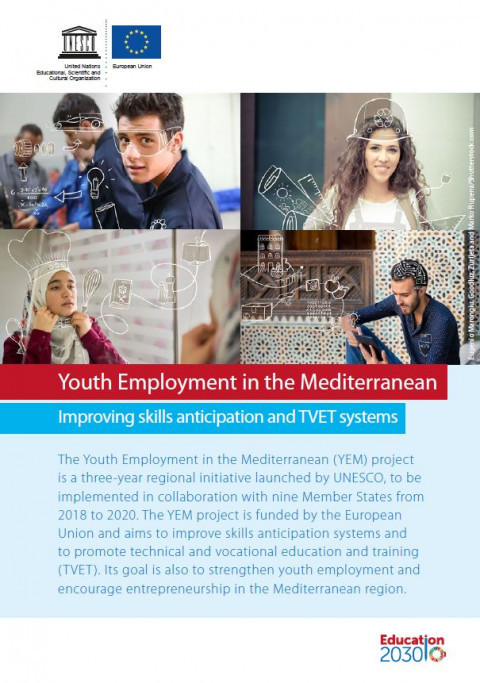 Youth Employment in the Mediterranean: Improving Skills Anticipation and TVET Systems Year of publication: 2018 Corporate author: European Union (EU) The Youth Employment in the Mediterranean (YEM) project is a three-year regional initiative launched by UNESCO, to be implemented in collaboration with nine Member States from 2018 to 2020. The YEM project is funded by the European Union and aims to improve skills anticipation systems and to promote technical and vocational education and training (TVET). Its goal is also to strengthen youth employment and encourage entrepreneurship in the Mediterranean region.
 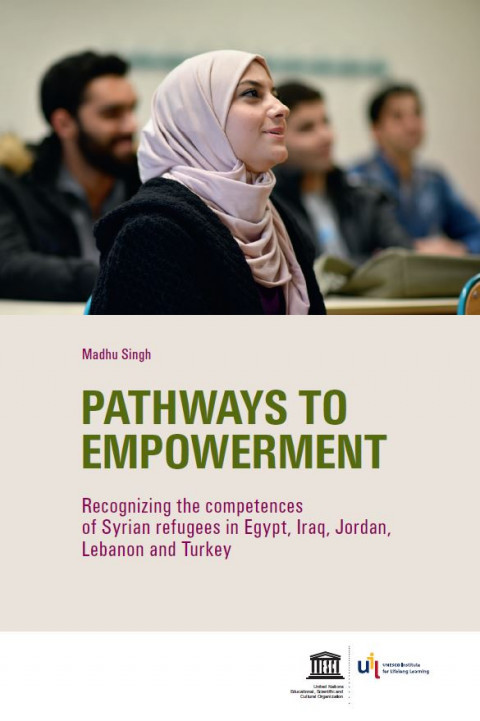 Pathways to Empowerment: Recognizing the Competences of Syrian Refugees in Egypt, Iraq, Jordan, Lebanon and Turkey Year of publication: 2018 Author: Madhu Singh Corporate author: UNESCO Institute for Lifelong Learning (UIL) For Syrian refugees living in Egypt, Iraq, Jordan, Lebanon and Turkey, recognition is a transformative mechanism that can help them enter or re-enter education, integrate into the world of work and participate fully in their host communities. However, while policy-makers in the region have prioritized the recognition, validation and accreditation of non-formal and informal learning, it remains a major challenge to develop systems that do this effectively. Pathways to Empowerment lays the essential groundwork for such a system, urging governments to develop comprehensive national strategies rather than ad hoc projects to recognize the competences of Syrian refugees. Its recommendations will contribute to dialogue between national authorities and social partners, and guide policy actions and RVA practices both in the region and in other parts of the world where recognition of refugees’ learning is a critical issue.
 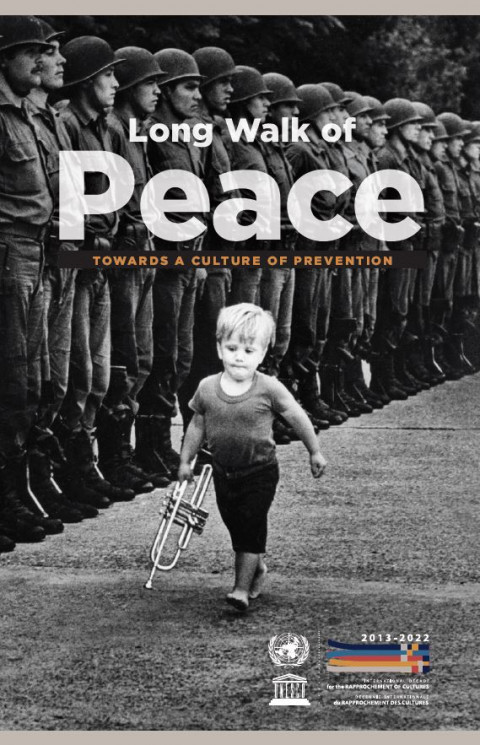 Long Walk of Peace: Towards a Culture of Prevention Year of publication: 2018 Corporate author: UNESCO How can the United Nations best address the imperatives of peace? Long Walk of Peace presents a fresh review of the conceptual and practical approaches to peace since the creation of the UN. Through an in-depth theoretical analysis, combined with a presentation of innovative practices across 32 UN bodies, it explores the long, steady haul towards peace and provides inspiration for the way forward.This book represents the collaborative efforts of scholars, experts and UN staff from a wide range of backgrounds. Long Walk of Peace, through its conceptual history and robust analysis, shows that peace is a dynamic process and a continuous journey of discovery. Thereby, the book provides a unique understanding of the emerging priorities of ‘sustaining peace’ and promoting ‘a culture of prevention’.As such it is an expression of UNESCO’s mandate to serve as a laboratory of ideas and thereby help advance the imperatives underscored by Agenda 2030.
 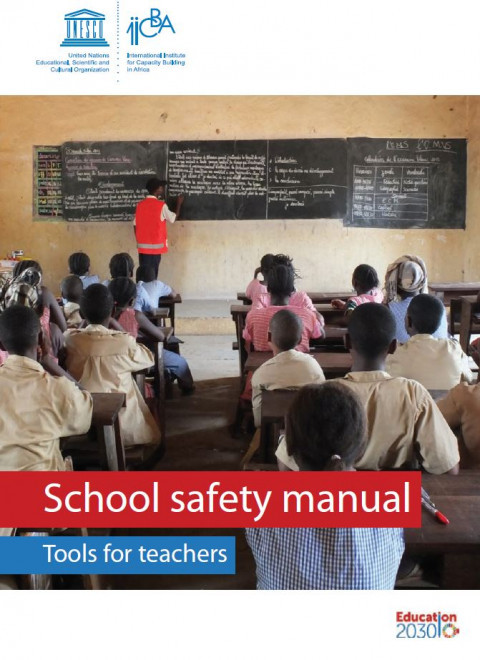 School Safety Manual: Tools for Teachers Year of publication: 2017 Corporate author: UNESCO International Institute for Capacity-Building in Africa (IICBA) This manual was produced as part of the Teacher Training and Development for Peace-building in the Horn of Africa and Surrounding Countries project and aims to introduce teachers to the knowledge and skills needed for the establishment, maintenance and sustainment of basic school safety. As more children are enrolling in school in Africa, creating a safe and peaceful environment must be a top priority of teachers and educational institutions.The responsibility of schools to provide a safe environment for their students has been affirmed in the United Nations (UN) Sustainable Development Goal (SDG) four on Education.
 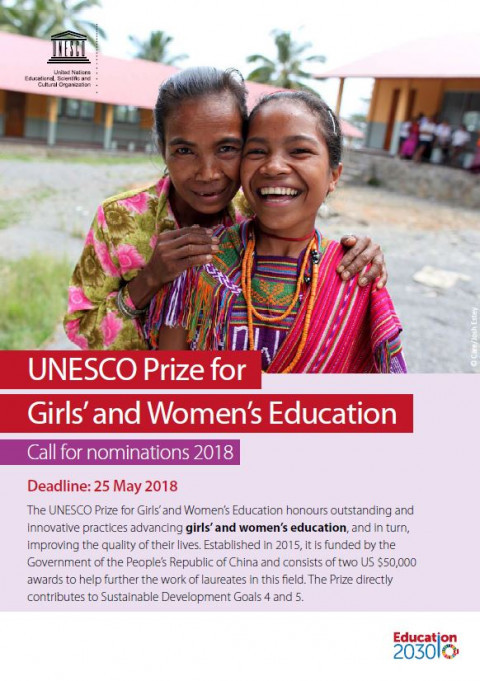 UNESCO Prize for Girls' and Women's Education: Call for Nominations 2018 Year of publication: 2018 Corporate author: UNESCO The UNESCO Prize for Girls’ and Women’s Education honours outstanding and innovative practices advancing girls’ and women’s education, and in turn, improving the quality of their lives. Established in 2015, it is funded by the Government of the People’s Republic of China and consists of two US $50,000 awards to help further the work of laureates in this field. The Prize directly contributes to Sustainable Development Goals 4 and 5.
  Accountability for Gender Equality Year of publication: 2018 Author: Elaine Unterhulter | Amy North | Orlanda Ward The aim of this paper is to consider approaches to understanding and evaluating accountability in education from the perspective of concerns with gender equality in education. This task has a number of facets and complexities, because ‘gender’ is not one simple set of relationships, and the notion of gender equality in education can be read in a number of different ways. Thus developing adequate conceptualizations for the key terms (accountability, and gender equality and education) needs to take account of gender as a particularly fluid, contextually located and contested idea signaling processes, which link with different formulations of policy and practice to enhance gender equality and accountability in education.In this paper we look at a range of different meanings of accountability, distilled in the main GEM Report (UNESCO, 2017) and consider their implications in relation to debates about gender and gender equality in education. The aim of the paper is to develop a ‘bespoke’ interpretation of accountability and different forms of gender equality in education through which we can assess a number of research studies and country examples of forms of accountability.This paper is also background paper prepared for the 2018 Global education monitoring report gender review: Meeting our commitments to gender equality in education.
 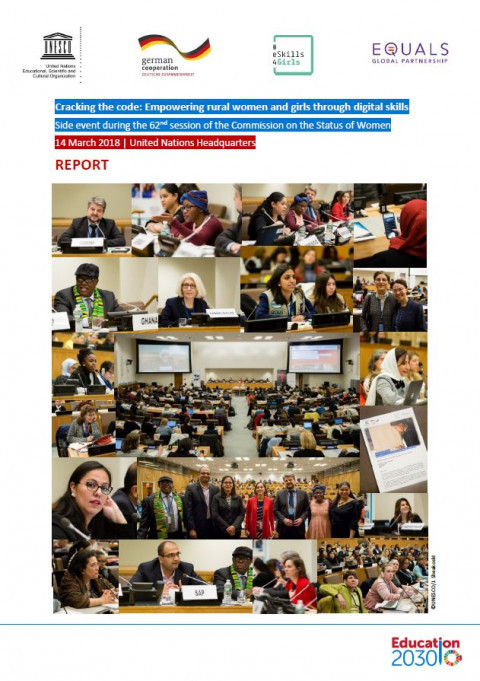 Cracking the Code: Empowering Rural Women and Girls through Digital Skills; Side Event during the 62nd Session of the Commission on the Status of Women, 14 March 2018, United Nations Headquarters: Report Year of publication: 2018 Corporate author: UNESCO | Germany. Federal Ministry for Economic Cooperation and Development (BMZ) UNESCO and the German Federal Ministry of Economic Cooperation and Development (BMZ) co-organised the side event ‘Cracking the code: Empowering rural women and girls through digital skills’ on 14 March 2018, United Nations Headquarters in New York, on the margins of the 62nd session of the CSW. More than 500 participants participated in the event while a broad global audience followed the discussions through live webcast.This report provides an overview of the discussions and examples of government, civil society organizations, and private sector initiatives to close the gender digital gap and empower rural girls and women to be ICT users, creators and innovators through gender-responsive digital skills training as well as science, technology, engineering and mathematics (STEM) education more broadly.
 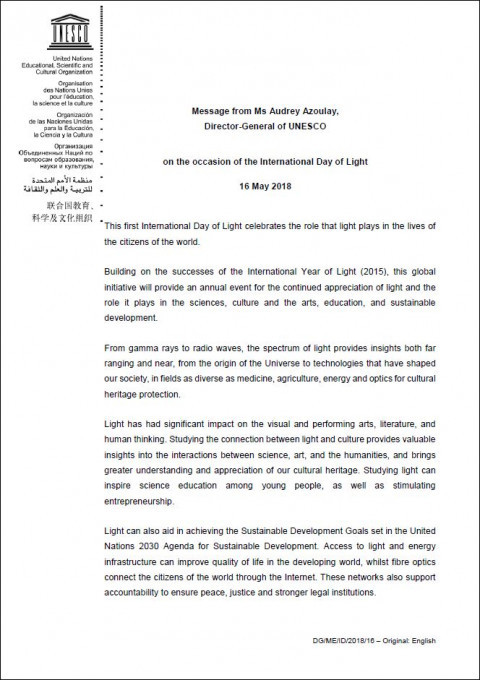 Message from Ms Audrey Azoulay, Director-General of UNESCO, on the occasion of the International Day of Light, 16 May 2018 Year of publication: 2018 Corporate author: UNESCO. Director-General, 2017-2025 (Azoulay, A.) This message was delivered by Audrey Azoulay, Director-General of UNESCO, on the occasion of the International Day of Light, on 16 May 2018.
 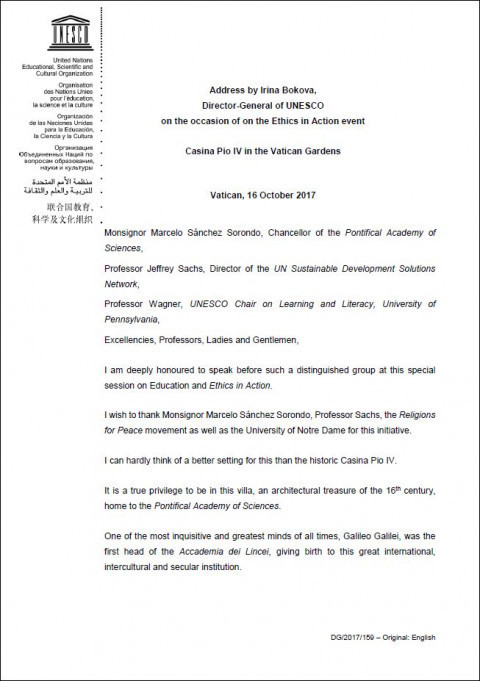 Address by Irina Bokova, Director-General of UNESCO, on the occasion of the Ethics in Action event, Casina Pio IV in the Vatican Gardens; Vatican, 16 October 2017 Year of publication: 2017 Corporate author: UNESCO. Director-General, 2009-2017 (Bokova, I.G.) This address was delivered by Irina Bokova, Director-General of UNESCO, on the occasion of the Ethics in Action event, Casina Pio IV in the Vatican Gardens; Vatican, on 16 October 2017.