
Resources
Explore a wide range of valuable resources on GCED to deepen your understanding and enhance your research, advocacy, teaching, and learning.
8,376 Results found
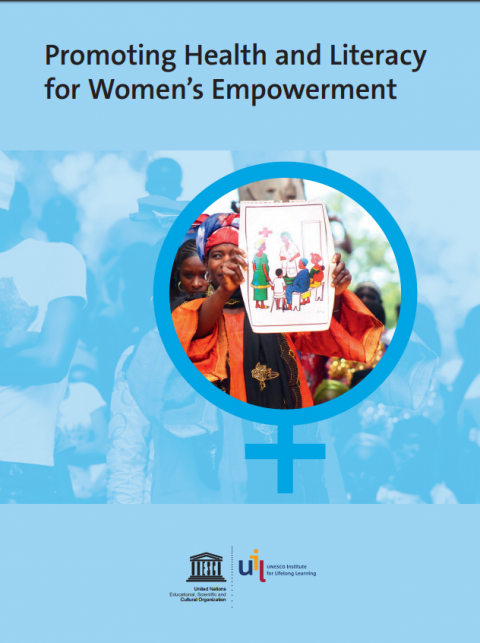 Promoting health and literacy for women's empowerment Year of publication: 2016 Author: Anna Robinson-Pant This publication is the third in a series of research studies focused on literacy and women’s empowerment. Its aim is to contribute to the development of crosssectoral approaches to the provision of adult literacy, education and training, traversing policy on education, family, integration, citizenship, health, social welfare and public finance. This paper uses a number of specific examples to show how literacy programmes for young people and adults, with a particular focus on young and adult women, can contribute to the achievement of the Sustainable Development Goals.
  The end of national models? Integration courses and citizenship trajectories in Europe Year of publication: 2007 Author: Dirk Jacobs, Andrea Rea Several European countries have recently introduced, or are planning to introduce, citizenship trajectories (voluntary or obligatory inclusion programmes for recent immigrants) or citizen integration tests (tests one should pass to be able to acquire permanent residence or state citizenship). Authors such as Joppke claim that this is an articulation of a more general shift towards the logic of assimilation(and away from a multicultural agenda) in integration policy paradigms of European states. Integration policies would even be converging in such a fashion that it would no longer make sense to think in terms of national models for immigrant integration. The empirical fact of diffusion of civic integration policies throughout Europe cannot be denied. This paper claims that there is, however, still sufficient distinctiveness between immigrant integration policies in order to continue and use an analytical framework that distinguishes national models.
  It's about us!: reflections on education for active citizenship within the European Union Year of publication: 2013 Author: Milana Marcella, Tarozzi Massimiliano The article is structured in three main parts. Grounded in the scientific literature, the authors unpack the notion of citizenship as key educational concept based on multiple and diverse identities. Then, they outline the major steps undertaken at EU level to formalise and expand citizenship rights and to endorse citizenship education across the Union’s nationals, by showing that citizenship education is promoted more as a strategy for legitimising the Union rather than a participatory practice aimed at fostering democratic processes within Europe. Finally, they discuss the implications of these policy advancements from a social justice perspective, by advancing a critique of their political assumptions and, to some extent, the pedagogical approach they suggest.
  Regional overview: Central and Eastern Europe and Central Asia Year of publication: 2015 Corporate author: UNESCO Central and Eastern Europe (CEE) and Central Asia (CA) have both made significant advances towards Education for All (EFA) since 1999. However, the 2015 EFA Global Monitoring Report shows that despite progress, Education For All remains unfinished business, including in Central and Eastern Europe and in Central Asia. This must be taken into account in the post-2015 agenda. An Evaluation of UNESCO Publications on Human Rights Education Year of publication: 2002 Corporate author: University of Leicester (UK) | Centre for Citizenship Studies in Education The purpose of this evaluation was to contribute to the formulation of a future strategy on Human Rights Education (HRE). The evaluation focused on nine publications commissioned by UNESCO Headquarters and field offices between 1997 and 2001.The relevance of the publications was assessed in light of UNESCO’s HRE goals and objectives. These were identified in UNESCO documents such as the 1995 Declaration and Integrated Framework of Action on Education for Peace, Human Rights and Democracy. The evaluation also included a report on the perception of users and UNESCO staff of the dissemination and impact of these publications, based on 11 staff interviews and an email questionnaire with 11 responses from 10 countries. In addition, the evaluators provided guidelines for the future development and evaluation of HRE publications.
 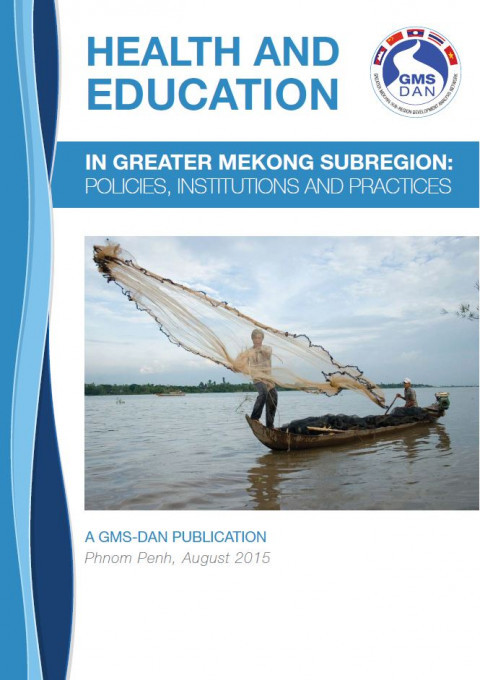 Health and Education in the Greater Mekong Subregion: Policies, Institutions and Practices Year of publication: 2015 Author: Greater Mekong Subregion Development Analysis Network Corporate author: Cambodia Development Resource Institute (CDRI) The focus of the paper is thus on the institutional frameworks and their effectiveness in policy-making and implementation in health and education and not so much on assessing whether these polices themselves are appropriate. In assessing institutional effectiveness, the paper does not purport to be comprehensive but selective in that it looks at only a few key issues: national, especially public, resource commitments; intra-governmental coordination, both vertical and horizontal; the roles of non-state actors, including private sector, civil society organisations and civil society more generally. An Investigation of Conflict Management in Cambodian Villages: A Review of the Literature with Suggestions for Future Research Year of publication: 2001 Author: Caroline Hughes Corporate author: Centre for Peace and Development, Cambodia Development Resource Institute This literature review sets out a conceptual framework for the investigation of conflict management in Cambodian villages, and gives suggestions for further research. It places the study of conflict and conflict management in the framework of ideas of a “culture of peace”, and argues that this requires examining questions of both active procedures (agency) and their context (structure) in responses to conflict.
  Multilingual education: Why is it important? How to implement it? Year of publication: 2014 Corporate author: UNESCO Mother tongue instruction is in the context of bilingual education / multilingual education (MLE) because it lays a solid foundation for learning, improves access to education (especially for girls), improves learning outcomes, raises the quality of education by emphasizing understanding and creativity rather than repetitive memorization. Furthermore, learners who are excluded from the education system are those who mosk likely benefit from multilingual education. There are several ways to implement MLE, such as by creating a favourable environment, using appropriate materials, training teachers and educators, and taking into account the learners' knowledge.
 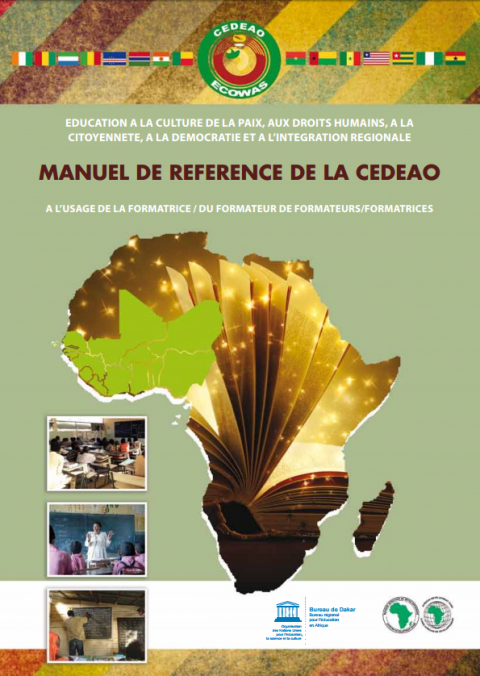 EDUCATION A LA CULTURE DE LA PAIX, AUX DROITS HUMAINS, A LA CITOYENNETE, A LA DEMOCRATIE ET A L’INTEGRATION REGIONALE MANUEL DE REFERENCE DE LA CEDEAO A L’USAGE DE LA FORMATRICE / DU FORMATEUR DE FORMATEURS/FORMATRICES Year of publication: 2013 Corporate author: UNESCO Dakar | Economic Community of West African States (ECOWAS) The manual comprises seven modules dealing with the Culture of Peace and Conflict Management; Human Rights; Civism and Citizenship; Democracy and Good Governance; Gender and Development; Public Health, Environment and Sustainable Development; and Regional Integration. Each module has sub-themes with introductions, reference materials, general objectives to guide the trainer and generic pedagogical tables that are flexible enough to be adapted to available teaching resources in the different ECOWAS countries. It is also suitable and adaptable to the training of teachers involved in both formal and non-formal education delivery at different levels of teaching and learning. The ultimate goal of the Manual is to build a critical mass of ECOWAS citizens equipped with competent skills, not only for cognitive and psycho-motor domains of education, but also affective skills for positive values, attitudes and behaviors that promote peace, tolerance and peaceful co-existence of community citizens. Active citizenship and late-life learning in the community Year of publication: 2013 Author: Carmel Borg This paper problematises dominant notions of active citizenship in later life and provides a framework for an alternative view of active citizenship. It also illustrates how adult educators can facilitate learning processes where late-life learners, reflect on the impact of the neoliberal value system and on the consequences of its hegemonic practices on personal and community life, before engaging in transformative action.