
Resources
Explore a wide range of valuable resources on GCED to deepen your understanding and enhance your research, advocacy, teaching, and learning.
8,376 Results found
 The 1994 Genocide as Taught in Rwanda’s Classrooms Year of publication: 2017 This blog looks at how textbook and curricula reforms in Rwanda have worked to cover the 1994 Genocide and instill the ideals of tolerance, unity and reconciliation in students. It is part of a series of blogs on this site published to encourage debates around a new GEM Report Policy Paper: Between the Lines, which looks at the content of textbooks and how it reflects some of the key concepts in Target 4.7 in the UN Sustainable Development Goals (SDGs).by Jean-Damascene Gasanabo, PhD, Director-General, Research and Documentation Center on Genocide, National Commission for the Fight against Genocide (CNLG), Kigali, Rwanda. The 1994 Genocide against the Tutsi saw the slaughter of more than one million people over the span of three months, and placed Rwanda at the forefront of the world’s political consciousness. Almost 23 years later, Rwanda has rebuilt and become a modern hub of progress and development, putting in place social, political and economic systems that are grounded in national unity and reconciliation – with education reforms playing a central role.The large-scale participation of children and adolescents in perpetrating acts of genocide made it clear that an education system that fails to integrate basic human values, will also inevitably fail the nation. Education was used prior to the Genocide to inculcate fear, intolerance and hatred; and so too is it being utilized by the current Government to foster peace and inclusivity, and combat genocide ideology. Post-genocide Rwanda has used education as a main tool to correct biased perceptions of its socio-political history, and to provide accurate representations of the root causes of the genocide, and preventative measures.With over 60% of Rwandans under the age of 24, the formal education system needs to instill the ideals of tolerance, unity and reconciliation in the next generation. With this realization, the Rwanda Education Board and the Ministry of Education have integrated genocide studies in the curricula of its primary, secondary and higher education institutions so that they are better able to lead a nation that is cognizant of its past. Instead of highlighting difference, the national curriculum of post-genocide Rwanda has been reconfigured to emphasize the politics of inclusion and to encourage a spirit of critical thinking that pursues peace, social cohesion and harmony above all else.Prior to the Genocide, educational resources were used as a tool by the genocidal regime to promote ethnic division, discrimination and propaganda. The biased curricula and teaching methods cemented ethnic segregation within classrooms and fostered genocide ideology. The students who were not expelled from primary and secondary school due to the ethnic and regional quota system were forced to identify themselves as being Tutsi – inherently separate to those who were Hutu or Twa. The pre-1994 curriculum lacked “the essentials of human emotion, attitudes, values and skills” as it continued to promote discriminatory and divisive ideologies that were “imparted through formalized rote learning in history, civic education, religious and moral education and languages.”Post-Genocide Rwanda faced the herculean task of rebuilding its dismantled institutions. With a profound lack of qualified teachers, a huge pool of orphaned children, insufficient funds and inaccurate textbooks following the genocide, many education challenges lay ahead. In early 1995, a moratorium was placed on history textbooks which disseminated biased information, as the country grappled with how and to what extent the nation’s past could be incorporated constructively in the education system, without causing pain or resurfacing conflicts.Rwanda chose a gradual, yet comprehensive, approach. In the years immediately following the Genocide, the history curriculum lightly touched on the subject so as to protect students from their recent past, and prevent division in classrooms based on differing family experiences. Classrooms promoted knowledge based on the essential ideas of unity, peace, tolerance and justice. In 2008 the National Curriculum Development Centre within the Ministry of Education published the new history curriculum which incorporated the Genocide against the Tutsi, coinciding with the renewed emphasis on the unifying and inclusive qualities of nationality, citizenship and patriotism, instead of ethnicity.The current national curriculum was formulated by the Rwanda Education Board in conjunction with varying public institutions, UN agencies and nongovernmental organizations. It incorporates the Genocide into the curriculum of every grade level, and discusses it in various contexts suited to the student’s particular stage in learning. Eyewitness accounts and the presence of elders in the classroom allow for a “multi-generational opportunity” for learning. In understanding how violent conflict erupts in society, it is possible to prevent future atrocities from beginning. Teaching the Genocide in present-day Rwanda aims to provide a more nuanced understanding of the event by using primary sources, encouraging class discussions on genocide denial, the persistence of genocide ideology, and the reconciliation efforts embarked on after the Genocide.Moreover, this change in the curriculum has been supplemented by a shift to transform learning from one based on standard rote memorization to one that encourages discussion and a spirit of critical thinking and analysis. This approach identifies the student as an active participant in the learning experience, not merely a silent recipient of history as “evangelical speech.” By promoting an environment that encourages spirited, objective discussions, the Ministry of Education seeks to redress the biases taught by the genocidal regime, as well as prepare young people to thoughtfully and constructively enter the workforce.Genocide education nevertheless faces some challenges ahead. With genocide denial still present, not only are ongoing revisions of educational resources required, but teacher training is also necessary to ensure that revisions to the curriculum are well presented by teachers.The way conflict and genocide has been taught through textbooks in Rwanda has evolved over time. For Rwandans, learning about the 1994 Genocide is not only vital in understanding the history of their country, but also in developing critical thinking skills that help young people become informed citizens in today’s globalized society. Peace education, as well as tools for conflict resolution and genocide prevention, are now heavily featured. Indeed the initiatives embarked on by the education sector signal a promising start to the continuous pursuit of truth through knowledge of the past.In comprehensively integrating the study of genocide into the national curriculum and by empowering students to become agents of their own learning process, Rwanda offers an ambitious recipe for successfully teaching one’s own history for the better.
  Final Report: 1st Global Capacity-Building Workshop on GCED Year of publication: 2016 Corporate author: APCEIU This report provides an overview of the activities carried out during the 1st Global Capacity-Building Workshop on GCED held in Seoul and Gwangju, Republic of Korea from 19 June - 2 July, 2016. APCEIU organized the 1st Global Capacity-Building Workshop on GCED in collaboration with UNESCO in order to contribute to achieving the Sustainable Development Goals(SDGs) target 4.7 by enhancing the capacity of teacher educators and trainers in implementing GCED. This intensive 2-week workshop provided the participating educators with the opportunities to better understand the concept and internalize the pedagogical principles of GCED while sharing their experiences and working on collaborative action plans. For more information, please contact APCEIU's Office of Education and Training at ent@unescoapceiu.org.
  Final Report: 2016 UNESCO/KOICA Joint Fellowship Programme Year of publication: 2016 Corporate author: APCEIU This report provides an overview of the activities carried out during the 2016 UNESCO/KOICA Joint Fellowship Programme held in Republic of Korea from 1 September - 31 October, 2016.In its 10th year of implementation, UNESCO/KOICA Joint Fellowship Programme 2016 invited 25 educators from 17 countries in Africa and the Asia-Pacific region for two months; from September 1st to October 31st. The overarching goal of the Programme was to enhance the capacities of participating educators under the themes of “Teacher Training for Basic Education,” “Use of ICT for Education (or e-Learning),” “Leadership in Global Education” and “Girls’ Education.” Composed of various segments such as lectures, workshops, hands-on activities, and seminars, which were closely interlinked with each module, the modules were designed to enable the participants to reorient their perspectives on educational development, to gain essential knowledge and skills, and furthermore to produce meaningful and relevant outputs that could be widely applied in their local contexts.For more information, please contact APCEIU's Office of Education and Training at ent@unescoapceiu.org.
  Message de Mme Irina Bokova, Directrice générale de l’UNESCO, à l’occasion du 50e anniversaire de la Journée internationale de l'alphabétisation Year of publication: 2016 Corporate author: UNESCO. Director-General, 2009-2017 (Bokova, I.G.) Literacy is essential to success across the board. A foundation for human rights and dignity, literacy is vital for poverty eradication, for gender equality, for more inclusive and sustainable societies. This is why we launch today the Global Alliance for Literacy, to mobilize investment and promote innovative initiatives, with a focus on gender and new information and communication technologies. We must seize every opportunity-- we must work across all sectoral boundaries.
  Reading the past, writing the future Year of publication: 2016
 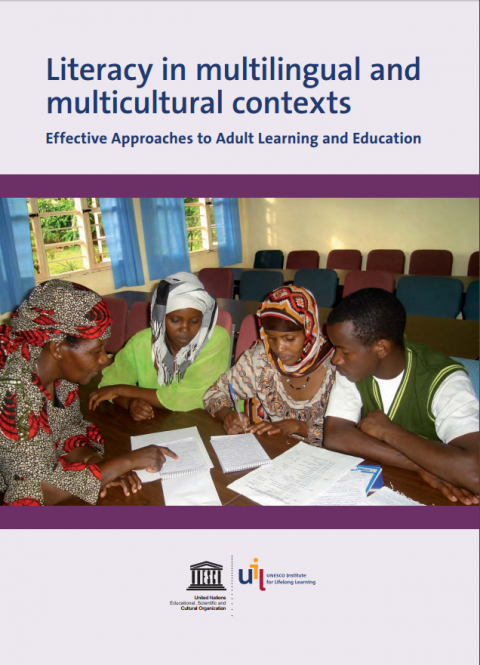 Literacy in multilingual and multicultural contexts: effective approaches to adult learning and education Year of publication: 2016 Author: Ulrike Hanemann, Cassandra Scarpino All of the literacy programmes featured in this publication offer valuable experiences and lessons on how the challenges posed by linguistic and cultural diversity can be productively addressed by harnessing the potential of language and culture as enriching resources in the process of literacy teaching and learning. A major lesson that has emerged over the years is that the use of local languages as the medium of instruction enhances the effectiveness and efficiency of the learning process in developing literacy, numeracy and (second or more) language skills. However, mother tongue-based literacy not only facilitates the learning process, but is also an important symbol of identity, unity and self-determination. It is closely intertwined with culture and local values, wisdom, worldviews and tradition. A number of the featured programmes demonstrate that language and culture in education are highly political. Respect for all languages and cultures, and their equal treatment, can play a critical role in fostering national cohesion. In some cases, this is contributing to rebuilding peace in post-conflict communities. Literacy programmes that contribute to the preservation of linguistic and cultural diversity should, also, be viewed as integral to sustainable development. Message from Ms Irina Bokova, Director-General of UNESCO, on the occasion of the International Literacy Day, 50th Anniversary, 8 September 2016 Year of publication: 2016 Author: Anna Robinson-Pant Corporate author: UNESCO. Director-General, 2009-2017 (Bokova, I.G.) Literacy is essential to success across the board. A foundation for human rights and dignity, literacy is vital for poverty eradication, for gender equality, for more inclusive and sustainable societies. This is why we launch today the Global Alliance for Literacy, to mobilize investment and promote innovative initiatives, with a focus on gender and new information and communication technologies. We must seize every opportunity-- we must work across all sectoral boundaries. An intercultural program from a Balkan perspective Year of publication: 2003 Author: Emilia Ilieva The author focuses on the particular case of the Bosporus International Network as an intercultural program. Bosporus International Network is a network of five independent and registered NGOs in Germany, Bulgaria, Romania, Greece and Turkey and four local groups in Albania, Macedonia/FYROM, Slovenia and Hungary that share the same name, goals and aims. The goal of the network can best be described as “building bridges" between cultures.
  Tool for quality assuarance of education for democratic citizenship in schools Year of publication: 2005 Corporate author: Council of Europe This Tool for Quality Assurance of Education for Democratic Citizenship (EDC) in Schools was prepared as a response to the compliance gap between policies and practices of EDC in various countries. While EDC policies are well developed, EDC practices in schools present significant weaknesses. The Tool was also prepared as part of the current interest and implementation of quality assurance in education. This Tool is designed as a reference document. It focuses on education for democratic citizenship and applies the principles and processes of quality assurance to EDC.
  Final Report: 2nd Youth Leadership Workshop on Global Citizenship Education Year of publication: 2016 Corporate author: APCEIU This report provides an overview of the activities carried out during the 2nd Youth Leadership Workshop on Global Citizenship Education (GCED) held in Busan, Republic of Korea, from 11 - 16 July 2016. As an APCEIU's 2nd youth workshop, this programme gathered 49 youth activists from 38 countries around the world to exchange their ideas and identify GCED leadership strategies in order to mobilize young people for GCED in local and national contexts and advance the agenda globally. This report also aims to convey the voice of the youth on GCED: their thoughts and reflections on GCED and its priority areas. The workshop was co-organized by APCEIU and UN Secretary General’s Global Education First Initiative (GEFI); it was sponsored by Busan University of Foreign Studies and the Geum-jeong District of Busan Metropolitan City. For more information, please contact APCEIU's Office of Education and Training at ent@unescoapceiu.org.