
Resources
Explore a wide range of valuable resources on GCED to deepen your understanding and enhance your research, advocacy, teaching, and learning.
8,354 Results found
 Advancing a Just Energy Transition in Central Asia: Women’s Key Role in the Energy Sector Year of publication: 2024 Corporate author: Организация по безопасности и сотрудничеству в Европе (ОБСЕ) | Global Women’s Network for the Energy Transition (GWNET) The OSCE study analyzes the socio-economic benefits of the energy transition for the five OSCE participating States in the region. It provides specific considerations for the strategic development of an appropriately skilled labour force and also contains critical yet unpublished data on the job creation potential of renewable energy in each Central Asian country.
 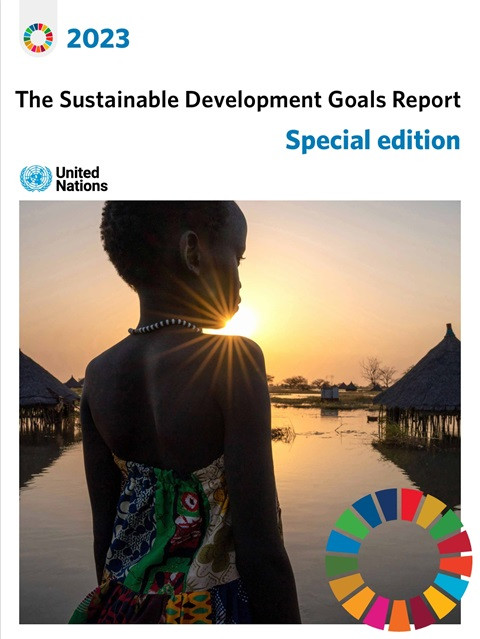 The Sustainable Development Goals Report 2023: Special Edition Year of publication: 2023 Corporate author: UN. Department of Economic and Social Affairs (UN. DESA) The annual report, a joint effort of the global statistical community, was launched during the UN High-level Political Forum on Sustainable Development as leaders from governments and different sectors of society gathered to chart strategies and efforts to fully implement the SDGs. The report provides essential data that allows decision-makers to guide efforts toward a sustainable recovery.
  Words that Heal: The Role of Young People in Addressing Hate Speech (EPDF Policy Brief No. 2) Year of publication: 2024 Corporate author: International Dialogue Centre (KAICIID) In the ‘post-truth era’, polarised opinions and knowledge fragmentation make it particularly challenging for young people to orient themselves and make sense of the world. Biased narratives and expressions of hate, exacerbated by echo chambers and artificial intelligence, significantly increase the risk that young social media users create or spread discriminatory content or become victims of hate speech. This can lead to long-lasting psychological and physical harm. Derogatory language often targets religious or ethnic communities, further inflamed by structural discrimination and boosted by the vicious spirals of algorithms. Based on experiences across Europe, this policy brief reflects on how to prevent young people from becoming involved in hate speech, both as victims and perpetrators, thanks to renewed alliances between secular and religious actors. Policymakers and faith leaders are encouraged to resort to interreligious and intercultural dialogue as a powerful tool that promotes mutual understanding and appreciation over mistrust and harmful stereotypes.
  Synergy Solutions for a World in Crisis: Tackling Climate and SDG Action Together Year of publication: 2023 Corporate author: UNFCCC | UN. Department of Economic and Social Affairs (UN. DESA) In May 2023 UNDESA and UNFCCC Secretariat co-convened the Expert Group on Climate and SDG Synergy. The Group consists of 14 renowned experts from diverse thematic and geographic backgrounds who were given the task of developing the First Global Report on Climate and SDG Synergies. This report demonstrates that aggressively acting on climate and development in an integrated and synergistic way is an important opportunity to achieve the course correction the UN Secretary- General has called for. It highlights some of the challenges but also the opportunities if the international community is seriously committed to enhancing these synergies and thereby addressing these challenges. The report is designed to provide a broad overview of available data and evidence, insights from experts on the frontlines, and recommendations for enhancing synergistic action across the 2030 Agenda and the SDGs. This first edition will form the basis for future iterations, which will entail a wider scope of sectors, and thematic areas and deep dives on specific issues pertaining to strengthening and operationalizing synergic climate and SDG actions at all levels.
 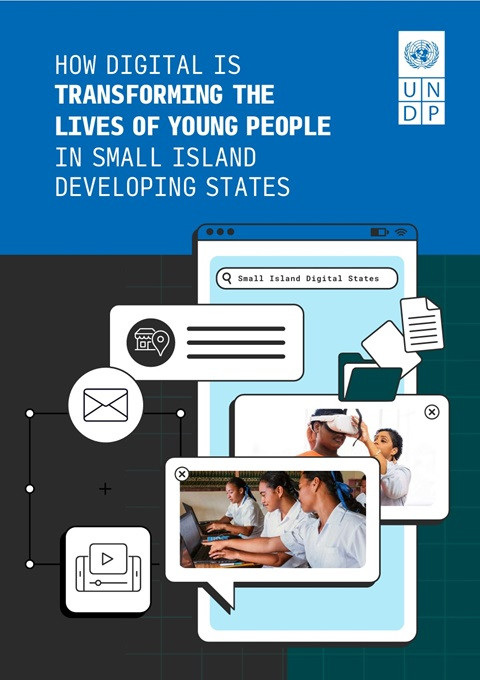 How Digital is Transforming the Lives of Young People in Small Island Developing States Year of publication: 2024 Corporate author: United Nations Development Programme (UNDP) Young people represent a sizeable and vital population in Small Island Developing States (SIDS). For them, digital technologies are more than just tools; they are gateways to new horizons. Digital is creating fresh opportunities, opening doors to unconventional careers, and redefining how knowledge is acquired and shared. Young people are using digital to start new businesses, explore new opportunities, learn new knowledge and skills, and to build global connections. However, young people are also cautious about digital – and they recognise risks and issues posed by digital channels, tools, and technologies. ‘How Digital is Transforming the Lives of Young People in SIDS’ explores these opportunities and challenges by hearing from young people – in their own words. Through a bespoke survey chatbot, running on messaging platforms most used by young people living in SIDS, more than 5,000 respondents from over 30 countries discuss how they’re using digital to transform their lives and livelihoods. And the barriers and challenges that they are facing on their digital journeys.
  Disinformation and Peacebuilding in Sub-saharan Africa: Security Implications of AI-Altered Information Environments; Research Report Year of publication: 2024 Author: Eduardo Albrecht | Eleonore Fournier-Tombs | Rebecca Brubaker Corporate author: United Nations University | Interpeace This report aims to further explore the way in which AI technologies as they currently stand impact peace and conflict, and what methods might be used to mitigate their adverse effects - through the development of better tools and the inclusion of peace and conflict considerations in AI governance frameworks. The report proposes the following recommendations: 1. More funding and support should be provided to civil society organization efforts to expand media literacy and fact-checking initiatives using AI tools to enhance capabilities. 2. Governments need to work with civil society to develop and implement comprehensive, transparent legal frameworks combating disinformation. These legislative measures need to support digital and media literacy campaigns and fact-checking organizations. 3. Social media companies need to expand investment and research into understanding local information environments, so they can better identify and respond to instances of disinformation in all contexts in which they operate and enhance transparency. 4. Peacebuilding organizations need to carefully consider local media ecosystems and information environments when conducting conflict analyses, and factor these dynamics into their projects' frameworks.
 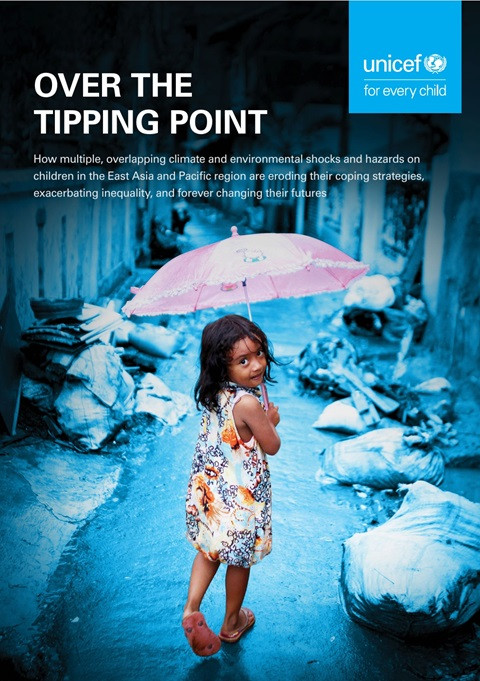 Over the Tipping Point: How Multiple, Overlapping Climate and Environmental Shocks and Hazards on Children in the East Asia and Pacific Region are Eroding their Coping Strategies, Exacerbating Inequality, and Forever Changing Their Futures Year of publication: 2023 Corporate author: United Nations Children's Fund (UNICEF) This report unveils the intensifying frequency and compounding effects of climate-related hazards intertwined with non-climate shocks like the COVID-19 pandemic and socio-economic challenges. Given that children are already facing the impacts of climate change, adaptation and resilience measures are needed now to reduce the full force of impacts. This report recommends three areas to do so: Children have continued access to the key services they need: This requires investing in climate-smart and disaster-resilient education, health, and water, sanitation and hygiene (WASH) services for children, so that children can access these services despite the shocks they face; Child protection and social protection systems are in place and are climate-responsive; and There is understanding of what to expect and how to adjust as necessary, establishing and utilizing strong early warning, risk management and disaster preparedness systems. In all of this, children and young people must be at the forefront of our actions. Urgency demands that they take action themselves, leading the way with innovative solutions for both mitigation and adaptation. We must support their efforts, providing them with the necessary skills and resources to amplify their work. Above all, we owe them every opportunity for success as we work together to secure a better world for generations to come.
 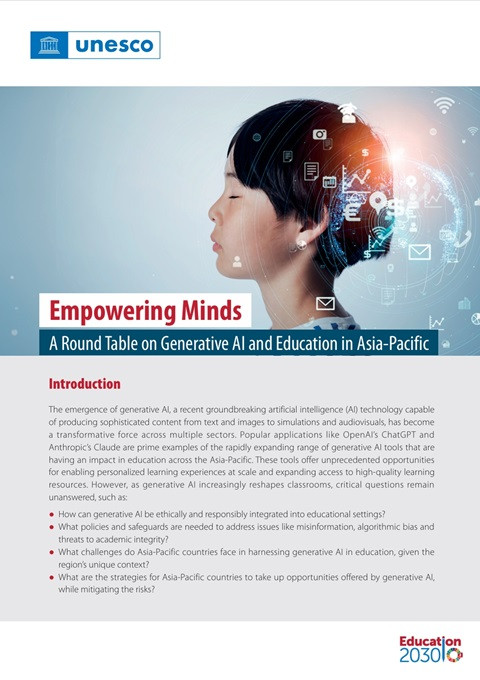 Empowering Minds: A Round Table on Generative AI and Education in Asia-Pacific Year of publication: 2023 Corporate author: UNESCO Bangkok The emergence of generative AI, a recent groundbreaking artificial intelligence (AI) technology capable of producing sophisticated content from text and images to simulations and audiovisuals, has become a transformative force across multiple sectors. Popular applications like OpenAI’s ChatGPT and Anthropic’s Claude are prime examples of the rapidly expanding range of generative AI tools that are having an impact in education across the Asia-Pacific. These tools offer unprecedented opportunities for enabling personalized learning experiences at scale and expanding access to high-quality learning resources. However, as generative AI increasingly reshapes classrooms, critical questions remain unanswered, such as:- How can generative AI be ethically and responsibly integrated into educational settings?- What policies and safeguards are needed to address issues like misinformation, algorithmic bias and threats to academic integrity?- What challenges do Asia-Pacific countries face in harnessing generative AI in education, given the region’s unique context?- What are the strategies for Asia-Pacific countries to take up opportunities offered by generative AI, while mitigating the risks? In response to these questions and emerging challenges in the region, the UNESCO Regional Office in Bangkok (UNESCO Bangkok), in collaboration with The Southeast Asian Ministers of Education Organization (SEAMEO), organized the regional experts meeting on 7-9 November 2023 in Bangkok, Thailand. This hybrid meeting, titled ‘Empowering Minds: A Round Table on Generative AI and Education in Asia-Pacific’, explored the implications of generative AI for teacher training and development. It served as an important platform to leverage opportunities and mitigate risks of generative AI in education across the Asia-Pacific region.
  International Trends of Lifelong Learning in Higher Education: Research Report Year of publication: 2023 Corporate author: UNESCO Institute for Lifelong Learning (UIL) | Shanghai Open University Against the background of a global education crisis and a growing recognition of the importance of lifelong learning, the UNESCO Institute for Lifelong Learning (UIL) and the Shanghai Open University (SOU) conducted a comprehensive research project from 2020 to 2022 that included, among other components, an international survey on the contribution of higher education institutions to lifelong learning, the results of which are presented in this report. Based on the comprehensive sets of quantitative and qualitative data collected across all world regions, this research constitutes a major step forward in building an international knowledge base on the role of HEIs in establishing lifelong learning opportunities for all.
  Re|shaping Policies for Creativity: Addressing Culture as a Global Public Good Year of publication: 2023 Corporate author: UNESCO The Global Report series monitors the implementation of the 2005 Convention on the Protection and Promotion of the Diversity of Cultural Expressions, as well as progress towards achieving the United Nations 2030 Agenda for Sustainable Development, within and with the cultural and creative sectors. Its 2022 edition revolves around two major questions: What is the state of the cultural and creative sectors? What policy changes to promote sustainable, human rights-based systems of governance for culture and equitable access to cultural opportunities and resources have resulted from stakeholders’ implementation and ownership of the Convention? In line with the 2015 and 2018 editions, this third edition of the Report presents the latest policy developments to support creativity and sheds light on current and future challenges in areas such as the digital environment, media diversity, sustainable development, mobility of artists and cultural professionals, gender equality and artistic freedom. The trends, innovative practices, gaps and recommendations that emerge from the 2022 edition provide valuable evidence to inform the policy dialogue leading up to the UNESCO World Conference on Cultural Policies and Sustainable Development – MONDIACULT 2022. With the mission to contribute to the 2030 Agenda, it feeds into a renewed vision of cultural policies based on a better understanding of what impacts the diversity of cultural expressions and the avenues for anchoring culture and creativity in the broader public policy spectrum.