
Resources
Explore a wide range of valuable resources on GCED to deepen your understanding and enhance your research, advocacy, teaching, and learning.
8,354 Results found
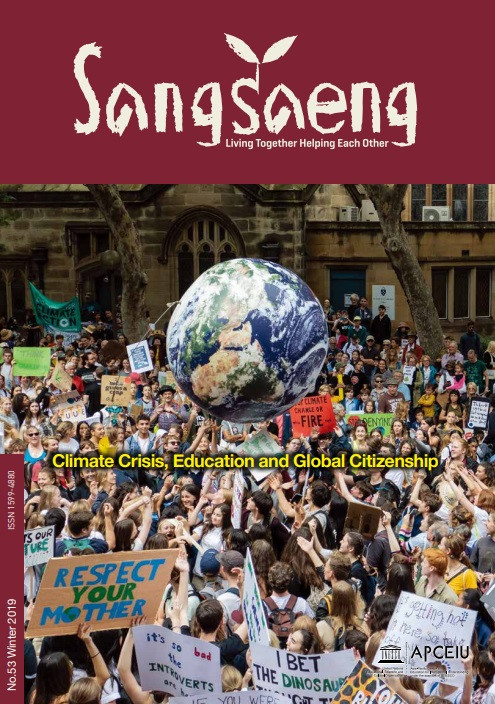 Climate Crisis, Education and Global Citizenship (SangSaeng no.53, 2019) Year of publication: 2023 Corporate author: APCEIU In view of the rapidly growing concerns about the climate crisis, the 53rd issue of SangSaeng focuses on how we should respond to the challenge under the theme of “Climate Crisis, Education and Global Citizenship.” Contents 03. Editor’s Note 04. Special Column Reimagining Our Future in Light of the Climate Crisis/Helena Norber-Hodge, 08. Focus 08 Empowering Learners for Climate Action and Transformation /Alexander Leicht 12 Changing Education, Not the Planet /Sun-kyung Lee 16 Power of a Global Classroom/Lynette Shultz and Carrie Karsgaard 19 Sustainability Starts with Teachers/Shepherd Urenje 24. Best Practices 24 Y-Adapt Inspires Youth-led Climate Change Action/ Brigitte Rudram 29 Local Energy Transition, from Imagination to Everyday Life/ Soyoung Kim 32. Story Time Pluto, a Stubborn Planet / Aprilia Sanie 34. Peace in My Memory 34 Global Citizenship Education in a Divided World / Makoto Kobayashi, 37 Clearing Streets of Burkina Faso / Francois Compaore 40. Understanding the Asia and the Pacific Melting Discoveries in Altai Plateau /In Uk Kang 44. GCED Youth Network Youth as the motor for GCED /Diego Manrique and GCED Youth Network 48. Letter The Journey of Making Peace in the Arab World /Khalaf Al'Abri, 50. APCEIU in Action
 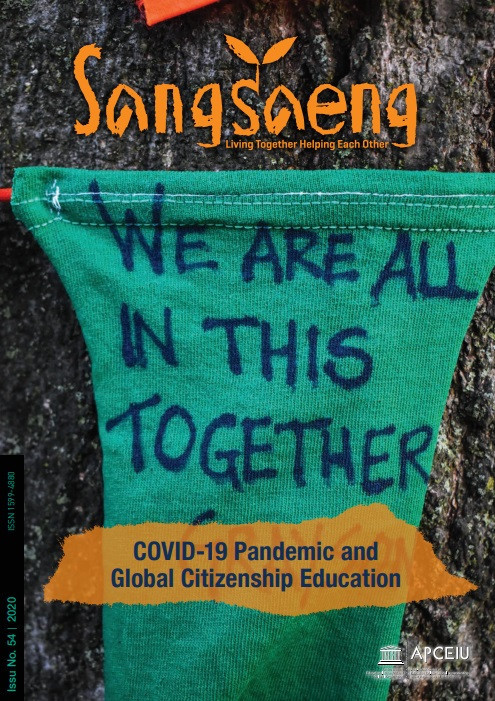 COVID-19 Pandemic and Global Citizenship Education (SangSaeng no.54, 2020) Year of publication: 2023 Corporate author: APCEIU Considering the significance of the global pandemic crisis, the 54th edition of SangSaeng focuses on the “COVID-19 Pandemic and Global Citizenship Education.” This issue invites readers to explore how the pandemic has affected the global community and reflect on how we should and can work together to address our common, multifaceted challenges while enhancing global citizenship and solidarity. Contents03 Editor’s Note04 Special Column What Changes Do We Want in the Post-Coronavirus World? / Hyun Mook Lim 08 FOCUS: COVID-19 Pandemic and Global Citizenship Education08 Reflecting on Global Citizenship Education in the Era of the Pandemic / Soon-Yong Pak12 Choosing Our Post-Pandemic World / Ilan Kelman16 Political Economy of COVID-19 and Global Cooperation / Chang-Yup Kim21 Peace in the Time of Global Pandemic / Yonas Adaye Adeto25 The Pandemic Stall of 2020 / Virginia A. Miralao30 Marine Conservation Efforts in Uncertain Times / Kerstin Forsberg35 Plague, Prejudice and Protest: The Role of Education in Pandemic World / Lynn Davies39 Media and Information Literacy Matters in Preparing for Post-Pandemic World / Divina Frau-Meigs 44 GCED Youth NetworkYouth Voices on the COVID-19 Pandemic and a New Work / Diego Manrique, Tshering Zangmo and Zanji Sinkala in collaboration with Hadi Althib 50 APCEIU in Action
 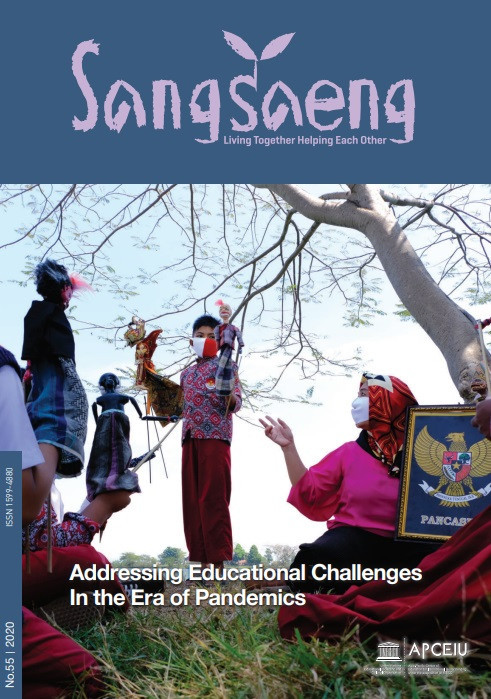 Addressing Educational Challenges In the Era of Pandemics (SangSaeng no.55, 2020) Year of publication: 2023 Corporate author: APCEIU With the prolonged COVID-19 pandemic, the global crisis has further aggravated various multifaceted challenges to humanity. We are forced to prepare for another paradigm shift or, in other words, a “New Normal.” With this in mind, the 55th edition of SangSaeng focuses on “Addressing Educational Challenges in the Era of Pandemics.” Contents03 Editor’s Note04 Special ColumnTowards Sustainability: Implications of Pandemic and How to Create the Future We All Want / Jae C. Choe 08 FOCUS: Addressing Educational Challenges in the Era of Pandemics08 Rethinking Education in the Shadow of the Pandemic / Edward Vickers12 Reimagining Education System to Reduce Social Inequalities / Paul R. Carr16 Reshaping Kenya for Beyond COVID / Jane Wanjiru Nyaga19 Rethinking Human Rights Education in the Pandemic / Abraham Magendzo K.22 Prioritizing GCED in Recovery of Pandemic: Challenges and Opportunities / Romina Kasman 26 Best Practices26 Loxo Yakaar: Hands of Hope / Karima Grant and Chakera McIntosh29 Care for Tomorrow Starts Today / Tina Trdin 32 Special ReportReport on the Round Table: “Next Normal” We Make / IGCED, APCEIU 36 Story TimeHow Do You Paint? / Recka Olasiman 38 Peace in My MemoryGive Me Peace on Earth / Libby Giles 41 Understanding the Asia-Pacific RegionWater Heritage in Southeast Asia / Karen Chin Ai Ying 45 GCED Youth NetworkMeaningful Spaces to Exchange and Learn Together / GCED Youth Network Core Group 48 LetterPromoting GCED in Sri Lanka / Deshamanya A.L.S. Abeywickrama 50 APCEIU in Action
 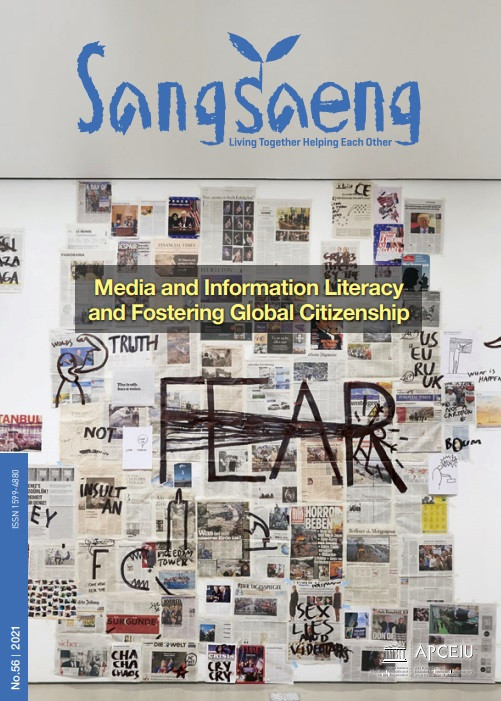 Media and Information Literacy and Fostering Global Citizenship (SangSaeng no.56, 2021) Year of publication: 2023 Corporate author: APCEIU In today’s digital age, we increasingly rely on media content and information mostly shared online to keep us informed and connected. Those issues of hate speech and stigma during the COVID-19 pandemic are closely related to the spread of fake news and disinformation. Thus, media and information literacy (MIL) has become more crucial than ever for global citizenship. In this context, the 56th edition of SangSaeng focuses on “Media and Information Literacy and Fostering Global Citizenship.” Contents 03 Editor’s Note 04 Special Column Media and Information Literacy to Ensure Rights, Freedoms / Milena Dragicevic Sesic 09 FOCUS: Media and Information Literacy and Fostering Global Citizenship09 Inclusive Media Education Promotes Media and Information Literacy / Sirkku Kotilainen13 Emotional Awareness in Age of Misinformation and Media and Information Literacy / Lisa van Wyk17 Empowering Youth to Shape Our Digital Future / Amie Kim20 A Narrative in Peace(s) / Bushra Ebadi 25 Best Practices25 Building a FaMiLLi* of MIL Educators in Namibia and Beyond / Uajorokisa Akwenye29 Youth Promoting Literacy for Life through HILA Alliance / Beatrice Bonami 33 Special Report33 Peace as an End and a Process – Dialogue with Dr. Betty Reardon on Peace Education / APCEIU38 Learn for Our Planet, Act for Sustainability – Highlights of World Conference on ESD / Alexander Leicht and Won Jung Byun 42 Story TimeGalap & Jomo / Sirhajwan Idek 44 GCED Youth NetworkYes, We Hear You, We See You / GCED Youth Network Core Group 48 LetterFostering Cultural and Language Diversity in Georgia / Marika Sikharulidze 50 APCEIU in Action
 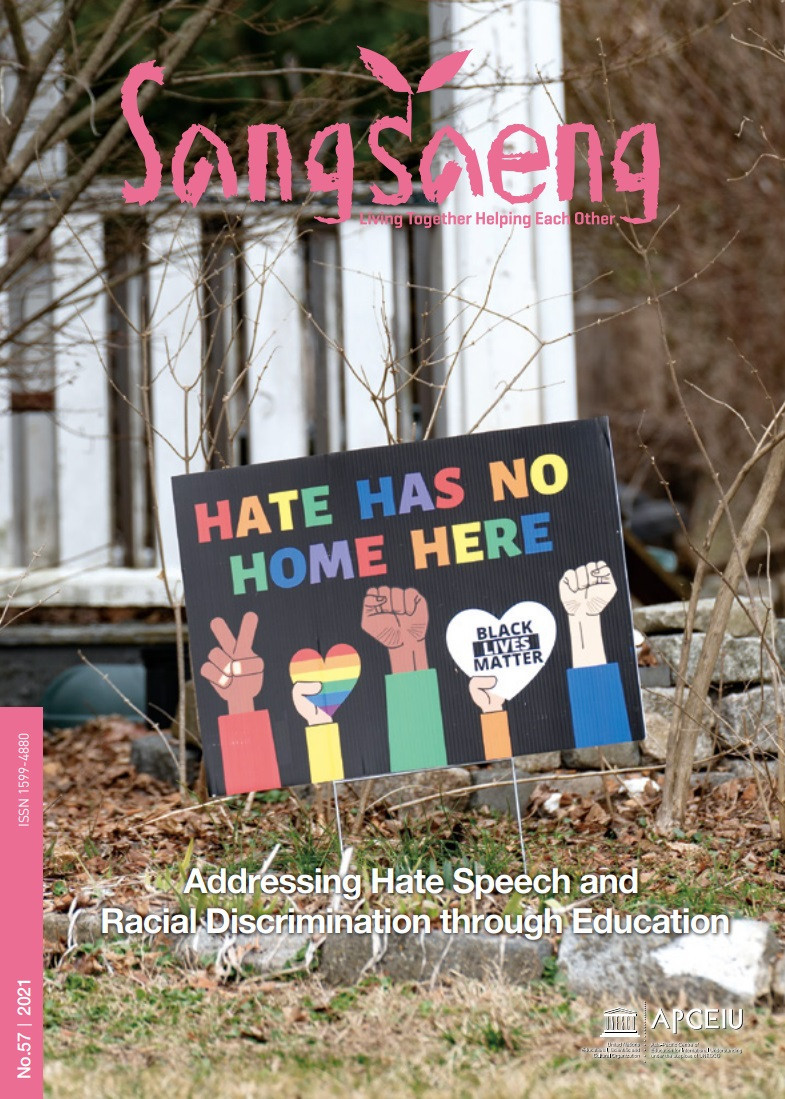 Addressing Hate Speech and Racial Discrimination through Education (SangSaeng no.57, 2021) Year of publication: 2023 Corporate author: APCEIU Today, humanity is faced with various multifaceted challenges such as climate change, increasing inequality, hate speech and racial discrimination. Moreover, the COVID-19 pandemic has crudely manifested those problems and further highlighted the acute need for concerted efforts to address them. In this context, SangSaeng No. 57 focuses on “Addressing Hate Speech and Racial Discrimination through Education” to provide readers with opportunities to reflect on these salient issues. Contents 03 Editor’s Note 04 Special ColumnFrom Hatred to Reconciliation - Learning from Rwanda / Freddy Mutanguha 08 FOCUS: Addressing Hate Speech and Racial Discrimination through Education08 Confronting Hate Speech - Thoughts, Challenges, Proposals from Educational Perspective / Gabriela Martini Armengol12 Missing Link in Global Citizenship Education – Taking into Account Identities, Alterities and Citizenships Hurt by Systemic and Chronic Racism / Gina Thesee16 Moving from Hate and Discrimination to Greater Humanity – Increasing Need for Empathy Education / Pat Dolan19 But What Can I Do? - Educational Responses to Hate Speech / Felisa Tibbitts 23 Best Practices23 Learning Democracy at Utoya - Young People’s Response to Hate and Extremism / Ingrid Aspelund26 Combatting Hate Speech – Experiences and Lessons from South Sudan / Marina Modi 29 Special Report29 Setting out Priorities for Addressing Hate Speech Through Educationt - Highlights of the Multi-Stakeholder Forum and Global Education Ministers Conference on Addressing Hate Speech through Education / UNESCO 32 Call for Global Action towards Transforming the World through Education - Highlights of the 5th UNESCO Forum on Transformative Education / APCEIU and UNESCO 35 Story TimeGrandfather’s Funeral / Sudipa Charkraverty 38 Peace in My MemoryPeace Turned into Pain / An anonymous contributor from Afghanistan 42 Understanding the Asia and the PacificMha Puja, Practicing Respect / Sharareh Bajracharya and Sanjeev Maharjan 45 Youth Network Youth Tackling Hate Speech and Racial Discrimination / GCED Youth Network Core Team 48 LetterReflections on Hate Speech and GCED / Sengpapah Holanouphab 50 APCEIU in Action
  Transforming Education and Shaping Our Futures Together (SangSaeng no.58, 2022) Corporate author: APCEIU As humanity is facing unprecedented social, economic and environmental challenges, positive changes are necessary. And education plays a key role in adapting and responding to a changing world as it can be the most reliable tool to shape our future into a more inclusive, sustainable, and just world. In this context, SangSaeng No. 58 focuses on “Transforming Education and Shaping Our Futures Together” with the goal of exploring possible alternatives to educational systems and practices. Contents 03 Editor’s Note 04 Special ColumnTransformative Education for Learning to Live Together / Lim Hyun Mook 08 FOCUS: Transforming Education and Shaping Our Futures Together 08 Global Movement to Educate for Peace – Develop Hope by Focusing on an Educational Renaissance that’s Deliberate / Fernando M. Reimers 12 University as the Foundation of Education – Effective Education System Discovers Attributes that Help to Excel / Madhav Das Nalapat 15 Vision for a Feminist, Decolonized Education – Develop Two-accountability Education that Furthers Today’s Standard / Shamah Bulangis 19 Best Practices 19 Best of Both Worlds – Collaborative Approach to Transforming Education / Dailess Banda-Zulu and Sibylle Freiermuth 23 Leading Impactful Transformation in Local Community – Grassroots Level Educational Innovation that Inspires Future Action / IniOluwa Odekunle 26 Special Report 26 Asia-Pacific Education Ministers Call for Responsive Covid-19 Learning Recovery, Transformation of Education Systems – Highlights of the Second Asia-Pacific Regional Education Minister’s Conference (APREMC-II) / Jenelle Babb, Worapot Yodpet, Seek Ling Tan 29 Transforming Education: A Call to Action – Education Stakeholders Gather to Reimagine Education and Revitalize Commitments at the Transforming Education Pre-Summit / Transforming Education Summit Secretariat 32 Story TimeMy Role Model Teacher / Joseph Sandamira 34 Letter OneCambodian Approach Toward Educational Development for Better Future Connectedness, Readiness / Mok Sarom 36 Peace in My MemoryLost and Found Peace in War Times – Defining Secret Puzzle of Peace in War-torn Ukraine / Valeria Moroz 40 Understanding the Asia and the PacificBringing Living Heritage to Asia-Pacific Classrooms – Contextualizing School Activities with Living Heritage Supports Teachers, Improves Learning Outcomes, Safeguards Living Heritage / Duong Bich Hanh and Vanessa Achilles 44 GCED Youth Network Shapers for Today and Tomorrow’s Education – Youth Tackle Educational Topics to Further Develop, Improve, Transform / Diego Manrique 47 Letter TwoSupporting Global Citizenship Education in Kenya / Jane Nyaga 49 APCEIU in Action
 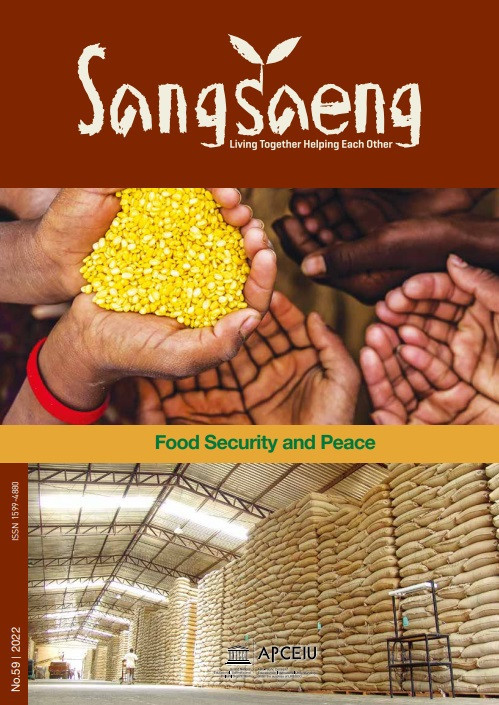 Food Security and Peace (SangSaeng no.59, 2022) Year of publication: 2023 Corporate author: APCEIU The food security issue is vital in pursuing the United Nations’ Sustainable Development Goals, which specifically include a goal of zero hunger. Hunger is both a cause and a result of conflicts. In this perspective, SangSaeng No. 59 focuses on the issue of “food security and peace” in order to examine the impacts of food insecurity and food crises and to explore possible alternatives or solutions to prevent conflicts and secure peace. Contents 03 Editor’s Note 04 Special ColumnRepositioning Youth for Responsible Citizenship / Michael Boakye-Yiadom and Raymond Chegedua Tangonyire, SJ. 08 FOCUS: Food Security and Peace 08 Conflict of Securing Food – ‘Food Insecurity is in Effect Creating an Existential Threat to Human Existence’ / Gavin E L Hall 12 Prioritizing Food Justice – Thinking About Water/Food Nexus for Latin America / Mayari Castillo 16 Feeding the Planet’s Survival – Climate Crisis and Food Security are Paramount Issues for Students to Connect with Nature / Simon Klein 21 Best Practices 21 Archipelagos of Certainty and Inclusion – Identifying Diverse Strategies to Make Learning Effective for Disabled / Eduardo Esteban Perez Leon 25 Adventure Education in Youth Work – Using Rick to Connect People and Nature to Unlearn Unhealthy Behaviours / Tina Trdin 30 InterviewRoad to Peace and Hope in Times of Crisis – Lee Chul Soo’s Works on Peace and Living Beings / APCEIU 36 Story TimeMessage of a Warlus / Marisol Bock 40 Peace in My MemoryPeace at Home / Ivy Joshia 44 Understanding the Asia and the PacificRenaissance of Traditional Archery in Asia / Lee Seunghwan 48 LetterMaking History with the EIU Photo Class Programme / Fanny Amalia Surya Tantular 50 APCEIU in Action
  Renewing Our Commitment through Revision of 1974 Recommendation (SangSaeng no.60, 2023) Year of publication: 2023 Corporate author: APCEIU After nearly 50 years, UNESCO is in the process of revising “the 1974 Recommendation”. The revision aims to ensure the sustained relevance of the Recommendation within the evolving global and educational landscape in the face of contemporary and future threats to peace, and notably included the concept of ‘global citizenship’. Recognising its profound significance, SangSaeng No. 60 focuses on the theme of “Renewing. Our Commitment through the Revision of the 1974 Recommendation” to delve into the intrinsic value and significance underpinning the revision of this normative instrument. Contents 03 Editor's Note 04 Special Column Peace Educators Reflect on Revision of 1974 Recommendation / Betty Reardon & Tony Jenkins Renewing Our Commitment to Build a Culture of Peace through Education / Toh Swee-Hin 12 FOCUS: Renewing Our Commitment through Revision of the 1974 Recommendation Highly Capable, Profoundly Human / Elisa Guerra Revisiting UNESCO 1974 Recommendation / Bert J. Tuga & Edward Shiener S. Landoy Creatively Innovative Thinking for 21st Century / Patrice Ssembirige Observations on Revision of 1974 Recommendation / Rilli Lappalainen 26 Special Report What You Need to Know about Revision of 1974 Recommendation / UNESCO and APCEIU 28 Best Practices Tell Me About My Planet / Elvira Sarsenova Crucial Strategy to Mainstream GCED in Education / Rebecca Rosario Bercasio 36 Story Time Bringing GCED to Life Through the Power of Social Impact Films / Virginia Pittaro 40 Understanding the Asia-Pacific Region Mosaic of Sri Lankan Cultural Life / Nirmal Ranjith Dewasiri 44 GCED YOUTH NETWORK Youth Addressing Pressing Social Issues / Umair Mushtaq & Anna Susarenco 48 Letter Butterfly Effect of Embracing Opportunities / Khalifa Affnan 50 APCEIU in Action
 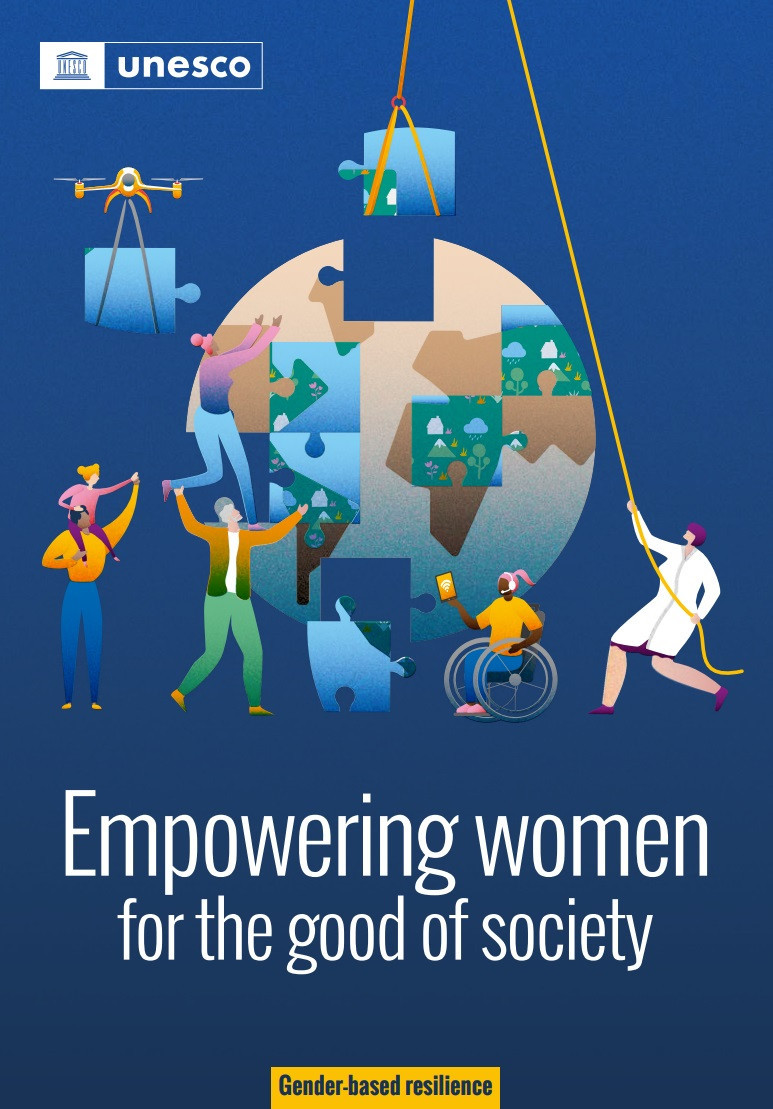 Empowering women for the good of society: gender-based resilience Year of publication: 2023 Author: Squicciarini, Mariagrazia | Sarlat, Garance | Manca, Anna Rita Corporate author: UNESCO <Short Summary> Let’s change the resilience paradigmWhat are the root causes and drivers of resilience? Societal resilience is shaped by the unique roles that individuals play and their ability to respond to shocks, gender-based expectations and discriminations hinder women’s and girls’ ability to participate in, and contribute to, society. In times of crises, their vulnerability intensifies resulting in a weakened response that ripples throughout society.In response, UNESCO designed the first Gender-Based Resilience Framework. As a compass for inclusive policymaking, this report analyzes how differences in opportunities, needs and constraints impact resilience and proposes a measurement Framework based on: (1) fundamental human rights; (2) socioeconomic characteristics, such as health, education, work, political engagement, and climate justice; (3) contextual factors, such as values and perceptions.Moving beyond the standard approach of coping with and recovering from shocks; UNESCO calls for a gender-transformative resilience, which leverages the interrelations between individuals and institutions. Decision- and policy-makers, researchers, and gender equality advocates are invited to use and add to this Framework to effectively navigate through current and future crises.It is only by empowering all women and girls, and people of all genders, that we will be able to face the challenges ahead.
 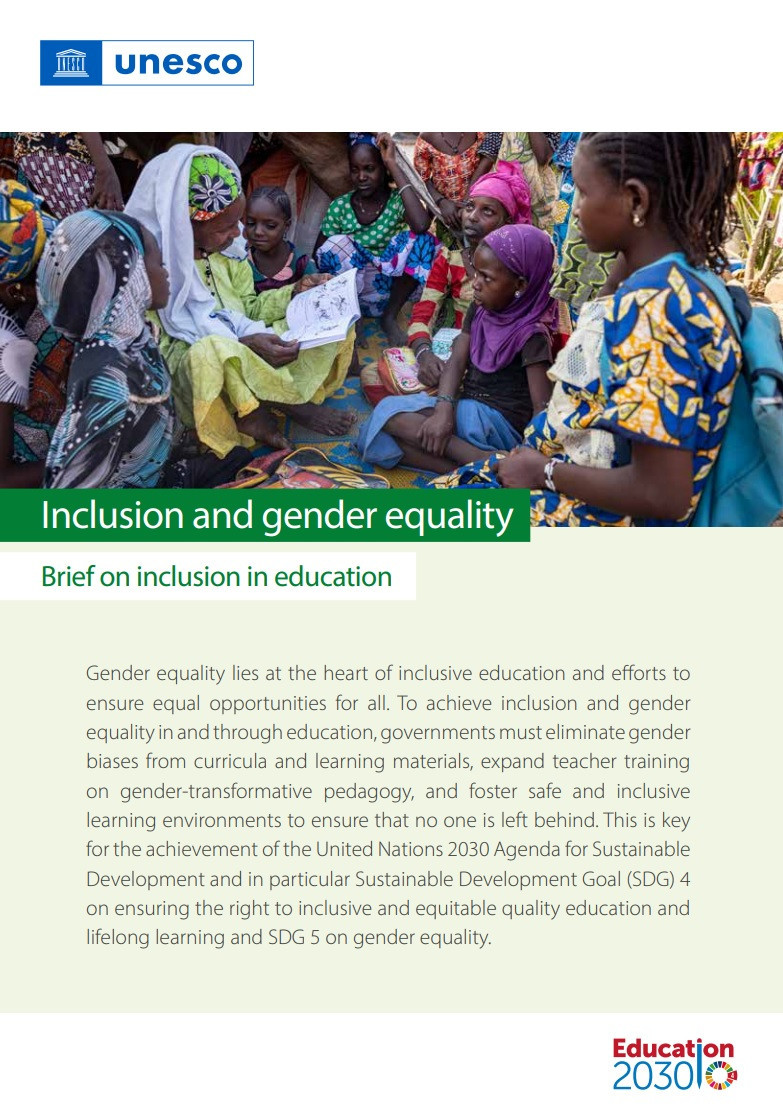 Inclusion and gender equality: brief on inclusion in education Year of publication: 2023 Corporate author: UNESCO <Brief on inclusion in education>Gender equality lies at the heart of inclusive education and efforts to ensure equal opportunities for all. To achieve inclusion and gender equality in and through education, governments must eliminate gender biases from curricula and learning materials, expand teacher training on gender-transformative pedagogy, and foster safe and inclusive learning environments to ensure that no one is left behind. This is key for the achievement of the United Nations 2030 Agenda for Sustainable Development and in particular Sustainable Development Goal (SDG) 4 on ensuring the right to inclusive and equitable quality education and lifelong learning and SDG 5 on gender equality.<Introduction>Gender refers to the socially constructed roles and relationships, personality traits, attitudes, behaviours, values, relative power and influence that society ascribes to the two sexes on a differential basis. Gender affects people’s lives every day in myriad ways. Gendered expectations, whether of oneself or of others, impact the choices people make. They structure people’s relationships and have the power to shape what people believe they can and should accomplish. Gendered power structures distribute and influence power, often resulting in systemic inequalities (UNESCO, 2021).Gender also intersects with other characteristics which can exacerbate education exclusion, such as age, geography, poverty, disability, ethnicity, indigeneity, language, religion, and migration or displacement status. Addressing the overlapping differences that create disadvantage and marginalization can help to build more inclusive and equitable education systems.Achieving gender equality in and through education is essential for inclusive education and inclusive societies. It is key to the achievement of the United Nations 2030 Agenda for Sustainable Development and in particular Sustainable Development Goal (SDG) 4 on ensuring the right to inclusive and equitable quality education and lifelong learning and SDG 5 on gender equality. In any country’s context, this means ensuring all learners have equal access to all levels of education, equal educational pathways and equal opportunities to apply the outcomes of their education. A world where inclusion and gender equality in and through education is achieved allows girls and boys, women and men and non-binary people to have equal rights and opportunities to education and the power and agency to shape their lives and futures.This brief discusses how gender equality impacts learners’ inclusion and the ways in which gender equality and inclusion are interconnected in education.