
Resources
Explore a wide range of valuable resources on GCED to deepen your understanding and enhance your research, advocacy, teaching, and learning.
8,354 Results found
 The Crime of Child Kidnapping within the Algerian Society Year of publication: 2021 Author: Abish Samir Algerian society has witnessed in recent years the emergence of social phenomena that are alien to its culture and customs, which have left its bed, distorted its appearance and instilled doubt and confusion in the hearts of its children. The most important of these is the phenomenon of kidnapping young children. This crime has witnessed a strange development threatening the life of children, the family and society in general. On the individual and society as a whole, which has made the institutions of the community to intensify their efforts to address this phenomenon hybrid and to address them and try to reach mechanisms that provide effective solutions to them. However, access to appropriate mechanisms that can address the phenomenon of child abduction and provide effective solutions can only go through the knowledge of the real causes and factors underlying the spread of this phenomenon within the Algerian society and work on diagnosing a diagnosis that allows the creation of these mechanisms. Sound and efficient. We believe that reality is the only one that can provide the real picture of the phenomenon. We have tried to investigate the phenomenon of child abduction by analyzing a sample of the cases of kidnapping that took place within Algerian society and to identify the forms and causes that led to them.
  العنف ضد الأطفال في المجتمع السعودي دراسة اجتماعية من واقع إحصاءات الجمعية الوطنية لحقوق الإنسان Year of publication: 2020 Author: Dr. Faisal bin Abdullah Al-Ruwais The study aimed to identify the reality of violence against children in Saudi society by determining the extent of violence against children by region, identifying patterns of violence against children according to the type of abuse they are exposed to, and identifying the children most exposed to violence by gender, in addition to revealing The most common family members commit violence against children, based on statistics from the National Society for Human Rights. This study is a descriptive and analytical study. The qualitative approach was used by using the content analysis method for the total statistical data for the period from 2014-2018 AD. It has become clear from the statistical data: that the highest percentage of violence against children over the five years occurred in the Riyadh region, followed by the Makkah Al-Mukarramah region, then the Medina region, and that the highest types of abuse to which children are exposed is physical abuse, then deprivation of education, then deprivation of Identification documents indicate that the highest degree of violence against children was committed against females, then males, and that the family member who committed the most violence against children was the father, then the mother, then the stepmother.
  The health, Psychological and Educational Damage resulting from School Children’s Addiction to Electronic Games Year of publication: 2022 Author: Mazara Naima, Ahmed Al-Sayed Abdel-Qawi Children’s, addiction to electronic games, and the researchers adopted the descriptive method, to achieve the objectives of the research, a questionnaire was prepared for health, psychological and educational damages, it was applied to a sample of 60 individuals (teachers and parents of children), and after statistical analysis, it showed The results found the following: - There are many health damages resulting from school children’s addiction to electronic games from the point of view of their teachers and parents, which are: short-sightedness and visual impairment by( 86%), health problems of the nervous system (75%),health problems in the spine(100%), malnutrition (58.3%) sleep disorders (83.3%), damage to the fingers of the hand (60%). - There are many psychological damages resulting from school children’s addiction to electronic games from the point of view of their teachers and parents, which are: introversion (78.33%), violence (70%), poor memory (53.33%), addiction (100%), feelings of depression (58.3%), emotional imbalance (76.67%). - There are many educational damages resulting from school children’s addiction to electronic games from the point of view of their teachers and parents, which are: School delay (100%), failure to attend homework (96.7%), preference for playing over review and study (50%), inability to pay attention to the lesson (80%), go to private lessons (73.33%).
  The Penal Protection Established for Child Labor Year of publication: 2022 Author: Aitbenamer Ghania Corporate author: University of Mostaghanem Central This study aims to clarify the important of the development of human resources in its various dimensions for companies specially the Algerian ones, by providing human resources with knowledge, skills and experience and improving their behavior, which help them to do their work and develop their performance, then provide an added value to the company where they work, This study focused on the reality of the application of the various dimensions of human resources development (training, learning, empowerment, career development) in the Eastern Company of Electricity and Gas Distribution – Unit of Tebessa. In order to answer the problem posed and to test the main hypothesis, the quantitative approach was adopted through a questionnaire that was distributed to a simple random sample of 234 employees of the company, representing 47.17% of the total population of the study. The collected data was analyzed using the Spss V25 program, The study concluded that the level of application of human resources development in its various dimensions in the Eastern Company of Electricity and Gas Distribution – Unit of Tebessa is good, although there is a discrepancy in the application of these dimensions, which ranged between high and medium.
 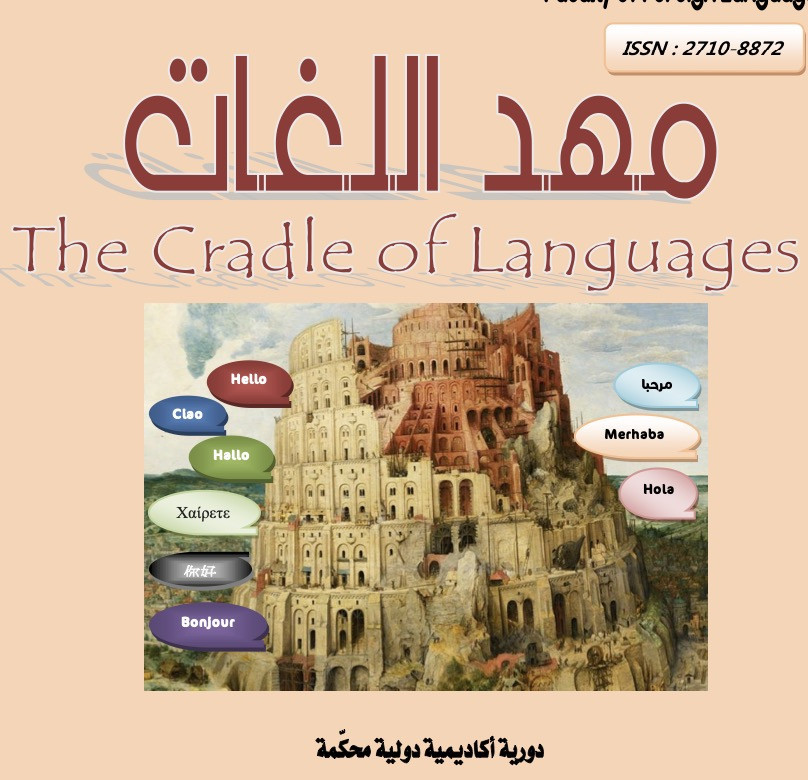 Use of Smartphone Applications to Teach Arabic to English Language Speakers Between the Tangible Reality and the Hoped-for Future Year of publication: 2022 Corporate author: University of Chlef This research examines a scientific phenomenon that hat has spread in the past few years on teaching Arabic to native English speakers using smartphone applications. Smartphone usage proved to be a stimulating phenomenon that drew the researcher's attention to studying it in great detail. The researcher observed several smartphone applications in teaching Arabic to English speakers. However, this led to the writer's description, clarification, and categorization of these applications based on their features and characteristics, just as he was keen to explain and clarify some demerits of these applications. The main goal was to help students when selecting the rightful applications for them should they resort to learning Arabic through such applications. In his attempt to explain more about these applications, the researcher used a descriptive method where he also defined some of the terminologies used in this research, for example, smartphone and Arabic language applications for English speakers. He also spoke about the most vital characteristics of Arabic language learning through smartphone applications. He then mentioned a range of smartphone applications, such as the famous Duolingo app used to teach Arabic and other languages to English speakers, as well as the Arabic unlocked application. In summation, the researcher concluded his research paper by looking into the future characteristics of such applications and what an ideal application in teaching Arabic to English speakers should be.
 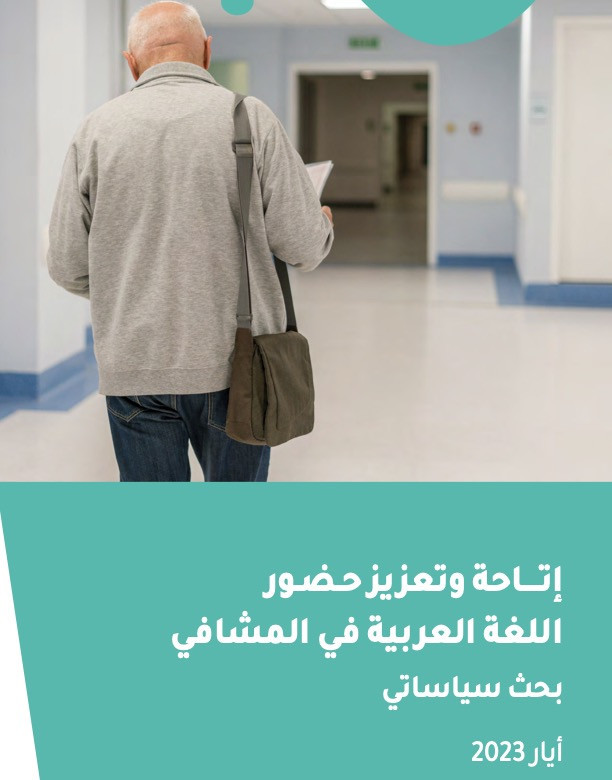 إتاحة وتعزيز حضور اللغة العربية في المشافي Year of publication: 2023 Author: لوريا دلة، خلود إدريس، عيدان رينغميخال شوستر، لوريا دلة Public space in Israel constitutes a meeting point between Arab and Jewish citizens. This space includes health institutions, higher education institutions, cultural and artistic institutions, and others. The presence of the Arabic language in the public sphere is necessary in order to enable Arab citizens to achieve their basic right to obtain clear and reliable information in their mother tongue. The absence of the Arabic language from this sphere and its partial or incomplete presence carries an implicit message of exclusion and neglect of Arab citizens. Hospitals are an extremely important part of the public space, because they are entrusted with the protection of basic rights – the right to life and the right to health. In addition to their vital services, hospitals are among the main employment centers in Arab society, employing doctors, therapists and many other professional staff. Therefore, enhancing the presence of the Arabic language in health institutions may contribute significantly to disseminating and consolidating the values of common life and building a common society in Israel. The Ministry of Health gave this issue utmost importance in the Director-General’s Circular of 2011, specifying that “signage in health institutions must be compatible with the linguistic composition of the main population segments that receive services in these institutions.”Wherever possible, signs are available in three languages: Hebrew, Arabic and English.The “Sikkuy-Ofoq” association believes that within the framework of health care, the Ministry of Health and hospitals must also bear responsibility for creating an equal and shared space that includes Arab citizens and their language.This research aims to survey and evaluate the level of Arabic language presence in hospitals. The survey was conducted at the beginning of 2022 in 12 hospitals in various parts of the country, where a survey was conducted to determine the extent of the presence of the Arabic language in the different types of signage on the paths frequented by the largest number of visitors within the hospital space. Emergency signs, warning signs, directions and prohibitions signs, and signs to direct and facilitate movement. .The results and obstacles that we reached in the survey process are documented in the full paper, along with a series of recommendations that contribute to improving the situation, and they are directed to the Ministry of Health and hospitals.
 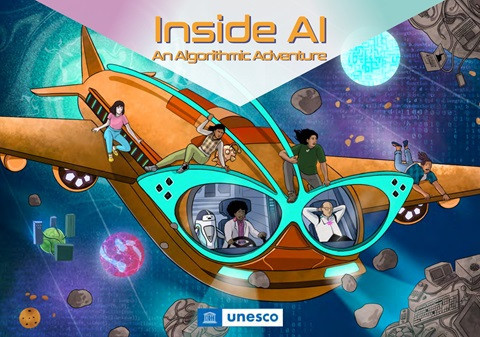 Inside AI - An Algorithmic Adventure Year of publication: 2022 Author: Katherine Evans Corporate author: UNESCO In the framework of UNESCO’s work to harness emerging technologies for sustainable development, this graphic novel for policymakers as well as youth explores the impact of Artificial Intelligence on humankind. Dive into the world of AI and follow the adventures of four characters whose lives are affected by algorithmic hazards: By following characters in four different corners of the globe as they grapple with the limits of AI technologies, the audience jointly embarks on a mission in an algorithmic galaxy called Plethor.A.I.. There, they have but one option: travel across this hidden world behind our screens to learn about the social, technical, ethical and human rights impacts of Artificial Intelligence, and help the characters find a way back to reality.UNESCO’s first graphic novel on Artificial Intelligence (AI) aims at providing an educational media to policymakers, adults and youth who are curious and interested in learning more about AI, its challenges and stakes.
 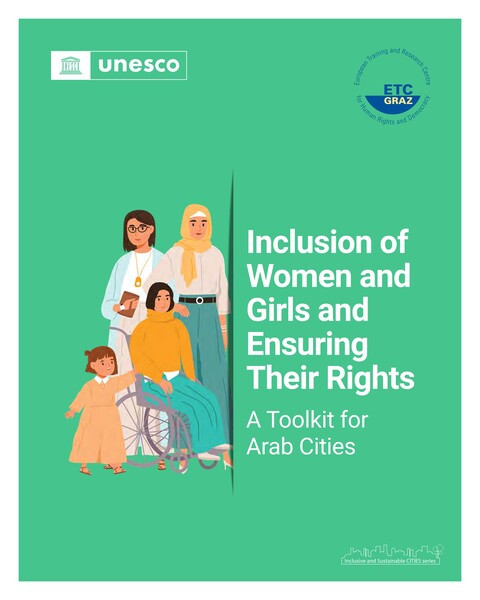 Inclusion of Women and Girls and Ensuring Their Rights: A Toolkit for Arab Cities Year of publication: 2023 Corporate author: UNESCO Cairo | European Training and Research Centre for Human Rights and Democracy (Austria) Even though women and girls represent close to or more than half of the population of most Arab cities, they are one of the groups that are historically and structurally excluded from decision-making and development planning in the cities. They face many barriers in accessing cities services, and inequality participating in cities activities. Developed on the basis of a virtual regional consultation workshop, as well as in-depth interviews with cities officials and representatives from the Coalition of Arab Cities against Racism, Discrimination, Xenophobia and Intolerance, this Toolkit provides tools and practical advice to enable Arab cities achieve a better inclusion of women and girls, and ensure their full right to benefit from local development programs. The toolkit mainly targets local authorities in Arab cities including Mayors, Members of Municipality Councils, Municipal executives, and Entities concerned with the design, implementation, follow-up, and evaluation of local projects and programs. “Since wars begin in the minds of men andwomen it is in the minds of men and womenthat the defences of peace must be constructed”Inclusion of women and girls in Arab cities: challenge or opportunity?This publication is the result of a joint effort involving the European Training and Research Centre for Human Rights and Democracy in Graz, UNESCO Coalition of Arab Cities against Racism, Discrimination, Xenophobia and Intolerance, and UNESCO Cairo Office.
 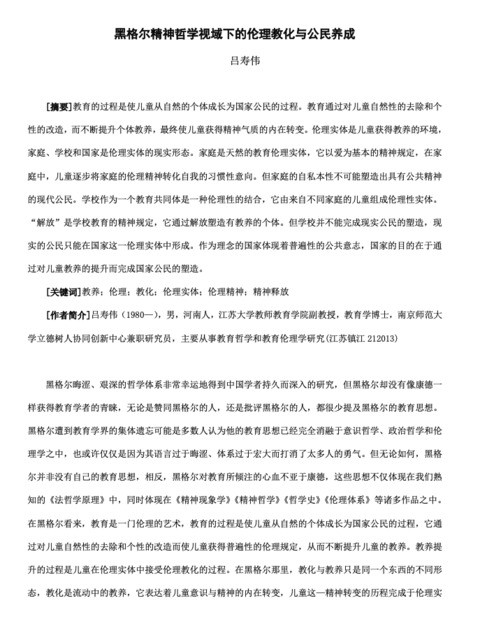 Ethical Civilization and the Cultivation of Citizens in the Perspective of Hegel’s Philosophy of Spirit (Ethical Education Research; No.2, 2019) Year of publication: 2019 Author: 吕寿伟 The process of education is to make children grow from natural individuals to national citizens. Education constantly improves individual upbring through the removal of children’s nature and the transformation of their individuality, and ultimately makes the inner change of children’s spirit. Ethical entities are the environment for children to be nurtured, and families, schools and states are the realistic forms. Family is the natural ethical entity of education, which takes love as the basic spiritual rule. In family, children gradually transform the family’s ethical spirit into the habitual intention of self. But the selfish nature of the family cannot create a modern citizen with a public spirit. The school, as an educational community, is an ethical combination which consists of children from different families. “Emancipation”,which is the spiritual rule of school education, creates educated individuals. But school cannot shape the real citizens, which can only be formed in the ethical entity of the country. The state, as a concept, embodies the common will of the public. The purpose of the state is to complete the shaping of the national citizens through the promotion of children' upbring.
 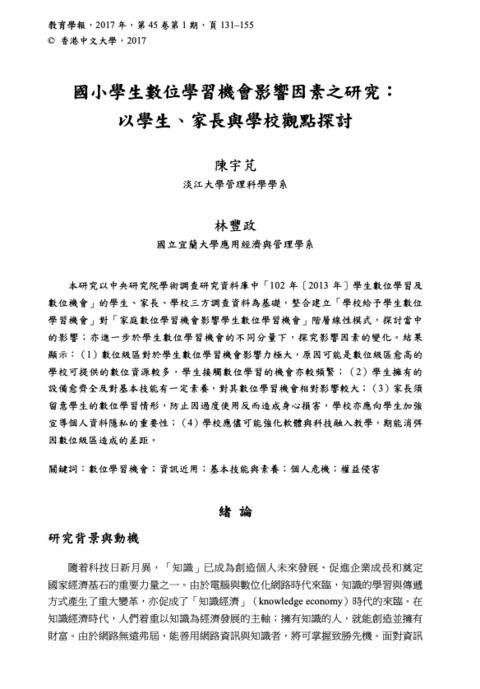 A Study on the Influential Factors of E-learning Opportunity for Elementary School Students: Perspectives from Students, Parents and Schools (Educational Journal ; Vol.45, No.1) Year of publication: 2017 Author: 陈宇芃 | 林丰政 Based on the data from students, parents and schools of the 2013 Survey of Student Digital Ability and e-Learning Opportunity from the Academia Sinica’s Survey Research Data Archive, this article constructed a hierarchical linear model to analyze how students’ e-learning opportunity is related to the multilevel influence effects of school- and parent-level covariates. Quantile regression was also used to study different covariate effects at different quantile levels of student e-learning opportunity. Results indicate that: (1) Digital Level Area is a very important influential factor for students’ e-learning opportunity due to the reason that schools in higher Digital Level Area have more digital resources, and students are likely to have more opportunity for access to and frequent use of e-learning; (2) the more IT equipment or IT literacy students have can greatly affect their possession of e-learning opportunity; (3) parents should pay special attention to problems of their children resulting from overuse of e-learning resources which could cause harm to their children both mentally and physically; moreover, schools should widely promote the awareness of personal information security to students; (4) in order to eliminate the digital divide caused by Digital Level Area, schools need to strengthen the integration of software and information technology into instruction as far as possible.