
Resources
Explore a wide range of valuable resources on GCED to deepen your understanding and enhance your research, advocacy, teaching, and learning.
8,354 Results found
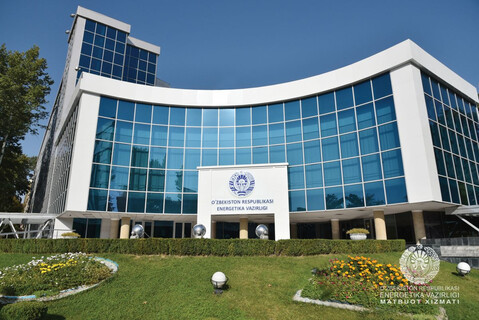 Transition to “Green Economy” in Uzbekistan: Opportunities and Challenges Year of publication: 2023 Author: Nodira Mukhammadkulova | Shakhrizoda Rakhimova Corporate author: Central Asian Bureau for Analytical Reporting (CABAR) Climate change issues and the crisis in the energy market have led to the development of technologies for the use of alternative, more environmentally friendly and possibly renewable resources, which are called “green” technologies. In Uzbekistan, the program of transition to a green economy and green growth until 2030 was adopted at the end of 2022. According to the program, by 2030, the share of renewable energy sources (RES) used will be about 30% of the country’s total electricity generation. The issue of awareness of the population as consumers about the relevance of diversification of energy consumption, advantages and disadvantages of alternative energy sources is relevant.
  Multilingual Education in Central Asian Institutions of Higher Education (Journal of Moscow University. Series 20. Pedagogical Education; No.2, 2020) Year of publication: 2020 Author: Цзэн Тин In the context of internationalization, language education and the choice of language for teaching have become important factors affecting the quality of higher education. Currently, in addition to Turkmenistan, the Governments of other Central Asian countries are putting forward strategies for multilingual development that correspond to their own national characteristics. The problems of the development of multilingual education in higher educational institutions of Central Asia are as follows: strong political coloring, lack of qualified teachers, educational materials and funds for education, difficulties in the development of the national language.
  New Challenges and Approaches to Regional and Global Security in Central Asia Year of publication: 2020 Corporate author: Organization for Security and Co-operation in Europe (OSCE) On 26 October 2018 in Nur-Sultan, the OSCE Programme Office in Nur-Sultan jointly with the Friedrich Ebert Foundation and the Kazakhstan Council on International Relations, with support from the Institute of Diplomacy under the Academy of Public Administration and the Public Opinion Research Institute co-organized an international conference entitled “New Challenges and Approaches to Regional and Global Security in Central Asia”. This compendium, which includes presentations given at the conference by both Kazakhstan’s and foreign participants, explores main regional security threats in Central Asia and ways to address these problems, as well as regional co-operation issues in responding to contemporary challenges. The edition will be of interest to political scientists, international relations experts, civil servants, scholars, educators, university-level students, and broad sections of the public interested in the contemporary development of the region. The edition is published in Russian and English. The paper of Mr. Pal Dunay is written in the English language in the original, the rest of the reports are in Russian. All reports have been translated and edited with the support of the OSCE Program Office in Nur Sultan. Any opinions and recommendations expressed in the materials arising from the conference are those of the authors and do not necessarily reflect the views of the conference organizers.
  Embracing Peace through UNESCO World Heritage Year of publication: 2024 Author: 장정아 | 김민성 | 김수진 | 김원호 | 안치영 | 오성희 | 오창현 | 이성영 | 이현경 | 전원희 Corporate author: Korean National Commission for UNESCO This resource kit is the product of long labor by 10 researchers consisting of scholars on UNESCO heritage and teachers working in schools that belong to the UNESCO Associated Schools Network (ASPnet). It is distinct from existing educational resources in several ways. First, this kit goes beyond introducing the variously inscribed World Heritage properties one after another, to explain the rich significance of the heritage properties through keywords such as peace, cultural diversity, and sustainability. We also sought to overcome misconceptions about World Heritage and presented the content through various interesting cases for easy, hands-on application in classroom settings. In 2024, KNCU has pilot-tested the teaching materials presented in this resource kit in Korean middle and high schools belonging to UNESCO ASPnet. An online teacher training course based on this book has also been provided in June this year.
 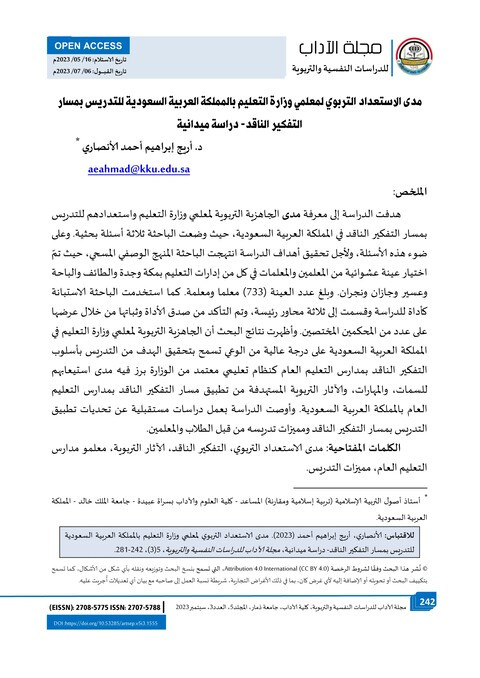 The Extent of Educational Readiness of Using Thinking Skills Strategy among Teachers at the Ministry of Education, Saudi Arabia: A Field Study (Arts for Educational & Psychological Studies; Vol.5, No.3) Year of publication: 2023 Author: Areej Ibrahim Ahmed Al Ansari Corporate author: Dhamar University This study aimed to identify educational readiness and willingness of teachers affiliated to the Ministry of Education to use critical thinking in their teaching, in Saudi Arabia. To achieve the study objectives, the descriptive survey method was adopted, and a questionnaire was used to collect data from the study sample which consisted of (733) male and female teachers, randomly selected from education directorates of Makkah, Jeddah, Taif, Al-Baha, Asir, Jazan, and Najran. The questionnaire included three main dimensions;and after testing its validity, and reliability, it was administered to the sample. The study results showed that teachers’ educational readiness scored a high degree of awareness that would allow achieving the goal of teaching by using critical thinking in schools as a teaching strategy approved by the Ministry of Education. The teachers also showed their understanding of the characteristics, skills and educational effects of the application of the critical thinking strategy in schools. The study recommended conducting future studies on the challenges and advantages of applying the critical thinking strategy from the perspective of students and teachers.Keywords: Extent of educational readiness, Critical thinking, Educational effects, School teachers.
 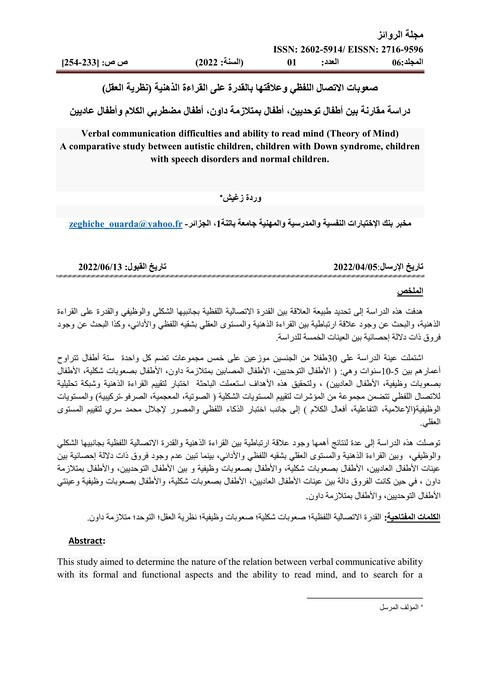 Verbal Communication Difficulties and Ability to Read Mind (Theory of Mind): A Comparative Study Between Autistic Children, Children with Down Syndrome, Children with Speech Disorders and Normal Children (Novels Magazine; Vol.6, No.1) Year of publication: 2022 Author: Zaghish Warda Corporate author: Batna 1 University This study aimed to determine the nature of the relation between verbal communicative ability with its formal and functional aspects and the ability to read mind, and to search for a correlation between mind reading and the mental level in both its verbal and performance aspects, as well as searching for the existence of statistically significant differences between the five samples of the study.The study sample included 30 children of both sexes distributed into five groups, each includes six children between the ages of 5-10 years: (Autistic children, children with Down syndrome, children with formal difficulties, children with functional difficulties,normal children), and to achieve these Objectives the researcher used a test to assess mental reading and an analysis grid for verbal communication, , in addition to the verbal and visual intelligence test of Ejlal Muhammad Serri to assess the mental level .This study reached several results: a correlation between mental reading and verbal communicative ability in its formal and functional aspects, and between mind reading and the mental level in both its verbal and performance aspects, while it was found that there were no statistically significant differences between the samples of normal children, children with formal difficulties, children with functional difficulties, autistic children, and children with Down syndrome, while the differences were significant between samples of normal children, children with formal difficulties, children with functional difficulties and the two samples of autistic children, and children with Down syndrome.
 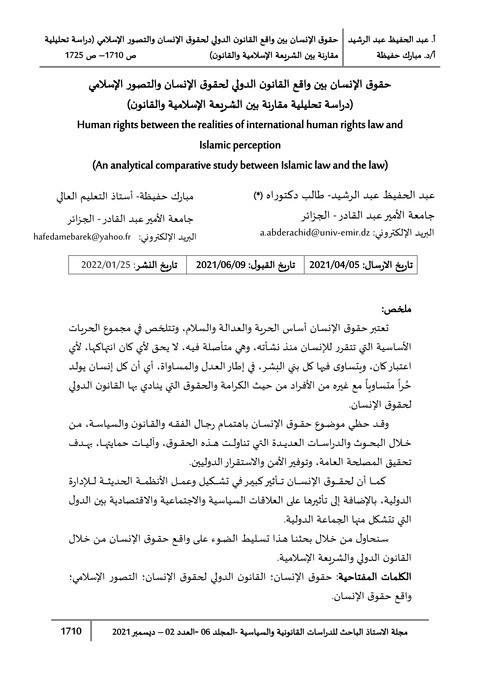 Human Rights Between The Realities of International Human Rights Law and Islamic Perception (An Analytical Comparative Study Between Islamic Law And the Law) (Journal of Professor Researcher for Legal and Political Studies; Vol.6, No.3) Year of publication: 2022 Author: Abderachid Abdelhafid | Hafeda Mebarek Corporate author: M'sila University Human rights are the basis of freedom, justice and peace. They consist of all the fundamental freedoms that have been established for human beings since their inception. They are inherent in human beings. No one shall violate them, on any account, and all human beings shall be equal, within the framework of justice and equality, that is, every human being shall be born free and equal to other individuals in terms of the dignity and rights proclaimed by international human rights law. The subject of human rights has received the attention of scholars, law and politics through numerous research and studies on human rights and their protection mechanisms, with a view to achieving public interest and international security and stability. Human rights also have a significant impact on the formation and functioning of modern regimes of international governance, as well as on the political, social and economic relations between the States that make up the international community. Through this research, we will try to highlight the reality of human rights through international law and Islamic law.
 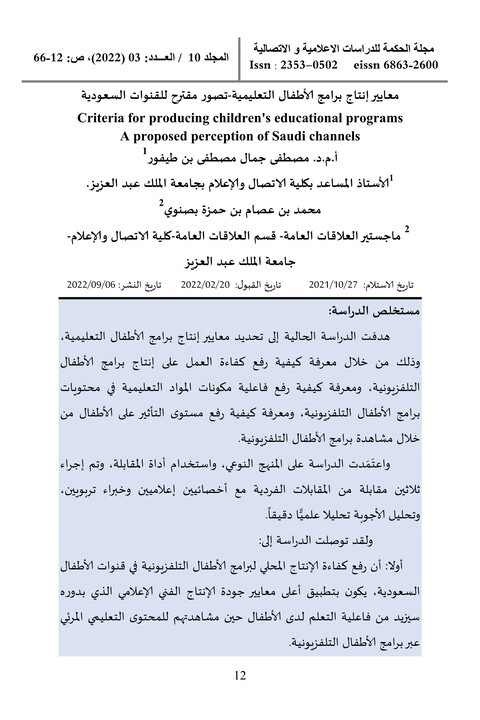 Criteria for Producing Children's Educational Programs A Proposed Perception of Saudi Channels (Al-Hikma Journal for Media and Communication Studies; Vol.10, No.3) Year of publication: 2022 Author: Basnawi Muhammad This study aimed to define the production criteria of children's educational programs, by knowing how to raise the work efficiency for the production of children's television programs, knowing how to raise the effectiveness of the components of educational materials in the contents of children's television programs, and knowing how to raise the influential levels on children by watching children's programs television. This study relied on the qualitative approach. By using the interview tool, thirty sessions of individual interviews were conducted with media specialists and educational experts; then the transcripts were scientifically analyzed. This study relied on the qualitative approach. By using the interview tool, thirty sessions of individual interviews were conducted with media specialists and educational experts; then the transcripts were scientifically analyzed. This study found: First: To increase the efficiency of local production of children’s television programs in Saudi children’s channels is by applying the highest quality standards of media artistic production, which, in turn, will increase the learning effectiveness of children when they watch visual educational content through children’s television programs. Secondly: The priority topics, which should be provided in the content of children’s educational programs, is: (Mental education, moral education,socialization). Third: The use of modern educational means in the content industry for children’s educational programs, which comprises (modeling, dramatic story, competitions, repetition) will increase the effectiveness of their impact on the contents of children's programs in Saudi channels. Based on the findings of this study, the researcher proposed an application model of the production criteria for children's educational programs when producing children's television programs on Saudi channels.
 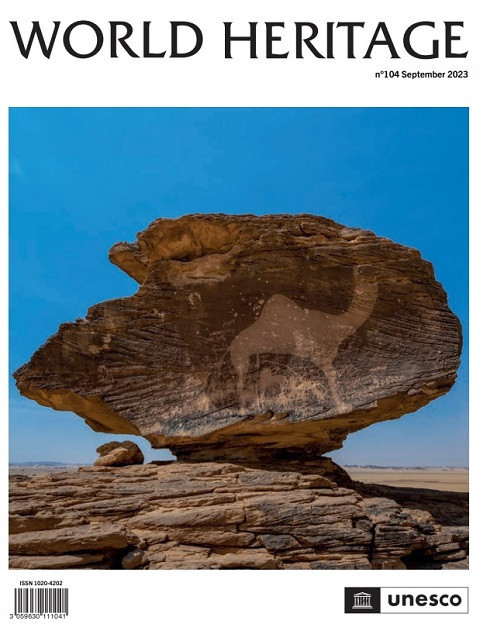 World Heritage, No.104 Year of publication: 2023 Corporate author: UNESCO As the extended 45th session of the World Heritage Committee begins in the Kingdom of Saudi Arabia, we express our gratitude to our hosts for convening the first in-person Committee since the onset of COVID-19. Surrounded by old friends and young professionals alike, we are reminded that this meeting is more than the sum of important decisions taken. It is a powerful platform where we rekindle the sense of ‘heritage community’ and renew our commitment to heritage. This issue of World Heritage magazine features African heritage leaders who are empowering peers and creating positive ripple effects from Egypt to Mozambique. A report on climate change details the critical benefits provided by World Heritage forests notably through carbon absorption, with one caveat – their capacity will continue to decline unless we act now. A compelling story comes from Havana, Cuba, where a major UNESCO programme Transcultura is blending tangible heritage, intangible practices and contemporary creativity, true to the way culture intersects in the local communities. Readers may notice the new design of this World Heritage magazine, which pays homage to the original iconic look. The first issue in 1996 put a spotlight on the accelerating international cooperation to conserve Angkor, bearing fruit in 2004 with the removal from the List of World Heritage in Danger. Just as the magazine has been a witness to history, it continues to champion the evolving principles of heritage safeguarding. This is why this revamped magazine will centrally feature stories of custodians, innovators and trailblazers, in line with the 'fifth C' (Communities) of the Strategic Objectives. The words by the 80-year-old Havana resident Noemí Moreno should echo with many of us: 'In the end, we are nothing more than a bird that comes and flies away. History is what remains'. And so we get to work together, pooling experience gained over the past five decades of the 1972 Convention and the ancestral knowledge passed down over centuries, to preserve the remnants of history as best as we can.
  Equipping To Deal With Intolerant Speech: Racism, Antisemitism, Sexism, Discriminations Year of publication: 2023 Corporate author: Citoyenneté Possible In this report, NGO Citoyenneté Possible shares 18 years' experience in the field of anti-discrimination and dialogue. It provides both hands-on experience, with testimonials and tools, and in-depth reflection, analysis and sharing of experiences, practices and visions. It's possible to dare to engage in constructive dialogue on divisive issues, provided you have the intention to do so, and above all, the skills to do so. This report offers very concrete and detailed recommendations for professionals working with young people (teachers, educators, associations, etc.).