
Resources
Explore a wide range of valuable resources on GCED to deepen your understanding and enhance your research, advocacy, teaching, and learning.
8,363 Results found
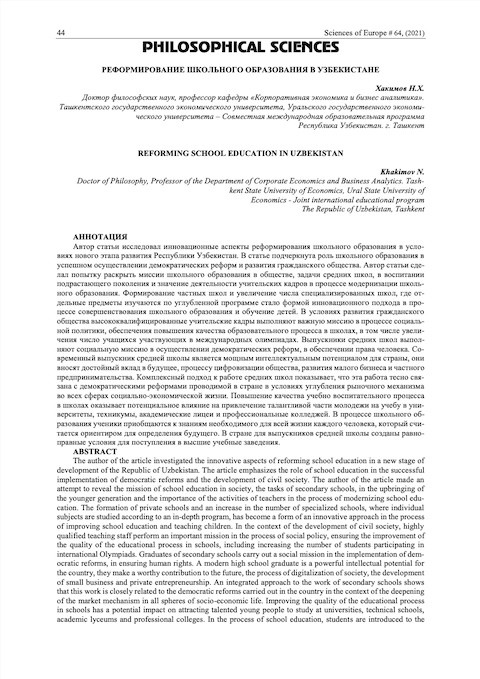 Reforming School Education in Uzbekistan (Sciences of Europe; no.64) Year of publication: 2021 Author: N. Khakimov The author of the article investigated the innovative aspects of reforming school education in a new stage of development of the Republic of Uzbekistan. The article emphasizes the role of school education in the successful implementation of democratic reforms and the development of civil society. The author of the article made an attempt to reveal the mission of school education in society, the tasks of secondary schools, in the upbringing of the younger generation and the importance of the activities of teachers in the process of modernizing school education.
 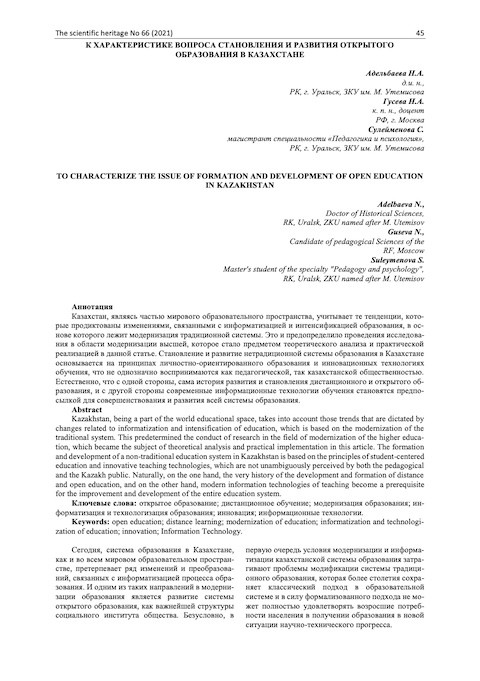 Сharacterizing the Formation and Development of Open Education in Kazakhstan (The Scientific Heritage; no. 66) Year of publication: 2021 Author: N. Adelbaeva | N. Guseva | S. Suleymenova Kazakhstan, being a part of the world educational space, takes into account those trends that are dictated by changes related to informatization and intensification of education, which is based on the modernization of the traditional system. This predetermined the conduct of research in the field of modernization of the higher education, which became the subject of theoretical analysis and practical implementation in this article. The formation and development of a non-traditional education system in Kazakhstan is based on the principles of student-centered education and innovative teaching technologies, which are not unambiguously perceived by both the pedagogical and the Kazakh public. Naturally, on the one hand, the very history of the development and formation of distance and open education, and on the other hand, modern information technologies of teaching become a prerequisite for the improvement and development of the entire education system.
 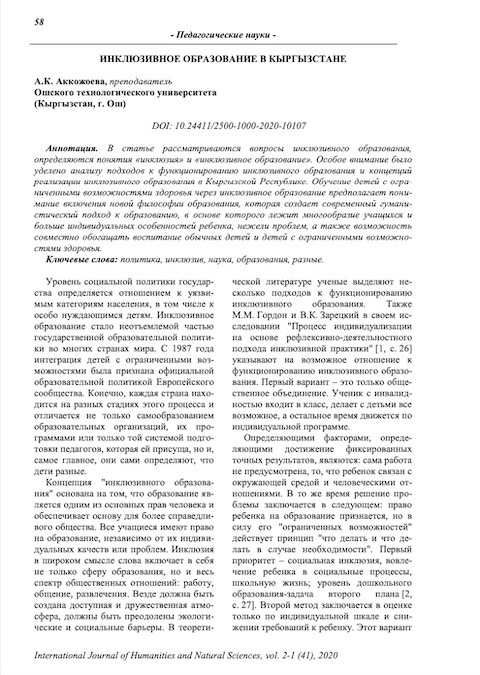 Inclusive Education in Kyrgyzstan (International Journal of Humanities and Natural Sciences; vol. 2-1, no. 41) Year of publication: 2020 Author: A.K. Akkojoeva The article deals with issues of inclusive education, defines the concepts of "inclusion" and "inclusive education". Special attention was paid to the analysis of approaches to the functioning of inclusive education and concepts for the implementation of inclusive education in the Kyrgyz Republic. teaching children with disabilities through inclusive education involves understanding the inclusion of a new philosophy of education that creates a modern humanistic approach to education based on the diversity of students and more individual characteristics of the child than problems, as well as the ability to jointly enrich the education of ordinary children and children with disabilities.
 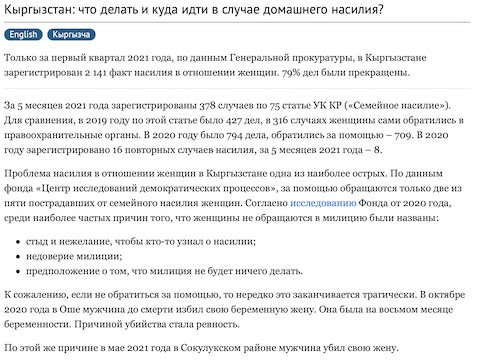 Kyrgyzstan: What to Do and Where to Go in Case of Domestic Violence? Year of publication: 2021 Author: Mehrinisa Sulaimanovna Corporate author: Central Asian Bureau for Analytical Reporting (CABAR) The problem of violence against women in Kyrgyzstan is one of the most relevant. According to the Centre for Democratic Processes Studies Fund, only two of five female victims of domestic violence call for help.
 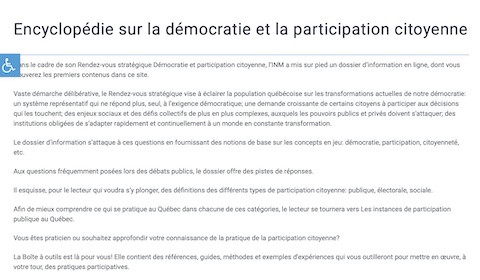 Encyclopedia on Democracy and Citizen Participation Author: Malorie Flon | Émilie Béorofei Corporate author: Institut du Nouveau Monde (INM) As part of its Strategic Meeting on Democracy and Citizen Participation, the INM has set up an online information pack, the first contents of which you will find on this site.A vast deliberative process, the Strategic Rendezvous aims to enlighten the people of Quebec on the current transformations of our democracy: a representative system that no longer responds, on its own, to the democratic requirement; a growing demand from certain citizens to participate in decisions that affect them; increasingly complex social issues and collective challenges, which public and private authorities must tackle; institutions forced to adapt quickly and continuously to a constantly changing world.The Briefing Kit tackles these questions by providing basic notions of the concepts involved: democracy, participation, citizenship, etc. To questions frequently asked during public debates, the dossier offers some possible answers. It outlines, for the reader who wants to dive into it, definitions of the different types of citizen participation: public, electoral, social. In order to better understand what is practiced in Quebec in each of these categories, the reader will turn to The authorities of public participation in Quebec.Are you a practitioner or would you like to deepen your knowledge of the practice of citizen participation? The Toolbox is here for you! It contains references, guides, methods and examples of experiences that will equip you to implement, in turn, participatory practices.
 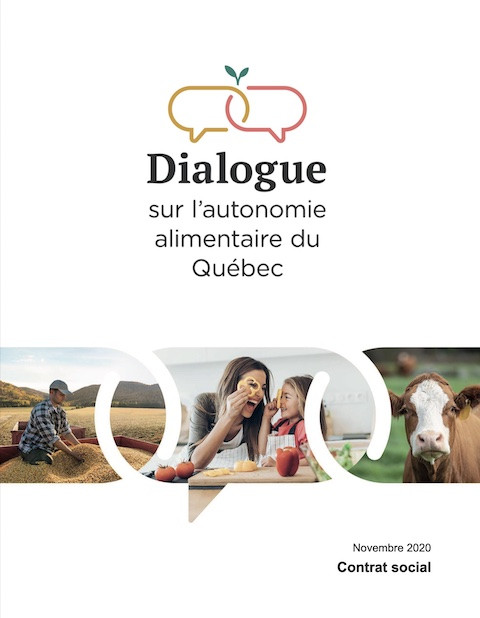 Dialogue on Quebec Food Autonomy Year of publication: 2020 Corporate author: Institut du Nouveau Monde (INM) Food autonomy is more than ever a crucial subject for Quebec society. The COVID-19 pandemic has revealed the fragility of our food system and has created a new opportunity to talk about this strategic issue. Several players are saying it: it It is time to bring agricultural producers closer to citizens, and to create new forms of solidarity between them.To do this, the Union des producteurs agricoles (UPA) wishes to set up a real opportunity for dialogue between the two ends of the production chain food, that is to say producers and citizens.The Dialogue on food autonomy is an opportunity for citizens to participate in the development of a social contract on issues related to food autonomy and to facilitate a dialogue between them and producers, who are an essential link. of this strategic issue. It provides opportunities for open and constructive exchanges between agricultural producers and citizens, first separately and then in a common group. It will then be offered to all of Quebec.
 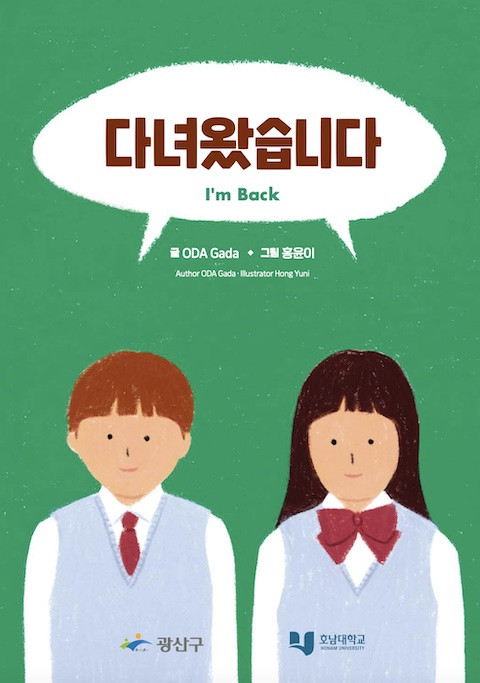 I'm Back Year of publication: 2020 Corporate author: ODA Gada | 광진구 | 호남대학교 〈I'm back〉 is the third illustrated book in the ‘Rainbow Youth Global Citizen Project’ jointly published by Gwangsan-gu Office of Gwangju and Honam University. Youths need gender equality education to become members of community that respect diversity. This book was made more meaningful as we listened directly to the stories of adolescents, the main audience of this book, and the contents were created with them from the composition stage through workshops. The participating teenagers were a great help to the publication of this book as they actively voiced their opinions.
  Why Is Music So Important in Our Life? Year of publication: 2019 Author: José Manuel Zapata Corporate author: BBVA Aprendemos Juntos The tenor José Manuel Zapata talks about the importance of music in people's lives, emphasizing the first years of life, the effects of teaching music on children, on the development of empathy and language.
  Virtual Conference: Positive Discipline; Tools to Connect and Guide Year of publication: 2021 Corporate author: Red Papaz In this virtual conference, Gigliola Nuñez made an explanation about what positive discipline is and shared tools for loving accompaniment in the upbringing of children, children and adolescents. The history of positive discipline began in the 1920s and was consolidated with greater force in the 1980s with Jane Nelsen and Lyn Lott, who supported the entire program in the research of Alfred Adler and Rudolph Dreikurs, ideas now supported by neuroscience.
 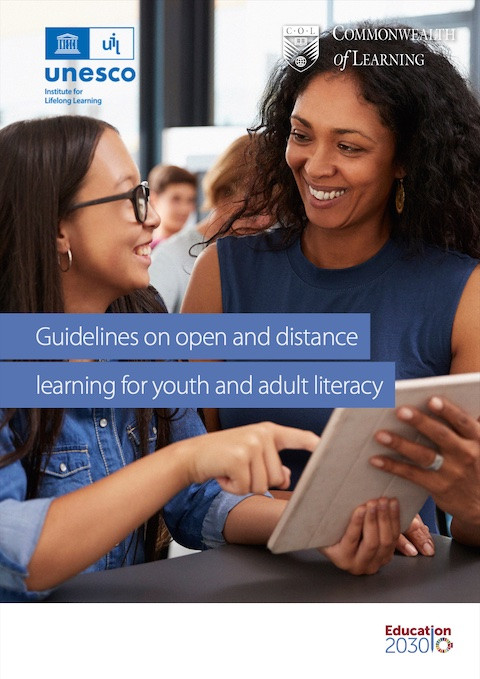 Guidelines on Open and Distance Learning for Youth and Adult Literacy Year of publication: 2022 Corporate author: UNESCO Institute for Lifelong Learning (UIL) | Commonwealth of Learning Guidelines on open and distance learning for youth and adult literacy addresses a gap in literacy provision by presenting open and distance learning (ODL) principles and practices to illustrate how learning and education can be delivered at a distance.This publication is divided into two main parts. Part 1 presents practical guidance in four areas—planning, development, implementation, and monitoring and evaluation—and part 2 considers the various technologies that are used for ODL programmes and could support youth and adult literacy learning.Policy-makers, literacy providers and educators will benefit from understanding and applying the concept and principles of ODL in designing and delivering effective, inclusive and sustainable literacy programmes and learning opportunities— strengthening the resilience of their literacy programmes and expanding outreach and participation in the process.