
Resources
Explore a wide range of valuable resources on GCED to deepen your understanding and enhance your research, advocacy, teaching, and learning.
8,363 Results found
 Progress on the Sustainable Development Goals: The Gender Snapshot 2021 Year of publication: 2021 Corporate author: United Nations Entity for Gender Equality and the Empowerment of Women (UN Women) | UN. Department of Economic and Social Affairs (UN. DESA) The pandemic has tested and even reversed progress in expanding women’s rights and opportunities. Women have not recovered lost jobs and income, hunger is on the rise, and school closures threaten girls’ educational gains. Women’s participation in government, research and resource management remains far from equal. Vulnerable groups of women, including migrants, those with disabilities and those affected by conflict, are frequently left behind. Disparities between rich and poor countries are preventing equal access to lifesaving COVID-19 vaccines and treatments, putting women in poorer countries at disproportionate risk. Moreover, despite women’s central roles in responding to COVID-19, including as front-line health workers, they do not have the leadership positions they deserve. Building forward differently and better will require placing women and girls at the centre of all aspects of response and recovery, including through gender- responsive laws, policies and budgeting.Progress on the Sustainable Development Goals: The Gender Snapshot 2021 presents the latest evidence on gender equality across all 17 Sustainable Development Goals, highlighting the progress made since 2015 but also the continued alarm over the COVID-19 pandemic, its immediate effect on women’s well-being and the threat it poses to future generations.
 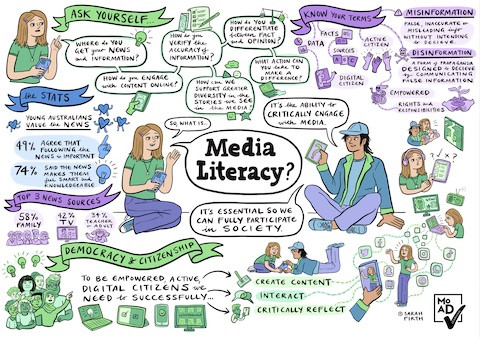 Media Literacy Author: Sarah Firth Corporate author: Museum of Australian Democracy at Old Parliament House This infographic helps hook students into reflecting and considering a range of questions and information about media literacy.
  Citizen Participation and Participatory Research in the Field of Social Inequalities (Nouvelles pratiques sociales; vol. 30, no. 1) Year of publication: 2018 Author: Baptiste Godrie | Guillaume Ouellet | Robert Bastien | Sylvia Bissonnette | Jean Gagné | Luc Gaudet | Audrey Gonin | Isabelle Laurin | Chrisopher McAll | Geneviève McClure | François Régimbal | Jean-François René | Mireille Tremblay Corporate author: University of Quebec at Montreal This article analyzes the effect of citizen participation on social inequalities, based on research conducted by a multidisciplinary team of researchers and community partners. Citizen participation may ensure comments and knowledge that have been completely or partially left out of the public space to emerge, and can help participants to get rid of a pre-established look towards people living in poverty. The analysis also focuses on power relations build during participatory research processes.
 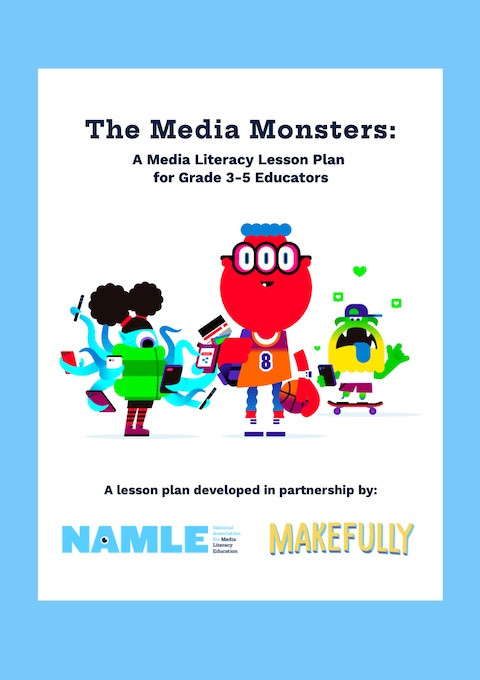 The Media Monsters: A Media Literacy Lesson Plan for Grade 3-5 Educators Year of publication: 2021 Corporate author: National Association for Media Literacy Education (NAMLE) | Makefully Studios In response to the increasing amount of media children are exposed to on a regular basis, the National Association for Media Literacy Education (NAMLE) and Makefully Studios are teaming up to provide educators with unique content that will inspire relevant, rich, and age-appropriate discussion in their classrooms about how we all consume and interact with different types of media. Using this lesson plan, students will begin to identify, reflect and recognize behaviors and media practices in themselves, and identify the media literacy skills needed to improve the ways they engage with media and think critically about the media messages around them.
 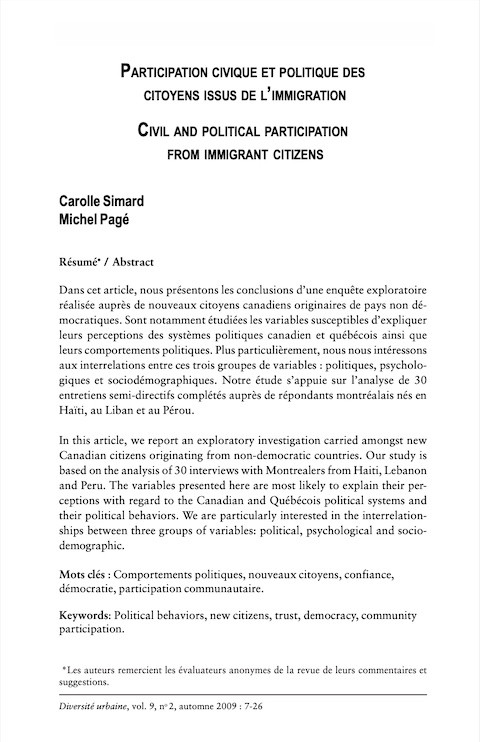 Civil and Political Participation From Immigrant Citizens (Diversité urbaine; vol. 9, no. 2) Year of publication: 2016 Author: Carolle Simard | Michel Pagé Corporate author: Groupe de recherche diversité urbaine (GRDU) | Centre d’études ethniques des universités montréalaises (CEETUM) In this article, we report an exploratory investigation carried amongst new Canadian citizens originating from non-democratic countries. Our study is based on the analysis of 30 interviews with Montrealers from Haiti, Lebanon and Peru. The variables presented here are most likely to explain their per- ceptions with regard to the Canadian and Québécois political systems and their political behaviors. We are particularly interested in the interrelation- ships between three groups of variables: political, psychological and socio- demographic.
  The Future of Global Citizenship Education After COVID Year of publication: 2020 Corporate author: Spur Change This is a video from the Spur Change webinar titled "The Future of Global Citizenship Education After Covid" "which took place on October 22, 2020.
  Beyond Academic Learning: First Results from the Survey of Social and Emotional Skills Year of publication: 2021 Author: Marta Encinas-Martin | Eva Feron | Francesco Avvisati | Marco Paccagnella | Javier Suárez-Alvarez | Michelle Cherian Corporate author: Organisation for Economic Co-operation and Development (OECD) Over the last few years, social and emotional skills have been rising on the education policy agenda and in the public debate. Policy makers and education practitioners are seeking ways to complement the focus on academic learning, with attention to social and emotional skill development. Social and emotional skills are a subset of an individual’s abilities, attributes and characteristics important for individual success and social functioning. Together, they encompass a comprehensive set of skills essential for students to be able to succeed at school, at work and fully participate in society as active citizens.The benefits of developing children’s social‐emotional skills go beyond cognitive development and academic outcomes; they are also important drivers of mental health and labour market prospects. The ability of citizens to adapt, be resourceful, respect and work well with others, and to take personal and collective responsibility is increasingly becoming the hallmark of a well‐functioning society. The OECD’s Survey of Social and Emotional Skills (SSES) is one of the first international efforts to collect data from students, parents and teachers on the social and emotional skills of students at ages 10 and 15. This report presents the first results from this survey. It describes students’ social and emotional skills and how they relate to individual, family, and school characteristics. It also examines broader policy and socio‐economic contexts related to these skills, and sheds light on ways to help education leaders and policy makers monitor and foster students’ social and emotional skills.
  Democracy and the Accommodation of Diversity: Advancing Pluralism Through Power Sharing, Self-Governance and Limited Government Year of publication: 2018 Author: Rotimi Suberu Corporate author: Global Centre for Pluralism (Canada) Democracy is, paradoxically, both essential and precarious in diverse and divided societies with deep cultural or ethnic (i.e., linguistic, regional, religious, racial, and other attributes of identity) divides. group). There are examples of relatively non-violent management of ethnic diversity in undemocratic systems, including the Ottoman Empire's millet system to accommodate non-Muslim communities; the British colonial system of indirect administration; and the informal ethnic balancing practices of many African dictatorships. However, the majority of ethnicity scholars agree that undemocratic regimes are often unsuccessful - and ultimately, unsustainable - managers of ethnic diversity, and that there are "no viable alternatives. democracy ”as a pluralist, peaceful, just and sustainable system of governance of such diversity. This is because basic democratic practices, including credible multiparty elections and effective protections for civil rights and freedoms, are essential for the proper articulation, representation and accommodation of competing ethnic interests.
 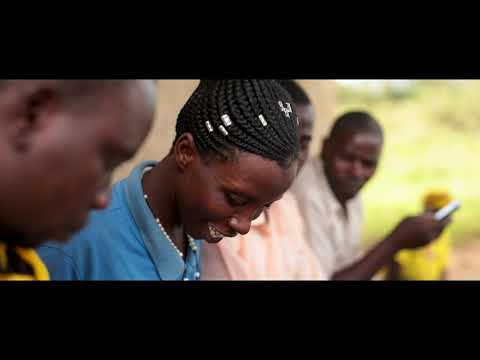 Mpanga Year of publication: 2020 Corporate author: Îles de Paix This 15-minute report allows you to discover the life of rural populations in the Kabambiro areas in Uganda, but also the challenges these people face. This report shows how solutions are put in place to overcome these various difficulties, in particular by addressing the issue of sustainable family farming.
  New Uzbekistan and Human Rights: Uzbekistan’s Progress Towards Compliance With International Obligations on Human Rights Year of publication: 2019 Corporate author: National Human Rights Center (NHRC) The present information briefly highlights the basic directions of state policy on the implementation of personal, political, economic and social rights in 2018-2019. It also underlines the development of national human rights institutions, the role of civil society institutions in protecting human rights, as well as Uzbekistan’s human rights initiatives at the international arena and the implementation of international human rights treaties.