
Resources
Explore a wide range of valuable resources on GCED to deepen your understanding and enhance your research, advocacy, teaching, and learning.
8,363 Results found
 The Role of the Mother Tongue in Learning Standard Arabic at the Primary Stage in the Algerian School Year of publication: 2012 Author: Khaled Abdel Salam Corporate author: Farhat Abbas Setif University Our study has two mean objectives: To determine the first language consequences, whatever they are general, Arabic, or Kabyle, in the learning of school language at different vocabulary, singular, grammar, and, conjugation structures, therefore, exploring if they are helping factors in the learning process or hampering it. To identify the cognitive strategies used by the novices in their learning process in relation to their language performance and errors made in the oral and written expression. In order to deal with this situation, we utilized the descriptive analytical method, in which we had chosen randomly two samples composed of 90 scholars (45 scholars speaking general Arabic language, and 45 scholars speaking Kabyle language), on which we administered two tests, one in the form of an interview about personal and health informations, and the other one about the environment conservation. After, we had analysed the content of the responses, via the extraction of the language errors expanded, and categorising them to different styles or patterns, and computing their frequencies, and explaining them, we founded the following results: Whatever, the first language is general, Arabic or Kabyle, it has a big consequence over all the language structures, therefore, making the scholars language not different from them. According to these results, we can conclude that these factors are not considered as helping factors in the learning process. There is a tendency for the novices to utilize more, both of the revising strategies of courses and the deduction strategy compared to the others. there are no significant differences between scholars speaking general Arabic language and scholars speaking kabyle language in the vocabulary structure, but, there are significant differences between these two samples on the grammatical and conjugational structures, related to personal, pedagogical and familiar factors. According to these results, we can conclude that the language level of the novices on both samples is not related to the abilities required by the school system.
  Pursuing the Sustainable Development Goals in a World Reshaped by COVID-19: Foundational Research Report Year of publication: 2021 Author: Barry B. Hughes | Taylor Hanna | Kaylin McNeil | David K. Bohl | Jonathan D. Moyer Corporate author: United Nations Development Programme (UNDP) | Frederick S. Pardee Center for International Futures This report advances existing monitoring and forecasting initiatives in three ways. First, it provides, for selected goals and targets, especially those related to human development, projections for the path of progress that the world seemed to be on prior to the outbreak of the COVID-19 pandemic. Second, despite the still very high levels of uncertainty around the ultimate course of the pandemic, it considers the possible impact on longer-term progress. Third, it explores the potential impact of a broad and integrated program of initiatives intended to move us more quickly toward achieving the goals.The SDG Push scenario successfully increases the rate of progress toward the targets sufficiently to overcome the global losses of even the High Damage COVID scenario before 2030 for most target variables. On top of the baseline COVID scenario it greatly increases the number of countries reaching target levels by 2030 and 2050.
  Innovation for Sustainable Development: Review of Kyrgyzstan Year of publication: 2019 Author: Anders Jönsson | Christopher Athey | Slavo Radosevic Corporate author: United Nations Economic Commission for Europe (UNECE) The practical work on the Innovation for Sustainable Development Review of Kyrgyzstan began in December 2016 with a preparatory mission to Bishkek by representatives of the UNECE secretariat to establish contact and discuss the structure and content of the Review with the national Government institutions and other stakeholders. The main project mission took place from 30 March to 7 April 2017 with the participation of a team that included representatives of the UNECE secretariat as well as international and national experts. This Review reflects the outcome of a series of consultations and discussions between the Review team and policymakers, Government officials, representatives of academic institutions and the business community, and other innovation stakeholders of Kyrgyzstan.This report presents a thematic regional analysis of unpaid work in Eastern Europe and Central Asia (EECA) and the resulting empowerment women gain when their responsibility for such work is reduced. The report focuses on Albania, Azerbaijan, Bosnia & Herzegovina, Georgia, Kazakhstan, Kyrgyzstan, Kosovo, Montenegro, North Macedonia, Republic of Moldova, Serbia, Turkey, Ukraine and Uzbekistan.Apart from three country case studies (on Kyrgyzstan, Republic of Moldova and Serbia) the other reports in the series cover the 56 UNECE member States, including the countries of Europe and countries in North America (Canada and United States), Central Asia (Kazakhstan, Kyrgyzstan, Tajikistan, Turkmenistan and Uzbekistan) and Western Asia (Israel).
  Times of Life and Death: Memories and Struggles of Indigenous Peoples in Colombia Year of publication: 2019 Corporate author: National Center for Historical Memory | National Indigenous Organization of Colombia This book presents research carried out by the National Center for Historical Memory and the national Indigenous organization of Colombia. This stories broaden the view on the conflict and the construction of the State in Colombia. It transcends the confrontation between armed actors in the recent conflict in the country, to expand the understanding of who we are and what we have been as a diverse and multicultural nation.
 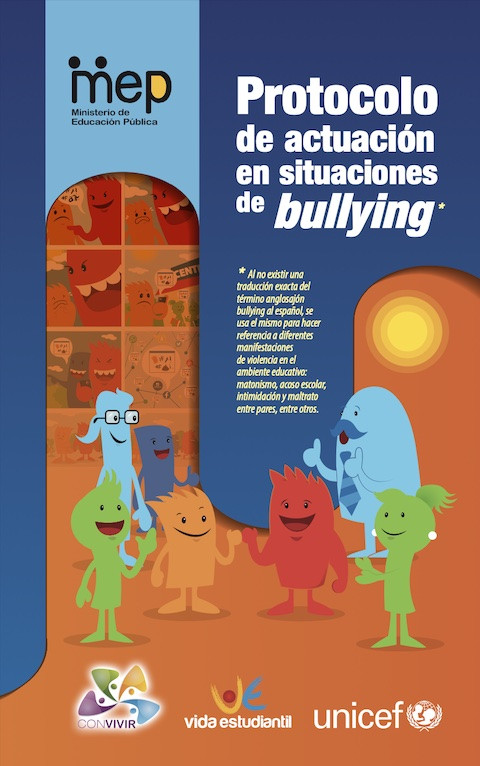 Action Protocol in Bullying Situations Year of publication: 2016 Corporate author: Costa Rica. Ministry of Public Education | Directorate of Student Life | United Nations Children's Fund (UNICEF) Bullying is a reality suffered by children, adolescents and young people all over the world. It affects their well-being, their development and the exercise of their rights as well as their responsibilities. Addressing these situations in the educational environment requires a coordinated and articulated effort to assign time, resources, tasks, and responsibilities of each and every actor in the educational community and institutions responsible for the care of the child and adolescent population.
  Why There Is War in Syria? Year of publication: 2015 Corporate author: CuriosaMente What is happening in Syria? What is the cause of the conflict in Syria? This video explains the situation in this region formerly known as Mesopotamia.
  SDG 4 Data Digest 2020: Using Household Survey Data to Monitor SDG 4 Year of publication: 2020 Corporate author: UNESCO Institute for Statistics (UIS) The 2020 edition of the SDG 4 Data Digest by the UNESCO Institute for Statistics focuses on household surveys as an important and underutilized tool to collect the data needed to track progress towards Sustainable Development Goal 4 and to ensure that no one is left behind. The Digest describes existing survey programmes and offers advice on the design and implementation of new surveys. The Digest identifies a number of advantages to using household surveys and describes the categories of indicators best suited for monitoring with survey data. Data from household surveys complement administrative data collected in schools and can be disaggregated to a greater extent than administrative data to facilitate the monitoring of exclusion in education. The definitions and calculation methods of selected indicators are laid out and the combination of household survey data with data from other sources is explained. This issue of the Digest is aimed at government officials, national planners, donors and others who make decisions about the implementation of nationally representative household surveys. It describes the requirements for conducting a household survey and the steps that must be followed from questionnaire design to data collection and analysis, and it gives advice on presentation of the findings. A section on COVID-19 summarizes the impact of the current pandemic on data collection. Additional resources, with suggested survey questions for the collection of education data through household surveys, are also included.
  Experiences of Education for Sustainable Development in the Further Education and Training Sector Year of publication: 2021 Corporate author: Education and Training Foundation The Education and Training Foundation (ETF) recognises the vital role the further education and training (FE) sector has to play in combating climate change and achieving sustainability and social justice, both nationally and globally. Not only does our sector provide the technical and vocation skills required to help transition to a sustainable future, it also reaches millions of learners from all walks of life, spread across diverse communities.This report provides the results and an analytical narrative of findings from a survey carried out among the FE and training sector workforce about their experiences of education for sustainable development (ESD).
 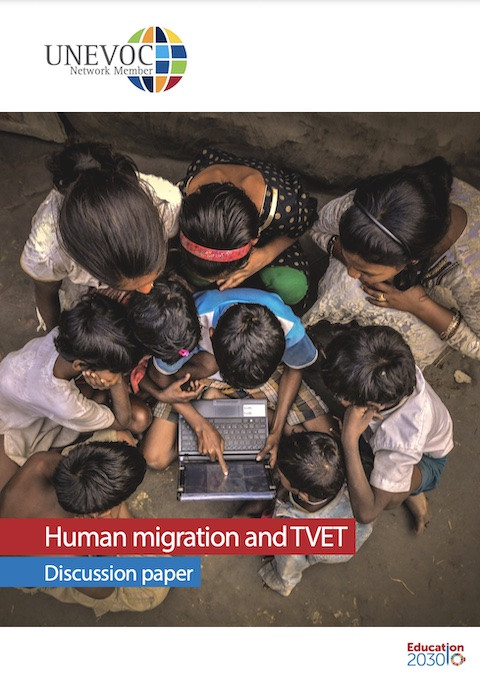 Human Migration and TVET Year of publication: 2019 Author: Volker Wedekind | Haya Fakoush | Joyceline Alla-Mensah Corporate author: UNESCO International Centre for Technical and Vocational Education and Training (UNEVOC) In the context of increased international migration, the importance of education and training and a global governance of migration is widely acknowledged in academic and international development debates. This discussion paper looks at the relationship between migration and technical and vocational education and training (TVET), distinguishing between forced, labour and environmental migration.
  How Mindful Compassion Practices Can Cultivate Social and Emotional Learning Year of publication: 2018 Author: Marilee Bresciani Ludvik | Tonya Lea Eberhart Corporate author: Mahatma Gandhi Institute of Education for Peace and Sustainable Development (MGIEP) A fundamental purpose of social-emotional learning (SEL) is to provide students with opportunities to develop self-awareness, self-management, and social awareness, which in turn would lead to positive goal-oriented behaviors and the cultivation of collaborative relationships. While scholarly literature lists several strategies to foster SEL skills, there is little evidence of their effectiveness. There is research to support that mindful compassion practices (MCPs) cultivate specific outcomes that align with SEL outcomes. However, questions as to how much of each of these practices and how long they need to be practiced in order to realize effective integration into school curricula remain unanswered. Nevertheless, it has been determined that in order for these approaches to have a positive effect, schools need support to define, implement, evaluate, and modify SEL curriculum according to their needs.