
Resources
Explore a wide range of valuable resources on GCED to deepen your understanding and enhance your research, advocacy, teaching, and learning.
8,363 Results found
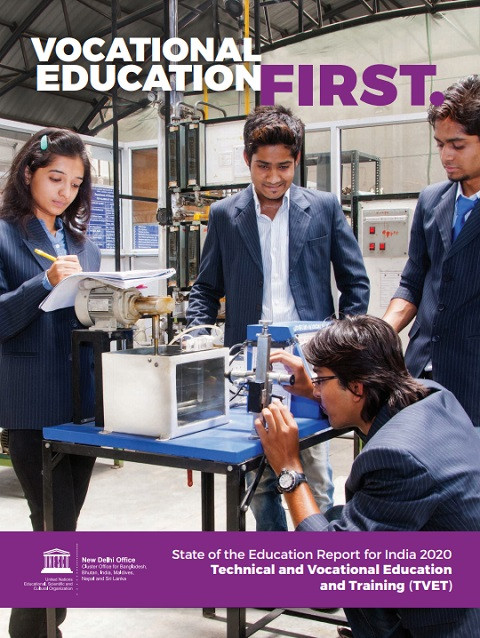 Vocational Education First: State of the Education Report for India 2020; Technical and Vocational Education Training (TVET) Year of publication: 2020 Author: Leena Chandran Wadia | Neela Dabir Corporate author: UNESCO New Delhi This report aims to capture the intense activity of the vocational education and training sector and highlights achievements and promising practices in India. The report makes important recommendations for reforms and for the use of TVET to empower youth to adapt to the post-COVID world.
  Media and Information Literacy for Knowledge Societies Year of publication: 2013 Corporate author: Interregional Library Cooperation Centre | UNESCO This book includes communications by the participants and other materials of the International Conference on Media and Information Literacy for Knowledge Societies (Moscow, Russian Federation, 24–28 June, 2012), that offered a unique opportunity to identify the key existing challenges in the field, to outline policies and professional strategies for the advocacy of media and information literacy (MIL), to promote best practices and strengthen international cooperation among various stakeholders. It also contains the Media and Information Literacy Competencies Catalogue prepared by The Modern Poland Foundation (Warsaw, Poland).
  Mapping of Media Information Literacy in Jordan Year of publication: 2018 Corporate author: UNESCO Amman This study has come out as results of conducting a regional mapping exercise in Jordan to identify organizations that operate in the field of MIL to:understand the general landscape of MIL in Jordan to pinpoint areas in which UNESCO should intervene,identify different stakeholders that operate in the field of MIL and understand the scope of their work in terms of activities, region and target,determine the areas of MIL that are considered priorities by organizations,identify the key skills covered by the different initiatives and the nature of these activities,determine the challenges organizations are facing in implementing MILThe results of the study revealed that organizations exhibit considerable enthusiasm for the field of MIL and consider the competencies that fall within its scope as paramount in building a society that is empowered to successfully navigate the increasingly complex media sphere and use this knowledge to further contribute to the societal, cultural, educational and scientific development.
 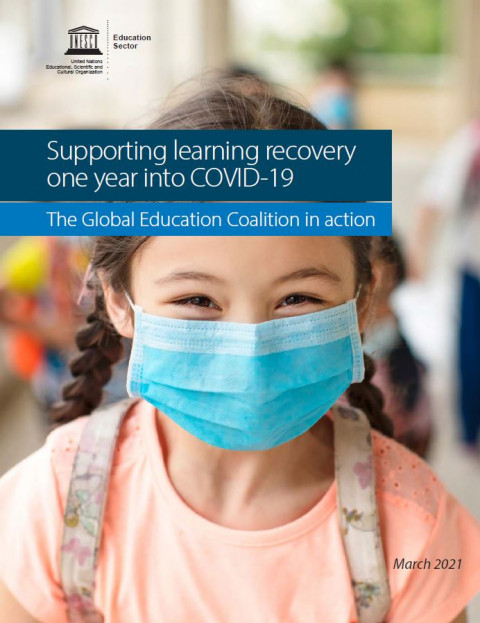 Supporting Learning Recovery One Year into COVID-19: The Global Education Coalition in Action Year of publication: 2021 Corporate author: UNESCO | Global Education Coalition The Global Education Coalition, launched by UNESCO, is a platform for collaboration and exchange to protect the right to education during this unprecedented disruption and beyond.This is the annual report of the Coalition, which builds on the inaugural report published in September 2020, and covers the activity between March 2020 and March 2021.
  Imagining and Practising Global Citizenship Education Year of publication: 2020 Corporate author: UNESCO Venice This methodological guide illustrates the ways in which the International Cooperation Centre (ICC) has been promoting and practicing Global Citizenship Education in Italy for more than ten years. The training work developed by the ICC in the field of GCED, presented here in its theoretical articulation and in its practical outlining in some concrete experiences, may offer some reflections in the form of useful recommendations for continuing and strengthening the promotion of GCED.
  Seoul Declaration on Media and Information Literacy for Everyone and by Everyone: A Defence Against Disinfodemics Year of publication: 2020 Corporate author: UNESCO On the 10th anniversary of Global Media and Information Literacy Week, stakeholders from all over the world gave a resounding affirmation as to the urgency to strengthen people’s media and information literacy competencies. The number of celebratory events increased from one hundred events in 2019 to over three hundred events in 2020.The outcomes of the deliberations in the Feature Conference and Youth Agenda Forum have been immortalized in the Seoul Declaration on Media and Information Literacy for Everyone and by Everyone: A Defence against Disinfodemics. This Seoul Declaration benefited from a consultation with close to one thousand registered participants.Through the Seoul Declaration, partners and participants called for media and information literacy for all. They:Emphasized that “media and information literacy (MIL) is a core competency for addressing the disinfodemic, and that MIL also contributes to access to information, freedom of expression, protection of privacy, prevention of violent extremism, promotion of digital security and combating hate speech and inequality”.Recognized “UNESCO’s effort to promote a Global MIL Cities Framework to stimulate creative learning about MIL in city spaces and the involvement of non-traditional actors in promoting MIL”.Called on duty bearers at the national to city levels to “commit to advancing ‘Media and Information Literacy for Everyone and by Everyone’ through policy and resource allocation across all relevant areas, including education, health, elections, child protection, climate, gender equality, governance and regulation, to mention some examples”.Urged technological intermediaries to “play an accountable role, through institutionalized multi-stakeholder systems, as part of the social endeavor to tackle disinformation and to build communities that are media and information literate”.Requested UNESCO, in cooperation with other UN Agencies, to “maintain a focus on inclusion of disadvantaged groups in MIL engagements, and to continue to foster gender equality in relation to MIL.”
  Overview of Information Literacy Resources Worldwide Year of publication: 2013 Author: Forest Woody Horton Corporate author: UNESCO This publication aims to bring together Information Literacy contributions in forty-two languages from all of the different geographic regions around the world in order to provide inclusive and multilingual Information Literacy resources for Library and Information Science professionals, teachers, researchers, and students.
  Do You Speak MIL?: Media and Information Literacy; A Handbook for Jordanian CSOs Year of publication: 2020 Author: Milica Pesic | Lucien Michael Steinberg | Anoud Al-Zou’bi Corporate author: Media Diversity Institute | UNESCO | UN. Office of Counter-Terrorism (UNOCT) This publication, “Do You Speak MIL?: Media and Information Literacy – A Handbook for Jordanian CSOs,” provides civil society organizations (CSOs) with practical tools to integrate Media and Information Literacy (MIL) into their training programs. Each chapter includes a technical introduction, thought-provoking questions, and real-life examples to guide trainers. Published in 2020, this handbook is a valuable resource for promoting MIL within Arab countries, intending to empower communities to navigate the evolving media landscape.
  Enhancing Jordanian Media’s Ability to Combat Extremism and Terrorism Through Media Literacy, Quality of Content, and Media Performance: Training Guide (2020) Year of publication: 2020 Author: Amani Jarrar Corporate author: Jordan Media Institute This training toolkit has been developed by the Jordan Media Institute in the frame of the project “Improving Jordan’s Media Capacity to Counter Violent Extremism and terrorism: Media Literacy and Performance & Content Quality Perspective”. The guide means to be a reference for journalists to enhance journalists media literacy, fact checking and news verification skills when covering stories of extremism and terrorism.This project has been implemented since December 2019 under the STRIVE Global Program, funded by the European Union, at Hedayah.
  Reopening Schools in Latin America and the Caribbean: Keys, Challenges, and Dilemmas to Plan for a Safe Return to in-Person Classes Year of publication: 2021 Author: Alejandro Vera | Martín Scasso | Alejandro Morduchowicz | Cecilia Berlanga Alessio Robles Corporate author: UNESCO Santiago | Inter-American Development Bank The suspension of in-person classes as a consequence of the COVID-19 pandemic profoundly affected the education systems in Latin America and the Caribbean (LAC) and compromised the achievements reached around the goals established in the SDG4-Education 2030 Agenda. The most vulnerable people have been the most affected by this situation, which widened the preexisting gaps. The countries of the region have carried out great efforts to guarantee the continuity of learning. However, these have been limited by the challenges that this unprecedented crisis brought, aggravated by unequal conditions in access to infrastructure and other resources that affect broad sectors of the population.This report analyzes the possibilities, restrictions and needs that the countries of the region will face during the process of returning to in-person classes, considering five dimensions: (i) safe schools (school infrastructure, access to water and sanitation); (ii) human resources (principals and teachers); (iii) access to ITC and connectivity; (iv) education financing and (v) information and planning.