
Resources
Explore a wide range of valuable resources on GCED to deepen your understanding and enhance your research, advocacy, teaching, and learning.
8,348 Results found
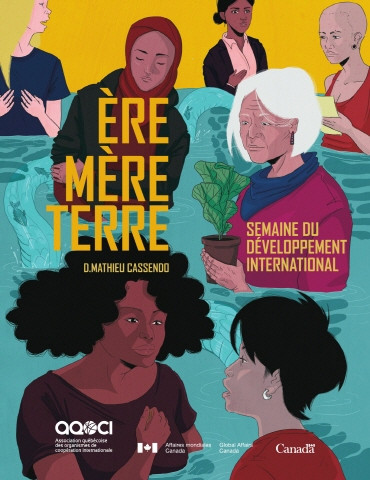 Age, Earth, Sea: International Development Week Year of publication: 2020 Author: Dimani Mathieu Cassendo Corporate author: Quebec Association of International Cooperation Organizations (AQOCI) Each year, International Development Week (IDW) highlights an international issue of concern to society. In Quebec, the Association québécoise des organismes de coopération internationale (AQOCI) organizes this public awareness week. CRÉDIL plays an active role in this campaign, and has participated in the production of comic strips as educational tools, such as "Ère, Terre, Mer" in 2021, which deals with the impact of the climate change on peoples.
  Our Reflections: Global Inequality and Solidarity Year of publication: 2022 Author: Jenny Bien-Aimé Corporate author: Quebec Association of International Cooperation Organizations (AQOCI) In 2022, the SDI took place from February 6 to 12, and the member organizations of AQOCI chose the theme "In the context of the COVID-19 pandemic: calling for the co-construction of a just and united world."With this theme, the public was invited to discuss the persistent global inequalities and injustices and to explore solutions for making our world more just, united, and equitable.For the occasion, the comic book Nos Reflets was created by the artist Jenny Bien-Aimée.
  [Podcast] Back to Srebrenica Year of publication: 2022 Corporate author: Doctors without Borders Since its creation in 1971, Médecins Sans Frontières has been providing medical assistance to populations in need in numerous extremely complex situations. Its staff has often witnessed various types of crimes and abuses. In this podcast, we will take a closer look at one of these crises: the siege of the city of Srebrenica and the massacre that followed the fall of this city during the Bosnian War in the 1990s.
 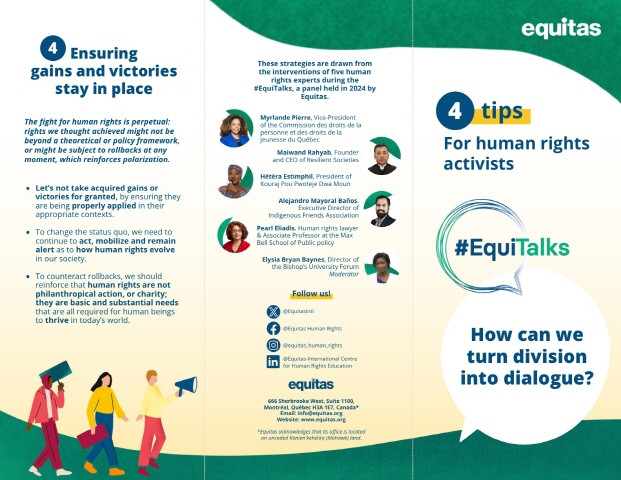 #EquiTalks: How Can We Turn Division into Dialogue? Year of publication: 2024 Corporate author: Equitas This brochure gathers the answers of five human rights defenders during the 2024 #EquiTalks panel discussion, who attempted to answer the question: How can we turn division into dialogue? The brochure suggests potential solutions and tips to counteract the polarization of opinions on human rights.
  Emerging Horizons: Youth Insights on Climate Change and Breakthrough Solutions; 2024 Leading Minds on Climate Action Year of publication: 2024 Corporate author: UNICEF Innocenti | United Nations Development Programme (UNDP) This paper shares insights from a participatory foresight workshop designed and facilitated by UNICEF Innocenti in the framework of the Youth4Climate: Sparking Solutions event co-hosted by UNDP and the Government of Italy. This convened 100 youth-led solutions in the areas of climate education, energy, food and agriculture, and urban sustainability. By using the Three Horizons foresight approach, a dialogue was created that delineated the patterns of change young people envisaged, their shared visions for the future, and the high potential innovations they felt could be leveraged to bring that future about. The paper identifies research and policy questions to be further explored by young climate leaders, UNDP, UNICEF, and their partners.
 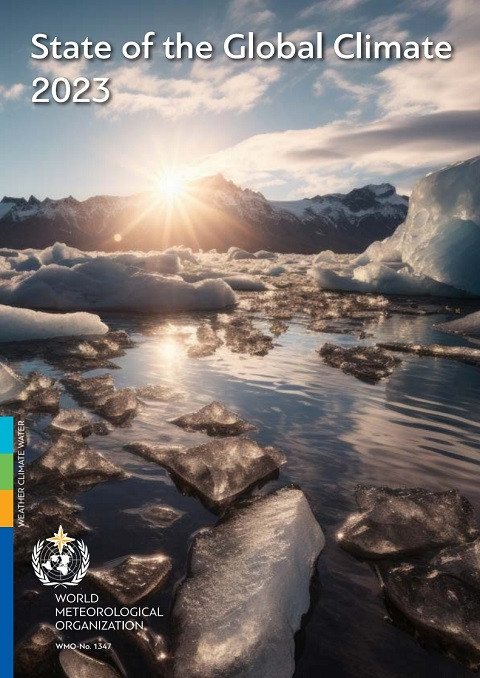 State of the Global Climate 2023 Year of publication: 2024 Corporate author: World Meteorological Organization (WMO) The publication provides a summary on the state of the climate indicators in 2023 with sections on key climate indicators, extreme events and impacts. The indicators include global temperatures, greenhouse gas concentration, ocean heat content, sea level rise, ocean acidification, Arctic and Antarctic sea ice, Greenland ice sheet and glaciers and snow cover, precipitation and stratospheric ozone, with an analysis of major drivers of inter-annual climate variability during the year including the El Niño Southern Oscillation and other ocean and atmospheric indices. The highlighted extreme events include those related to tropical cyclones and wind storms; flooding, drought and extreme heat and cold events. The publication also provides most recent finding on climate related risks and impacts including on food security and population displacement.
 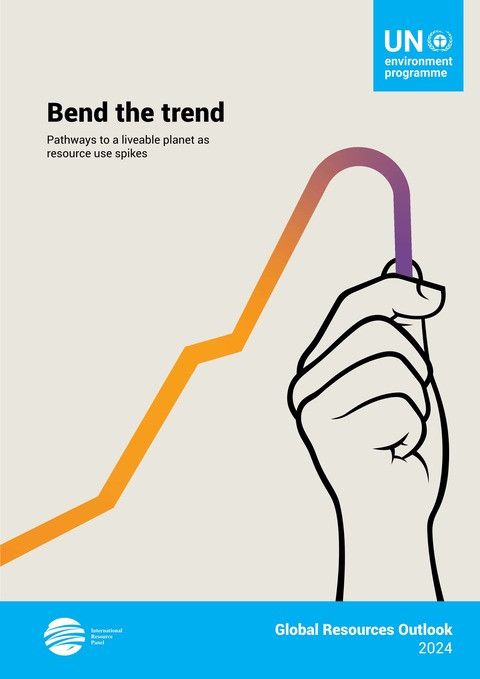 Global Resources Outlook: 2024 Bend the Trend; Pathways to a Liveable Planet as Resource Use Spikes Year of publication: 2024 Author: Hans Bruyninckx, Steve Hatfield-Dodds, Stefanie Hellweg, Heinz Schandl Corporate author: United Nations Environment Programme (UNEP) | International Resource Panel (IRP) The world is in the midst of a triple planetary crisis of climate change, biodiversity loss and pollution and waste. The global economy is consuming ever more natural resources, while the world is not on track to meet the Sustainable Development Goals. The scientific community has never before been more aligned or more resolute on the need for urgent global transformation towards the sustainable use of resources. This 2024 edition of the Global Resources Outlook sheds light on how resources are essential to the effective implementation of the Agenda 2030 and multilateral environmental agreements to tackle the triple planetary crisis. The report brings together the best available data, modelling and assessments to analyse trends, impacts and distributional effects of resource use. It builds on more than 15 years of work by the International Resource Panel, including scientific assessments and inputs from countries, a vast network of stakeholders in the field and regional experts. The report illustrates how, since the 2019 edition of this report, rising trends in global resource use have continued or accelerated. The report also shows how demand for resources is expected to continue increasing in the coming decades. This means that, without urgent and concerted action, by 2060 resource extraction could rise by 60% from 2020 levels – driving increasing damage and risks. However, this fate is not sealed. The report also describes the potential to turn negative trends around and put humanity on a trajectory towards sustainability. For that, bold policy action is critical to phase out unsustainable activities, speed up responsible and innovative ways of meeting human needs and create conditions conducive to social acceptance and equity within the necessary transitions. This includes urgent action to embed resources in the delivery of multilateral environmental agreements, define sustainable resource use paths and roll out appropriate financial, trade and economic incentives. The pathway towards sustainability is increasingly steep and narrow, and the window of opportunity is closing. The science is clear: The key question is no longer whether a transformation towards global sustainable resource consumption and production is necessary, but how to make it happen now. Addressing this reality, based on evolving concepts of a just transition, is an essential part of any credible and justifiable way forward.
 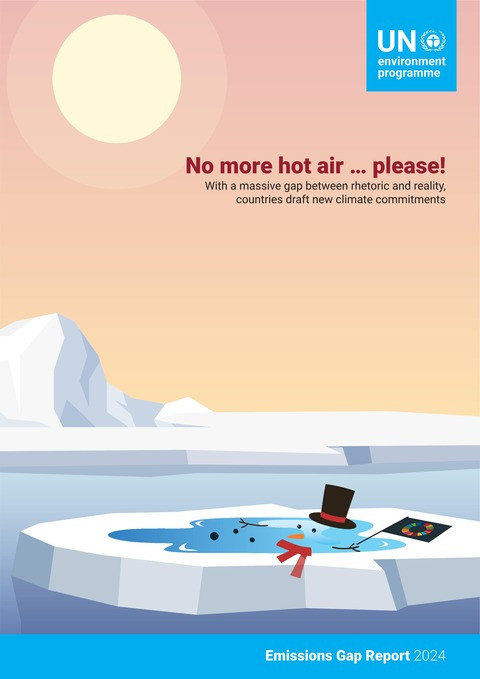 Emissions Gap Report 2024: No More Hot Air … Please! With a Massive Gap Between Rhetoric and Reality, Countries Draft New Climate Commitments Year of publication: 2024 Author: Anne Olhoft | John Christensen | William F. Lamb | Minal Pathak | Takeshi Kuramochi | Taryn Fransen | Joeri Rogelj | Michel den Elzen | Joana Portugal-Pereira | Neil rant | Jiang Kejun | Stephanie Roe | Chris Bataille | Kornelis Blok | Kelly Levin | Eleonore Soubeyran | Costanza Strinati Corporate author: United Nations Environment Programme (UNEP) As climate impacts intensify globally, the Emissions Gap Report 2024: No more hot air … please! finds that nations must deliver dramatically stronger ambition and action in the next round of Nationally Determined Contributions or the Paris Agreement’s 1.5°C goal will be gone within a few years. The report is the 15th edition in a series that brings together many of the world’s top climate scientists to look at future trends in greenhouse gas emissions and provide potential solutions to the challenge of global warming.
 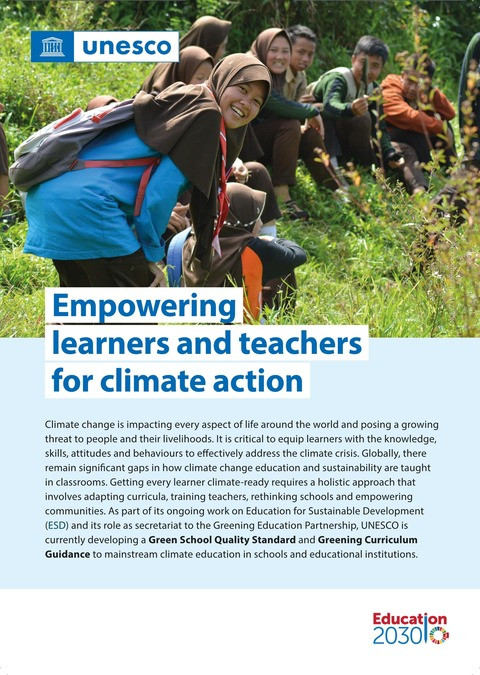 Empowering Learners and Teachers for Climate Action Year of publication: 2023 Corporate author: UNESCO Climate change is impacting every aspect of life around the world and posing a growing threat to people and their livelihoods. It is critical to equip learners with the knowledge, skills, attitudes and behaviours to effectively address the climate crisis. Globally, there remain significant gaps in how climate change education and sustainability are taught in classrooms. Getting every learner climate-ready requires a holistic approach that involves adapting curricula, training teachers, rethinking schools and empowering communities. As part of its ongoing work on Education for Sustainable Development (ESD) and its role as secretariat to the Greening Education Partnership, UNESCO is currently developing a Green School Quality Standard and Greening Curriculum Guidance to mainstream climate education in schools and educational institutions.
 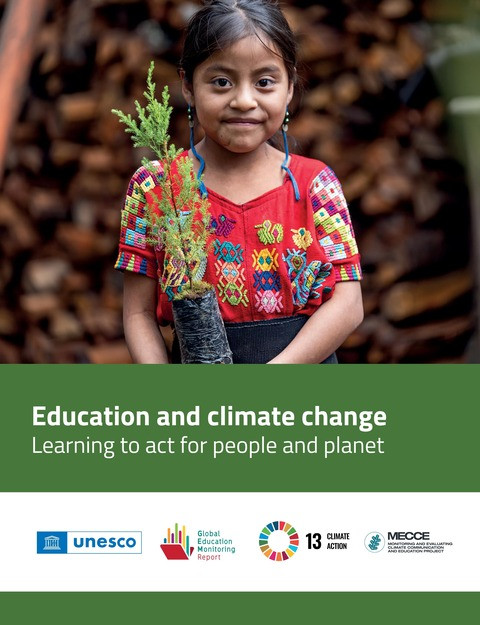 Education and Climate Change: Learning to Act for People and Planet Year of publication: 2024 Corporate author: Global Education Monitoring Report Team | Monitoring and Evaluating Climate Communication and Education Project (MECCE) | University of Sakatchewan How can education lead to climate change action?Despite strong evidence on the impact of education on other development outcomes and the role it plays in developing professional capacity for sustainable development transitions, education is often absent from other sectors’ strategic, policy, planning and financing considerations. The Global Education Monitoring Report is introducing a new series to advance dialogue on the interrelationship of education with the other Sustainable Development Goals.The first paper in the series focuses on climate change. It starts by reviewing the growing impact of climate change on education before turning to the role of education in climate action. Education has a somewhat underappreciated contribution to developing professional capacities for the transition to a green economy. Formal, non-formal and informal learning are also commonly believed to be playing a critical role in motivating actions on climate change mitigation and adaptation.Yet a positive association between education attainment and unsustainable consumption levels, as well as inconclusiveness of much research on the direct impact of education on climate change adaptation and mitigation actions has in part contributed to education receiving low priority in global and national climate change agendas.This paper argues that climate change education needs to adapt to fulfil its potential. The education paradigm cannot rely solely on knowledge transfer but needs to focus on social and emotional, and action-oriented learning.Much of the research has focused on the impact of education attainment and cognitive learning. More research is therefore needed to assess other drivers through which education can influence behaviours and motivate climate change action. Such research is needed to formulate viable education reform packages that improve the curriculum, strengthen climate-readiness of schools and education systems, engage learners and prepare educators accordingly.