
Resources
Explore a wide range of valuable resources on GCED to deepen your understanding and enhance your research, advocacy, teaching, and learning.
8,354 Results found
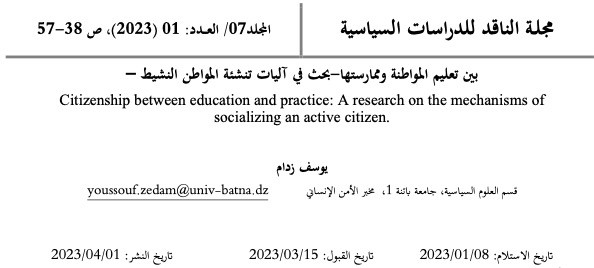 Citizenship Between Education and Practice: A Research on the Mechanisms of Training an Active Citizen (vol.7, no.1; Al-Naqid Journal for Political Studies) Year of publication: 2023 Author: Yusuf Zadam Corporate author: Mohamed Khider University of Biskra The study delves into the relationship between citizenship and education, aiming to understand the mechanisms for fostering an engaged citizenry. It argues that merely educating individuals about citizenship is insufficient; rather, democracy must be practiced within the diverse institutions, processes, and behaviors within the school. As such, the study elucidates the characteristics of the ideal citizen and desired citizenship, emphasizing the distinction between an 'active citizen' and a 'passive recipient.' Additionally, it explores the transition from citizenship education to a comprehension of democracy. The findings reveal that the school serves as a crucial arena shaping both active citizens and passive recipients. Therefore, the dynamics among various actors within the school environment significantly influence the type of citizen produced.
 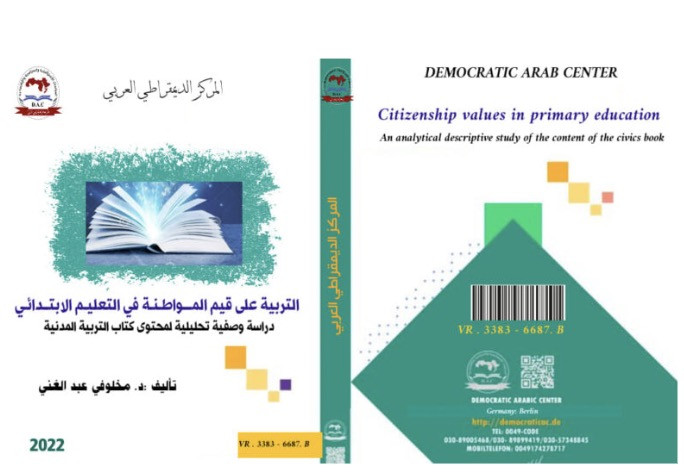 Citizenship Values in Primary Education : An Analytical Descriptive Study of the Content of the Civics Textbook Year of publication: 2022 Author: Abdelghani Makhloufi Corporate author: Democratic Arab Center The study aimed to assess the alignment between the citizenship values presented in the civics textbooks for primary education and those outlined in the National Education Directive Law, which serves as the guiding framework for curriculum and textbook development. Employing a content analysis approach, the study compared the network of citizenship values delineated in the directive law with the contents of civics textbooks for primary education. Findings revealed a discrepancy, with the citizenship values in the civics textbooks aligning with only 53.85% of those specified in the directive law for national education. This disparity suggests a lack of adherence by textbook authors and publishers to the values prescribed in the directive law.
  The Impact of a Program Based on Education for Sustainability Principles in Developing Awareness of Climate Change and the Environmental Citizenship Values Among Middle School Students in Slum Areas. (vol.48, no.2; International Journal for Research in Education) Year of publication: 2024 Author: Nermin Awny Mohammad | Ibrahim Ahmed Abdelhady Corporate author: United Arab Emirates University The research aimed to investigate the impact of a program grounded in sustainability education principles on the development of climate change awareness and environmental citizenship values among second-grade middle school students residing in slum areas. The study utilized a quasi-experimental approach.
 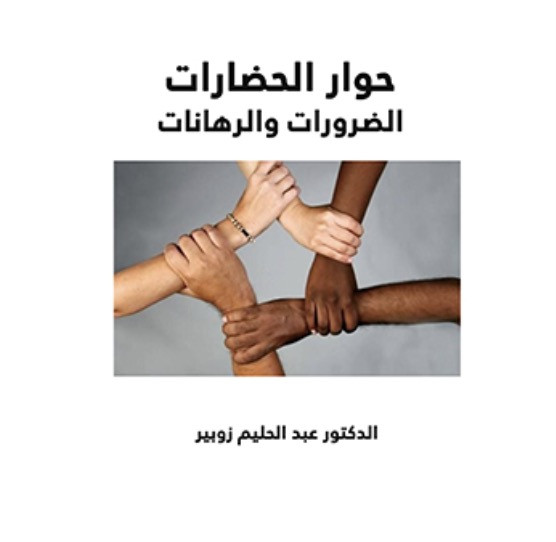 Dialogue of Civilizations: Necessities and Stakes Year of publication: 2023 Author: Abdelhalim Zoubair Corporate author: Fatima Al-Fihri Center for Research and Studies (MAFAD) The book's theme was approached from two perspectives: the imperative of dialogue and its significance. After introducing the key elements of the subject, such as dialogue and civilization, the book is divided into two chapters. The first chapter delves into the necessity of dialogue among civilizations, with a detailed examination of the dialogue system presented in the Quran. The second chapter explores the significance of dialogue among civilizations, focusing on three theoretical and practical levels: acquaintance, cooperation, and alliance.
 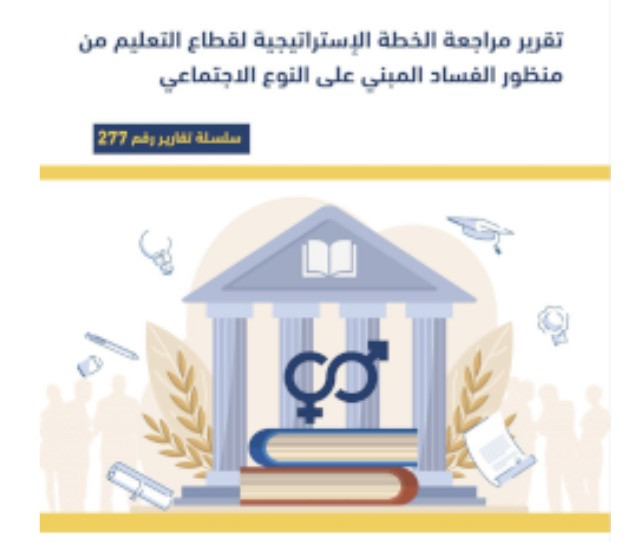 Report on Reviewing the Strategic Plan for the Education Sector From a Gender-Based Corruption Perspective Year of publication: 2023 Author: Hudhaifah Jalamna Corporate author: Coalition for Integrity and Accountability (AMAN) The report aims to review and analyze the strategic plan for the education sector to assess its effectiveness in addressing corruption in general, and gender-based corruption in particular. It proposes recommendations aimed at incorporating policies and mechanisms to enhance integrity and combat corruption in the subsequent strategic plan.
  Tolerance (Non violence) in the Curricular of Algerian Primary Schools (vol.2, no.1; Journal of Cognitive Fields for Social and Human Sciences) Year of publication: 2021 Author: Morad Fatima Zahra | Fantazi Karima Corporate author: Algeria. Ministry of Higher Education and Scientific Research This study aims to identify tolerance values within primary school curricula in two ways: explicitly and implicitly, focusing specifically on Islamic books due to their significant role in instilling values, particularly respect. The study utilizes the descriptive method and content analysis to analyze primary school books spanning five years. Statistical analysis is conducted using duplicates and percentages. The findings indicate that these books predominantly convey tolerance values implicitly rather than explicitly, which is believed to be more readily accepted by children of this age group. It is concluded that fostering tolerance values should be a shared responsibility of both the community and the school, not solely the latter.
 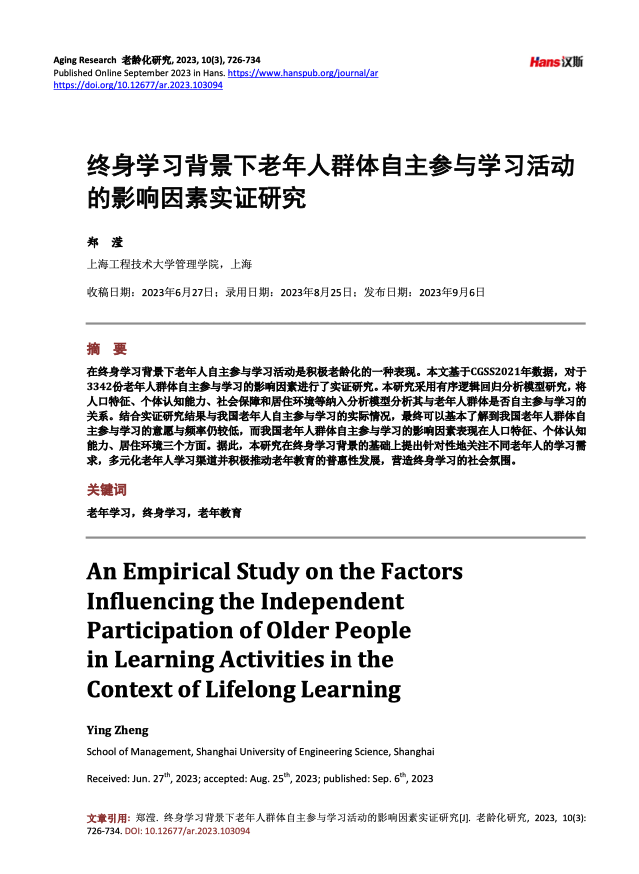 终身学习背景下老年人群体自主参与学习活动的影响因素实证研究 (老龄化研究 第10卷 第3期) Year of publication: 2023 Author: 郑滢 在终身学习背景下老年人自主参与学习活动是积极老龄化的一种表现。本文基于CGSS2021年数据,对于3342份老年人群体自主参与学习的影响因素进行了实证研究。本研究采用有序逻辑回归分析模型研究,将人口特征、个体认知能力、社会保障和居住环境等纳入分析模型分析其与老年人群体是否自主参与学习的关系。结合实证研究结果与我国老年人自主参与学习的实际情况,最终可以基本了解到我国老年人群体自主参与学习的意愿与频率仍较低,而我国老年人群体自主参与学习的影响因素表现在人口特征、个体认知能力、居住环境三个方面。据此,本研究在终身学习背景的基础上提出针对性地关注不同老年人的学习需求,多元化老年人学习渠道并积极推动老年教育的普惠性发展,营造终身学习的社会氛围。
 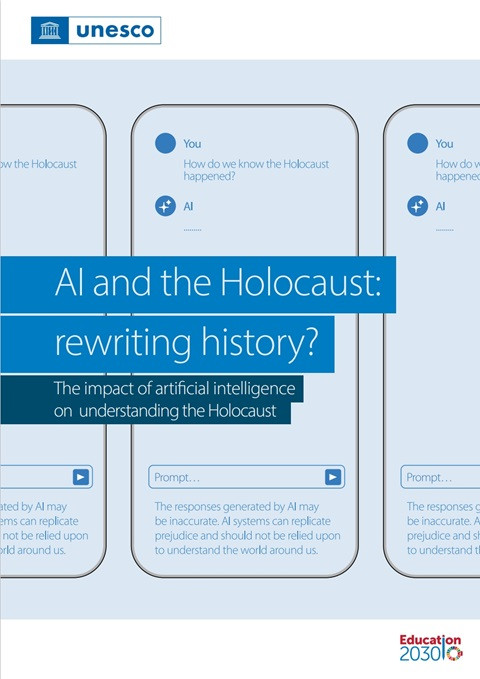 AI and the Holocaust: Rewriting History?; The Impact of Artificial Intelligence on Understanding the Holocaust Year of publication: 2024 Author: Mykola Makhortykh | Heather Mann Corporate author: UNESCO The threats associated with AI on safeguarding the record of the Holocaust are manifold, including the potential for manipulation by malicious actors, the introduction of falsehoods or dissemination of biased information, and the gradual erosion of public trust in authentic records. This paper provides a warning of what is at stake for the preservation of historical truth in a digital era increasingly mediated by AI. It highlights five major concerns:1. AI automated content may invent facts about the Holocaust2. Falsifying historical evidence: Deepfake Technology3. AI models can be manipulated to spread hate speech4. Algorithmic bias can spread Holocaust denial5. Oversimplifying history While there are some benefits to be gained, such as enhanced engagement and interaction opportunities for learners, as well as more efficient data processing capabilities for researchers, to navigate these challenges and capitalize on the benefits, it’s essential for AI designers, policymakers, educators, and researchers to collaborate closely. Only AI systems equipped with robust safeguards and human rights assessments, coupled with an increased focus on developing digital literacy skills, can uphold the integrity of historical truth and ensure the responsible use of artificial intelligence.
  Developing Global Guidance for Child Rights Impact Assessments in Relation to the Digital Environment: Summary of Initial Project Findings Year of publication: 2024 Corporate author: United Nations Development Programme (UNDP) | German Institute of Development and Sustainability (IDOS) The age of technology and the Internet have brought tremendous benefits, including for children. However, the spread of digital technologies also comes with a broad spectrum of risks and harms to which children can be particularly vulnerable. Under the UN Guiding Principles on Business and Human Rights and the Children’s Rights and Business Principles, businesses have a responsibility to identify, assess, and address relevant human rights risks, including risks to children’s rights. With respect to the digital environment, a rapidly evolving landscape and the emergence of new technologies has changed the nature and severity of actual and potential child rights risks relating to business activities. In response, UNICEF has initiated a project to assess the current child rights impact assessment (CRIA) landscape in relation to digital business activities and develop new guidance to support robust implementation going forward. A summary of initial project findings is now available here. Further project outputs including the updated guidance (currently under development) are anticipated in late 2024.
  Inter-Agency Policy Brief: Accelerating SDG Localization to Deliver on the Promise of the 2030 Agenda for Sustainable Development Year of publication: 2024 Corporate author: United Nations Centre for Human Settlement Programme (UN Habitat) | UN. Department of Economic and Social Affairs (UN. DESA) | United Nations Development Programme (UNDP) SDG localization is the process of adapting and customizing the SDGs and translating them into local development plans and strategies that fit the needs, context, and priorities of a particular region or locality, in coherence with national frameworks. It means placing local communities at the center of sustainable development and anchoring development action on the principles of inclusion, partnership, and multilevel governance, with adequate data and financing availability at the local level. This inter-agency policy brief examines the critical role of local and regional governments in accelerating achievement of the 2030 Agenda and provides policy recommendations to help advance the essential work of localizing SDG action. This policy brief was prepared by UNDESA, UN Habitat and UNDP in close collaboration with the Global Taskforce of Local and Regional Governments and United Cities and Local Governments, with input from the United Nations Regional Commissions: UNECA, UNECE, UNECLAC, UNESCAP, and UNESCWA.