
Resources
Explore a wide range of valuable resources on GCED to deepen your understanding and enhance your research, advocacy, teaching, and learning.
8,348 Results found
 Asia-Pacific Living Heritage Lesson Plan 2023 Year of publication: 2023 Corporate author: APCEIU | UNESCO Bangkok | International Information and Networking Centre for Intangible Cultural Heritage in the Asia-Pacific Region (ICHCAP) In partnership with UNESCO Bangkok and ICHCAP (International Information and Networking Centre for Intangible Cultural Heritage in the Asia-Pacific Region), APCEIU (Asia-Pacific Centre of Education for International Understanding) carried out “Bringing Living Heritage to the Classroom in the Asia-Pacific” since 2020. As a part of this multi-year project, the UNESCO Asia-Pacific Living Heritage Lesson Plan Contest 2023, co-organized by UNESCO Bangkok, APCEIU, and ICHCAP was launched and 18 lesson plans from 10 countries – Bhutan, China, India, Indonesia, the Republic of Korea, Malaysia, Nepal, The Philippines, Singapore, and Viet Nam - were selected as follows. - Saykha Offering (Subject: English), Tsirangtoe Central School, Bhutan- Setting Up a Herbarium, Learning about Medicinal Herbs and their Cultural and Traditional Uses in the Community (Subject: Science/Grades 7–9), Zilukha Middle Secondary School, Bhutan- Shamanistic Worship and Propitiation to the Spirits (Subject: Bhutan History and Civics and Citizenship Education/Grade 8), Bajothang Higher Secondary School, Bhutan- Beauty of Intangible Cultural Heritage (Subject: Foundations of College Art Education/ Freshman Year), Anhui Medical University, China- The Folk Custom of Building the Peace Kiln for the Mid-Autumn Festival in Jingdezhen (Subject: Mathematics/Grade 7), Jingdezhen No.13 Secondary School, China - When Xiabu Meets Batik (Subject: Art/Grade 5–6), ChongQing Shuren Primary School, China- Agricultural Practices (Subject: Biology/Grade 8), Paramita Heritage School, India- Living Heritage – Quilting in the Kalbelia Community of Rajasthan (Subject: Social Science/Grade 9), St. Stephen's Senior Secondary School, India- My City: Varanasi (Subject: Environmental Studies/Grade 2), Sunbeam School Lahartara, India - Bringing Back the Javanese Saka Calendar through Ethnomathematics (Subject: Mathematics/Grade 7–12), Binus School Bekasi, Indonesia- Song, Play, and Dance (Subject: Interdisciplinary for Indonesian Language, Balinese Culture, Music and Physical Education/Grade 3), Green School Bali, Indonesia- Teaching Sound Wave with Sundanese Traditional Instruments (Subject: Physics/Grade 8), Binus School Bekasi, Indonesia- Wau – The Malays Traditional Kite: Introduction, Wau Bulan Appreciation, Wau Making and Flying Workshop and Wau Corner (Subject: Traditional Games/Grades 4–5), SMU (A) Tarbiah Islamiah (SABK), Malaysia- Himalayan Aromatic Incense-Making and Meditation Workshop (Subject: Economics and Social Studies/ Grades 8–9, 11–12), Pragati Pathshala, Nepal- Influence of Biodiversity on the Stability of Ecosystems (Subject: Science/Grade 10), Philippine Normal University Mindanao, The Philippines- Understanding the Nature of Religion: From the Perspective of the Tripeople (Christians, Muslims, & Lumads) of Kidapawan City, North Cotabato (Subject: Humanities and Social Sciences/Grade 12), Kidapawan City National High School, The Philippines- Bongsan Talchum that Helps the Community Become More Sustainable (Subject: Korean Language and Literature, Social Studies, P.E., Arts/Grade 6), Kimje Buk Elementary School, Republic of Korea- Exploring Community Gardens – How and why are they so precious to humans? (Subject: Geography/Grade 9), Admiralty Secondary School, Singapore
  Human Rights in Argentina and Latin America: Training and Debates for Critical Citizenship Year of publication: 2022 Author: Ana Laura Sucari | Ramiro Manduca Corporate author: Red de Investigadores y Organizaciones Sociales de Latinoamérica (RIOSAL) This book is an invitation to study about Human Rights. At the same time, it seeks to be a material that expands rights by opening debates that promote teaching and learning in a framework of respect for Human Rights since it is necessary to learn what our rights are in order to intervene in reality, according to them.
  Education for Global Citizenship as a Transformative Methodological Proposal: Reflections and Practical Proposals Year of publication: 2019 Author: Isarel García | Joan Gratacós | Desiderio De Paz | Mercè Gil | Assumta Zapata Corporate author: Oxfam International This publication, the result of the collaborative work of the Network of educators for global citizenship, is a proposal for reflection and practical examples regarding the transformative nature of Education for global citizenship, being essential that for this educational approach that its actions educational activities are aimed at promoting critical thinking, dialogue, collaboration, solidarity and commitment to transform inequalities and promote social justice, equity and sustainable development. The methodological approach, therefore, must also be transformative and the strategies that accompany processes, promote this social transformation. Transformative methodologies are inherent to Education for global citizenship and the methodological processes that contribute to the construction of schools for global citizenship, in our opinion, should be based on three different pillars: promote the transformative dimension of education to build another world possible and necessary, promote a socio-affective approach focused on solidarity and cosmopolitan empathy and promote the construction of a more participatory and integrated curriculum that generates meaning in teachers and students.
  A Diverse World Year of publication: 2023 Corporate author: Entreculturas | European Union (EU) This publication is Entreculturas' pedagogical proposal to educate everyone in global citizenship. With it we intend to contribute to the training of people capable of exercising active and committed citizenship, of transforming their environment and of assuming as their own the global challenges of our time as well as the fulfillment of the 2030 Agenda and the Sustainable Development Goals. This publication collects activities from previous publications, with the difference that it has been adapted to an easy-to-read model to make it much simpler and more accessible for people with functional diversity. The activities address three major themes: 1.) Defense of the environment, 2.) Gender equality, and 3.) Interculturality. By addressing these topics we seek to promote reflection on the different global challenges that affect us and learn about the different ways to contribute to these causes.
 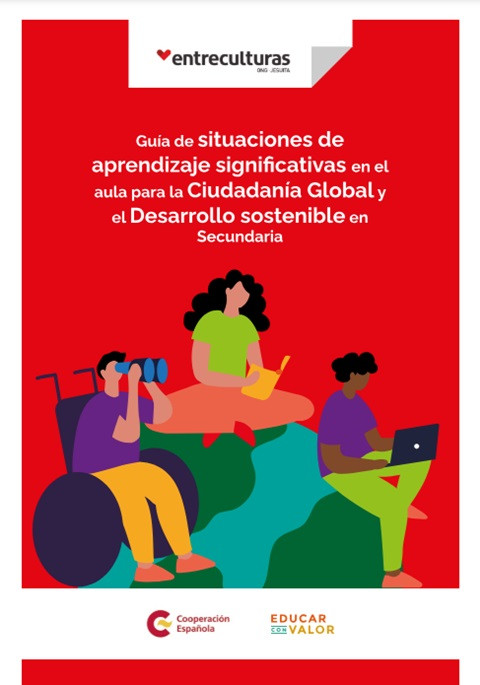 Guide to Significant Learning Situations in the Classroom for Global Citizenship and Sustainable Development in Secondary School Year of publication: 2024 Author: Helena Rodriguez de Guzmán Corporate author: Entreculturas | Spanish Agency for International Development Cooperation (AECID) This didactic proposal aims to promote new models of education so that they are more attractive, more conscious and with a profound and greater influence on the exercise of citizenship. Designed from the foundations of Transformative Education, it is committed to giving all students the opportunity to acquire the necessary skills for global and critical citizenship by supporting their vital growth in a comprehensive manner, as proposed by UNESCO (UNESCO, 2022). In turn, this teaching resource provides tools that support the educational strategies promoted by the LOMLOE whose main objective is to guarantee the comprehensive training of students, contributing to the development of their personality, the full exercise of human rights and active and democratic citizenship in the actual society.
  Minutes World Heritage Education: Education in Times of Digital, Sustainable, Inclusive and Fair Transformation Year of publication: 2024 Corporate author: University of Alcala | Organization of Ibero-American States for Education, Science and Culture (OEI) Document obtained from the XVII International and Interuniversity Congress of the Ibero-American Education Meeting. The University of Alcalá (UAH) in Madrid (Spain) and the Organization of Ibero-American States (OEI) organize the XVII Ibero-American Education Meeting (EIDE 2023) with the purpose of continuing to offer a scientific, rigorous and committed space for discussion and interdisciplinary exchange , interuniversity and international, with the focus on the Ibero-American geographical and cultural context, responding to the need to continue analyzing the educational reality from a global and collaborative perspective, as demanded by all professional and academic fields of education, at a time of great transformation challenges in the digital field, sustainability, inclusion, social justice and interculturality.
  Challenges and Perspectives of Inclusive Education: A Regional Perspective Year of publication: 2024 Corporate author: National Commission for the Continuous Improvement of Education (Mejoredu) | Organization of Ibero-American States for Education, Science and Culture (OEI) This work compiles the four analysis tables Challenges and perspectives of inclusive education, which, to contribute to this purpose, were constituted as spaces for reflection and plural and democratic dialogue. During the analysis tables held in June 2023, the prominent speakers gave life to a space for reflection and plural and democratic dialogue, seeking to contribute through conversations to a topic of debate that cannot be postponed in the life of schools, speaking about the current situation of populations historically violated in their fundamental rights, the challenges of inclusive education in the region, experiences in educational care for historically disadvantaged populations and proposals for actions that contribute to educational systems moving towards inclusive education.
  Manual on Citizenship Competencies: Citizenship Academy Project Year of publication: 2020 Corporate author: Organization of Ibero-American States for Education, Science and Culture (OEI) | Panamanian Debate Association (ASPADE) | Eduardo Morgan Foundation (FUNDAMORGAN) The Citizen Competencies Manual is a tool for facilitators of the Ibero-American Education Program in human rights, democracy and citizenship. Citizen Academy is an initiative led by the Organization of Ibero-American States (OEI) with the Panamanian Debate Association (ASPADE) and the Eduardo Morgan Foundation (FUNDAMORGAN). Within the Citizen Academy Program, various initiatives have been developed, all focused on the importance of citizen participation and the development of skills that contribute to the personal and professional growth of the participants. In this manual, teachers and trainers will be able to find a roadmap to learn and teach their students about: i) citizenship skills, ii) debate and democracy, iii) culture of legality, iv) good governance, v) human rights , vi) equity and diversity and vii) peaceful conflict resolution and the ImPacta methodology.
 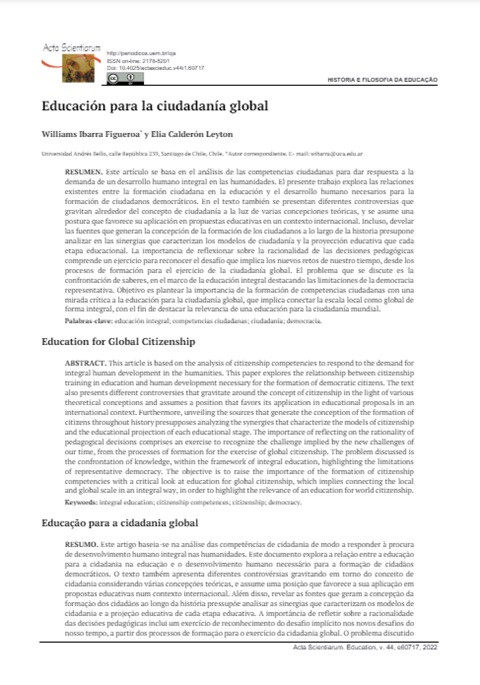 Education for Global Citizenship(Acta Scientiarum. Education; vol. 44) Year of publication: 2022 Author: Williams Ibarra Figueroa | Elia Calderón Leyton Corporate author: Maringá State University Press This work explores the relationships between citizen training in education and the human development necessary for the formation of democratic citizens. The text also presents different controversies that revolve around the concept of citizenship in light of various theoretical conceptions, and a position is assumed that favors its application in educational proposals in an international context. Even revealing the sources that generate the conception of the formation of citizens throughout history presupposes analyzing the synergies that characterize the models of citizenship and the educational projection of each educational stage. The importance of reflecting on the rationality of pedagogical decisions includes an exercise to recognize the challenge that the new challenges of our time imply, from the training processes for the exercise of global citizenship.
 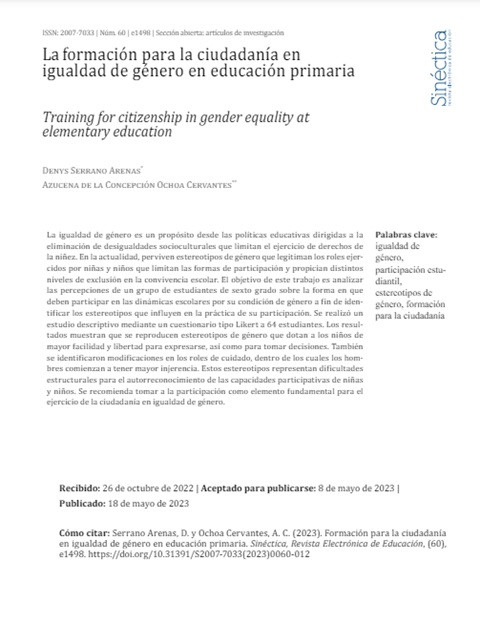 Training for Citizenship in Gender Equality at Elementary Education(Sinéctica, Revista electrónica de educación; no. 60) Year of publication: 2023 Author: Denys Serrano Arenas | Azucena de la Concepción Ochoa Cervantes Corporate author: Sinéctica, Revista Electrónica de Educación Gender equality is a purpose from educational policies aimed to eliminating sociocultu-ral inequalities that limit the exercise of children's rights. At present, gender stereotypes that legitimize the roles exercised by girls and boys that limit the forms of participation persist, promoting different levels of exclusion in school life. The objective of this work is to analyze the perceptions of a group of sixth grade students, about how they consider they should participate in school dynamics due to their gender condition, to detect tho-se stereotypes that influence the practice of their participation. A descriptive study was carried out using a Likert-type questionnaire to 64 students. The results show that gen-der stereotypes are reproduced that provide children with greater ease and freedom to express themselves, as well as to make decisions. Modifications in the care roles were also identified, within which, they begin to have greater interference. In parallel, it was found that these stereotypes represent structural difficulties for the self-recognition of the par-ticipatory capacities of girls. It is recommended to take participation as a fundamental element for the exercise of citizenship in gender equality.