
Resources
Explore a wide range of valuable resources on GCED to deepen your understanding and enhance your research, advocacy, teaching, and learning.
8,365 Results found
 The Urgency of Talking About Sexuality in Early Childhood Year of publication: 2021 Corporate author: Red Papaz This virtual meeting seeks to build a scenario for public discussion to guide and contribute to the strengthening of protective environments for children and adolescents. The psychologists María Clara González and Claudia Sánchez Salamanca talk about the importance of sex education in early childhood.
  The Neuroscience of Emotions Year of publication: 2021 Corporate author: BBVA Aprendemos Juntos The psychiatrist and writer Marian Rojas-Estapé speaks in this video about neuroscience and emotional intelligence, stating there are no shortcuts or magic formulas to be happy. She talks about how society has substituted self-destructive habits for the meaning of life and identifies the ability we have to be happy even in the midst of difficult situations.
  Fifteen Analytical Keys to Strengthen the Education 2030 Agenda Year of publication: 2017 Author: Renato Opertti Corporate author: UNESCO International Bureau of Education (IBE) The joint review of the goals of the Education 2030 agenda and global change accentuated by the emergence of a fourth industrial revolution highlights the need to rethink the concepts that have influenced education over the past forty years. This necessity is accompanied by a major challenge: that of giving a new meaning to these concepts, in the same way education systems, in a transformational and united perspective. The present document proposes a global reflection based on fifteen keys of analysis, in order to help define a vision of education and learning that is in line with the Education 2030 agenda examines the following aspects: 1) education as a reflection of the type of society targeted; 2) the state as guarantor of the right to education; 3) education as a cultural, social and economic ; 4) the characteristics and roles of education systems; 5) learning throughout life long; 6) education according to age groups; 7) inclusion as a basis for education systems; 8) education for global and local citizenship; 9) education for sustainable development ; 10) STEM training to build sustainable societies; 11) the relevance of the gender issue at a time of the democratization of society and education; 12) computer programming as a new challenge in the teaching of ICT; 13) the evolution of the relationship between training and work; 14) the trio formed by curricula, educational establishments and pedagogy; and 15) teachers as decision-makers.
  Transforming Our World: The 2030 Agenda for Sustainable Development Year of publication: 2015 Corporate author: United Nations (UN) This Agenda is a plan of action for people, planet and prosperity. It also seeks to strengthen universal peace in larger freedom. We recognize that eradicating poverty in all its forms and dimensions, including extreme poverty, is the greatest global challenge and an indispensable requirement for sustainable development. All countries and all stakeholders, acting in collaborative partnership, will implement this plan. We are resolved to free the human race from the tyranny of poverty and want and to heal and secure our planet. We are determined to take the bold and transformative steps which are urgently needed to shift the world on to a sustainable and resilient path. As we embark on this collective journey, we pledge that no one will be left behind. The 17 Sustainable Development Goals and 169 targets which we are announcing today demonstrate the scale and ambition of this new universal Agenda. They seek to build on the Millennium Development Goals and complete what they did not achieve. They seek to realize the human rights of all and to achieve gender equality and the empowerment of all women and girls. They are integrated and indivisible and balance the three dimensions of sustainable development: the economic, social and environmental. The Goals and targets will stimulate action over the next 15 years in areas of critical importance for humanity and the planet.
  Global Environment Outlook 4 (GEO-4): Environment for Development Year of publication: 2007 Corporate author: United Nations Environment Programme (UNEP) The fourth Global Environment Outlook – environment for development ( GEO-4 ) places sustainable development at the core of the assessment, particularly on issues dealing with intra- and intergenerational equity. The analyses include the need and usefulness of valuation of environmental goods and services, and the role of such services in enhancing development and human well-being, and minimizing human vulnerability to environmental change. The GEO-4 temporal baseline is 1987, the year in which the World Commission on Environment and Development (WCED) published its seminal report, Our Common Future . The Brundtland Commission was established in 1983, under UN General Assembly resolution 38/161 to look at critical environment and development challenges. It was established at a time of an unprecedented rise in pressures on the global environment, and when grave predictions about the human future were becoming commonplace.
  We Are Different But We Love Each Other- Example Year of publication: 2015 Author: Ahmad Al Shugairi Corporate author: Aram TV The video talks about Oman as a model for coexistence between sects. Ahmed Al Shugairi visited Amman and prayed in its mosques and met with Omanis, highlighting the coexistence between them. Oman, according to the video, is one of the countries that succeeded in harmonizing its three sects without problems.
  Analysis (Didactic) of a Historical Video Game: Democracy and Citizenship Education in Civilization VI (Revue de recherches en littératie médiatique multimodale; no. 9) Year of publication: 2019 Author: Vincent Boutonnet Corporate author: Groupe de recherche en littératie médiatique multimodale Civilization VI, published in 2016, is a turn-based strategy game allowing the player to go through historical eras by leading a civilisation toward cultural, economic, military or technological sophistication. This new entry introduces a civic tree presenting new gameplay with government systems and civics policies. This research is descriptive and aims at a formal analysis of the gameplay. We examine the various components and the principles of design as well as the conceptual and civics limits of such a game. We believe this game is an opportunity to analyse and talk about these limits with pupils to foster critical thinking about democracy and citizenship.
 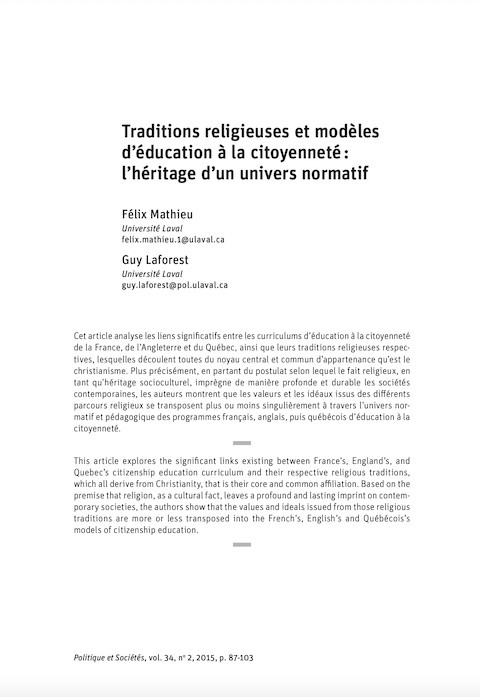 Religious Traditions and Models of Citizenship Education: The Legacy of a Normative Universe (Politique et Sociétés; vol. 34, no. 2) Year of publication: 2015 Author: Félix Mathieu | Guy Laforest Corporate author: Société québécoise de science politique This article analyzes the significant links between the citizenship education curricula of France, England and Quebec, as well as their respective religious traditions, which all stem from the central and common core of belonging that is christianity. More precisely, starting from the postulate according to which the religious fact, as a socio-cultural heritage, permeates in a deep and lasting way contemporary societies, the authors show that the values and the ideals resulting from the various religious paths are transposed more or less singularly through the normative and pedagogical universe of French, English and Quebec citizenship education programs.
 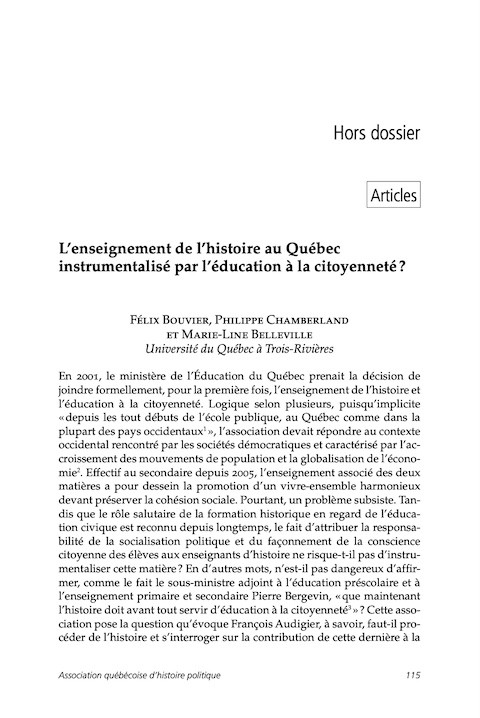 Is History Teaching in Quebec Instrumentalized by Citizenship Education? (Bulletin d'histoire politique; vol. 21, no. 3) Year of publication: 2013 Author: Félix Bouvier | Philippe Chamberland | Marie-Line Belleville Corporate author: Association québécoise d'histoire politique | VLB Éditeur In 2001, the Quebec Ministry of Education made the decision to formally join, for the first time, the teaching of history and education to citizenship. Logical according to many, since implicit" since the very beginning. beginnings of public schools, in Quebec as in most Western countries”, the association had to respond to the Western context encountered by democratic societies and characterized by the increase in population movements and the globalization of the economy. In secondary school since 2005, the associated teaching of the two subjects aims to promote a harmonious living together to preserve social cohesion. However, a problem remains. history with regard to civic education has long been recognized, the attribution of responsibility for political socialization and the shaping of consciousness citizen of students to history teachers risk instrumentalizing this subject? In other words, is it not dangerous to assert, as the Assistant Deputy Minister for Preschool, Elementary and Secondary Education Pierre Bergevin does, “that now history must above all serve as education for citizenship”? This association poses the question that François Audigier evokes, namely, should we proceed from history and question the latter's contribution to citizen consciousness, or proceed from the aspects of citizen consciousness that one wishes to construct and then determine the historical objects which should be studied? The experience of comparable nations on a planetary scale makes us doubt the relevance of the association of the two disciplines. In fact, some Western democracies are worried about the quality of the civic education of their young people since the waves of industrialization and the great wars of the XIXth and XXth centuries which changed manners forever: intensification of migrations, upheavals social roles, loss of influence of religions, etc. Thus, although Great Britain has for some time taken the path taken by Quebec, France clearly dissociates the teaching of history from that of civic education. In order to understand all the ins and outs of the issue, we first provide a portrait of the context at the origin of the association of history and education for citizenship. Then, we will discuss the arguments in favor of combining the two subjects, especially in Great Britain, France and Australia. Finally, our gaze will focus on the case of Quebec and the type of privileged citizenship, in order to determine whether the teaching of history is not instrumentalised for the benefit of a citizenship education valuing the concealment of conflicts and divergences and if, to use the writings of Robert Martineau, the Ministry of Education has sacrificed the history class on the altar of citizenship education.
  The Puzzle of Citizenship by Birthright (The Ethics Forum; vol. 7, no. 2) Year of publication: 2012 Author: Ayelet Shachar Corporate author: University of Montreal This paper is the French translation of Ayelet Shachar’s introduction, «The Puzzle of Birthright Citizenship», digitally reproduced by permission of the publisher from The Birthright Lottery : Citizenship and Global Inequality, Cambridge, Mass.: Harvard University Press, pp.1-18. © 2009 by the President and Fellows of Harvard College. Translation by Martin Provencher.