
Resources
Explore a wide range of valuable resources on GCED to deepen your understanding and enhance your research, advocacy, teaching, and learning.
8,363 Results found
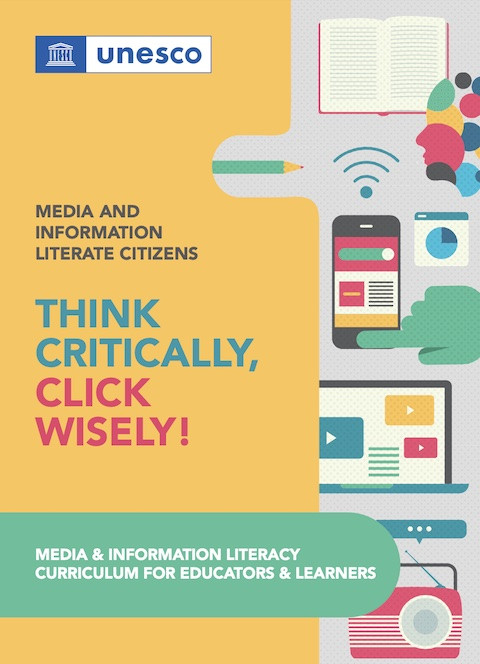 Media and Information Literate Citizens: Think Critically, Click Wisely! Year of publication: 2021 Author: Alton Grizzle | Carolyn Wilson | Ramon Tuazon | C.K. Cheung | Jesus Lau | Rachel Fischer | Dorothy Gordon | Kwame Akyempong | Jagtar Singh | Paul R. Carr | Kristine Stewart | Samy Tayie | Olunifesi Suraj | Maarit Jaakkola | Gina Thésée | Curmira Gulston Corporate author: UNESCO Content providers such as libraries, archives, museums, media and digital communications companies can enable inclusive and sustainable development. However, they do not always live up to these ideals, which creates challenges for the users of these services. Content providers of all types open up new opportunities for lifelong learning. But at the same time, they open up challenges such as misinformation and disinformation, hate speech, and infringement of online privacy, among others.Media and information literacy is a set of competencies that help people to maximize advantages and minimize harms. Media and information literacy covers competencies that enable people to critically and use of digital technologies. Capacities in these areas are indispensable for all citizens regardless of their ages or backgrounds.This pioneering curriculum presents a comprehensive competency framework of media and information pedagogical suggestions. It features various detailed modules covering the range of competencies needed to navigate today’s communications ecosystem. This resource links media and education, education for sustainable development, cultural literacy and the exponential information literacy curriculum, everyone can become media and information literate as well as peer-educators of media and information literacy.
  ПЕРЕОСМЫСЛИМ НАШЕ БУДУЩЕЕ Year of publication: 2021 Corporate author: International Commission on the Futures of Education | UNESCO Наше человечество, наша планета находятся в опасности, пандемия лишь подтвердила нашу хрупкость и взаимозависимость, чтобы изменить ход вещей и переосмыслить наше будущее, необходимы неотложные совместные действия; в этом докладе Международной комиссии по перспективам образования подтверждается способность образования к осуществлению коренных изменений. Перед нами стоит двойная задача – выполнить невыполненное обещание обеспечить право на качественное образование для каждого ребёнка, молодого человека и взрослого и полностью реализовать преобразующий потенциал образования, способного проложить путь к устойчивому коллективному будущему. Для этого нам нужен новый общественный договор в области образования, который сможет устранять проявления несправедливости, преобразуя будущее.Этот новый общественный договор должен основываться на принципах прав человека, недопущения дискриминации, социальной справедливости, уважения жизни, человеческого достоинства и культурного разнообразия. Он должен включать в себя этику заботы о людях, взаимности и солидарности. Он должен укреплять позиции образования как общественного дела и общего блага.Этот доклад, который готовился два года на основе глобального процесса консультаций с участием миллиона человек, предлагает правительствам, учреждениям, организациям и гражданам всего мира разработать новый общественный договор в области образования, который поможет нам построить мирное, справедливое и устойчивое будущее, отвечающее всеобщим интересам.Представленные здесь концепции, принципы и предложения являются лишь отправной точкой. Их воплощение в практику в конкретных условиях – это коллективная работа. Уже есть много положительных моментов, и в настоящем докладе предпринята попытка их отразить и развить. Это не инструкция и не план, а начало жизненно важного разговора.
 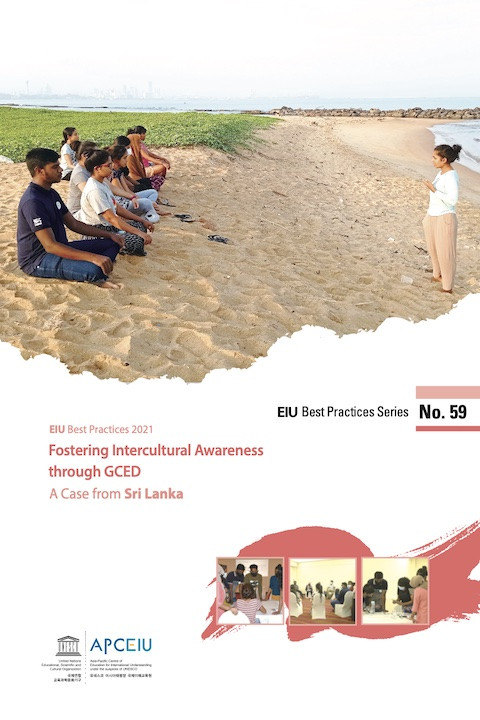 EIU Best Practices 2021: Fostering Intercultural Awareness through GCED; A Case from Sri Lanka (EIU Best Practices Series; no.59) Year of publication: 2021 Author: Oshan Madushanka Gunathilake Corporate author: APCEIU This monograph is one of APCEIU's EIU Best Practices Series, which aims to encourage educators, scholars, and activists to implement and share local initiatives on EIU. The Series No.59 introduces ‘Citizen Culture’ which is designed to foster intercultural and interreligious understanding within youth communities through the theories and learnings of GCED. The programme focused on a selected group of young individuals who are representing both vulnerable communities as well as privileged, also belonging to a diverse mixture of cultural, religious, social and ethnic backgrounds. The learners will go into their respective communities and spread this message as agents of positive change and actively contribute to the social cohesion, trust and awareness building through volunteer participation for transforming popular harmful narratives and practices which are structured in our society - cultivating a culture of peace.
 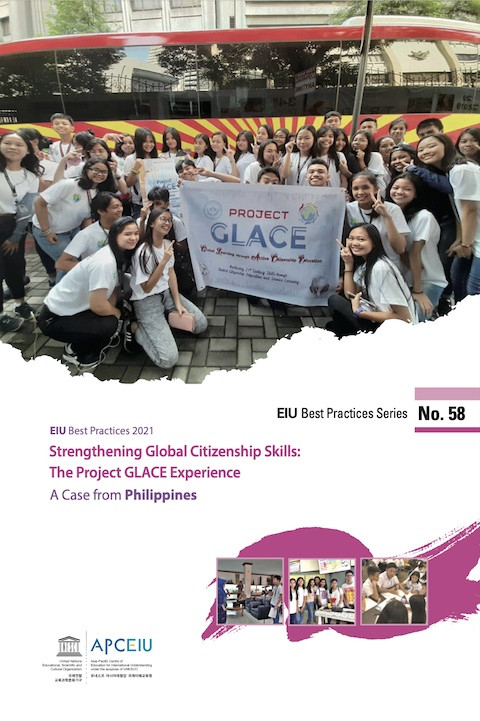 EIU Best Practices 2021: Strengthening Global Citizenship Skills; The Project GLACE Experience, A Case from Philippines (EIU Best Practices Series; no.58) Year of publication: 2021 Author: Marco Meduranda Corporate author: APCEIU This monograph is one of APCEIU's EIU Best Practices Series, which aims to encourage educators, scholars, and activists to implement and share local initiatives on EIU. The Series No.58 introduces ‘Project GLACE’ or ‘Global Learning through Active Citizenship Education’. It is an after-school enhancement program that sought to enhance students' global citizenship skills through afterschool learning sessions, off-campus intercultural education experiences, and service-learning or community outreach activities. Using the 4-I's (Inquire, Investigate, Innovate and Impact), selected teachers taught global citizenship education concepts for a span of 12 - 15 weeks with the first six to ten weeks exploring the themes of social justice and equity, identity and diversity, self-awareness and reflection, concern for the environment, commitment to sustainable development, and commitment to participation and inclusion.
 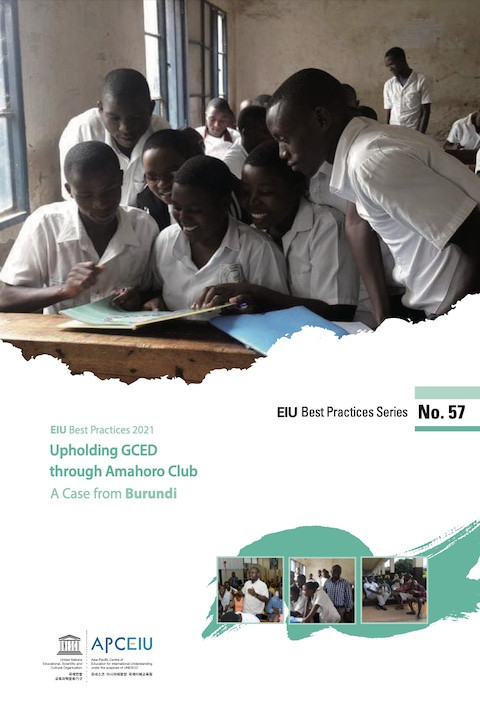 EIU Best Practices 2021: Upholding GCED through Amahoro Club; A Case from Burundi (EIU Best Practices Series; no.57) Year of publication: 2021 Author: Sinai Bakanibona Corporate author: APCEIU This monograph is one of APCEIU's EIU Best Practices Series, which aims to encourage educators, scholars, and activists to implement and share local initiatives on EIU. The Series No.57 introduces ‘Amahoro Clubs’ which means Peace Education Clubs. It is a project that has been initiated in other secondary schools of Burundi in terms of consolidating culture of peace and stability in Burundian society by applying different concepts of Global Citizenship Education in our life. This programme influence positively different social stratifications of people to know how to live together and be united by facing diverse challenges which can somber the population in violent conflicts. Amahoro Clubs serve as a platform in which people become aware of the various social issues. Students and teachers are gaining the necessary knowledge and skills that will help prevent the occurrence of conflicts.
 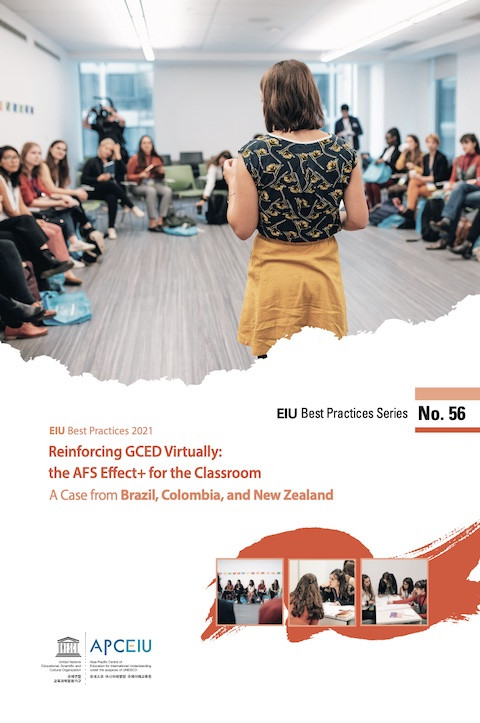 EIU Best Practices 2021: Reinforcing GCED Virtually; the AFS Effect+ for the Classroom, a Case from Brazil, Colombia, and New Zealand (EIU Best Practices Series; no.56) Year of publication: 2021 Author: Ana Carolina Cassiano Corporate author: APCEIU This monograph is one of APCEIU's EIU Best Practices Series, which aims to encourage educators, scholars, and activists to implement and share local initiatives on EIU. The Series No.56 introduces ‘the AFS Effect+ for the Classroom Programme’ which is launched in September 2020. The programme has engaged 150+ high-school teachers from Brazil, Colombia, and New Zealand who completed 20 hours of virtual teacher training, collaborated virtually with each other and piloted activities developed by AFS with their classrooms, reaching over 2,500 students. As a result of the programme, the AFS Effect+ for the Classroom: Toolkit for Educators is now available to teachers worldwide to use as a resource for teaching Active Global Citizenship & the SDGs for high school students. The toolkit is currently available in English, Spanish and Portuguese, and being disseminated through AFS Network Organizations which are present in 50+ countries.
 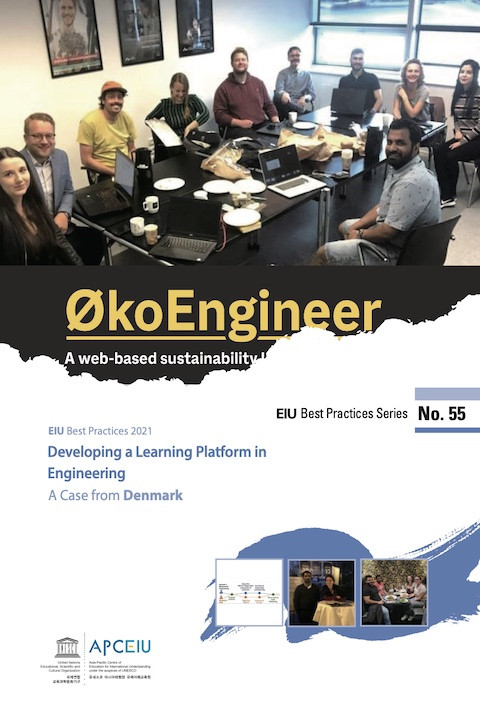 EIU Best Practices 2021: Developing a Learning Platform in Engineering; A Case from Denmark (EIU Best Practices Series; no.55) Year of publication: 2021 Author: Serena Leka Corporate author: APCEIU This monograph is one of APCEIU's EIU Best Practices Series, which aims to encourage educators, scholars, and activists to implement and share local initiatives on EIU. The Series No.55 introduces ‘ØkoEngineer’ which is a sustainability learning platform created to educate engineering students in Aarhus on sustainability concepts and how they couple with engineering design through the gamification of project-based learnings. The project aims to prepare the future engineers to play their crucial role in the significant global issues that we face. In response to the above challenges, future engineers, today's students are embracing initiatives that stimulate sustainability education. The students are motivated by the urge to relate sustainability with their domain-specific engineering theories. ØkoEngineer is a web-based game platform designed for integrating sustainability learning in engineering curricula.
  Understanding Policy Instrument Choice Concerning Citizenship in Education and Youth Policies: A Typology of Public Tools (Citoyenneté des enfants et des adolescents; no. 80) Year of publication: 2018 Author: Valérie Becquet Corporate author: Lien social et Politiques This article proposes a typology of public action instruments mobilized in the education and youth sectors. Three main ones currently coexist: legislative and regulatory, conventional and incentive, informative and communicational. They favor dimensions of citizenship (legal, political and civil) and are aimed at both pupils and young people. This typology is a tool for grasping the meaning of public action, highlighting the preferences of decision-makers for certain types of devices2 and recalling that heterogeneous devices coexist and structure juvenile experiences. In this regard, the taking into account of these devices in the analysis of careers and youth engagement practices is very uneven in the surveys, even though they constitute markers in the same way as other experiences contributing to political socialization, such as participation in protest actions. Given the development of public systems, this marginalization is not without effects on the understanding of the role of the latter in the construction of juvenile practices. After a general presentation of the typology, the main characteristics of the three identified instruments are analyzed.
  Transnational Citizenship: European Ideals and Realities Year of publication: 2013 Author: Claus Leggewie Corporate author: Sens public Claus Leggewie brings together the preconditions for transnationality - migrant communities, religious pluralism and hybrid popular mass culture - bringing to the fore the challenge it presents: between local cultures and global markets, how a cross-border demos can it be built?
 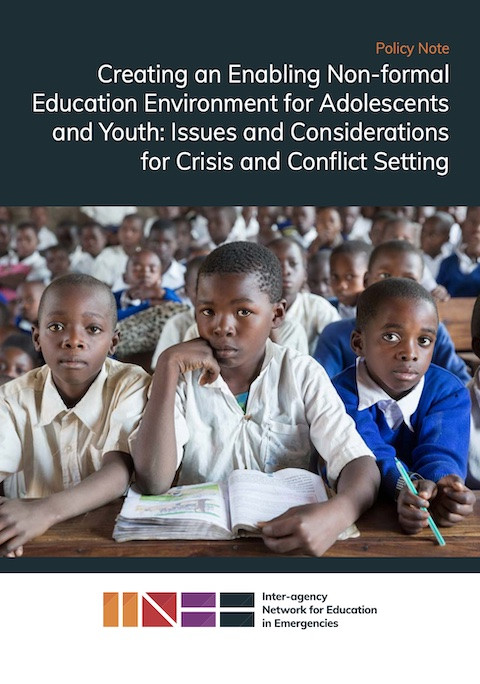 Creating an Enabling Non-formal Education Environment for Adolescents and Youth: Issues and Considerations for Crisis and Conflict Setting Year of publication: 2021 Corporate author: Inter-agency Network for Education in Emergencies (INEE) This policy brief offers recommendations to strengthen the policy environment within which non-formal education is delivered and highlights key considerations for those planning, designing and implementing non-formal programmes that seek to meet the core education and skill development challenges faced by out-of-school adolescents and youth, particularly those affected by conflict, crisis, or forced displacement.