
Resources
Explore a wide range of valuable resources on GCED to deepen your understanding and enhance your research, advocacy, teaching, and learning.
8,363 Results found
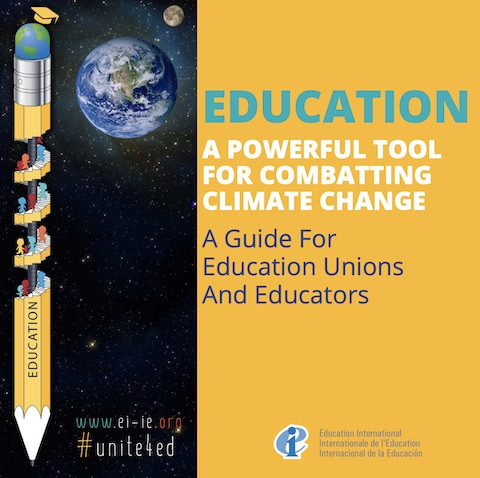 Education: A Powerful Tool for Combatting Climate Change; A Guide for Education Unions and Educators Year of publication: 2019 Author: Richard Langlois Corporate author: Education International (EI) This guide aims to provide EI member organisations with a tool for exploring the principal questions, issues and challenges arising from the climate crisis and how unions can respond.
 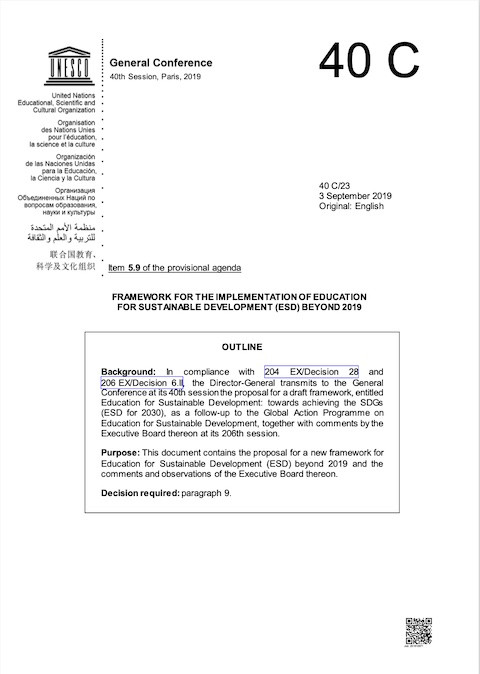 Framework for the Implementation of Education for Sustainable Development (ESD) Beyond 2019 Year of publication: 2019 Corporate author: UNESCO This document contains the proposal for a new framework for Education for Sustainable Development (ESD) beyond 2019 and the comments and observations of the Executive Board thereon.
 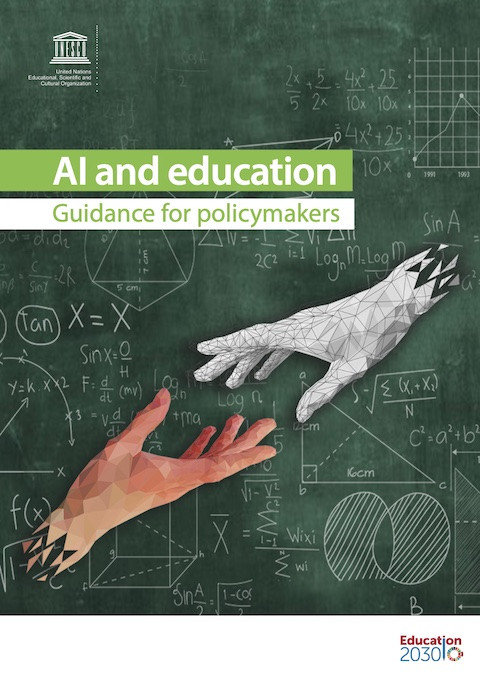 AI and Education: Guidance for Policy-Makers Year of publication: 2021 Author: Fengchun Miao | Wayne Holmes | Ronghuai Huang | Hui Zhang Corporate author: UNESCO Artificial intelligence (AI) is envisioned as a new tool to accelerate the progress towards the achievement of SDG 4. Policies and strategies for using AI in education are central to maximizing AI’s benefits and mitigating its potential risks. Fostering AI-ready policy-makers is the starting point of the policy development process.This publication offers guidance to policy-makers in understanding AI and responding to the challenges and opportunities in education presented by AI. Specifically, it introduces the essentials of AI such as its definition, techniques, technologies, capacities and limitations. It also delineates the emerging practices and benefit-risk assessment on leveraging AI to enhance education and learning, and to ensure inclusion and equity, as well as the reciprocal role of education in preparing humans to live and work with AI.The publication summarizes three approaches to the policy responses from existing practices: independent approach, integrated approach and thematic approach. In a further step, it proposes more detailed recommendations and examples for planning AI and education policies, aligned with the recommendations made in the 2019 Beijing Consensus on AI and Education.
 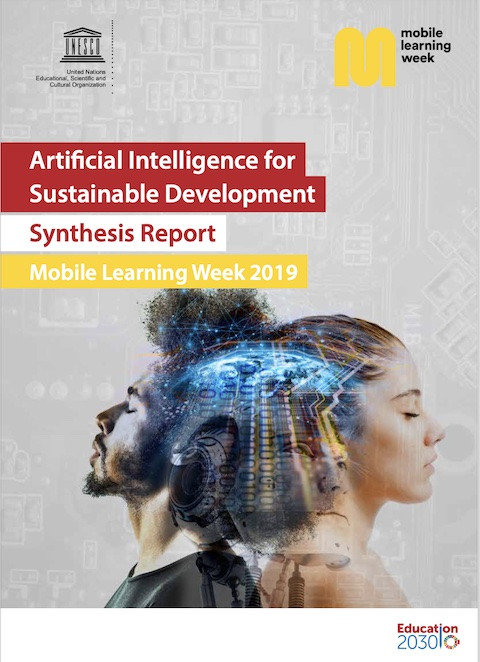 Artificial Intelligence for Sustainable Development: Synthesis Report; Mobile Learning Week 2019 Year of publication: 2019 Corporate author: UNESCO During the five-day event for Mobile Learning Week 2019, UNESCO gathered participants from around the world to share experiences, initiatives and plan joint actions with a view to harnessing artificial intelligence (AI) to achieve Sustainable Development Goal (SDG) 4. The report stems from the work that the speakers presented and the insights that all the participants shared at the event.
  International Forum on AI and the Futures of Education: Developing Competencies for the AI Era Synthesis Report; 7-8 December 2020 Year of publication: 2021 Author: Fengchun Miao | Wayne Holmes Corporate author: UNESCO This synthesis report has been developed by the UNESCO Unit for Technology and Artificial Intelligence in Education within the Future of Learning and Innovation Team, drawing on the International Forum on AI and the Futures of Education held in Beijing and simultaneously online from 7 to 8 December 2020.The Forum underlined the importance of reviewing the very purpose of education, together with the opportunity for real transformation, and the role that AI might play. It is widely acknowledged that current educational practices and educational environment are very rigid, and that the future of education should be more flexible and responsive to changing circumstances and innovation. National education authorities should identify what skills young people need to enable them to live and thrive in the new realities of a constantly changing world, and what digital transformation makes possible in the national and international context. In short, new education models are needed to put students at the centre, to move away from a focus on memorizing content, to integrate the digital and the analogue, and to foster human cognitive, socioemotional and critical skills, all of which might – with foresight and careful attention – be enabled by AI and other digital technologies.
  Trash Hack Action Learning for Sustainable Development: A Teacher's Guide Year of publication: 2021 Corporate author: UNESCO Education for Sustainable Development (ESD) gives people the tools to tackle the problems of the present and future, to fight the climate crisis, change the world and achieve the SDGs. ESD rethinks what we learn, where we learn and how we learn. It is about lifelong learning, which lets people develop the knowledge, skills, values and attitudes that enable them to make informed decisions and actions on global problems.The action-based activities in this guide intend to contribute to fostering the three dimensions of learning (cognitive, socio-emotional andbehavioural) and thereby promoting cross-cutting competencies for the SDGs, such as systems thinking, anticipatory competency, collaboration, critical thinking and integrated problem-solving.
  Education for Life Socio-Emotional Education Program Year of publication: 2018 Author: José Fernando Mejía | Gloria Inés Rodríguez | Nancy Guerra | Andrea Bustamante | Maria Paula Chaparro | Melizza Castellanos Corporate author: Alcaldía Mayor de Bogotá This teacher's guide is part of the Emotions for Life program, which seeks to develop social-emotional competencies by providing tools so that teachers can promote them with their students. This first grade guide offers a set of practical sessions for working in the classroom. These competencies allow children to get to know each other better, manage their emotions, relate better with others, make responsible decisions, decrease aggression, and increase satisfaction with their life.
  Power, Politics and Democracy (Didactic Notebooks Series on the Theory and Practice of Democracy; No. 1) Year of publication: 2012 Author: Manuel Rojas Bolaños | Rotsay Rosales Valladares Corporate author: Instituto Interamericano de Derechos Humanos (IIDH) | Centro de Investigación y Estudios Políticos This material shows the main theoretical-conceptual approaches and the central historical elements of democracy as a political regime and form of organization of social life, in order to serve as a general context for the study of democracy in Costa Rica.
  The Right to Non-Discrimination Year of publication: 2018 Corporate author: National Commission for Human Rights This document talks about the concept of discrimination, its origins and the concepts that this phenomenon contains: stereotypes, prejudices, systematic discrimination. It also reviews the forms as discrimination is presented and its consequences, to later refer to the right to non-discrimination and what can be done in case of being a victim.
 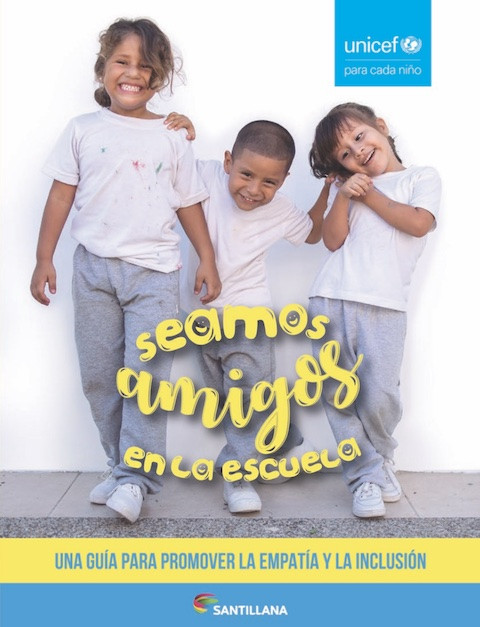 Let's Be Friends at School: A Guide to Promoting Empathy and Inclusion Year of publication: 2019 Corporate author: United Nations Children's Fund (UNICEF) Empathy is a skill that allows us to understand the emotions and experiences of other people. This guide seeks to promote empathy in the educational context, to promote peaceful coexistence, inclusion and non-violence in schools. It focuses its vision on the mission of teachers to educate not only the academic curriculum but also their emotional managing skills to deal with their own emotions and those of others.