
Resources
Explore a wide range of valuable resources on GCED to deepen your understanding and enhance your research, advocacy, teaching, and learning.
8,363 Results found
 Understanding the Impact of Artificial Intelligence on Skills Development Year of publication: 2021 Author: Kelly Shiohira Corporate author: UNESCO International Centre for Technical and Vocational Education and Training (UNEVOC) The era of artificial intelligence is young in years but advanced in impact. Intermediate skill jobs as we know them are fast disappearing as their tasks are systematically automated, and individuals are increasingly likely to encounter AI technology in their everyday lives. In fact, fifty percent of organizations worldwide report using some form of AI in their operations.It is clear that AI has broad implications for the whole of humanity, and therefore on the education and training institutions that equip lifelong learners with the skills to navigate both work and society. A wide range of institutions and other stakeholders have risen to the challenge through research and innovative programmes, paving the way for a better understanding of AI’s potential – and its pitfalls.This paper synthesizes research on current trends, programmes, policies and uses of AI related to technical and vocational education and training across six continents, covering developing and developed contexts, as a resource for stakeholders invested in the future of intermediate-level workers and TVET. Lecturers, students, administrators, policymakers, programme implementers and lifelong learners are invited to examine current practices, opportunities and challenges raised by AI, and recommendations to build a future-ready education and training system.
  Mapping the Mainstreaming of Education for Sustainable Development Across SDG 4.7: A Comparative Analysis of the Mainstreaming of ESD in Cyprus, Greece, Malta and Turkey Year of publication: 2020 Author: Devonne Goad Corporate author: UNESCO The objective of the present report is to summarize the state of ESD implementation in Cyprus, Greece, Malta and Turkey. This report summarizes and shares the successes and challenges highlighted within National Implementation Reports, as such a summary could be an important contribution to UNESCO, as the organization is currently facilitating dialogues to establish the direction of the new global programme for ESD. For that reason, these four countries within the regional scope of the UNESCO Regional Bureau in Venice, Italy, were chosen for the preliminary study. For the purpose of this study, the binary data contained within the National Implementation reports of Cyprus, Greece, Malta and Turkey were extracted to summarize the state of ESD implementation.
  The World in 2030: Public Survey Report Year of publication: 2021 Corporate author: UNESCO This report presents the results of the World in 2030 Survey, launched by UNESCO in May 2020 to provide a platform for people to share their views on our world’s most pressing challenges, including what specifically they are worried about, and, most importantly, what solutions they feel are mostneeded. The results of this survey present a clear and systematic framework for action, one that can enrich global reflection over the coming decade as part of a renewed push to achieve the Sustainable Development Goals of the UN 2030 Agenda.Over 15,000 respondents from all regions of the world responded to the survey, providing a clear snapshot of global per- spectives. This survey received particular participation from women and young people. A majority of respondents had a university education, and the top region from which participants hailed was Latin America and the Caribbean.Responses to the World in 2030 Survey indicate clear trends in the concerns felt by global citizens. According to survey respondents, the top challenge facing peaceful societies in the lead up to 2030 was, by far, climate change and loss of biodiversity, ranking in the top four challenges of 67% of respondents, and coming out on top for all regions and demographics. When examining this challenge, people were most concerned about increasing natural disasters and extreme weather, loss of biodiversity and its impact on people, pollution of the ocean and rising sea levels, and risk of conflict or violence. The top proposed solutions were investing in green energy and sustainable economies, teaching sustainability through education, effective international cooperation, and building trust in science and science-based decisions.The next four most highlighted global challenges were violence and conflict (44%), discrimination and inequality (43%), lack of food, water and housing (42%), and health and disease (37%). There was some limited variation in the rankings of the relative importance of these four challenges across regions and demographics. For example, women and minority group respondents both ranked discrimination and inequality as the second most important global challenge, following climate change and biodiversity loss, rather than third, while respondents from indigenous communities and from Asia and the Pacific ranked health and disease as the second most important global challenge, rather than fifth. The World in 2030 survey was an open online questionnaire held from May to September 2020. It was made available in more than 25 languages. This report also analyses results along regional, gender, age and other demographic lines, presenting a complex and valuable portrait of global sentiment on these key issues.
 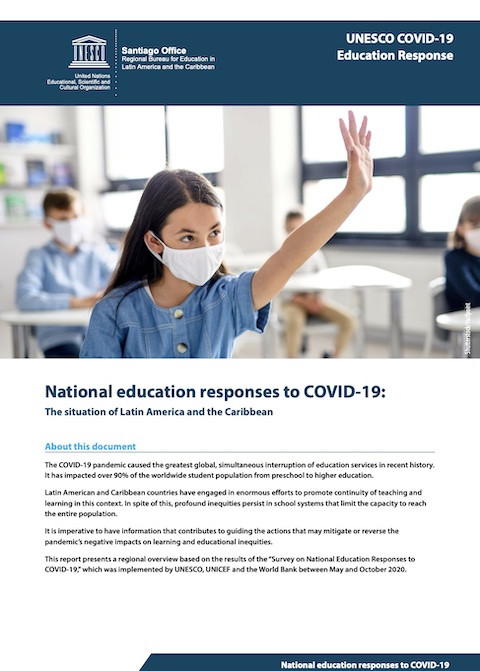 National Education Responses to COVID-19: The Situation of Latin America and the Caribbean Year of publication: 2021 Corporate author: UNESCO The COVID-19 pandemic caused the greatest global, simultaneous interruption of education services in recent history. It has impacted over 90% of the worldwide student population from preschool to higher education.Latin American and Caribbean countries have engaged in enormous efforts to promote continuity of teaching and learning in this context. In spite of this, profound inequities persist in school systems that limit the capacity to reach the entire population.It is imperative to have information that contributes to guiding the actions that may mitigate or reverse the pandemic’s negative impacts on learning and educational inequities.This report presents a regional overview based on the results of the “Survey on National Education Responses to COVID-19,” which was implemented by UNESCO, UNICEF and the World Bank between May and October 2020.
  The Responsibility of the School in Developing Awareness of Human Rights in the Light of Islamic Education Year of publication: 2017 Author: Asaad Al Hussein Corporate author: Cairo University Based on the importance of developing awareness of human rights and what it aims to achieve in developing the values of freedom, equality, cooperation and promoting rights and duties, this paper examines the responsibility of the school in developing awareness of human rights in the light of Islamic education. The school is considered the most important educational institution entrusted with promoting awareness of human rights.
  Evaluation of UNESCO’s Action to Revitalize and Promote Indigenous Languages: Within the Framework of the International Year of Indigenous Languages Year of publication: 2021 Author: Claire Thomas | Lydia van de Fliert | Oliver Loode | Silvia Quattrini | Mihaela Cojocaru Corporate author: UNESCO To draw attention to the critical loss of indigenous languages and the urgent need to preserve, revitalize and promote them and to take further urgent steps at the national and international levels, in 2016 the United Nations General Assembly in its resolution 71/178 proclaimed the year beginning on 1 January 2019 the International Year of Indigenous Languages (hereafter the IYIL2019). UNESCO was invited to serve as the lead agency for the Year and the coordination role was internally assigned to the Communication and Information Sector. UNESCO requested an evaluation of its action within the IYIL2019 with a view to learning from its experience during 2019 and further strengthening its coordination and implementation role during the upcoming Decade of Indigenous Languages (2022-2032).As the lead agency for the IYIL2019, UNESCO played a key role raising awareness of not only the critical loss of indigenous languages, but also the positive value and meanings that indigenous languages provide to Indigenous Peoples and humanity at large. The evaluation found that UNESCO led the development of an ambitious and relevant Action Plan for the Year. It also succeeded in setting up an 18-member Steering Committee composed of representatives of Member States, Indigenous Peoples and the UN three-party indigenous mechanisms. UNESCO staff implemented more than 80 activities around the world, with three-quarters of these at the global level and the majority of national events in Latin America and the Caribbean region. It also maintained an interactive website, which registered more than 880 events around the world.Leading and coordinating the IYIL2019 was not without its challenges, particularly as UNESCO was asked to lead this effort within existing resources and relying on a very small core team. Its programme sectors found creative solutions for indigenous language programming, but without a budget for intersectoral activities, collaboration between sectors was limited to information sharing and activities in Africa and the Arab States were few. The evaluation also found that the Action Plan lacked a meaningful results framework and thereby did not facilitate the monitoring of the IYIL2019. Partnerships with UNESCO networks and the wider UN system were underutilized and many opportunities for future collaboration have been highlighted for the upcoming Decade.
  Taking Stock of Progress Towards Gender Equality in the Water Domain: Where Do We Stand 25 Years After the Beijing Declaration? Year of publication: 2021 Corporate author: UNESCO World Water Assessment Programme (WWAP) Women are not only the main persons responsible for water collection in many parts of the world, but they also possess invaluable knowledge with regard to water resources and play a key role in water and sanitation management at the local and community levels. Accordingly, women must be able to enjoy equal access to water and also have an equal say in the management and governance of water resources. Twenty-five years after the Beijing Declaration and Platform for Action, progress towards gender equality through the fulfilment of the basic right to water and sanitation is clearly off track.Despite advances at the policy level in acknowledging the need to progress towards gender equality in the water sector – and the resulting benefits – large gender inequalities persist in practice. Women are generally under-represented in terms of participation at all levels: from institutional bodies that manage national or transboundary waters, to water-related institutions such as governmental water agencies and water utilities, to local water management institutions.This report provides a detailed overview of the existing and emerging challenges to gender equality in the water domain with a particular focus on: access to water, sanitation and hygiene (WASH), health, employment,climate change management, water governance, education and training, and data collection and funding. Systematic and sustained efforts to eliminate these inequalities are essential to achieve meaningful and lasting gender equality in the water sector, and to promote sustainable development in general.Governments, international organizations, professionals and policy-makers in the water sector, academia and NGOs are invited to join forces to accelerate the achievement of gender equality in water for a more just, sustainable and peaceful future.
  Global Citizenship and Liberation History in Secondary Curricula in Southern Africa: Summary Report on the Findings of a Desk Review Year of publication: 2021 Corporate author: UNESCO Harare This report presents key findings of a desk study on the extent of integration of Global Citizenship Education (GCED) and Southern Africa Liberation History (SALH) educationin the secondary schools curricula in Angola, Democratic Republic of Congo, Eswatini, Lesotho, Malawi, Mauritius, Mozambique, Namibia, South Africa, Seychelles, United Republic of Tanzania, Zambia and Zimbabwe.
  Skills Development and Climate Change Action Plans: Enhancing TVET's Contribution Year of publication: 2021 Corporate author: UNESCO International Centre for Technical and Vocational Education and Training (UNEVOC) Climate change is an ongoing process that, at the current pace of such activities, cannot be avoided. Tools have been proposed to deal with climate change focus on adaptation and mitigation. Strengthening national and international awareness of and commitment to reducing the impact of climate change has become the only viable option to ensure the sustainability of life on Earth.The Paris Agreement entered into force in 2016 with the aim of bringing all nations together in a common goal of combating climate change and adapting to its impacts. According to the Agreement, every party should submit a climate plan laying out its adaptation and mitigation targets. Technical and vocational education and training (TVET) has the potential to play significant roles in these plans. The smooth transition to green societies and economies relies on amongst others the knowledge, skills and competencies to promote sustainable development. Effective education and training for sustainable development pivots on governance and vision, and the ability to empower people in an inclusive manner to act in favour of sustainable development. It also relies on the ability to train, upskill, reskill and empower those that can take advantage of the job growth and job creation potential in a changing economy.This discussion paper compiles and reviews relevant information regarding the country submissions (Nationally Determined Contributions and National Communications) which lay out adaptation plans and the policies created in fifty-seven selected countries. The aim is to summarize key information that can help assess the ongoing and potential contribution of TVET to the realization of these plans. The analysis made through this discussion paper has helped to generate a set of approaches for climate change adaption, through the education and training lens. These approaches can be used to advance the discussion in strengthening the technical and vocational skills development component in country climate adaptation plans.
 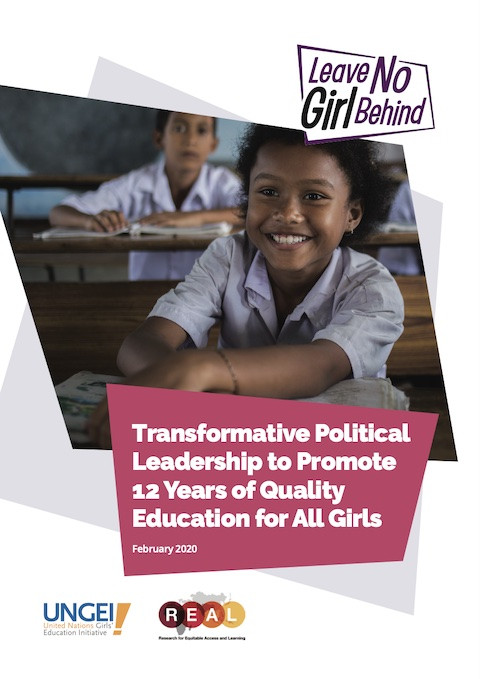 Transformative Political Leadership to Promote 12 Years of Quality Education for All Girls Year of publication: 2020 Author: Gloria Diamond Corporate author: University of Cambridge. Research for Equitable Access and Learning (REAL) Centre | United Nations Girls' Education Initiative (UNGEI) How can political leadership promote 12 years of quality education for all girls? This report from the Research for Equitable Access and Learning (REAL) Centre, University of Cambridge, seeks to answer this question. The study is based on a review of global evidence, with a focus on low- and lower-middle income countries where most action is needed to achieve the world’s development goals. The researchers also conducted interviews with 11 current and former political leaders involved in championing girls’ education. On the basis of this research, this report outlines seven recommendations on how political leadership can be leveraged to achieve 12 years of quality education for all girls.