
Resources
Explore a wide range of valuable resources on GCED to deepen your understanding and enhance your research, advocacy, teaching, and learning.
8,363 Results found
 International Human Rights Law & Sexual Orientation & Gender Identity Year of publication: 2017 Corporate author: UN. Office of the United Nations High Commissioner for Human Rights (UN. OHCHR) | United Nations Free & Equal What are human rights?Human rights are rights inherent to all human beings. We are all equally entitled to our human rights without discrimination, whatever our nationality, place of residence, sex, national or ethnic origin, color, religion, language, or any other status, such as age, disability, health status, sexual orientation or gender identity. These rights, whether they are civil and political rights (such as the right to life, equality before the law and freedom of expression) or economic, social and cultural rights (such as the rights to work, social security and education) are indivisible, universal, interrelated and interdependent.Human rights were developed and articulated in the Universal Declaration of Human Rights (1948) as a response to the atrocities of World War II. Universal human rights are often expressed and guaranteed by law, in the forms of treaties, customary international law, general principles and other sources of international law. International human rights law lays down obligations of Governments to act in certain ways or to refrain from certain acts, in order to promote and protect human rights and fundamental freedoms of individuals or groups.By becoming parties to international treaties, States assume obligations and duties under international law to respect, to protect and to fulfil human rights. The obligation to respect means that States must refrain from interfering with or curtailing the enjoyment of human rights. The obligation to protect requires States to protect individuals and groups against human rights abuses by third parties. The obligation to fulfil means that States must take positive action to facilitate the enjoyment of basic human rights.What is international human rights law? International human rights law lays down obligations that States are bound to respect. Through ratification of international human rights treaties, Governments undertake to put into place domestic measures and legislation compatible with their treaty obligations and duties. Where domestic legal proceedings fail to address human rights abuses, mechanisms and procedures for individual complaints or communications are available at the regional and international levels to help ensure that international human rights standards are indeed respected, implemented, and enforced at the local level. At the international level these mechanisms include treaty bodies, expert committees established by treaty and tasked with monitoring implementation of treaty obligations, and special rapporteurs and other independent experts appointed by the United Nations Human Rights Council to investigate and report on pressing human rights challenges.Is it ever legal to discriminate against lesbian, gay, bisexual, transgender or intersex people?No. The right to equality and non-discrimination are core principles of human rights, enshrined in the United Nations Charter, The Universal Declaration of Human Rights (UDHR) and human rights treaties. The opening words of the Universal Declaration of Human Rights are unequivocal: “All human beings are born free and equal in dignity and rights.”The equality and non-discrimination guarantee provided by international human rights law applies to all people, regardless of sex, sexual orientation and gender identity or “other status.” There is no fine print, no hidden exemption clause, in any of our human rights treaties that might allow a State to guarantee full rights to some but withhold them from others purely on the basis of sexual orientation and gender identity.Moreover, United Nations human rights treaty bodies have confirmed that sexual orientation and gender identity are included among prohibited grounds of discrimination under international human rights law. This means that it is unlawful to make any distinction of people’s rights based on the fact that they are lesbian, gay, bisexual or transgender (LGBT), just as it is unlawful to do so based on skin color, race, sex, religion or any other status. This position has been confirmed repeatedly in decisions and general guidance issued by several treaty bodies, such as the United Nations Human Rights Committee, the Committee on Economic, Social and Cultural Rights, the Committee on the Rights of the Child, the Committee against Torture, and the Committee on the Elimination of Discrimination against Women.What are some of the most common forms of human rights violations affecting LGBT people? The UN human rights office has documented a wide range of human rights violations committed against individuals on the basis of their sexual orientation and gender identity.These include:Violent attacks, ranging from aggressive verbal abuse and psychological bullying to physical assault, beatings, torture, kidnapping and targeted killings.Discriminatory criminal laws, often used to harass and punish LGBT people, including laws criminalizing consensual same-sex relationships, which violate rights to privacy and to freedom from discrimination.Discriminatory curbs on free speech and related restrictions on the exercise of rights to freedom of association and assembly, including laws banning dissemination of information on same-sex sexuality under the guise of restricting the spread of so-called LGBT “propaganda.”Discriminatory treatment, which can take place in a range of everyday settings, including workplaces, schools, family homes and hospitals. Without national laws prohibiting discrimination by third parties on grounds of sexual orientation and gender identity, such discriminatory treatment continues unchecked, leaving little recourse to those affected. In this context, lack of legal recognition of same-sex relationships or of a person’s gender identity can also have a discriminatory impact on many LGBT individuals. What have the UN General Assembly and Human Rights Council said on this subject?The United Nations General Assembly, in a series of resolutions, has called on States to ensure the protection of the right to life of all persons under their jurisdiction and to investigate promptly and thoroughly all killings including those motivated by the victim’s sexual orientation and gender identity (see, for example, resolution A/RES/67/168).In June 2011, the United Nations Human Rights Council became the first UN intergovernmental body to adopt a wide-ranging resolution on human rights, sexual orientation and gender identity. Resolution 17/19 expressed the Council’s “grave concern” at violence and discrimination against individuals based on their sexual orientation and gender identity, and commissioned a study on the scope and extent of these violations and the measures needed to address them.The requested study, prepared by the Office of the High Commissioner for Human Rights, was released in December 2011. It pointed to a pattern of violence and discrimination directed at individuals because of their sexual orientation and gender identity. Its findings and recommendations formed the basis of a panel discussion that took place at the Council in March 2012 – the first time a formal intergovernmental debate on the subject had been taken place at the United Nations.
  The Symbiosis Relationship Between Ethnic Identity and National Identity in School Education Field: A Case Study Of Axi Yi High School Students in Yunnan (Journal of Research on Education for Ethnic Minorities; Vol. 28, No. 141) Year of publication: 2017 Author: Chen Yukui Corporate author: Minzu University of China This paper uses educational anthropolog to examine and analyse ethnic identity and national identity of ethnic Axi Yi high school students. It finds that they have both very strong ethnic and national identities, and there is a moderate positive correlation between the two identities. This shows that the two identities can coexist harmoniously for ethnic minorities. This paper also finds that the symbiosis relationship between students’ ethnic identity and national identity is built on common foundations, such as common territorial awareness, common consanguinity,common historical memory,common heroic characters and common national symbols. This paper argues that schools are the important place where those common foundations are built.
  Supporting Quality Journalism Through Media and Information Literacy Year of publication: 2020 Author: Martina Chapman | Markus Oermann Corporate author: Council of Europe MIL - Media and Information Literacy used to be seen as the responsibility of the educational sector mostly targeting younger people in full-time education. This responsibility has to be extended to all stakeholders who are in a position to reach citizens of all age groups where they currently are and create new dissemination networks for MIL knowledge and skills.All relevant stakeholders, especially member states, need to recognise their own roles and responsibilities in relation to media literacy. They should be prepared to lead on, participate in, and fund MIL projects on a long-term basis.
  Human Rights Storytelling: Manual for the Educators Year of publication: 2018 Corporate author: Huristo Project Consortium Huristo project developed a methodology about awareness and advocacy about the European Human Rights Charter as a part of global citizenship education with low skilled adult learners (refugees and migrants living in the city and natives living in rural places). This methodology is based on digital storytelling: participants work on personal narratives illustrating different topics of the charter.The main result for the adult learners are increased digital skills, reading and writing skills, awareness about the Human Rights Charter and European citizenship. The work on the Charter and the personal narratives also improve participants’ analytic media literacy, interpersonal and intercultural skills, but also core skills for employability, such as teamwork, problem solving, learning to learn and communication. Additionally, the adult trainers who are involved increase their teaching skills using digital media and the methodology of digital storytelling in particular.In the HURISTO project trainers start with the stories of the participants, and afterwards the stories are linked to articles of the Charter. To do so, the methodology is using two concepts:1) PHOTOLANGUAGE SET: a set of 30 flashcards for students with photos that illustrate the European Charter of Human Rights. They have been created as a tool to start up conversations about human rights in Europe and the situations in which these rights may be at risk. Based on these discussions and the sharing of stories, each participant chooses one photo out of the flashcards, as a starting point for a digital story. The HURISTO Photolanguage set for educators contains guidelines for educators who want to use it in a human rights digital storytelling workshop with adult learners.2) STORY CIRCLES: in different rounds participants share their stories with the group and develop them together into short stories for their film.
  Explained: What is False Information? Year of publication: 2020 With so much information at our fingertips it can be easy to come across something online that isn’t quite as accurate or reliable as it should be. This kind of information is often called Fake News but a better description might be false information because it affects more than news stories. This animation, explaining false information, supports the education resource Connected - an introduction to digital media literacy.
  Reflect–Share–Act: A Guide to Community-based Education for Sustainable Development Year of publication: 2021 Corporate author: UNESCO | UNESCO Bangkok This guidebook aspires to build a community where learning for sustainable development takes place everywhere for everyone as an ongoing practice. It introduces you to Reflect-Share-Act, a process to discover and define sustainable development in your own contexts together with others in your community. The guide compiles resources that can support this learning process, including stories of various communities’ actual experiences of Reflect-Share-Act.
  Background Document: National Media and Information Literacy (MIL) Policies and Strategies in Albania; 2020-2021 Year of publication: 2021 Corporate author: Albanian Media Institute This background study was conducted in the framework of the project "Building trust in the media in Southeast Europe and Turkey, phase II" supported by UNESCO and the European Union and implemented by the Albanian Media Institute. The project, at this stage of implementation, aims to increase the skills of young people for media and information literacy (MIL) through the integration of the MIL curriculum in the formal education system in Albania. The implementation of the project started in June 2020 and will last until 2022.This document suggests objectives for MIL policies and strategy, which should be extended to formal education (university and pre-university level); in non-formal and informal education thus affecting all members of society with the aim of increasing the level of education on media and information in Albania.
  Racial Literacy Year of publication: 2021 Author: Yolanda Sealey-Ruiz Corporate author: National Council of Teachers of English (NCTE) This paper gives a clear definition of the racial literacy connected to the concepts of democracy and equity and presents racial literacy development model for teaching and learning.
  Critical Media Literacy and Popular Culture in ELA Classrooms Year of publication: 2021 Author: Jamila Lyiscott | Nicole Mirra | Antero Garcia Corporate author: National Council of Teachers of English (NCTE) This publication explores key issues on the Media Literacy impacting literacy educators and their students and articulate student-centered policy recommendations.
 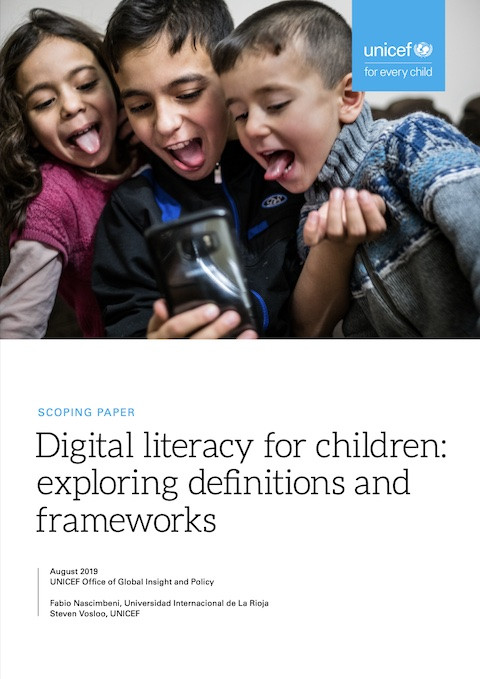 Digital Literacy for Children: Exploring Definitions and Frameworks Year of publication: 2019 Author: Fabio Nascimbeni Corporate author: United Nations Children's Fund (UNICEF) This paper presents the results of a scoping exercise on children’s digital literacy that has been undertaken with the following objectives:To understand the current digital literacy policy and practice landscape;To highlight existing competence frameworks and how they can be adapted to UNICEF’s needs;To analyze the needs and efforts of UNICEF country offices; andTo reflect on policy and programme recommendations, including a definition of digital literacy for UNICEF