
Resources
Explore a wide range of valuable resources on GCED to deepen your understanding and enhance your research, advocacy, teaching, and learning.
8,363 Results found
 On Education & Democracy: 25 Lessons from the Teaching Profession Year of publication: 2019 Author: Susan Hopgood | Fred van Leeuwen Corporate author: Education International (EI) On the occasion of the 25th anniversary of Education International, the authors have selected 25 lessons which educators and their organizations have learnt throughout history on education and democracy.These lessons serve as a set of recommendations to every classroom teacher working at all levels in education systems and in their education unions. These lessons are an invitation to take a stand in favour of democracy and its institutions and to consider contributions that teachers, schools, universities and representative organizations can make to solidify and progress democratic life.
  Inequalities in Learning in Vietnam: Teachers’ Beliefs About and Classroom Practices for Ethnic Minorities (RISE Working Paper Series; 21/061) Year of publication: 2021 Author: Joan DeJaeghere | Vu Dao | Bich-Hang Duong | Phuong Luong Corporate author: Research on Improving Systems of Education (RISE) Global and national education agendas are concerned with improving quality and equality of learning outcomes. This paper provides an analysis of the case of Vietnam, which is regarded as having high learning outcomes and less inequality in learning. But national data and international test outcomes may mask the hidden inequalities that exist between minoritized groups and majority (Kinh) students. Drawing on data from qualitative videos and interviews of secondary teachers across 10 provinces, we examine the role of teachers’ beliefs, curricular design and actions in the classroom (Gale et al., 2017). We show that teachers hold different beliefs and engage in curricular design – or the use of hegemonic curriculum and instructional practices that produce different learning outcomes for minoritized students compared to Kinh students. It suggests that policies need to focus on the social-cultural aspects of teaching in addition to the material and technical aspects.
 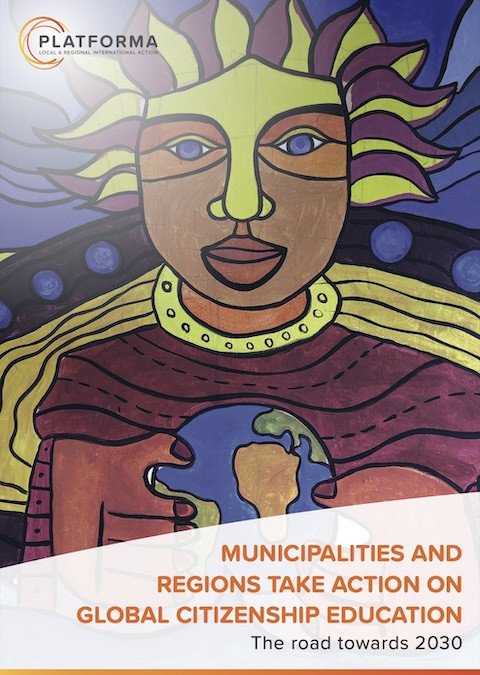 Municipalities and Regions Take Action on Global Citizenship Education: The Road Towards 2030 Year of publication: 2021 Author: Aurèle Destrée | Tereza Čajková Corporate author: PLATFORMA | European Union (EU) Development Education and Awareness Raising (DEAR)/Global Citizenship Education (GCE) can cultivate the spirit of the 2030 Agenda because it helps acquiring missing knowledge on global interconnections and creates spaces for enquiries.Whilst old constraints still remain and new challenges are appearing, local and regional governments continue to innovate, experiment and work hand in hand with key partners, including with their peers across the globe, to find new solutions and achieve their ambitions.Discover in this publication how local and regional governments are active in supporting learning and fostering changes in a context of socio-economic recovery plans.
  Sub-Education Policy Review Report: Inclusive Education Year of publication: 2021 Corporate author: UNESCO Inclusion highlights opportunities for an equal involvement of individuals with disabilities (physical, social, and emotional) when possible into typical education, but leaves accessible the probability of individual selections and possibilities for special aid and accommodations for persons who need it. This review was initiated by UNESCO to inform the ongoing discourse about inclusive education within Malaysia, Indonesia, Brunei, Philippine and Timur-Leste. Sustainable Development Goal 4 (SDG 4) reinforces the importance of inclusive education which adheres nations to adopt the framework of action in providing inclusion and equity through education of children with perceived differences. The review contributes to the body of literature on inclusive education by synthesizing policy recommendations and evaluations and identifying contradictions and overlaps in those policies. This review draws upon UNESCO reports pertaining to inclusive education policies and initiatives. In addition, a systematic review of empirical studies on inclusive education policy (2010-2020) identified from related and major databases (Eric) is conducted. Both the UNSECO reports and empirical studies are analyzed based on the SDG4 and its targets pertaining to inclusion policy.
  The Impact of COVID-19 on Inclusive Education at the European Level: Literature Review Year of publication: 2021 Corporate author: European Agency for Special Needs and Inclusive Education | European Commission The coronavirus (COVID-19) pandemic has affected learners around the world. School closures forced emergency responses from education systems, resulting in various forms of remote schooling. The crisis highlighted pre-existing inequalities in education and provided a reason for systemic change in education worldwide.This literature review aims to map evidence and identify acknowledged ways in which COVID‑19 has impacted on education in general and inclusive education in particular at European and national levels. The intention is to provide a comprehensive overview of key messages for Agency member countries. It will also inform possible future Agency work on this topic.
  Achieving SDG4 Through a Human Rights Based Approach to Education: World Development Report 2018 Background Paper Year of publication: 2018 Author: Kate Moriarty Corporate author: World Bank Quality education is a critical dimension for the achievement of sustainable development. The renewed political commitment set out in sustainable development goal 4 (SDG4) is an opportunity to ensure strong coherence between education policy and the right to education first articulated more than 70 years ago. This paper presents the results of a desk-based study on a human rights-based approach to education (HRBAE) in the context of SDG4. It explores the ways in which such an approach can guide policy, planning, and the delivery of education in observance with agreed international frameworks providing for the right to education. The paper argues that the human rights conventions on the right to education are not passive instruments designed to remain only at the level of discourse but, as legal obligations, require action from the state and should be central in the development of education services, including in the context of large scale displacement and crisis. This paper outlines the legally binding commitments of the right to education. It considers how these can be applied practically through a HRBA-E to address the continuing barriers to access and completion of quality education and learning.
  Building Knowledge Exchange Partnerships: Dialogues Across Europe Year of publication: 2020 Corporate author: Bridge 47 This publication ‘Building Knowledge Exchange Partnerships Dialogues Across Europe’ shares some of the experiences learned from this area of the Bridge 47 project.The Knowledge Exchange Partnerships hosted expert events, on site and online, carried on networking and exchange, disseminated information about GCE on other platforms and collectives, and came together for specific activities, such as workshops, webinars, publications, with the support of the larger Bridge 47 network.
  Curriculum GlobALE: Competency Framework for Adult Educators Year of publication: 2021 Corporate author: DVV International | German Institute for Adult Education, Leibniz Centre for Lifelong Learning | International Council for Adult Education | UNESCO Institute for Lifelong Learning (UIL) This publication introduces Curriculum globALE, a basic com- petence framework for the training of adult educators worldwide. By providing a modular, competency-based framework and cross-curricular approach, Curriculum globALE is unique in its aim to professionalize adult learning and education (ALE) on an international scale, via the competencies that support adult educators to work in any educational setting, field or form.It strives to ensure that educators’ knowledge, competencies, skills and attitudes are of a professional standard.Curriculum globALE is suitable to different contexts and its character and structure enables its inclusion in diverse national education systems.Curriculum globALE aims to: enhance the professionalization of ALE by providing a common reference framework for adult learning programmes and a suggested standard of competencies for adult educators; support ALE providers in the design and implementation of ‘train-the-trainer’programmes; foster knowledge exchange and mutual understanding between adult educators worldwide.
  How Human Rights Shape Social Citizenship: On Citizenship and the Understanding of Economic and Social Rights (Washington University Global Studies Law Review. Vol.13, No.2) Year of publication: 2014 Author: Ulrike Davy Corporate author: Washington University This Article reconceptualizes citizenship, a notion usually tied to the nation state, as “layered.” Human rights may serve as the international “layer” of citizenship, addressing nationals and non-nationals alike. It took some time, however, for “social” citizenship to emerge as a human rights issue and, hence, for human rights to become an international layer for social citizenship rights granted on the national level. Around 1993, states started to accept a human rights-based obligation toward the poor, requiring social policies to focus on targeted, individual welfare. Nowadays, poverty mitigation is the human rights core of “social” citizenship. Nowadays, poverty mitigation is the human rights core of “social” citizenship.
 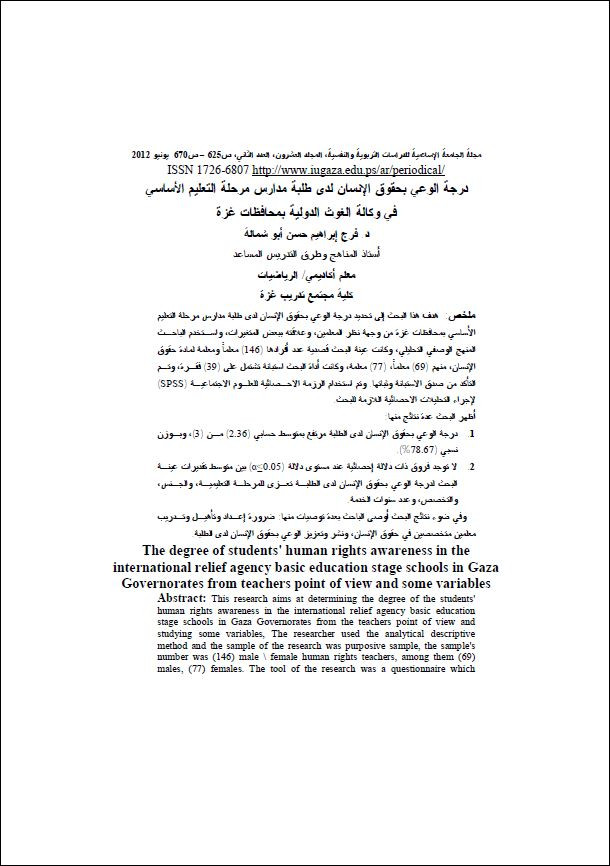 The Degree of Students' Human Rights Awareness in the International Relief Agency Basic Education Stage Schools in Gaza Governorates from Teachers Point of View and Some Variables Year of publication: 2012 Author: Faraj Abu Shamala Corporate author: Islamic University of Gaza The aim of this research is to determine the degree of awareness of human rights among students of basic education schools in the governorates of Gaza from the teachers ’point of view, and its relationship to some variables. The research revealed several results, including: The degree of awareness of human rights among students is high, with a mean of (2.36) out of (3). In light of the results of the research, the researcher recommended several recommendations, including: the necessity of preparing, qualifying and training teachers specialized in human rights, and spreading and enhancing awareness of human rights among students.