
Resources
Explore a wide range of valuable resources on GCED to deepen your understanding and enhance your research, advocacy, teaching, and learning.
8,363 Results found
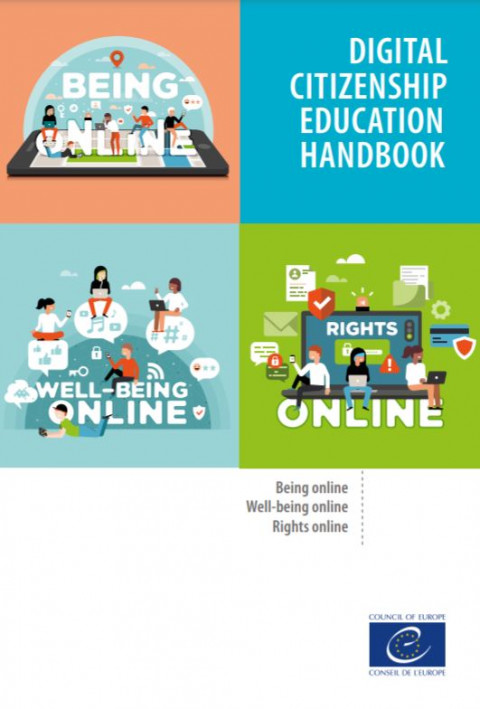 Digital Citizenship Education Handbook Year of publication: 2019 Author: Janice Richardson | Elizabeth Milovidov Corporate author: Council of Europe Digital citizenship and engagement involves a wide range of activities, from creating, consuming, sharing, playing and socialising, to investigating, communicating, learning and working. Competent digital citizens are able to respond to new and everyday challenges related to learning, work, employability, leisure, inclusion and participation in society, respecting human rights and intercultural differences.This Digital citizenship education handbook is designed to help educators and other interested adults understand and deal with them. It builds on the Council of Europe’s Reference Framework of Competences for Democratic Culture and the achievements of our longstanding Education for Democratic Citizenship programme, and complements the Internet literacy handbook as part of a coherent approach to educating citizens for the society of the future.
 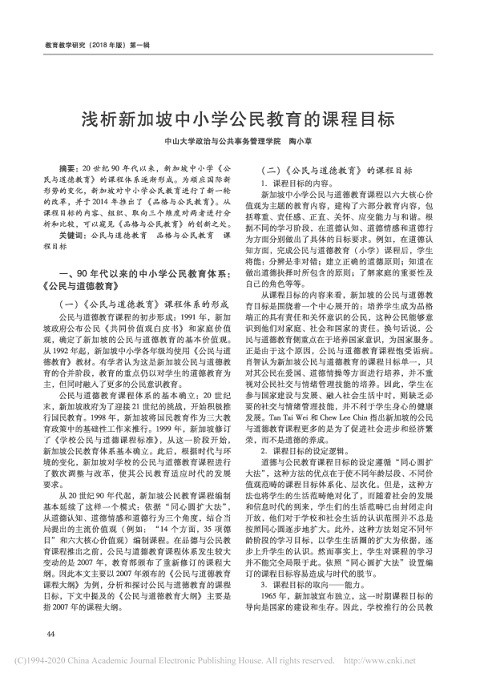 A Brief Analysis of the Curriculum Objectives of Citizenship Education in Primary and Secondary Schools in Singapore Year of publication: 2018 Author: Tao Xiaocao Corporate author: Guangdong Chenyue Education Development Since the 1990s, the curriculum system of Citizenship and Moral Education has gradually taken shape in Singapore’s primary and secondary schools. In order to adapt to the new international situation, Singapore has carried out a new round of reform on citizenship education in primary and secondary schools, and launched character and Citizenship Education in 2014. From course objectives to content, organization. By analyzing and comparing the two in the three dimensions of orientation, we can see the innovation of Citizenship and Moral Education.
 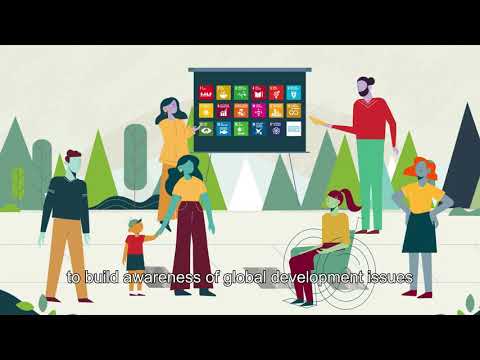 DEAR: Action Through Education Year of publication: 2020 Corporate author: Development Education and Awareness Raising (DEAR) Programme | European Commission This video explains how DEAR programme works and supports educators in their endeavours to spread greater understanding of the world around us.
  Practices of Citizenship in East Africa: Perspectives from Philosophical Pragmatism Year of publication: 2020 Author: Katariina Holma | Tiina Kontinen Corporate author: Routledge Practices of Citizenship in East Africa uses insights from philosophical pragmatism to explore how to strengthen citizenship within developing countries. Using a bottom-up approach, the book investigates the various everyday practices in which citizenship habits are formed and reformulated. In particular, the book reflects on the challenges of implementing the ideals of transformative and critical learning in the attempts to promote active citizenship. Drawing on extensive empirical research from rural Uganda and Tanzania and bringing forward the voices of African researchers and academics, the book highlights the importance of context in defining how habits and practices of citizenship are constructed and understood within communities. The book demonstrates how conceptualizations derived from philosophical pragmatism facilitate identification of the dynamics of incremental change in citizenship. It also provides a definition of learning as reformulation of habits, which helps to understand the difficulties in promoting change. This book will be of interest to scholars within the fields of development, governance, and educational philosophy. Practitioners and policy-makers working on inclusive citizenship and interventions to strengthen civil society will also find the concepts explored in this book useful to their work.
  Europe and North America Regional GCED Network Meeting: Final Report (21-22 November 2018, Lisbon, Portugal) Year of publication: 2018 Corporate author: APCEIU This meeting report is for the meeting, held on 21-22 November 2018 in Lisbon, Portugal, which aimed to strengthen global action on Global Citizenship Education. The event was jointly organized by the Asia-Pacific Centre of Education for International Understanding (APCEIU) under the auspices of UNESCO, the UNESCO Venice Office and ANGEL project partners GENE.The meeting brought together over 50 GCED-related stakeholders, including those from academia, nongovernmental organizations (NGOs), intergovernmental organizations, ministries, and the National Commissions for UNESCO. The meeting featured a range of presentations and reflections from partners and provided a platform to discuss action to strengthen GCED networking strategies within and beyond the region. It also offered participants the opportunity to share experiences, insights and knowledge with one another, and encouraged them to explore areas of collaboration in the future.
  Identity, Altruism and Cross-Cultural Issues Year of publication: 2020 Author: Muhammad Yakin This book chapter discusses issues of diversity, diversity and difference. It is exposed to approaches to individuality, identity and coexistence. In this article, the questioning of the concepts of identity and altruism and the relationship of one to the other seeks to address the manifestations of the transmission of paradigm in the fields of social sciences in general, and the field of anthropology in particular, in the direction of consolidating the foundations of the "multi-site anthropology" approach.
  Democracy in the Educational Institution: Between the Qualification of Schooling and the Rooting of Training Year of publication: 2017 Author: Abdel Karim Belhadj | Abd al-Ilah Shrayat Corporate author: Supreme Council for Education, Training, and Scientific Research This paper discusses the relationship between school and democracy. It shows the intersection between them. Then the paper turns on how to educate for democracy. The paper concludes with a vision for global citizenship education.
 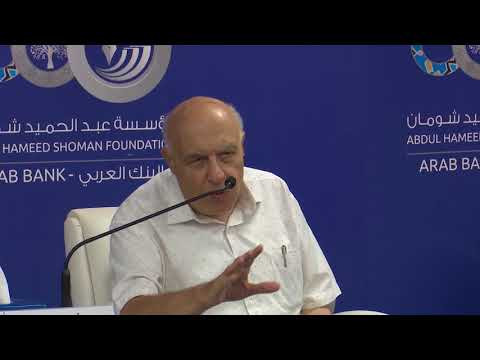 Globalization and Its Impact on the Concept of Identity Year of publication: 2017 Author: Hisham Ghassib Corporate author: Abdul Hameed Shoman Foundation The Abdul Hameed Shoman Cultural Foundation Forum, on 7/8/2017, hosted the Jordanian thinker, Dr. Hisham Ghosseb in a lecture entitled "Globalization and its Impact on the Concept of Identity", presented by Dr. Maher Al-Sarraf.This video is a lecture in which the lecturer talks about globalization and its impact. The lecturer discusses the concept of globalization, its ideologies, and the extent of its impact on identity.
  The Concept of Religion and Citizenship in Modern Country (Yatfakroon Season 3 Episode 22) Year of publication: 2019 Corporate author: Alghad TV The emergence of Islam took a qualitative leap in political life in the Arabian Peninsula, as the new religion succeeded in dismantling tribal structures and changing class concepts based on narrow affiliations in favor of the concept of the homeland, which equates everyone in rights and duties. This was clearly demonstrated in the Medina document that organized the relationship between Muslims, Jews and others, as they are all a nation without the people, and in spite of this, some still call for non-Muslims to be considered second-class citizens, with no jurisdiction or equality with them in Muslim countries. This contradicts the foundations on which the modern nation state was established, considering Religion is for God and the homeland for all! The same question arises: Can the concept of the state be based on religious considerations that exclude the other and ignore his existence?
 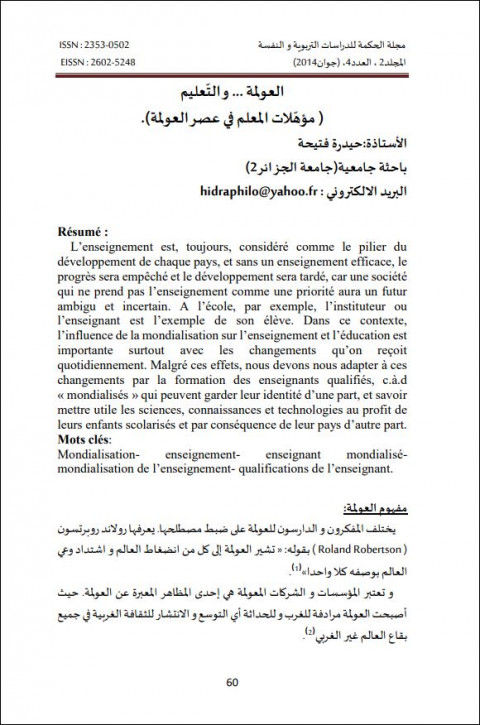 Globalization and Education (Teacher Qualifications in the Era of Globalization) Year of publication: 2014 Author: Haidara Fatiha Education is, always, considered as the pillar of the development of every country, and without effective education, progress will be impeded and development will be delayed. This is because a society that does not take education as a priority will have an ambiguous future. In school, for example, the teacher is the model for his students. In this context, the influence of globalization on teaching and education is important especially with the changes that we receive daily. Despite these effects, we must adapt to these changes by training qualified teachers, ie "globalized" teachers who can keep their identity on the one hand, and know how to use science, knowledge and technology for the benefit of their teachers. children in school and consequently from their country on the other hand.