
Resources
Explore a wide range of valuable resources on GCED to deepen your understanding and enhance your research, advocacy, teaching, and learning.
8,364 Results found
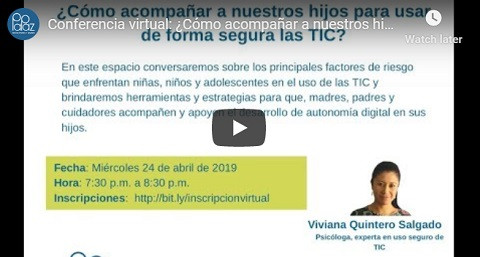 Virtual Conference: How to Accompany Our Children to Use ICT Safely? Year of publication: 2019 Author: Viviana Quintero Corporate author: Red Papaz This conference discusses the main risk factors faced by girls, boys and adolescents in the use of ICTs and provides tools and strategies so that, from home, mothers, fathers and caregivers accompany and support the development of digital autonomy in their children.
  Kit Papaz Families and Communities Educating for Peace Year of publication: 2016 Author: Melisa Castellanos | María Paula Chaparro Corporate author: Organización Internacional para las Migraciones (OIM) | Corporación Colombiana de Padres y Madres (Red PaPaz) This kit offers practical and simple tools so that, through the development of citizen competencies, fathers, mothers and other educational agents promote peace-building education in children and adolescents.
 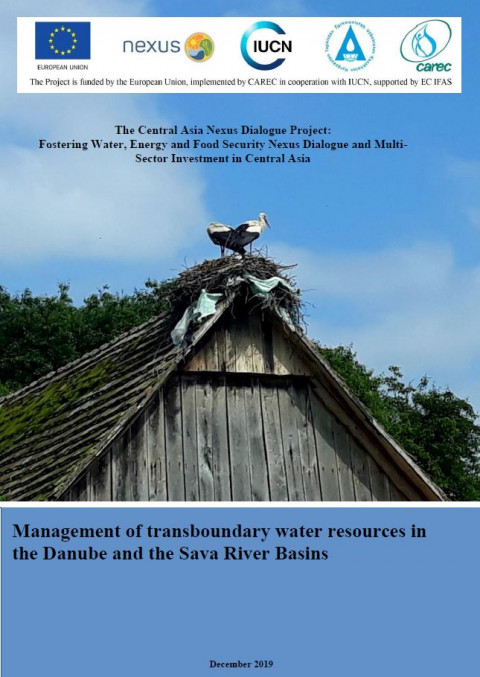 Management of Transboundary Water Resources in the Danube and the Sava River Basins Year of publication: 2019 Author: Aksulu Kushanova Corporate author: Regional Environmental Centre for Central Asia (CAREC) This analytical work “Management of transboundary water resources in the Danube and Sava River Basins” conveys knowledge and information on the management of the transboundary water resources by acknowledging the importance of the WEF Nexus in the Danube and Sava River Basins. Firsthand information was received during face-to-face meetings with the ICPDR and the ISRBC and the summarized work at hand shares the European experience with a wider audience.The analytical work narrates the institutional and legislative frameworks within the sectoral characteristics on the management of two River Basins: the Danube River Basin, which is the largest and the most international one in Europe, and the Sava River Basin, which serves as the greatest tributary to the Danube River. The study reviews the operations of the ICPDR and the ISRBC and technical tools applied at the basin level, which include accident emergency warning systems, monitoring networks, flood forecasting and more.
 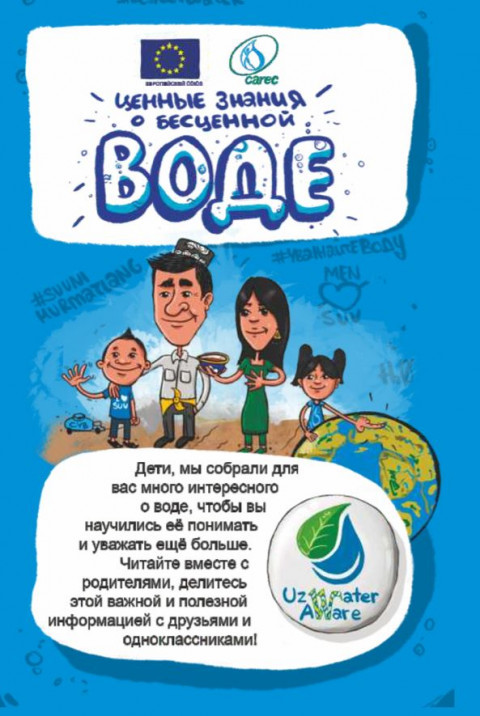 Valuable Knowledge on Invaluable Water Year of publication: 2020 Corporate author: Regional Environmental Centre for Central Asia (CAREC) UzWaterAware Water Awareness Children's Learning Book “Valuable knowledge about invaluable water” is an illustrated children's collection on the respectful and respectful attitude to water resources, prepared as part of the UzWaterAware project. The project is implemented by CAREC with financial support from the European Union. National partner: Ministry of Water Resources of the Republic of Uzbekistan.The publication was prepared in the framework of the project’s cooperation with the only children’s eco-magazine “Rodnichok” (Uzbek. “Buloqcha”) of the Ecological Movement of Uzbekistan in Uzbekistan.The book, in a language accessible to children and in a fascinating, colorful format, provides information on the world’s water reserves, the main waterways of Uzbekistan, tells what “virtual water” is, water-saving technologies, and also provides many interesting facts, experiments with water, riddles, crosswords, etc.
  Religion and Belief Issues in the Countries of Central Asia (Kyrgyzstan, Kazakhstan, Uzbekistan, Tajikistan) and Russia in the Media; April 2016 - April 2017 Year of publication: 2017 Author: Evgeny Zavyalov Corporate author: Open Position (Kyrgyzstan) This publication is a review of news on religion and belief issues that appeared in the media from April 2016 to April 2017, in Central Asia (Kyrgyzstan, Kazakhstan, Uzbekistan, Tajikistan) and Russia. The materials included in the publication were distributed monthly on a newsletter including members of religious communities and experts working on issues of religion and belief.
  Virtual Conference: How Can We Prevent Bullying and Cyberbullying? Year of publication: 2019 Author: Enrique Chaux Corporate author: Red Papaz This conference presents strategies that can contribute to preventing and managing bullying and cyberbullying situations, especially emphasizing the role that mothers, fathers, caregivers and teachers can have.
  Kit Papaz for Bullying and Cyberbullying Prevention and Intervention Year of publication: 2014 Author: Lina Saldarriaga | José Fernando Mejía | Enrique Chaux | Andrea Bustamante | Melisa Castellanos | Manuela Jiménez | María Isabel Mejía Corporate author: Red Papaz | ICBF This Kit is a tool for parents, teachers and caregivers to know what bullying and cyberbullying are, how they can prevent and manage them, and promote healthy school and family coexistence.
 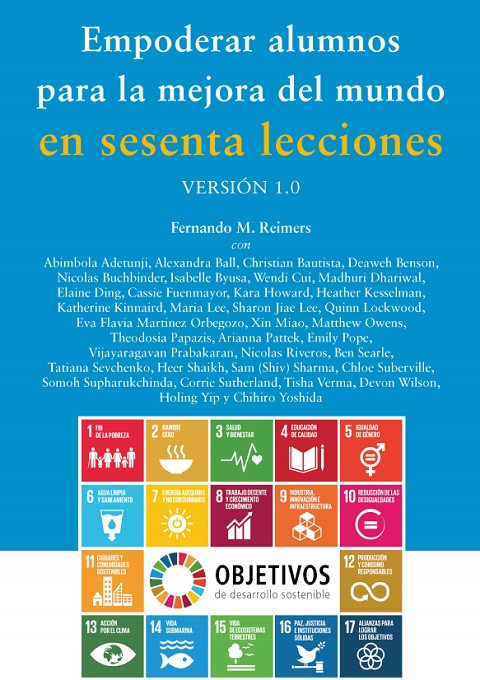 Empowering Students for the Improvement of the World in 60 Lessons: Version 1.0 Year of publication: 2017 Author: Fernando Reimers Corporate author: Centro de Cooperación Regional para la Educación de Adultos en América Latina y el Caribe (CREFAL) This book presents tools for creating and adapting curriculum for Global Citizenship Education as well as a 60-lesson prototype for all grades, from 1th to 12th.
 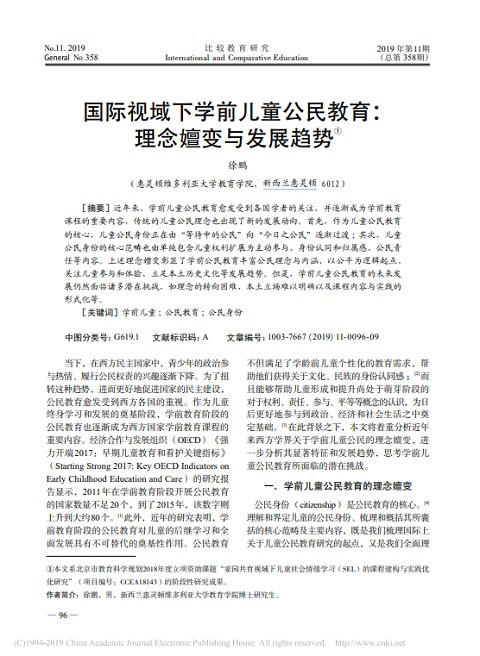 Preschool Children's Citizenship Education in Global Context: The Transformation of Ideas and Development Trends Year of publication: 2019 Author: Xu Peng Corporate author: International and Comparative Education In recent years, preschool children’s citizenship education has been emphasized globally and gradually becomes a main content in early childhood curriculum. Traditional ideas on early age citizens see some new changes. As the core of early age children’s citizenship education, children’s citizenship is gradually transferred from citizens in waiting to citizens today, including right, active participation, identity and sense of belonging, and collective responsibility. The above transformation highlights global trends such as enriching ideas and contents on citizenship, regarding equity as the logic starting point, paying attention to young children’s participation and experience, and being rooted in indigenous context and culture. In the meantime, potential challenges still exist for the future development of young children's citizenship, such as the difficulty of transferring ideas, ambiguous standing point and the tokenism of curriculum content and practice.
 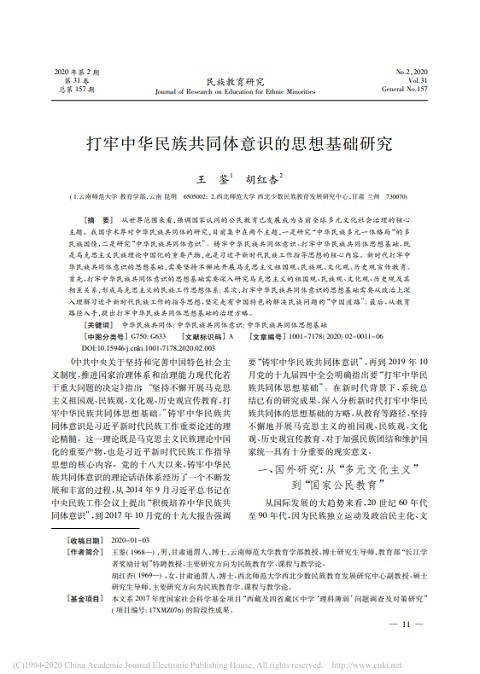 Research on Building Ideological Foundation of a Sense of Community for the Chinese Nation Year of publication: 2020 Author: Wang Jian | Hu Hong-Xing Corporate author: Central Minzu University From a global perspective, the development of citizenship education emphasizing national identity has become the core theme of multicultural society. At present, the research on the sense of community for Chinese nation focuses on two themes: one is the situation of “the pattern of diversity in unity of the Chinese nation”, and the other is the sense of community for Chinese nation. It is an important part of Xi Jinping’s thought on ethnic work of the new era to strengthen the consciousness and foundation of the Chinese nation community. To lay an ideological foundation of the Chinese nation community in the new era, we need to unswervingly carry out the propaganda and education of Marxist views on the motherland, the nation, culture and history. It means that firstly we should study Marxist views on them and their relations to form a Marxist ideological system of national work. Secondly, we need to understand the Xi Jinping’s guiding ideology of ethnic work in the new era and firmly follow the “Chinese road” with Chinese characteristics to solve ethnic problems. Finally, starting from the path of culture, education, and propaganda, we need to strengthen a strategy of the Chinese Nation Community.