
Resources
Explore a wide range of valuable resources on GCED to deepen your understanding and enhance your research, advocacy, teaching, and learning.
8,364 Results found
 Climate Revolution: How Dare Youth; Resource Pack Year of publication: 2019 Author: Valerie Duffy | Leo Gilmartin | Valery Molay | Dermot O’Brien Corporate author: National Youth Council of Ireland (NYCI) This resource explores the issue of Climate Change and the Sustainable Development Goals. Produced as part of the national One World Week youth work programme and during an era of youth-led climate strikes, Climate Revolution contains many new and innovative activities that cover a wide range of learning levels on topics related to climate change and climate justice.It is designed for Global Educators, Youth Workers, Development Education practitioners, trainers, climate activists, changemakers of all shapes and sizes but in particular those working with the current generation of young people.
  Climate Action: Teacher Resource Year of publication: 2018 Author: Gráinne Ryan Corporate author: An Taisce The Climate Action Teacher Resource has been devised to equip Geography, C.S.P.E., Science, English teachers with the tools and guidance to explore the topic of climate change through their curriculum. This comprehensive guide provides teachers with the resources to educate, encourage and inspire students to take action on climate change, a challenge that faces Irish society and the wider international community.
  Kindness: The Force That Will Help Us Achieve the Sustainable Development Goals (The Blue Dot Issue 11, 2020) Year of publication: 2020 Corporate author: Mahatma Gandhi Institute of Education for Peace and Sustainable Development (MGIEP) In the eleventh issue of The Blue Dot, we focus on ‘Kindness’ – as the force that will help us achieve the Sustainable Development Goals, towards making the world more peaceful and sustainable – a better place to live in the future for our children. We hear from Ramesh Pokhriyal ‘Nishank’, Minister of Human Resource Development, Government of India on ‘The Need for Kindness and Compassion – Embodying the values of Mahatma Gandhi’, experts such as Zoran Josipovic on the neuroscience behind kindness; Michael Karlin and Brendran Ozawa-De Silve on the science and theory behind kindness, and from educators (Vicki Zakrzewski and John-Tyler Binfet) on how kindness can be practiced in our classrooms.Our cover story on ‘Kindness – the force to Achieve the Sustainable Development Goals’ discusses the biology of kindness, how kindness can help us achieve the SDGs and Kindness and SDGs and the Youth. Further, we have a hand-picked collection of youth stories on kindness, extracted from the 7,300+ stories we have from 120 countries around the world as part of UNESCO MGIEP’s #KindnessMatters for the SDGs youth campaign.
  UNESCO: Promise of Gender Equality; Key Actions of 2018 and 2019 Year of publication: 2020 Corporate author: UNESCO This is the first UNESCO Annual Report on Gender Equality that highlights the key initiatives implemented in 2018-2019. The advancement of gender equality through education, the sciences, culture, information and communication, at the heart of UNESCO’s mandate, aims to equip both women and men to address the challenges of sustainable development in a fast-changing world.
 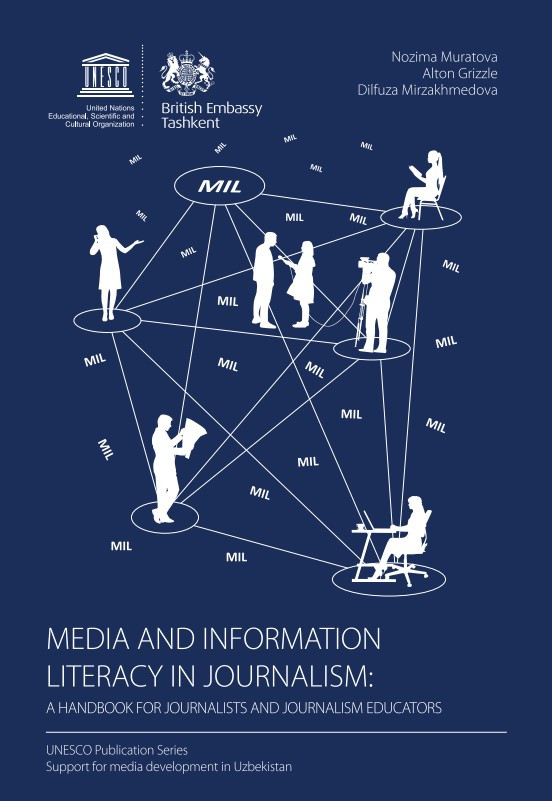 Media and Information Literacy in Journalism: A Handbook for Journalists and Journalism Educators Year of publication: 2019 Author: N. Muratova | A. Grizzle | D. Mirzakhmedova Corporate author: UNESCO Tashkent This handbook aims at being an important and practical tool for journalists in fulfilling their professional activities and mainly in media information literacy (MIL).The first three parts of the Handbook include theoretical material and are accompanied with exercises and case studies; the last part consists entirely of practical tools and exercises that aim to ensure that the material was understood. The Handbook deals with "fake news" and disinformation, provides a conceptual framework for media and information literacy, shows its importance, and explores principles and role of the MIL in journalism education. Also, the Handbook covers topics such as ethics on the Internet, human rights and work with sources, journalistic skills in collecting and processing information, ways to verify and provide reliable information, and the identification of fakes that may adversely affect the public.
  Global Citizenship Education (GCE) for Unknown Futures: Mapping Past and Current Experiments and Debates Year of publication: 2019 Author: Rene Suša Corporate author: Bridge 47 This Bridge 47-commissioned report by Rene Suša provides a thorough overview of current debates and opportunities within the field of Global Citizenship Education (GCE). The report addresses the following questions: 1) What is the benefit of GCE to our societies? 2) What is the impact of GCE to our societies? and 3) Why do we believe that GCE is the answer to global challenges?The publication also maps GCE-related or GCE-inspired initiatives, projects and partnerships, and offers key findings from a comparative study of these cases. Additionally, Susa also further builds on the recent work of Vanessa Andreotti by elucidating her taxonomy of soft, radical and beyond reform spaces for GCE, as well as relates these to current (international) policy developments in the field.
  The Future of Education and Skills: Education 2030 Year of publication: 2018 Corporate author: Organisation for Economic Co-operation and Development (OECD) The aim of OECD’s Education 2030: The Future of Education and Skills project is to support countries to find answers to two far-reaching questions: “What knowledge, skills, attitudes and values will today’s students need to shape and thrive their world in 2030?” and “How can instructional systems develop these knowledge, skills, attitudes and values effectively?” This OECD Education 2030 position paper considers the challenges that young people will face; suggests the importance of the concept of learner agency; proposes an overarching learning framework with transformative competencies; reviews the nature of the knowledge, skills, attitudes and values that young people will need; and ends with possible curriculum design principles. It encapsulates the key messages of the project so far.
  Research on the Strategy of Inner Mongolia Ecological Cultural Construction Year of publication: 2019 Author: WEI Zhiyong | BAI Zhifeng Corporate author: China Environment Publishing Group Focusing on the Ecological Civilization of Inner-Mongolia, China, this book presents to readers the backgroud and history of the ecological civilization development in the area. By analyzing the relevant policies, introducing the available resouces and typical cases, it showcases how the concept of harmonized development between man and nature evolving into the core of ecological cultural development in Inner-Mongolia. It summarizes the experiences and lessons learnt during the process, presents challenges faced and proposed practical suggestions and solutions. It also introduced some successful cases from the international experiences.
 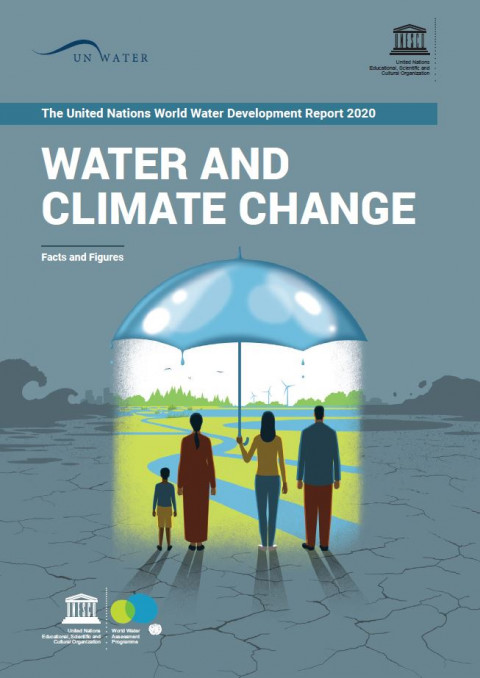 [Facts and Figures] The United Nations World Water Development Report 2020: Water and Climate Change; Facts and Figures Year of publication: 2020 Author: Engin Koncagül | Michael Tran | Richard Connor Corporate author: UNESCO World Water Assessment Programme (WWAP) Since the mid-20th century, changes in the intensity and frequency of extreme weather and climate events have been observed, including a decrease in cold temperature extremes, an increase in warm temperature extremes, an increase in extremely high sea levels and an increase in the number of heavy precipitation events in a number of regions (Min et al., 2011).Climate projections indicate with high confidence that extreme precipitation events will become more intense and frequent in many regions, but also that heatwaves will occur more often and last longer. The former will increase global flood risk (Hirabayashi et al., 2013), while the latter is expected to make droughts more intense (Trenberth et al., 2014). These risks are unevenly distributed geographically, and are generally larger for vulnerable people and communities in countries at all levels of development (IPCC, 2014a). Figure 1. Global water withdrawals throughout the previous centuryFigure 2. Climate change scenario trends in water availabilityFigure 3. Annual baseline water stressFigure 4. Seasonal variabilityFigure 5. World weather-related natural catastrophes by peril, 1980–2018Figure 6. Spatial distribution of water-related disasters (droughts, floods, landslides and storms), 2001–2018Figure 7. Spatial distribution of floods, 2001–2018Figure 8. Spatial distribution of droughts, 2001–2018Figure 9. Electricity consumption in the water sector by process, 2014–2040Figure 10. Number of people living under water stress under the Baseline Scenario
 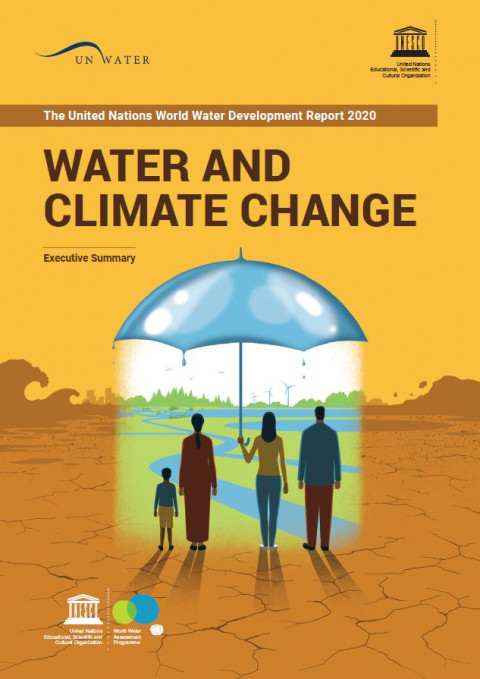 [Summary] The United Nations World Water Development Report 2020: Water and Climate Change; Executive Summary Year of publication: 2020 Corporate author: UNESCO World Water Assessment Programme (WWAP) The 2020 edition of the United Nations World Water Development Report (WWDR) addresses the critical linkages between water and climate change in the context of the broader sustainable development agenda. The report is not meant to be a purely technical examination of the impacts of climate change on the hydrological cycle. Rather, the report focuses on the challenges, opportunities and potential responses to climate change – in terms of adaptation, mitigation and improved resilience – that can be addressed through improving how water resources are management and used, while providing water supply and sanitation services for all in a sustainable manner. In doing so, the report tackles two of the most critical crises the world will continue facing over the next several decades: Water (in)security and climate change.