
Resources
Explore a wide range of valuable resources on GCED to deepen your understanding and enhance your research, advocacy, teaching, and learning.
8,364 Results found
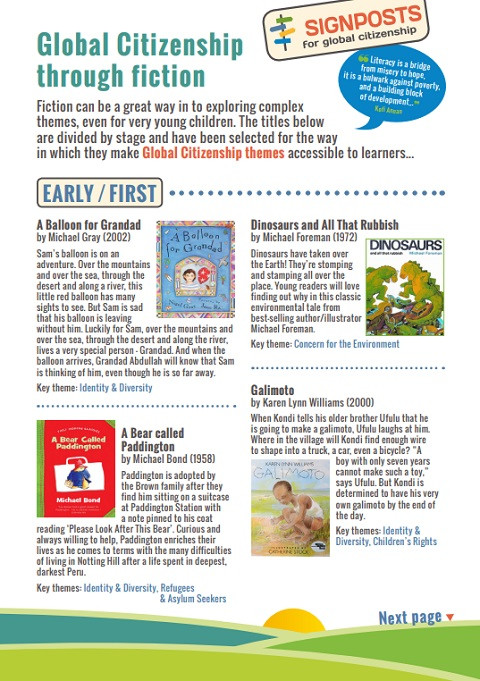 Global Citizenship through Fiction Year of publication: 2016 Corporate author: Signposts | International Development Education Association Scotland (IDEAS) This flyer summarises a selection of texts linking global citizenship and fiction. There is a synopsis of each text and texts range from Early Years to Stage 2.
 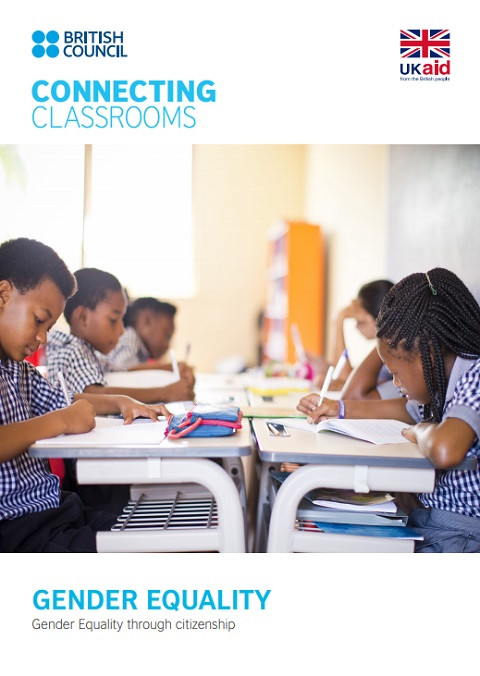 Connecting Classrooms: Gender Equality; Gender Equality through Citizenship Year of publication: 2019 Corporate author: British Council | UK aid This material shows an example of how you can support the development of pupils’ core skills such as citizenship, critical thinking, problem solving, creativity and imagination through the study and investigation of gender equality. This can be done in the context of English, citizenship, geography, history or other subjects. The materials can be used either with an international partner school or without one and instructions are provided on how to best use the resources. This learning unit will explore the Global Goals for Sustainable Development, and in particular, gender equality.
  Adult Education and the Challenge of Exclusion: UIL Policy Brief 10 Year of publication: 2020 Corporate author: UNESCO Institute for Lifelong Learning (UIL) The fourth Global Report on Adult Learning and Education (G RALE 4) shows that raising participation in adult learning and education (ALE) is pivotal for achieving not only Sustainable Development Goal (SDG) 4 on education, but also the other goals of the 2030 Agenda, spanning issues from climate change to poverty reduction. This places an onus on countries to review ALE policies and progress in the light of evidence on participation, and to invest in sustainable provision that is accessible to all learners, throughout their lives and in all the different contexts in which adults learn.
 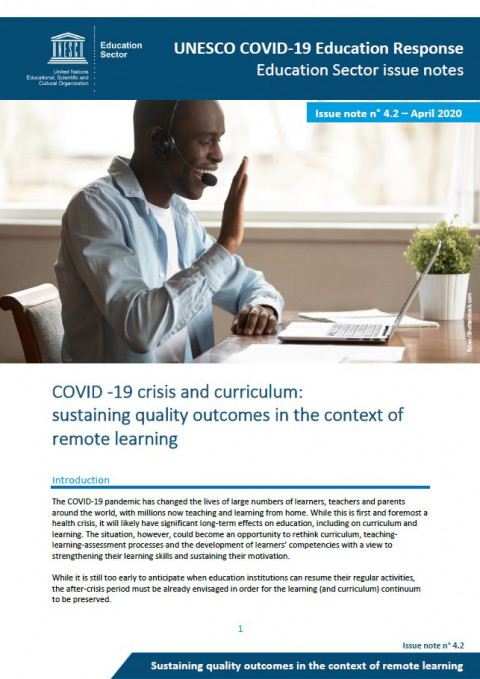 COVID-19 Crisis and Curriculum: Sustaining Quality Outcomes in the Context of Remote Learning (Issue Note no. 4.2 – April 2020) Year of publication: 2020 Corporate author: UNESCO The COVID-19 pandemic has changed the lives of large numbers of learners, teachers and parents around the world, with millions now teaching and learning from home. While this is first and foremost a health crisis, it will likely have significant long-term effects on education, including on curriculum and learning. The situation, however, could become an opportunity to rethink curriculum, teaching-learning-assessment processes and the development of learners’ competencies with a view to strengthening their learning skills and sustaining their motivation.This crisis will likely provide an opportunity for schools to strengthen their ties with families, and for teachers to communicate and cooperate better with parents in the interest of learners. In the same vein, the crisis means teachers and parents may become more involved in decisions regarding curriculum appropriateness. This can support the development of a learner-centred, participative and inclusive learning paradigm that takes into account the interests of learners, as well as their environments and aspirations.
  Educating Students to Improve the World (SpringerBriefs in Education) Year of publication: 2020 Author: Fernando Reimers This open access book addresses how to help students find purpose in a rapidly changing world. In a probing and visionary analysis of the field of global education Fernando Reimers explains how to lead the transformation of schools and school systems in order to more effectively prepare students to address today’s’ most urgent challenges and to invent a better future. It discusses several global citizenship curricula that have been adopted by schools and school networks, and ties them into an approach to lead school change into the uncharted territory of the future. Given its scope, the book will help teachers, school and district leaders tackle the change management needed in order to introduce global education, and more generally increase the relevancy of education. In addition, the book offers a “bridge” for more productive collaboration and communication between those who lead the process of educational change, and those who study and theorize this important work.
 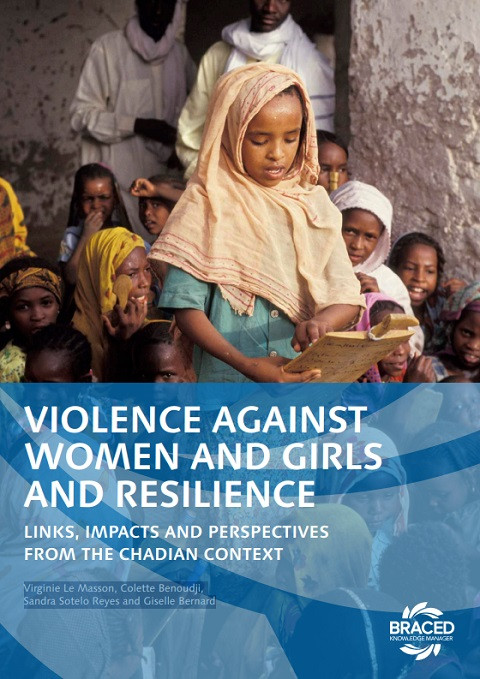 Violence against Women and Girls and Resilience: Links, Impacts and Perspectives from the Chadian Context Year of publication: 2017 Author: Virginie Le Masson | Colette Benoudji | Sandra Sotelo Reyes | Giselle Bernard Corporate author: Building Resilience and Adaptation to Climate Extremes and Disasters (BRACED) This report explores the links between gender-based violence (GBV), and the resilience shown by survivors, their households and the wider community. The purpose of this study is to explore two main questions: 1. How does violence against women and girls (VAWG) impact the processes of social change required to build resilience? 2. How can resilience programmes address VAWG?
 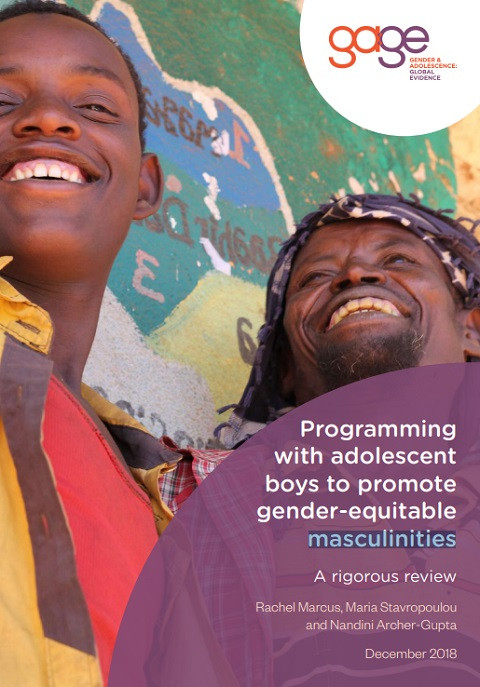 Programming with Adolescent Boys to Promote Gender-Equitable Masculinities: A Rigorous Review Year of publication: 2018 Author: Rachel Marcus | Maria Stavropoulou | Nandini Archer-Gupta Corporate author: Gender and Adolescence: Global Evidence (GAGE) | UK aid This review brings evidence from 36 studies of 34 programmes working with adolescent boys and young men to promote more gender-equitable masculinities. It draws on studies with a range of evaluation designs; the key requirements were adequate description of methodology and a valid comparison between participants and non-participants, or of attitudes and behaviour before and after participation.
  Envision 4.7: Bridge 47 Global Event; Helsinki, Finland 5–7 November 2019: Report Year of publication: 2019 Corporate author: Bridge 47 | Frinland. Ministry of Education and Culture | Finland. Ministry for Foreign Affairs Global event Envision 4.7 was held in Helsinki in November 2019. The event brought around 200 people together to discuss ways to take the SDG Target 4.7 forward. In this report you can find summaries of all the speeches, panel discussions, workshops and working groups that were held at the event, together with a summary of discussions around all the different topics. You can also find pictures and drawings from the event at the report.
 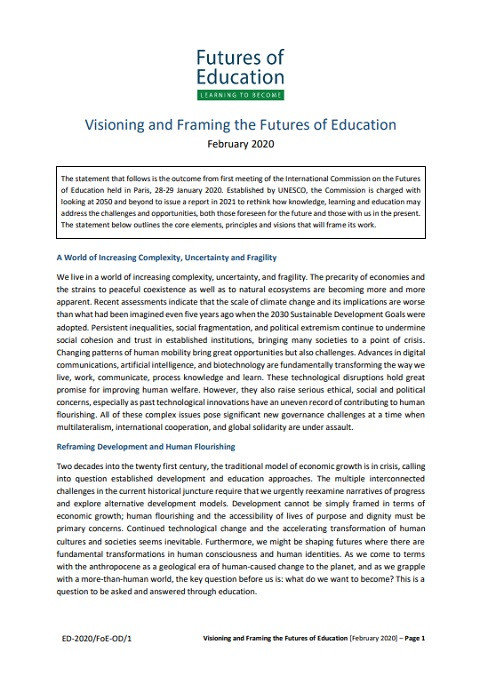 Visioning and Framing the Futures of Education: February 2020 Year of publication: 2020 Corporate author: UNESCO This statement is the outcome from first meeting of the International Commission on the Futures of Education held in Paris, 28-29 January 2020. Established by UNESCO, the Commission is charged with looking at 2050 and beyond to issue a report in 2021 to rethink how knowledge, learning and education may address the challenges and opportunities, both those foreseen for the future and those with us in the present.
 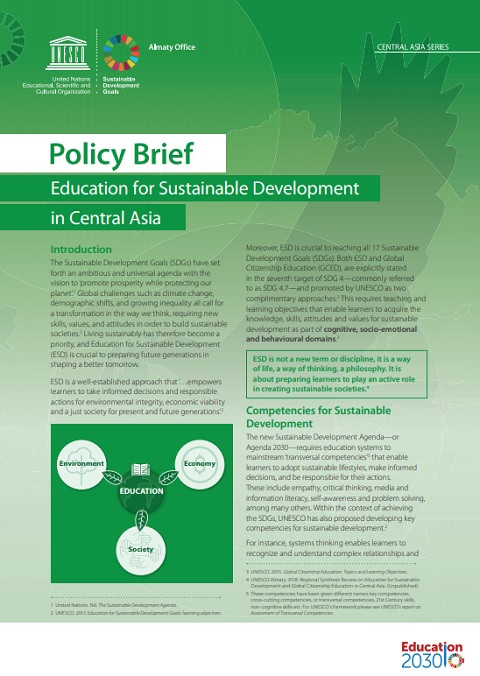 Policy Brief: Education for Sustainable Development in Central Asia Year of publication: 2019 Corporate author: UNESCO Almaty Education for Sustainable Development(ESD) is crucial to reaching all 17 Sustainable Development Goals (SDGs). Both ESD and Global Citizenship Education (GCED) are explicitly stated in the seventh target of SDG4 and promoted by UNESCO as two complimentary approaches. This requires teaching and learning objectives that enable learners to acquire the knowledge, skills, attitudes and values for sustainable development as part of cognitive, socio-emotional and behavioural domains. This policy brief explores the challenges, promising practices, and policy recommendations when it comes to mainstreaming ESD in Central Asia’s education systems.