
Resources
Explore a wide range of valuable resources on GCED to deepen your understanding and enhance your research, advocacy, teaching, and learning.
8,364 Results found
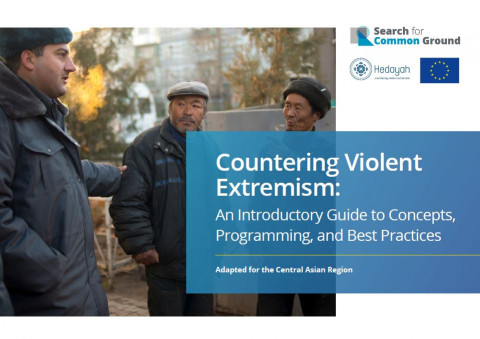 Countering Violent Extremism: An Introductory Guide to Concepts, Programming, and Best Practices Year of publication: 2019 Corporate author: Search for Common Ground This curriculum aims to update the best practices and experience gained in the process of countering violent extremism. The anti-violent extremism program, adapted for Central Asia, is designed to train civil servants and civil society organizations. This curriculum delivers a contextually literate countering violent extremism and awareness-raising training program that is relevant to your context in an accessible way. It highlights the benefits of collaborative approaches beyond the use of military or securitized responses to violent extremism, drawing on good practices, and offers tools and guidance for easy adaptation to your local context and cultures. Finally, it encourages the early identification and mitigation of risks with programming, as well as ensuring a Do No Harm approach.While this curriculum will offer guidance around how to design, implement, and monitor constructive responses to violent extremism, an understanding of project management is assumed. Therefore, it is not a training program on general project management skills, monitoring and evaluation, or on fundraising.Since the problem of violent extremism is complex and highly context-specific, it is also not a guide to the drivers of violent radicalization in your local context, nor does it proscribe the programs and policies that would be most effective. Instead, it introduces you to the guiding questions and tools necessary to make informed and effective choices in your own efforts to counter violent extremism.
  Information Flows and Radicalization Leading to Violent Extremism in Central Asia Year of publication: 2019 Corporate author: Search for Common Ground This study was carried out as part of the regional project “Promoting Stability and Peace in Central Asia through Media Literacy, Effective Lighting and Regional Cooperation”, implemented by the Internews office and funded by the European Union. The project aims to support national and regional initiatives that help prevent radicalization in Central Asia by increasing the capacity of journalists, civic activists and media professionals in the production of high-quality media content and the level of critical media consumption of representatives of civil society, decision-makers and active citizens.
  INTRAC in Central Asia 1994-2018: A Story of the Past, the Present and the Future; Special Series Paper Year of publication: 2019 Author: Charles Buxton | Anne Garbutt | Janice Giffen | Chynara Irisova | Konstantin Kovtunets | Anara Moldosheva | Brian Pratt | Medet Tiulegenov | Chris Wardle | Nazgul Zakiriaeva Corporate author: International Non-Governmental Organisation Training and Research Centre (INTRAC) This publication is a special newsletter which marks the next phase of support provided by INTRAC to civil society in Central Asia. The articles in this special bulletin describe the history of INTRAC in Central Asia from the very first days to the present, and also provide a glimpse into the future.
 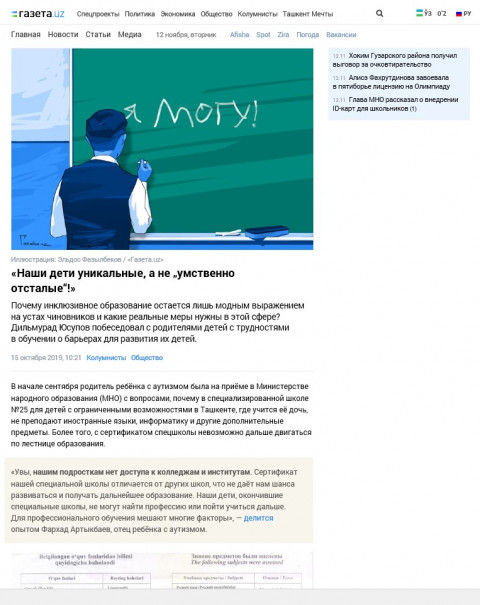 “Our Children Are Unique, Not 'Mentally Retarded'!” Year of publication: 2019 Author: Dilmurad Yusupov The article analyzes the necessary measures in the field of inclusive education in Uzbekistan. The author spoke with parents of children with learning difficulties about the barriers to their children's development.
 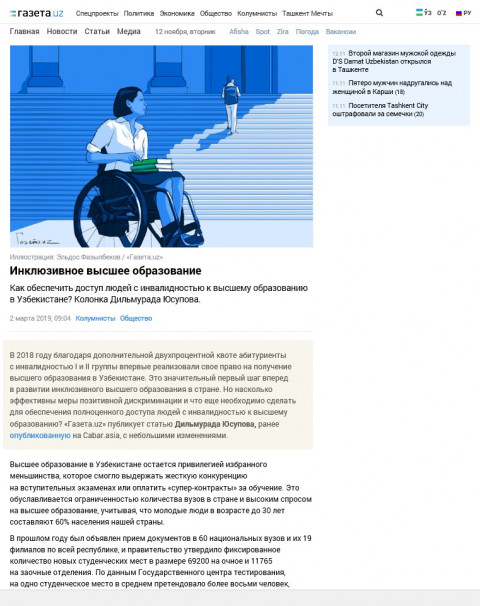 Inclusive Higher Education: How to Ensure Access for People with Disabilities to Higher Education in Uzbekistan? Year of publication: 2019 Author: Dilmurad Yusupov The article is devoted to the analysis of changes occurring in the higher education system of Uzbekistan, as well as the measures necessary to ensure full access for people with disabilities to higher education.
 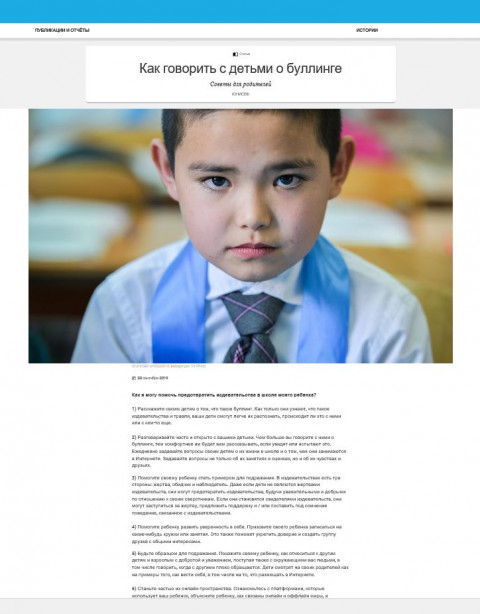 How to Talk with Children About Bullying: Tips for Parents Year of publication: 2019 Corporate author: UNICEF Kazakhstan In this article, parents are offered practical advice on how to talk with children about bullying in order to prevent its occurrence and teach children how to effectively counteract it.
 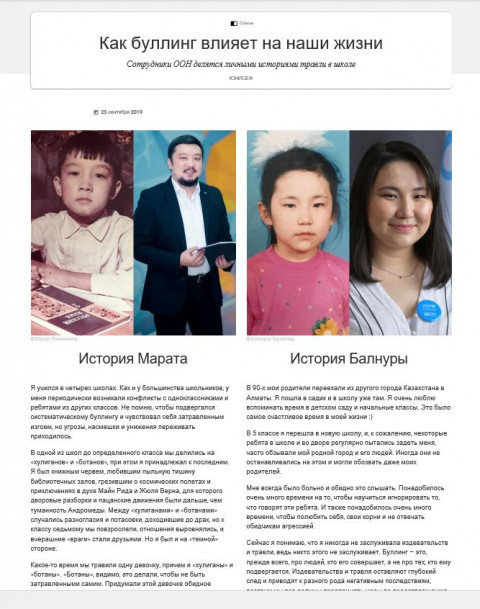 How Bullying Affects Our Lives Year of publication: 2019 Corporate author: UNICEF Kazakhstan In this article, UN staff members share personal stories showing how they dealt with bullying at school.
  National Reforms of the Higher Education in Uzbekistan Year of publication: 2019 Author: G. Burkhonova This article addresses the issues of national reform of higher education in Uzbekistan. The author of the article believes that the reforms will lead to the further development of the education system as an important factor in the country's prosperity, sustainable economic growth, and employment.
 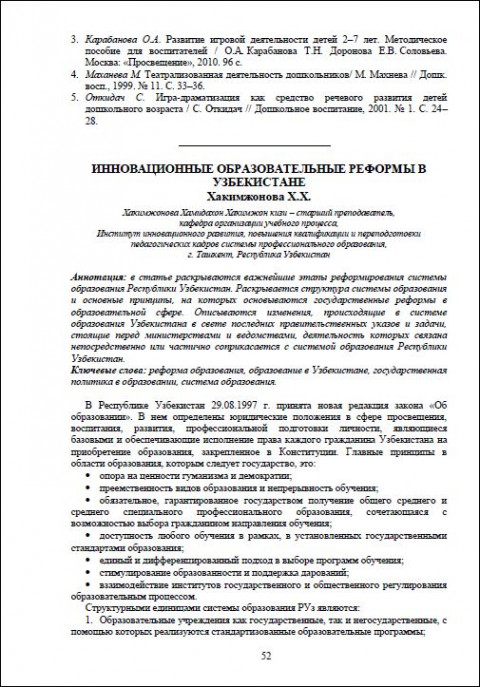 Innovative Educational Reforms in Uzbekistan Year of publication: 2019 Author: Kh. Khakimjonova The article reveals the most important stages of reforming the education system of the Republic of Uzbekistan. The structure of the education system and the basic principles on which state reforms in the educational sphere are based are revealed. Describes the changes taking place in the education system of Uzbekistan in the light of recent government decrees and the challenges facing ministries and departments whose activities are directly or partially related to the education system of the Republic of Uzbekistan.
 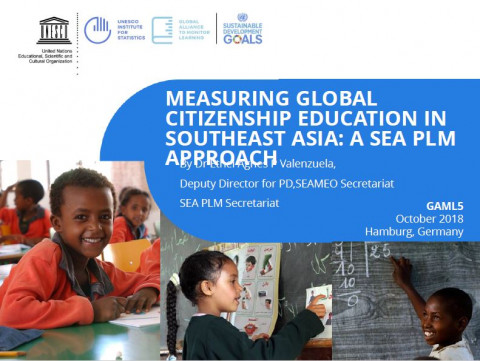 Measuring Global Citizenship Education in Southeast Asia: A SEA PLM Approach Year of publication: 2018 Author: Ethel Agnes P. Valenzuela Corporate author: Southeast Asian Ministers of Education Organization (SEAMEO) | UNESCO Institute for Statistics (UIS) Audit of Curricula for the Southeast Asia Primary Learning Metrics (March 2016), an early issue confronted in developing an assessment framework for SEA-PLM wasdetermining how to design and construct a single assessment program across all ASEAN member countries.The design and approach needed to take account of the similarities and differences in the curriculum frameworks in each country for the four domains that were to be assessed through SEA-PLM: Mathematics, Reading, Writing, and Global Citizenship.