
Resources
Explore a wide range of valuable resources on GCED to deepen your understanding and enhance your research, advocacy, teaching, and learning.
8,364 Results found
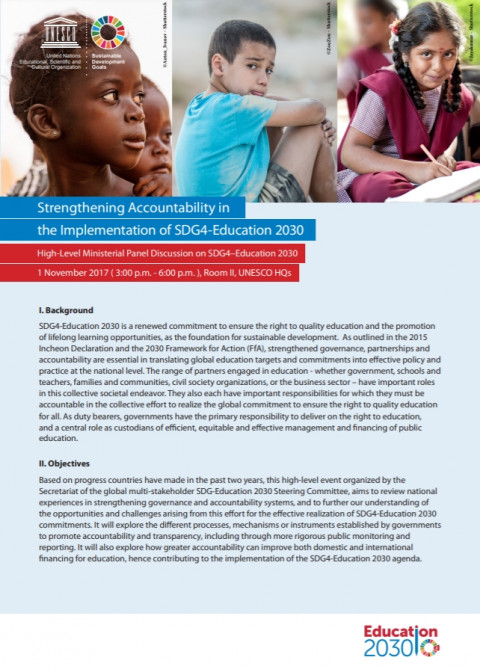 Strengthening accountability in the implementation of SDG4 - Education 2030 Year of publication: 2017 Corporate author: UNESCO SDG4-Education 2030 is a renewed commitment to ensure the right to quality education and the promotion of lifelong learning opportunities, as the foundation for sustainable development. As outlined in the 2015 Incheon Declaration and the 2030 Framework for Action (FfA), strengthened governance, partnerships and accountability are essential in translating global education targets and commitments into effective policy and practice at the national level. The range of partners engaged in education - whether government, schools and teachers, families and communities, civil society organizations, or the business sector – have important roles in this collective societal endeavor. They also each have important responsibilities for which they must be accountable in the collective effort to realize the global commitment to ensure the right to quality education for all. As duty bearers, governments have the primary responsibility to deliver on the right to education, and a central role as custodians of efficient, equitable and effective management and financing of public education.
  Early Childhood Development and Early Learning for Children in Crisis and Conflict Year of publication: 2018 Author: Kolleen Bouchane Corporate author: Global Education Monitoring Report Team There is an urgent need for a comprehensive response, including early learning and family support programs, to the rapidly growing population of young children worldwide living in crisis and conflict. Substantial evidence from neuroscience to economics indicates that the early years of a child’s life lay the foundation for long-term health, learning and behavior. The first months and years are not only a critical period in an individual child’s lifelong capacity for learning, but weak learning foundations of children can compromise the long-term development of nations. Yet a review of Refugee and Humanitarian Response Plans conducted for this paper revealed that only 9 percent of plans included the essential elements of early learning. Relative to health and nutrition programming, early education and parenting interventions were more likely to be omitted from the Response Plans.The rationale for focusing new attention on the educational needs of young children living in fragile conditions is strong: there is a broad body of scientific evidence; the international legal framework of the United Nations Convention of the Rights of the Child asserts that all children have the right to health, education, legal registration, and protection from violence and separation from parents, beginning at birth; and the Sustainable Development Goals for all will be not reached without a focus on the earliest years of life in crisis and conflict situations. This background paper presents the case for increased attention and investment in early childhood in conflict and crisis contexts, with focused attention on early learning and family support. The scale of the problem, current science and evidence, current global standards and principles, and case studies are all discussed and priority recommendations are offered.
 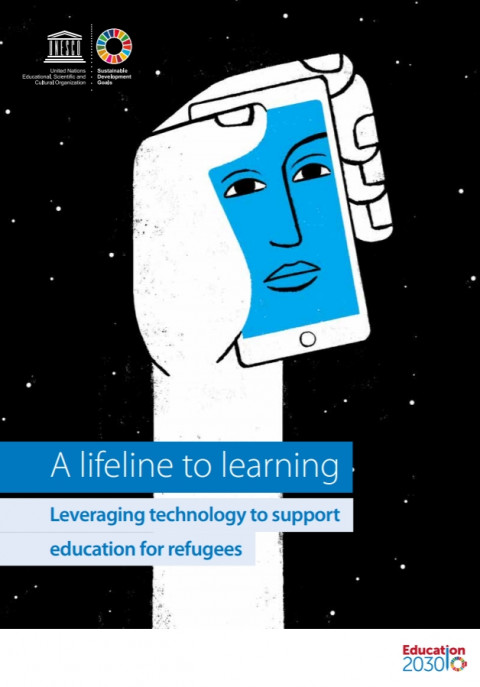 A Lifeline to Learning: Leveraging Mobile Technology to Support Education for Refugees Year of publication: 2018 Corporate author: UNESCO This publication examines the evidence base for key assumptions on using mobile technology to address individual refugees’ learning challenges, broader education system challenges, and challenges to providing refugees with specific levels and types of education. The report presents findings from a review of 117 relevant papers and reports, and lessons drawn from the implementation of 52 projects that use mobile learning for refugees and the actual use of 35 digital apps or platforms. While acknowledging a limited reach, the report identifies effective mobile solutions and organizational strategies that should be scaled up.
 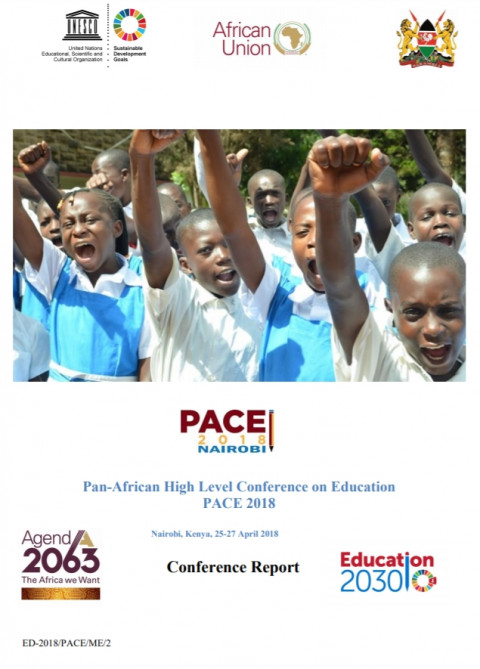 Pan-African High Level Conference on Education, PACE 2018: conference report Year of publication: 2018 Corporate author: African Union | Government of the Republic of Kenya The Pan-African High-level Conference on Education (PACE 2018) was held in Nairobi, Kenya from 25th to 27th April 2018. PACE 2018 was convened by UNESCO, the Government of Kenya and the African Union, with the collaboration of the Association for the Development of Education in Africa (ADEA) and contributions from the Sustainable Development Goal 4 (SDG4) co-conveners. The initiative to organise the PACE 2018 came in the wake of a number of regional consultations organised in Sub Saharan Africa and the Arab states regions to focus attention on the way forward, following the adoption in 2015 of the United Nations’ Sustainable Development Goal 4 on Education (SDG 4) and of the African Union’s Continental Education Strategy for Africa 2016-2025 (CESA 16-25).
  Inclusive early childhood care and education: background paper prepared for the International Forum on inclusion and equity in education, every learner matters Year of publication: 2019 Author: Sheldon Shaeffer Corporate author: UNESCO | Open Society Foundation Experiences around the world show that it is necessary to respond to the specific needs of each category of exclusion (sex, poverty, remoteness, ethnicity, language, legal status,and developmental delay anddisability) and to each excluded child–without further marginalizing or labelling them. The overall focus should be on inclusive ECCE policies, strategies, and practicesto remove all barriers, and promote optimal development and learning for all children, build ramps for participation and inclusion, and thereby help all relevant ministriesto become fully inclusive, both in vision and in practices. Only then can we really achieve the goal of good quality education for all.
 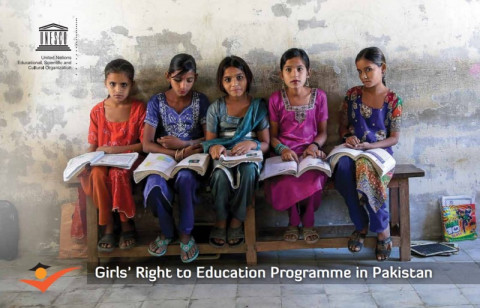 Girls' Right to Education Programme in Pakistan Year of publication: 2018 Corporate author: UNESCO Islamabad The programme is in progress in 14 very marginalized districts of the country selected in consultation with concerned education counterparts. Basic indicators for education, such as literacy rate, enrolment and retention of girls, and level of learning outcomes in primary grades are quite low in each selected district. Each province and area based project has three integrated components: (a) improving girls’ access through social mobilization and advocacy, (b) improving retention through improvement in school physical and learning environments – activation of parents-teachers committees (PTCs), school management committees (SMCs) and teachers training in multi-grade teaching and activity-based learning and, (c) capacity building of education officials at district, provincial and national level to create an enabling environment for girls’ education. All projects are implemented through local civil society organizations (CSOs) as implementing partners in consultation with national, provincial and area education departments. The programme is making significant progress in transforming the parental and community perception towards girls' education. Over seven thousand out of school girls have been enrolled in the target areas and retention is ensured through the provision of school facilities and improvement in overall learning environment.
  Early childhood care and education and education for sustainable development & global citizenship Year of publication: 2019 Corporate author: UNESCO This document brings together the responses to a survey on Early Childhood Care and Education in the context of Education for Sustainable Development and Global Citizenship, initiated by GAP Partner Network 3 on educators, in the framework of preparing the UNESCO 2019 Forum. Key findings A majority of respondents recommend better cooperation, both in sharing of educational resources and in general, between early childhood structures and GAP Key Partners. According to them, the best way to transmit values and teach ESD to children is through play. This must be done in a fun way, in contact with nature. Concerning training, practical and continuous training of childcare educators is requested and recommended. This should facilitate the integration of ESD and global citizenship, as well as provide insights for enhancing the content of teacher education.
  Casebook on human dignity and human rights Year of publication: 2011 Corporate author: UNESCO Article 3 of the Declaration reads as follows:1. Human dignity, human rights and fundamental freedoms are to be fully respected.2. The interests and welfare of the individual should have priority over the sole interest of science or society
  Gender, migration and non-formal learning for women and adolescent girls Year of publication: 2019 Author: Amy North Corporate author: Global Education Monitoring Report Team Processes of international migration and displacement are highly gendered. Who migrates, and how they experience migration and displacement, is affected by gender norms and relations in both in countries of origin and countries of settlement, the gendered dynamics of conflict and violence, and the gendered nature of global and local labour markets. These gendered dynamics of migration both affect and are affected by education in often complex ways, as education may both facilitate processes of migration, and be enabled or limited by them, and as gendered engagements with education prior to and during migration and settlement may have a significant influenced on how these processes are experienced. This paper is concerned with exploring this gender-migration- education nexus through a focus on the educational engagements and experiences of migrant and refugee women and adolescent girls. It first considers the wider body of research that has explored the relationship between gender, migration and displacement, particularly in relation to the experiences of migrant women and girls, before drawing out some of the key conceptual ideas from this, considering their implications for education, and presenting a conceptual diagram to represent this relationship. It then focuses more specifically on experiences of non-formal education for women and adolescent girls in refugee contexts and in host countries. Finally it identifies a number of key issues and recommendations emerging from this research.
 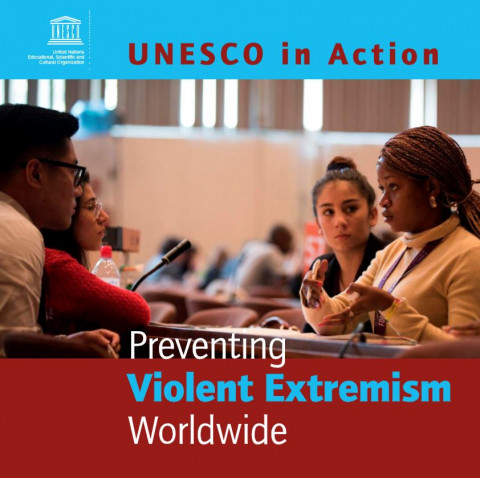 UNESCO in action: preventing violent extremism worldwide Year of publication: 2018 Corporate author: UNESCO UNESCO supports countries in crafting education programmes that build young people’s resilience to violent extremist messaging and foster a positive sense of identity and belonging. From this angle, the role of education is not to intercept violent extremists or identify individuals who may potentially become violent extremists, but to create conditions to build the defences of peace within learners through values, skills and behaviours that reject violent extremism, and by strengthening their commitment to non-violence and peace. This work is undertaken within the broader framework of Global Citizenship Education, where UNESCO leads implementation of Target 4.7 of the Sustainable Development Goal 4 on Education. The work undertaken in the field of Global Citizenship Education also embraces activities pertaining to human rights and peace education, Holocaust and genocide education, and activities to combat all forms of intolerance, racism and anti-Semitism.