
Resources
Explore a wide range of valuable resources on GCED to deepen your understanding and enhance your research, advocacy, teaching, and learning.
8,364 Results found
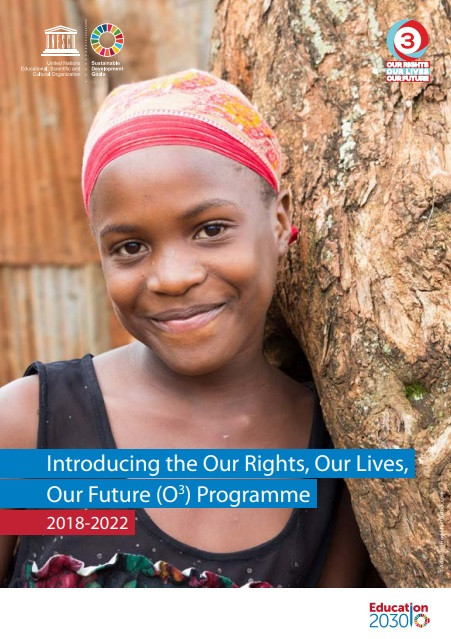 Introducing the Our Rights, Our Lives, Our Future (O3) Programme 2018-2022 Year of publication: 2019 Corporate author: UNESCO Harare Comprehensive sexuality education is a curriculum-based process of teaching and learning about the cognitive, emotional, physical, and social aspects of sexuality. It aims to equip children and young people with the knowledge, skills, attitudes, and values that will empower them to protect their health, well-being, and dignity, as well as to develop respectful social relationships and consider the well-being of others affected by their choices. Importantly, it also helps them to understand and act upon their rights throughout their lives.
 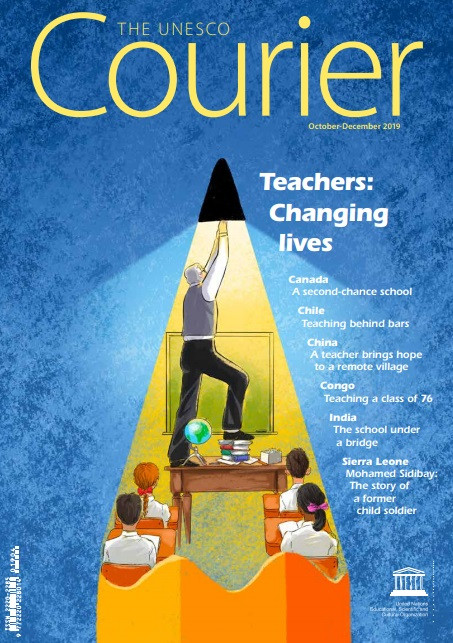 Teachers: changing lives (The UNESCO Courier no. 4, October-December 2019) Year of publication: 2019 Corporate author: UNESCO Certainly, everyone recognizes the key role teachers play. On a personal level, we can all name at least one teacher who made a difference – sometimes to such an extent that it redirected our whole lives. At the international level, the United Nations Sustainable Development Goals (SDGs), Goal 4 in particular, recognize the importance of teachers in the implementation of the Sustainable Development Agenda by 2030. Yet, the profession is being undermined. The development of cognitive neuroscience and the many applications of new technologies in the field of education are forcing the profession to adapt and reinvent itself.
  Bringing it out in the open: Monitoring school violence based on sexual orientation, gender identity or gender expression in national and international surveys Year of publication: 2019 Corporate author: UNESCO This technical brief has been developed by the United Nations Educational, Scientific and Cultural Organization (UNESCO) to strengthen the routine monitoring of school violence that is based on sexual orientation, gender identity or gender expression (SOGIE). It is informed by best practice from large institutional surveys that have been successfully conducted at the international or national level. The Brief provides recommendations on: • Questions to capture data on the sexual orientation or gender identity of students.• Questions to capture data on school violence that is specifically based on SOGIE. The Brief also gives guidance on: • The challenges in collecting data on school violence based on SOGIE• Identifying and fulfilling indicators on school violence based on SOGIE
  Handbook on measuring equity in education Year of publication: 2018 Corporate author: UNESCO Institute for Statistics (UIS) This handbook provides a conceptual framework for measuring equality in learning; offers methodological guidance on how to calculate and interpret indicators; and investigates the extent to which measuring equity in learning has been integrated into country policies, national planning and data collection and analysis.
 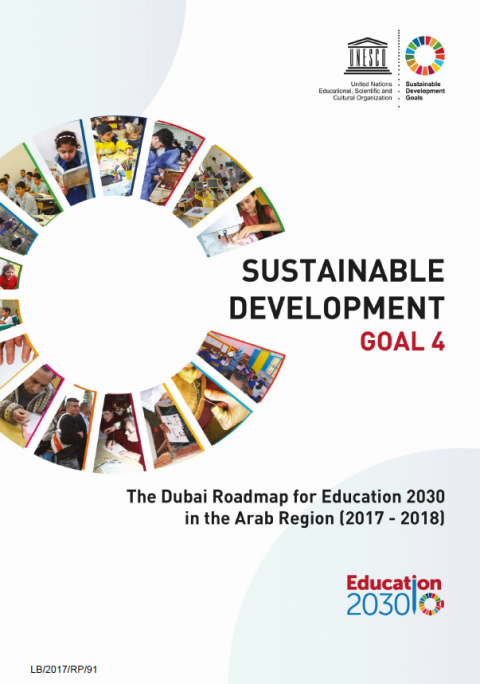 Sustainable Development Goal 4: The Dubai Roadmap for Education 2030 in the Arab Region (2017-2018) Year of publication: 2017 Corporate author: UNESCO Beirut SDG 4 agenda inspires us to pursue a humanistic vision of education and development based on human rights and dignity, social justice, protection, cultural diversity, and shared responsibility and accountability. Also, it is underpinned by the principle that education is a public good, a fundamental human right and a basis for guaranteeing the realization of other rights. Furthermore, it is essential for peace, human fulfillment and sustainable development. Having adopted the Arab Regional Roadmap for SDG 4 and Education 2030 (Cairo Roadmap) at ARMED I, we, Arab Member States and partners, have since commenced implementation of the Agenda as appropriate and relevant to national contexts.
 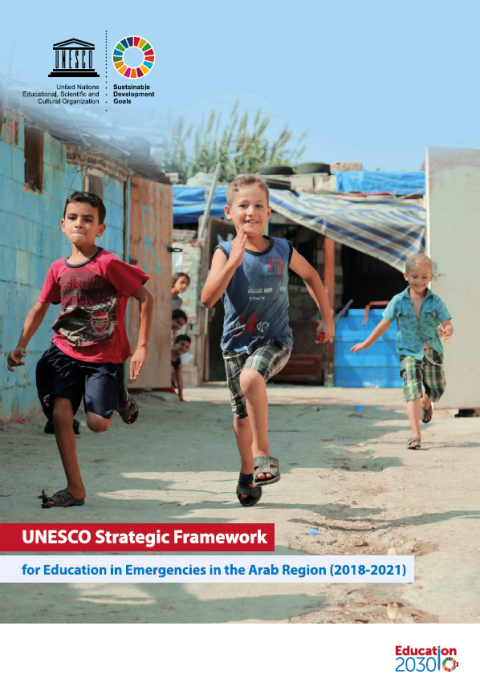 UNESCO Strategic Framework for Education in Emergencies in the Arab Region (2018-2021) Year of publication: 2017 Corporate author: UNESCO The Strategic Framework consists of four strategic goals that are anchored in the three pillars of education (Access, Quality and System Strengthening) and which emphasize the importance of relevant and inclusive education to meet the challenges confronting learners, educators, and education systems in both crisis and post-crisis settings. The strategic goals are: Strategic Goal 1: Children and youth affected by crisis access inclusive and quality learning opportunitiesStrategic Goal 2: Learners affected by crisis are empowered with values, knowledge, and skills for life and workStrategic Goal 3: Education actors provide quality education for better learning outcomesStrategic Goal 4: Education systems are responsive and resilient to crisis
  Transforming teaching and learning in Asia and the Pacific: case studies from seven countries Year of publication: 2015 Corporate author: UNESCO Bangkok This publication grew out of the Third Regional High-Level Expert Meeting Beyond 2015: Transforming Teaching and Learning in the Asia-Pacific Region, held from 16 to 18 October 2013 in Bangkok, Thailand. At the meeting, over 40 experts from countries across Asia and the Pacific came together to exchange views on issues and challenges in teaching and learning and to reflect on pedagogical approaches for the future. The chapters in this publication originate from seven case studies presented at the meeting. The authors thank all the participants of the meeting for the valuable thoughts and comments they shared on that occasion.
 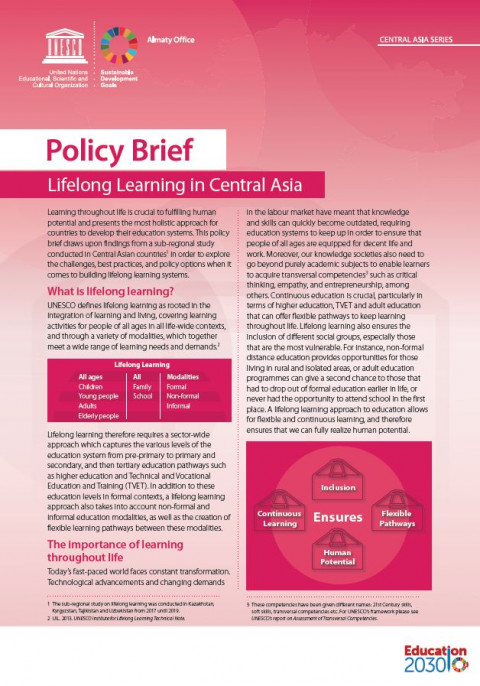 Policy brief: lifelong learning in Central Asia Year of publication: 2019 Corporate author: UNESCO Almaty Lifelong learning stands at the very core of the global education agenda and SDG 4, with a commitment to ensure ‘inclusive and equitable quality education and lifelong learning opportunities for all.Central Asian education systems have been successful in ensuring near-universal literacy, including among adults, as well as the universal provision of education at the primary and secondary levels. However, the legacy of the Soviet Union has resulted in a certain inflexibility of education systems in the sub-region, as well as their inability to rapidly adapt to the diverse needs of learners—posing a significant challenge to ensuring lifelong learning.
 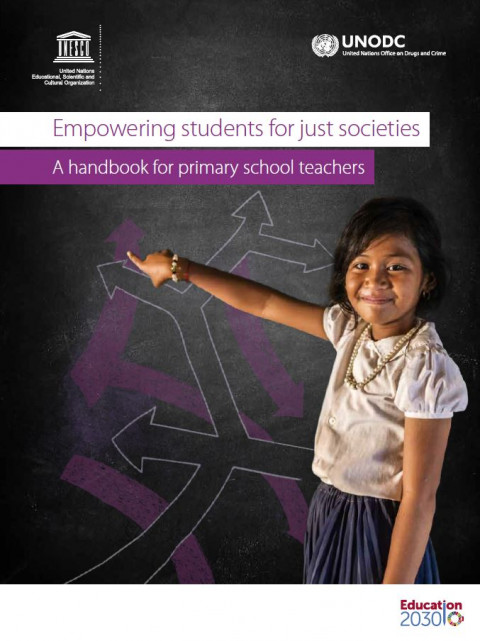 Empowering Students for Just Societies: A Handbook for Primary School Teachers Year of publication: 2019 Corporate author: UNESCO | UN. Office on Drugs and Crime (UNODC) The purpose of the handbook is to: Provide teachers with a selection of relevant and accessible in-classroom and out-of-classroom educational resources (summaries of short activities, lessons, units) that aim to instil the principles of the RoL among primary school students. Assist teachers in applying the teaching resources to their local educational settings by providing ideas for adaptation for a variety of learning environments. This handbook provides: Summaries of existing teaching resources selected from UN agencies, INGOs, NGOs, and ministries that work to meet the learning outcomes on GCED for the RoL. Links to the original resource that offers additional learning opportunities. Tips and suggestions for adaptation, extension and cross-references of teaching resources; and Suggestions for learning assessment. This handbook can be useful for: Teachers and teacher trainers in formal school settings at the primary school level. It encourages teachers to strengthen the RoL through education by integrating it into their lessons and planning. Professionals working in non-formal education or engaging with young people, for example, in sports associations, community organizations, social work and the justice sector. Parents seeking to raise empowered young citizens who actively contribute to peace and justice.
 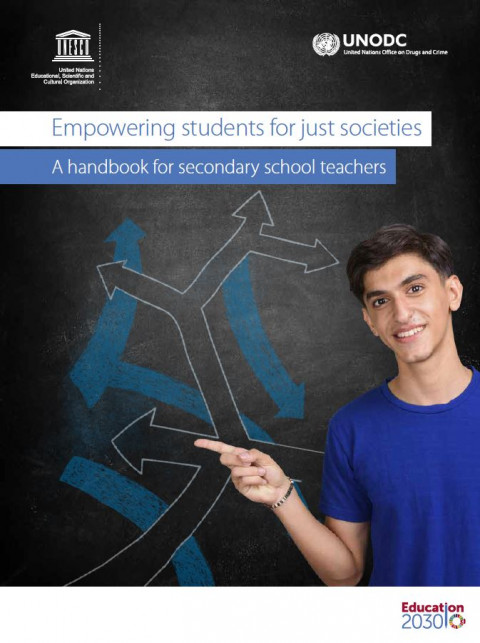 Empowering Students for Just Societies: A Handbook for Secondary School Teachers Year of publication: 2019 Corporate author: UNESCO | UN. Office on Drugs and Crime (UNODC) The purpose of the handbook is to: Provide teachers with a selection of relevant and accessible in-classroom and out-of-classroom educational resources (summaries of short activities, lessons, units) that aim to instil the principles of the RoL among secondary school students. Assist teachers in applying the teaching resources to their local educational settings by providing ideas for adaptation for a variety of learning environments. This handbook provides: Summaries of existing teaching resources selected from UN agencies, INGOs, NGOs, and ministries that work to meet the learning outcomes on GCED for the RoL. Links to the original resource that offers additional learning opportunities. Tips and suggestions for adaptation, extension and cross-references of teaching resources; and Suggestions for learning assessment. This handbook can be useful for: Teachers and teacher trainers in formal school settings at the secondary school level. It encourages teachers to strengthen the RoL through education by integrating it into their lessons and planning. Professionals working in non-formal education or engaging with young people, for example, in sports associations, community organizations, social work and the justice sector. Parents seeking to raise empowered young citizens who actively contribute to peace and justice.