
Resources
Explore a wide range of valuable resources on GCED to deepen your understanding and enhance your research, advocacy, teaching, and learning.
8,364 Results found
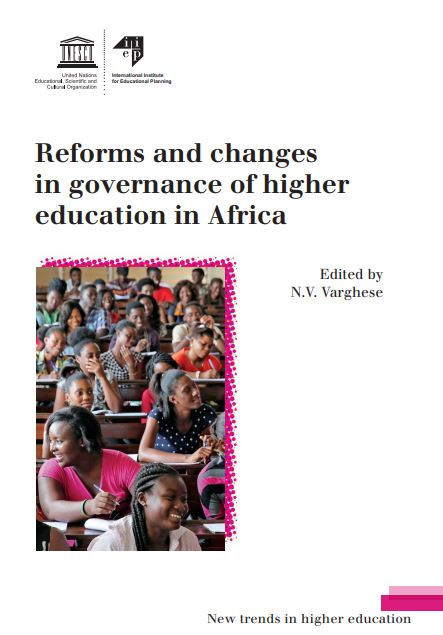 Reforms and Changes in Governance of Higher Education in Africa Year of publication: 2016 Author: N.V. Varghese Corporate author: UNESCO International Institute for Educational Planning (IIEP) Higher education in Africa has received favourable political attention and funding support in the period following independence. The rationale for state funding was questioned in the 1980s, and the higher education reforms in the 1990s centred on finding alternative ways of financing and on improving the managerial efficiency of universities. This focus was reflected in the market-friendly reforms that led to the privatization of public institutions and the promotion of private institutions. These reforms resulted in substantial changes in the governance and management of higher education. IIEP initiated a research study to analyse the reforms and to understand their effects on the governance of higher education at institutional and national levels. Based on studies carried out in Ethiopia, Ghana, Kenya, Nigeria, and South Africa, this book shows how the reforms have effected changes in the governance and management of institutions of higher education in Africa.
  UNESCO, Climate Change Education and COP22 Year of publication: 2016 Corporate author: UNESCO Education is a key vector to prepare societies for global changes. It plays a critical role in achieving sustainable development goals and putting into practice a global agreement on climate change. Education plays a paramount role in raising awareness and promoting behavioural change for climate change mitigation and adaption. It helps increase the climate change mitigation and adaptation capacity of communities by enabling individuals to make informed decisions.
 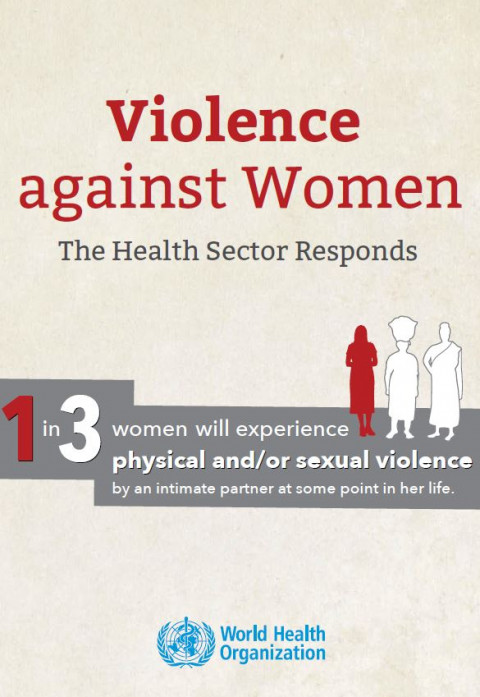 Violence Against Women Infographic: Health Impacts and the Role of the Health Sector Year of publication: 2013 Corporate author: World Health Organization (WHO) The WHO Department for Management of NCDs, Disability, Violence and Injury Prevention, and Department of Reproductive Health and Research, have prepared an infographic displaying the prevalence and health and social consequences of violence against women, and what the health sector can do to address this public health problem. The infographic is targeted at policy makers and professionals working in the health sector and other relevant sectors.
  RESPECT Women: Preventing Violence Against Women Year of publication: 2019 Corporate author: World Health Organization (WHO) Violence against women and girls remains pervasive across the world, despite significant efforts being made to recognize, eliminate, and prevent it in all its forms. Eliminating violence against women and girls is pivotal to achieving gender equality, women’s empowerment, and the Sustainable Development Goals. Elimination can only be done through prevention. Successful prevention requires: political commitment and leadership,implementing laws and policies that promote gender equality,investing in women’s organizations,allocating resources to prevention, andaddressing the multiple forms of discrimination women face daily. Based on the principles of respect and equality, and lessons learned from evidence-based results on what works in preventing violence from occurring and recurring, the World Health Organization (WHO) and UN Women, in collaboration with ten other UN, bilateral, and multilateral agencies, have developed “RESPECT Women: Preventing violence against women”. This publication provides a comprehensive framework to inform policy makers and implementers about designing, planning, implementing, monitoring, and evaluating interventions and programmes on preventing and responding to violence against women. The framework outlines seven inter-related intervention strategies derived from the word “respect”: Relationships skills strengthenedEmpowerment of womenServices ensuredPoverty reducedEnvironments made safeChild and adolescent abuse preventedTransformed attitudes, beliefs and norm
 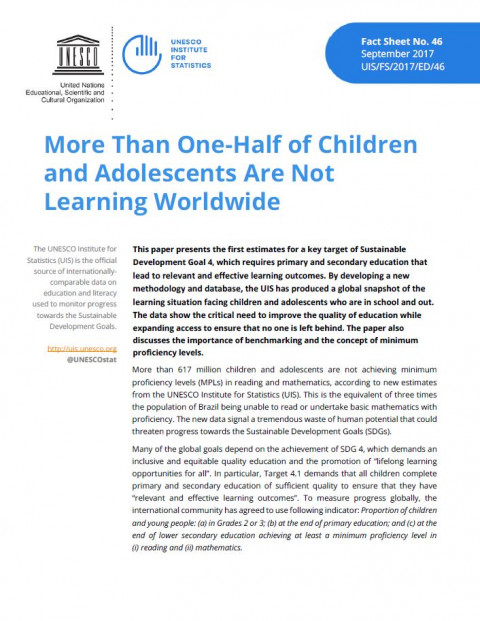 More Than One-half of Children and Adolescents Are Not Learning Worldwide; UIS Fact Sheet No. 46 Year of publication: 2017 Corporate author: UNESCO Institute for Statistics (UIS) This paper presents the first estimates for a key target of Sustainable Development Goal 4, which requires primary and secondary education that lead to relevant and effective learning outcomes. By developing a new methodology and database, the UIS has produced a global snapshot of the learning situation facing children and adolescents who are in school and out. The data show the critical need to improve the quality of education while expanding access to ensure that no one is left behind. The paper also discusses the importance of benchmarking and the concept of minimum proficiency levels.
 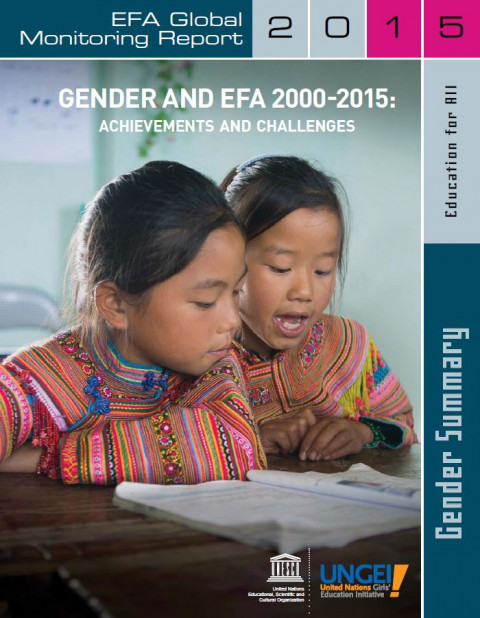 [Summary] Gender and EFA 2000-2015: Achievements and Challenges; EFA Global Monitoring Report 2015; Gender Summary Year of publication: 2015 Corporate author: Global Education Monitoring Report Team This report describes an array of country efforts, some quite effective, to achieve and go beyond gender parity in education. Many of these policies and programmes focus on the immediate school environment in which girls learn. Others focus on the informal and formal laws, social norms and practices that deny girls their right of access to, and completion of, a full cycle of quality basic education. The analyses and key messages in Gender and EFA 2000–2015: Achievements and Challenges deserve careful scrutiny as the world embarks on a universal, integrated and even more ambitious sustainable development agenda in the years to come.
 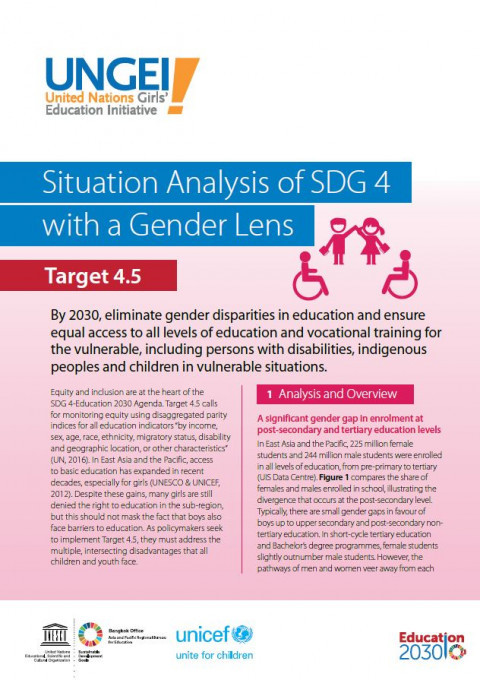 Situation Analysis of SDG 4 with a Gender Lens, Target 4.5 Year of publication: 2018 Corporate author: UNESCO Bangkok Equity and inclusion are at the heart of the SDG 4-Education 2030 Agenda. Target 4.5 calls for monitoring equity using disaggregated parity indices for all education indicators “by income, sex, age, race, ethnicity, migratory status, disability and geographic location, or other characteristics” (UN, 2016). In East Asia and the Pacific, access to basic education has expanded in recent decades, especially for girls (UNESCO & UNICEF, 2012). Despite these gains, many girls are still denied the right to education in the sub-region, but this should not mask the fact that boys also face barriers to education. As policymakers seek to implement Target 4.5, they must address the multiple, intersecting disadvantages that all children and youth face.
 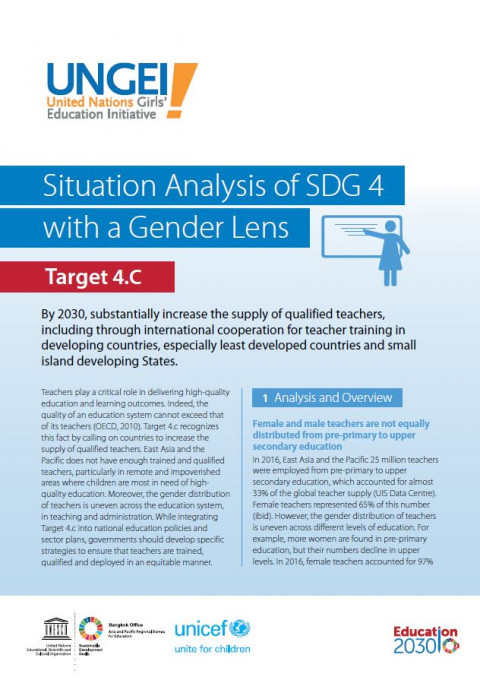 Online Programme and Meeting Document Situation Analysis of SDG 4 with a Gender Lens, Target 4.C Year of publication: 2018 Corporate author: UNESCO Bangkok Teachers play a critical role in delivering high-quality education and learning outcomes. Indeed, the quality of an education system cannot exceed that of its teachers (OECD, 2010). Target 4.c recognizes this fact by calling on countries to increase the supply of qualified teachers. East Asia and the Pacific does not have enough trained and qualified teachers, particularly in remote and impoverished areas where children are most in need of highquality education. Moreover, the gender distribution of teachers is uneven across the education system, in teaching and administration. While integrating Target 4.c into national education policies and sector plans, governments should develop specific strategies to ensure that teachers are trained, qualified and deployed in an equitable manner.
 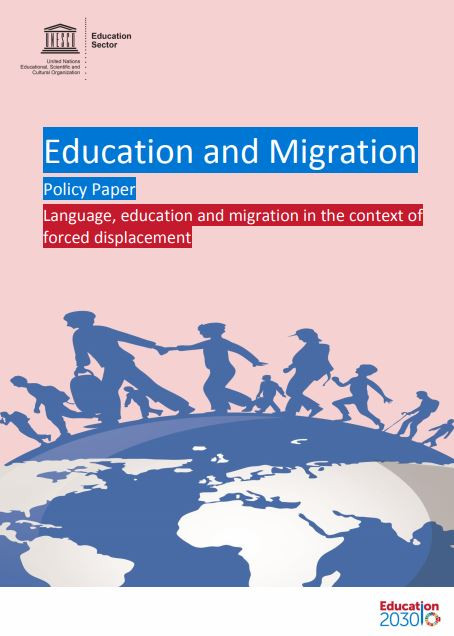 Education and Migration Policy Paper: Language, Education and Migration in the Context of Forced Displacement (Policy Brief Series, no 1) Year of publication: 2018 Author: Francine Sara Menashy | Zeena Zhakaria A surge in global migration, spurred in part by conflict, emergency, and fragility, has elicited increased attention to the specific needs of migrant and refugee learners. The international community faces an urgent global challenge: more people are now displaced than since the end of the Second World War. Half of those displaced are under the age of 18. Further, while two-thirds of international migrants are in high-income countries, 85% of those displaced by conflict and natural disaster now live in low-income countries. Forced displacement creates particular vulnerabilities, including access to education free from discrimination. Meeting Sustainable Development Goal 4 by 2030 demands that all children, youth, and adults receive an inclusive and equitable quality education. Education is a right that plays a critical role in advancing both sustainable development and peace. Yet refugees, migrants, and asylum seekers encounter numerous barriers to an inclusive andequitable quality education in host countries worldwide.
  Inclusive Education for Persons with Disabilities - Are We Making Progress? Year of publication: 2019 Corporate author: UNESCO | Leonard Cheshire (UK) The paper ‘Inclusive education for persons with disabilities – Are we making progress?’ has been developed as a background paper for the UNESCO International Forum on inclusion and equity in education – Every learner matters, being held in Cali, Colombia from 11-13 September 2019. The Forum is being organised in commemoration of the 25th anniversary of the passing of the Salamanca Statement and Framework for Action. The paper will explore the global progress towards inclusive education, the successes achieved and learnings observed specifically in countries of the global South. In these countries the concerns of universal access to and retention in education is still a concern for many governments, but large-scale exclusion of children with disabilities (an estimated 32 million or 1 out of 3 are out of school) remains the order of the day and is not always high on government agendas.