
Resources
Explore a wide range of valuable resources on GCED to deepen your understanding and enhance your research, advocacy, teaching, and learning.
8,376 Results found
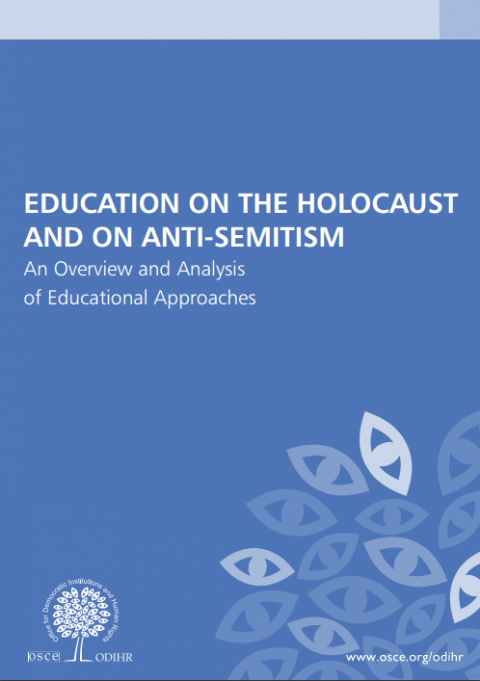 Education on the Holocaust and on Anti-Semitism : An overview and analysis of Educational Approaches Year of publication: 2006 Corporate author: OSCE. Office for Democratic Institutions and Human Rights (ODIHR) This study provides both the background on what is already being done in the field of Holocaust education and the identification of good practices to support future efforts by OSCE states and civil society. It also highlights new challenges that need to be addressed in education on both the Holocaust and on anti-Semitism. The first part of the study is based on information provided to the ODIHR by national ministries of education; national delegations of the Task Force for International Cooperation on Holocaust Education, Remembrance and Research (ITF); experts; educators; Jewish communities; and NGOs, in response to a questionnaire sent out by the ODIHR between December 2004 and April 2005. Comprehensive recommendations regarding Holocaust education conclude this first part of the overview. The second part of this report constitutes a first step in this regard: using country overviews on four OSCE states, it highlights the need to supplement Holocaust education in response to new forms of anti-Semitism and provides a number of relevant recommendations. (By the publisher)
  Human rights education at Holocaust memorial sites across the European Union : An overview of practices Year of publication: 2011 Corporate author: European Union Agency for Fundamental Rights Most European Union (EU) Member States have memorial sites and museums that both preserve the memory of the Holocaust and encourage visitors, in particular young people, to reflect on current human rights issues. In this handbook, the European Union Agency for Fundamental Rights (FRA) provides examples of the various ways in which memorial sites link the history of the Holocaust to human rights, ensuring that the past resonates in the present and its lessons are brought to bear on difficult contemporary issues against its backdrop. The report offers a sampling of educational programmes at selected historical sites and museums that either address human rights directly or approach, in a more general way, the dignity of human life and the equality of all human beings. (By the publisher)
  Values and Attitudes - Positive and Negative: A study of the impact of teaching the Holocaust on citizenship among Scottish 11-12 year olds Previous research on teaching the Holocaust, notably case studies in the primary or the secondary sectors, suggests that Holocaust education can make a significant contribution to citizenship by developing pupils’ understandings of justice, tolerance, human rights issues, and the many forms of racism and discrimination. Yet, there have been no longitudinal studies into its impact on primary pupils. This paper reports on the first stages of ongoing longitudinal research (sponsored by the Scottish Executive Education Department) and concentrates on the relevance of Holocaust education to citizenship, by comparing the attitudes of primary 7 pupils before and after Holocaust teaching using data from questionnaires. Results show an improvement in pupils’ values and attitudes after learning about the Holocaust in almost every category related to minority groups, ethnic or otherwise. One significant finding was a deep anti-English feeling and this in itself indicates the need for further investigation. (By the author) Developing Positive Values: A case study of Holocaust Memorial Day in the primary schools of one local authority in Scotland Many schools and local authorities saw the initial Holocaust Memorial Day as an important stimulus to develop lessons and events in Holocaust history amongst young people of vital importance for today. The focus of this paper is to examine the potential for Holocaust education in the primary curriculum in Scotland and whether the instance of Holocaust Memorial Day and the undertaking of a serious commitment to it by a local authority had an impact on the teaching and raising of Holocaust issues in the primary schools in that area. The authors previously argued (Maitles & Cowan, 1999) that there needed to be a major commitment from the Scottish Executive and/or local councils to encourage teachers and schools to coordinate or introduce Holocaust education in the schools. To test this, the field research for this survey was conducted by means of a questionnaire to every primary school in the local authority and achieved a 91% response rate. Strong national commitment to Holocaust educational activities, backed up by commitment from the local authority, in terms of staff development and teaching materials, ensured a quality of experience as well as the quantity. Linked to this was an effective structure in the schools, with a designated Holocaust education coordinator and the involvement of the wider community. This led teachers in schools to imaginatively develop pupil skills, knowledge and understanding and informed attitudes in Holocaust history which potentially has a resonance in the wider citizenship area. (By the publisher) Seeing, Hearing and Feeling: How Can a Visit to Auschwitz Encourage Young People to Practise Citizenship? In 2005 the first national educational visit to Auschwitz took place for Scottish pupils aged between 16 and 17 years. This study examines the impact this had on pupils in Fife Region, the third largest local authority in Scotland. Soon after this visit, pupils formed ‘The Auschwitz Experience Group’, and over a year organized the ‘Anne Frank and You Festival’, a large-scale community initiative that focused on citizenship issues. The research sought pupil feedback on the educational visit and identified key issues of importance for teachers and cultural managers who work alongside education services. (By the author) Identifying with Horror: Teaching about the Holocaust - A response to Simone Schweber's "Simulating Survival" The author responds to Simone Schweber's article "Simulating Survival", an article that praised the use of a simulation about the Holocaust by a public school teacher. In her response, Ben-Peretz discusses the impact of Schweber's article, some issues concerning the public school teacher's mode of teaching, why the Holocaust should be taught, and implications for teacher education. (Abstract In : Educating about Social Issues in the 20th and 21st Centuries: A Critical Annotated Bibliography)
  Teaching and Studying the Holocaust - Annoted version Teaching and Studying the Holocaust is comprised of thirteen chapters by some of the most noted Holocaust educators in the United States. In addition to chapters on establishing clear rationales for teaching this history and Holocaust historiography, the book includes individual chapters on incorporating primary documents, first person accounts, film, literature, art, drama, music, and technology into a study of the Holocaust. It concludes with an extensive and valuable annotated bibliography especially designed for educators. Chapter Ten instructs how to make effective use of technology in teaching and learning about the Holocaust. The final section of the book includes a bibliography especially developed for teachers that lists invaluable resources. (By the publisher) "Nobody Told Us about What Happened": The Current State of Holocaust Education in Romania This research study sought to understand the current state of Holocaust education in Romanian classrooms and how sociocultural and institutional forces influence its treatment. By identifying the obstacles, challenges, and successes of Holocaust education in Romania, this study can both disseminate the techniques and conditions that bring about meaningful Holocaust education and provide a generative knowledge base for curriculum proposals, symposia and other initiatives that seek to disrupt reticence on this topic. Given their recent accession to the European Union, this is a timely study that also examines Romania's educational efforts concerning the development of democratic skills and dispositions, many of which often result from addressing controversial topics and closed areas, including the Holocaust in Romania. Holocaust education is a relatively new phenomenon in Romania and studying its inception can offer insights for other societies and cultures that are working to introduce Holocaust or controversial issues into their middle and high school curricula. As more post-Soviet and post-communist states attempt to build pluralistic, tolerant, and open-minded societies their treatment of historical silences and the renegotiation of their past become critical features for the development of democratic citizens. Holocaust education is well-qualified to meet the demands of citizenship education as it helps to promote tolerant societies free from prejudice, racism and bigotry, while simultaneously promoting the inclusivity of others, justice-oriented dispositions and commitments to peace (Salmons, 2003). (By the author)
  “We did also save people”: A Study of Holocaust Education in Romania After Decades of Historical Silence Year of publication: 2008 Author: Thomas Misco This research study seeks to understand the current state of Holocaust education in Romanian classrooms and the variety of forces that influence its treatment. By identifying obstacles, challenges, and successes, this study provides a generative knowledge base for curriculum proposals, symposia, and other initiatives that seek to disrupt reticence on this topic. Given the wide range of possible influences on Holocaust instruction, this study employs ethnographic methods to seek out constructed meanings among students, teachers, subject matter, and numerous forces within the milieu. The findings reveal some promise for addressing this history in schools, including teacher autonomy, institutional support, and teacher trainings. Yet Romania faces a number of challenges, such as the legacy of communism, the role of Antonescu in the curriculum, few opportunities to address controversies, limited instructional time, and other institutional and community forces. Holocaust education is a relatively new phenomenon in Romania and understanding its evolution can inform other societies and cultures that are working to introduce Holocaust studies or controversial issues into their curricula. As more post-Soviet and post-communist states attempt to build pluralistic, tolerant and open-minded societies, their treatment of historical silences and the renegotiation of their past become critical features for the development of democratic citizens. (By the author) Textbooks and the Holocaust in Independent Ukraine: An Uneasy Past The article examines how Ukrainian history textbooks dealt with the Holocaust between independence and 2006. The analysis reveals two major, conflicting narratives about the Holocaust, though both externalize and relativize the Holocaust. As a template for understanding genocide, the Holocaust was applied to the Soviet-imposed 1932-33 famine in Ukraine, the Holodomor. The emphasis placed on the famine in both narratives partially obscures the Holocaust and in propagating the Judeo-Bolshevik myth, turns Jews into leading perpetrators of the Holodomor. In the Ukrainian case, the complex relationship among history, historical culture, and contemporary politics is compounded by the familiar tension between national history and the international reality of the Holocaust. The historical Sovietization of Holocaust victims was attacked by historians in the Ukrainian diaspora who resented the accusations that Ukrainians were collaborators and fascists. They sought to replace the Soviet historical narrative with one that made Ukrainians the central victims, not perpetrators. Ukraine's own nationalization of the Holocaust functioned in much the same way as the Sovietization of the Holocaust. Nationalization, obfuscation, and an implicit competition among victim narratives all contribute to the relatively complicated place of the Holocaust in Ukrainian historical narratives. (By the author)