
Resources
Explore a wide range of valuable resources on GCED to deepen your understanding and enhance your research, advocacy, teaching, and learning.
8,376 Results found
 Teaching the Holocaust at a distance : reflections from the field As technology continues to improve and online learning programs continue to proliferate each year throughout the United States, it is necessary for teachers to establish a sound understanding of proper pedagogical techniques for a digital environment. This phenomenon has ushered in a new era of education, thus bringing forth a myriad of new questions and issues that must be addressed. For instance, how should online instructors properly transfer and teach traditional core subjects in an online milieu? Social studies educators are faced with additional quandaries, such as teaching democratic processes for effective citizenship and the teaching of controversial issues/topics like the Holocaust. Undeniably, controversial topics elicit strong emotions and come with a plethora of concerns that seem only possible to address in a face-to-face classroom. This current exploration draws upon the scholarship and experience of experts in the field of social studies education, distance learning, and Holocaust Studies to provide suggestions as to how teachers should approach controversial topics in a digital learning environment. An example lesson plan is also provided to showcase a successful integration of controversial issues into an online high school social studies classroom. (By the author)
 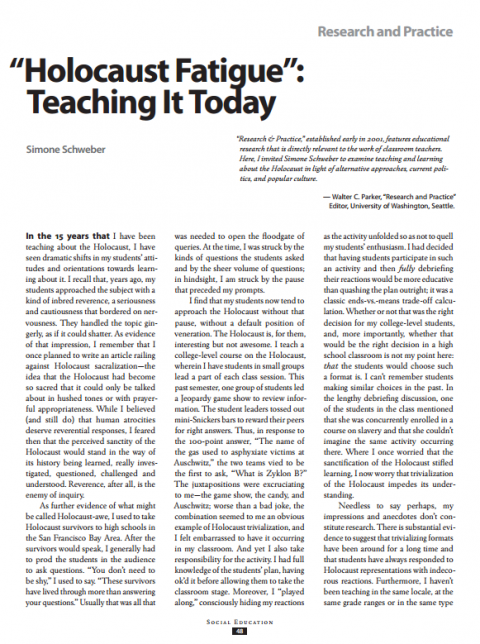 ´Holocaust Fatigue': Teaching it today The review "Research & Practice", established early in 2001, features educational research that is directly relevant to the work of classroom teachers. Here, I invited Simone Schweber to examine teaching and learning about the Holocaust in light of alternative approaches, current politics, and popular culture. (By the publisher)
 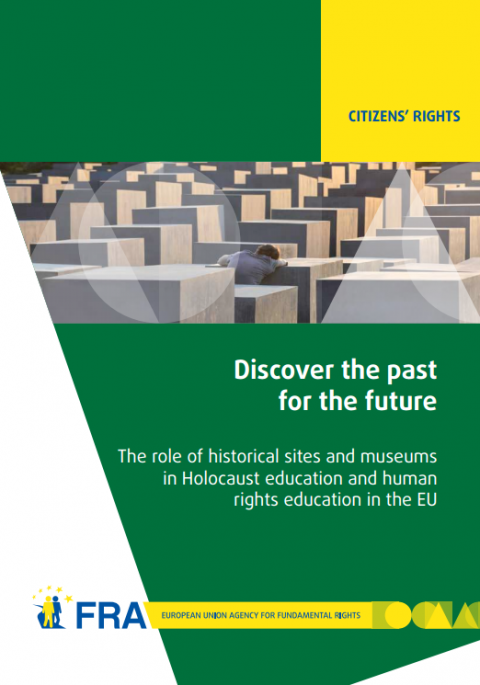 Discover the past for the future: The role of historical sites and museums in Holocaust education and human rights education in the EU The Holocaust has rightfully become an integral part of the collective cultural memory of Europe and the world. This report outlines the findings of the first EU-wide research on the role of Holocaust-related sites and exhibitions in educating young Europeans about the Holocaust and human rights. With this research, the European Union Agency for Fundamental Rights (FRA) brings the two fields of Holocaust education and human rights education together and suggests how the merging of the two could develop into a new knowledge of past and present. The report highlights that attempts to expand knowledge of human rights and to establish links between Holocaust education and human rights education need a broader focus than the memorial sites or museums can offer. Much of the work on linking Holocaust education and human rights education needs to be accomplished in schools. This requires teachers to have opportunities to gain a better understanding of human rights education, and human rights education to be better integrated into school curricula in the EU. Visits to memorial sites and museums can stimulate, support and supplement such work. (By the publisher)
  Discussion Papers Journal (Vol 3) Volume III presents a diverse group of authors writing on a wide range of topics. Among the contributors are academics, researchers, and sociologists, the chairman of a world-renowned Holocaust museum, the Special Advisers to the Secretary-General on the Prevention of Genocide and the Responsibility to Protect, a Hollywood filmmaker, and a former United Nations intern. They are from Canada, Denmark, Israel, Morocco, Senegal, Serbia, the United Kingdom and the United States. Their articles deal with a fascinating wide range of issues including Holocaust education in Denmark, and in Morocco; the International Holocaust Remembrance Alliance; music and the Holocaust; rescue; the preservation of former Nazi concentration and death camps; crimes committed against the Roma and Sinti during the Second World War; the post-Holocaust memory of German-Jewish achievements; and the prevention of atrocity crimes. (By the publisher)
  Discussion Papers Journal (Vol 2) In Volume II, Chinese author Pan Guang delivers a gripping account of how Jews made their way to Shanghai during the Second World War while Polish writer Andrzej Mirga details the Nazi persecution of Roma and Sinti during the same period. Argentine professor Juan E. Méndez bring us to the 21st century with a discussion of the 2011 arrest and pending trial of accused Serbian war criminal Ratko Mladic. And the timeless value of Holocaust education is explored as South African Tali Nates shows how education is helping to heal the divisions wrought by apartheid in South Africa and Russian scholar Ilya Altman lays out Holocaust remembrance and education in contemporary Russia. Other contributors are Edward Mortimer and Kaja Shonick Glahn (UK / Germany), David Matas (Canada), Lenore Weitzman (USA), and Robert Krell (Canada). (By the publisher)
  Discussion Papers Journal (Vol 1) In Volume I, students are introduced to the subject of the Holocaust and its implications through the writings of experts in this field of study and testimonies from survivors. German Professor Monika Richarz provides the reader with historical context and insight into Jewish culture before the war and French-born Holocaust survivor Simone Veil gives a first-hand account of experiencing the Holocaust as a Jew. Hungarian writer László Teleki talks about the Roma experience and how this group was similarly targeted by the Nazis. Historian and Professor Yehuda Bauer (Israel) explains how the Holocaust evolved from a utopian ideology that involved hatred of Jews, while Nobel Laureate and Holocaust survivor Elie Wiesel (USA) challenges the reader with the question “Why hate?” Other contributors include Professor Xu Xin (China), Professor Ben Kiernan (Australia), Professor Edward Kissi (South Africa), and Francis Deng (former Special Adviser to the United Nations Secretary-General on the Prevention of Genocide and today Permanent Representative of South Sudan to the United Nations). (By the publisher) Enseigner l'histoire et la prévention des génocides - Peut on prévenir les crimes contre l'humanité ? The question of barbarism dominates remembrance issues. The study of the prevention of crimes against humanity constitutes another major challenge. But these sensitive and complex debates are problematic. All fields are concerned : history, memory, law, philosophy, politics. How can schools tackle them ? Two solutions : opting for a comparative study of genocides, particularly the Holocaust and the Tutsis in Rwanda; and using the "universal/particular" dialectic, institutions and individuals. Recollections of the past and edification of the future, this book gives meaning to education and presents a sensitive reflection of the challenges of history and the contemporary world. (By the author - Translation) Centropa - Preserving Jewish memory - Bringing History to Life Centropa is a non-profit, Jewish historical institute dedicated to preserving 20th century Jewish family stories and photos from Central and Eastern Europe and the Balkans, and disseminating these stories and photos through films, books and exhibitions. The teaching materials available on this website relate individual histories and Jewish way-of-life aspects to provide an alternative way to teach History. Educator Resources from Kazerne Dossin The Kazerne Dossin museum aims to remember the persecution of Jews and Roma in Belgium. Study guides and biographies are available for teachers to broach this part of history. Articles about mass violence and other genocides are also downloadable in order to encourage critical thinking. Museo del Holocausto Buenos Aires The Museo del Holocausto in Buenos Aires contains numerous resources for Holocaust Education. As a support, teachers have dowloadable lessons, FAQ Column, literature reviews, timeline and a few Spanish language testimonies.