
Resources
Explore a wide range of valuable resources on GCED to deepen your understanding and enhance your research, advocacy, teaching, and learning.
8,376 Results found
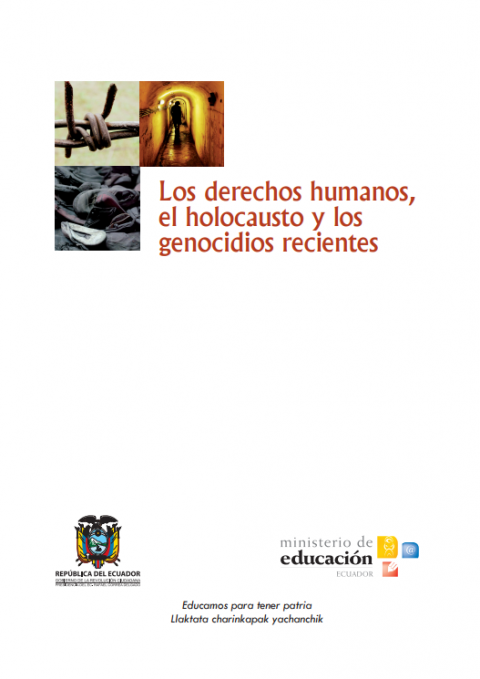 Los derechos humanos, el holocausto y los genocidos recientes Year of publication: 2008 Corporate author: Ecuador. Ministerio de Educacion This resource guide designed for high school students in Ecuador broaches Holocaust history through broader thematics such as Human Rights, mass violence and a comparative analysis with other genocides. It is an valuable document for understanding worldwide issues.
  T.E.A.C.H : Teaching emotive and controversial History 3-19 Many historical topics, including the Crusades, the Transatlantic Slave Trade or the Arab-Israeli conflict, can be considered emotive and controversial. The TEACH report found, in interviews with teachers carried out before 2007, that some teachers sometimes feel uncertain how best to approach such topics in such a way as to do the topics justice while respecting the feelings of particular groups of pupils. At no point did any teacher interviewed for the TEACH report claim to have avoided teaching about the Holocaust at Key Stage 3 for fear of offending Muslim children. The TEACH report outlines the sort of good practice in teaching sensitive topics which is available for teachers to share, not least through the Historical Association's programme of subject-specific training. (By the publisher)
  Teaching the Holocaust in School History: Teachers or Preachers? If we expose students to a study of human suffering we have a responsibility to guide them through it. But is this the role of school history? Is the rationale behind teaching the Holocaust primarily historical, moral or social? Is the Holocaust to be taught as a historical event, with a view to developing students' critical historical skills, or as a tool to combat continuing prejudice and discrimination? These profound questions lie at the heart of Lucy Russell's fascinating analysis of teaching the Holocaust in school history. She considers how the topic of the Holocaust is currently being taught in schools in the UK and overseas. Drawing on interviews with educationalists, academics and teachers, she discovers that there is in fact a surprising lack of consensus regarding the purpose of, and approaches to, teaching the Holocaust in history. Indeed the majority view is distinctly non-historical: there is a tendency to teach the Holocaust from a social and moral perspective and not as history. This book attempts to explain and debate this phenomenon. (By the publisher)
  Israeli Youth Pilgrimages to Poland. Rationale and Polemics The article, based on material collected as part of a project evaluating the pilgrimage trips to Poland by Israeli adolescents as part of the Holocaust curriculum, attempts to provide the reader with the background for these trips. In this context, the authors discuss the evolving national agenda in Israel, and the transition from experiencing independence to experiencing the Holocaust. The authors of the article stress that in the wake of the profound social changes that took place in Israeli society, the memory of the Holocaust gained new significance among the country’s national priorities. While a policy known as “the great silence” regarding the Holocaust prevailed among the first generation after statehood, the Holocaust has now become a factor that shaped the national ethos. In 1979, for the first time, the Ministry of Education commissioned two curricula dealing exclusively with the Holocaust. The article notes that the Holocaust and its lessons can be examined from three different perspectives: The first focuses on presenting the universal significance of the Holocaust and perceiving it as parallel to other cases of genocide. The second focuses on presenting the national significance of the Holocaust as a unique and unparalleled case of the Jewish People. The perception held by this approach is actually “the whole world is against us.” The third perspective is a synthesis of these two approaches. In this article, the authors note that the longstanding debate in Israeli society over the various methods for instilling the Holocaust and the journeys to Poland by adolescents expresses these three perspectives. (By the author)
  Translating globalization theories into educational research : thoughts on recent shifts in Holocaust education Much educational research on globalization aims to prepare students to be successful citizens in a global society. We propose a set of three concepts, drawing on systems theory (Nassehi, Stichweh) and theories of the subject (Butler, Foucault), to think the global which enables educational research to step back from hegemonic discourses and reflect on current practices. Globalization is understood in this approach as referring to: (1) a cognitive shift; (2) expanding relevancy spaces; and (3) new forms of subjectivation. The framework is illustrated with examples from educational policy and learning materials, with an extended look at how globalization is articulated in recent shifts in Holocaust education. (By the author)
  Intercultural Education : Supplement 1 : Teaching the Holocaust in diverse classrooms : Opportunities and Challenges (Vol 21) Supplement 1 "Intercultural Education is a global forum for the analysis of issues dealing with education in plural societies. It provides educational professionals with the knowledge and information that can assist them in contributing to the critical analysis and the implementation of intercultural education." This special issue is about the opportunities and challenges about teaching the Holocaust in diverse classrooms.
  Intercultural Education : special issue on Holocaust Education in North America and Europe (Vol 14) Issue 2 "Intercultural Education is a global forum for the analysis of issues dealing with education in plural societies. It provides educational professionals with the knowledge and information that can assist them in contributing to the critical analysis and the implementation of intercultural education." This special issue concerns Holocaust Education in North America and Europe.
  Learning from genocide: a study in the failure of Holocaust education The importance of learning lessons from the Holocaust and from the mass slaughter in Rwanda was recognised in the theme underpinning Britain’s Holocaust Memorial Day in 2004. This article is principally concerned with the lessons learnt from the Holocaust by a culturally diverse group of students aged 14 to 16. They all attended schools in an outer London borough and were interviewed after taking part in a local event held to mark the 2004 commemoration. The article concludes with a discussion of the main findings of the investigation. (By the author)
  Breaking Historical Silence through Cross-cultural collaboration: Latvian curriculum writers and United States Holocaust Memorial Museum fellows In response to the need for Holocaust curricula in Latvia, Latvians and Americans worked collaboratively to overcome the historical silence surrounding this event. During their project, Latvian curriculum writers worked with teachers and scholars at the United States Holocaust Memorial Museum. This descriptive analysis of the Latvians' experience with Museum Fellows revealed opportunities to learn from each other the complexities of teaching the Holocaust in a country viewed by some as collaborators and still somewhat anti-Semitic. Findings included depth of guidance, values, and limits of innovative teaching methods, cross-cultural benefits, and continued collaboration. Recommendations for future efforts by post-Communist countries and American partners to develop curriculum on teaching a most complex and contentious aspect of history such as the Holocaust conclude the study. (By the author)
  Seeing the world from today from a different viewpoint: The impact of the lessons from Auschwitz project on schools in Scotland Auschwitz remains the epitome of inhumanity and barbarism. In 2007, the Holocaust Educational Trust organised the first Lessons from Auschwitz (LFA) project for Scottish schools. Its participants were two plane-loads of Scottish pupils and teachers from 31 local authorities – typically two pupils from a school accompanied by a teacher. This research, funded by the Holocaust Educational Trust and the Pears Foundation, involved these participants being invited to complete an online questionnaire with selected follow-up interviews. The aims were to evaluate the LFA project and provide insight into the impact this project had on individuals, schools and communities. This paper will report on: Student evaluation of the LFA project ; The impact of the LFA project on individuals, schools and local communities. Conclusions as to the value of the LFA project in Scotland. (By the author)