
Resources
Explore a wide range of valuable resources on GCED to deepen your understanding and enhance your research, advocacy, teaching, and learning.
8,376 Results found
 An Unimagined Community? Examining Narratives of the Holocaust in Lithuanian Textbooks 2011 marked 20 years since the collapse of the Soviet Union. This represented a change not just in the content of education or ideologies, but in the relationships between individuals, institutions and systems. During this time, the post-Soviet Republic of Lithuania not only had to reimagine its national identity in a local context, but it also had to reimagine itself as a community within the political, economic, and historical imaginations of the North Atlantic Treaty Organization (NATO) and the European Union (EU). Therefore, in Lithuania, as in many other post-Soviet countries, debates over which events should or should not be included as part of the national identity, and thus represented in the school curriculum, are more than just discussions about educational content; they are debates over the moral legitimacy of certain narratives and the ability of sovereign states to define them. (By the publisher)
 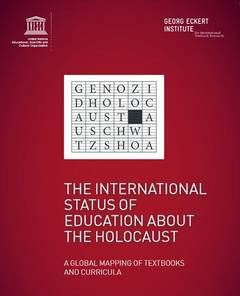 The International status of education about the Holocaust : A global mapping of textbooks and curricula Year of publication: 2015 Corporate author: UNESCO This publication by UNESCO and the Georg Eckert Institute documents ways in which the Holocaust is presented in secondary school level history and social studies curricula worldwide, and conceptualized and narrated in textbooks from twenty-six countries, with all continents represented. Historical understandings of the Holocaust are defined in terms of the spatial and temporal scales with which the event is portrayed, the protagonists involved, interpretative patterns (according to definitions, comprehensiveness, causes, relativization or banalization), narrative techniques and viewpoints, didactic methods, and national idiosyncrasies. The study is based on 272 currently valid curricula from 135 countries, and on 89 textbooks published in 26 countries since 2000. The aim of the study is primarily to document information in such a way that it reflects local understandings of the Holocaust, principally by recording concepts and narratives of the Holocaust found in educational media currently in use in schools. The findings show both convergence and divergence in the representations analysed. The Holocaust is subject to shared patterns of representation, which include selectivity, personalization, appropriation, screening and omission. It is also subject to narrative idiosyncrasies. One of the main trends worldwide is domestication, a process whereby countries place emphasis on the local significance of the event or appropriate them in the interests of local populations. Drawing on such national and international patterns of representation, the publication concludes by formulating recommendations for future curricula and textbook narratives about the Holocaust. These recommendations relate to such issues as the use of terms, the comprehensiveness of historical facts, the definition of causes, the combination of universal and local approaches, and the development of historical literacy. (By the publisher) La enseñanza del Holocausto en América Latina - Los desafios para los educadores y legisladores Year of publication: 2015 Corporate author: UNESCO The Holocaust has become a point of reference worldwide to raise awareness about violations of human rights and state violence. What is the importance of Holocaust education in regions of the world that have no direct relation to the history of the Jewish people and the crimes of Nazism, especially in Latin America? Is there a rise of relevant educational practices internationally as a result of the expansion of education about the Holocaust ? How can educators address a subject so complex and emotionally charged in changing multicultural societies ? This UNESCO publication brings together the contributions of important historians and educators around the world and frames current debates in the field, emphasizing the issues that educators in Latin America are facing and revealing the reasons why it is vital to continue teaching Holocaust history in the world today, regardless of where we live. (By the publisher - Translation) Fearful symmetry: Palestinian and Jewish teachers confront contested narratives in integrated bilingual education The present paper deals with Jewish and Palestinian teachers who work in an integrated school in Israel, and shows the challenges and possibilities by examining these teachers' powerful historical narratives in the context of in-service training sessions. It is shown how these teachers essentially remain firmly rooted in the hegemonic historical narratives of their own community, even when their attitudes are challenged and clearer alternatives are considered to the reigning narratives. The findings highlight predominantly the failures, concerning the potential of educational efforts to help overcome situations of intractable conflict, even within contexts specifically devised for this purpose; yet, some openings also become apparent in the process of negotiating competing narratives and inventing new dialogic possibilities. The paper suggests that schools with their historical tradition are places where it is difficult to reach change or to produce it—even in integrated schools in which partial structural change takes place—and teacher training may not always be the answer. However, it also indicates that an ongoing agonistics of raising critical issues regarding one's identifications with hegemonic narratives does offer openings to take responsibility for both the challenges and the dialogic possibilities that are created in the process.
 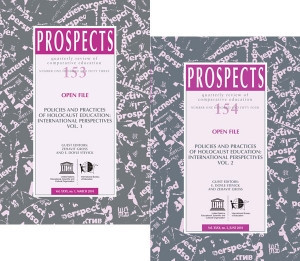 Policies and practices of holocaust education : international perspectives (Vol 40) Issue 153-154 Year of publication: 2010 Corporate author: UNESCO International Bureau of Education (IBE) This double issue of Prospects (UNESCO/IBE) includes important contributions and new insights from researchers who have examined the practices of Holocaust education in various parts of the world. An open call for papers for this issue brought more than 30 contributions, a pool of high quality papers that greatly exceeded expectations, leading to the production of a double issue on the topic. The broad interest and new research are a testimony both to the significance of the field and to its challenges. The articles in the first volume contribute empirical research about the actual policies and practice of Holocaust education and carry direct lessons from school and classroom practices not only for countries in Europe but also for human rights and peace education worldwide. The second volume continues to reflect its authors’ practical and intellectual engagement with the implications of Holocaust education for human rights, multicultural, peace, and civic education. (By the publisher)
  As the witnesses fall silent : 21st century Holocaust education in curriculum, policy and practice Year of publication: 2015 Corporate author: UNESCO International Bureau of Education (IBE) This UNESCO/IBE publication represents the most comprehensive collection ever produced of empirical research on Holocaust education around the world. It comes at a critical time, as the world observes the 70th anniversary of the liberation of Auschwitz. The policies and practices of Holocaust education around the world are as diverse as the countries that grapple with its history and its meaning. Educators around the globe struggle to reconcile national histories and memories with the international realities of the Holocaust and its implications for the present. These efforts take place at a time when scholarship about the Holocaust itself has made great strides. In this book, these issues are framed by some of the leading voices in the field, including Elie Wiesel and Yehuda Bauer, and then explored by many distinguished scholars who represent a wide range of expertise. (By the publisher) Learning the lessons of the Holocaust? A critical consideration of the antiracist and citizenship potential of Holocaust education in English secondary schools Year of publication: 2010 Author: Alice Pettigrew In this paper I draw upon data collected as part of a national study of current practice in Holocaust education within English secondary schools. The paper emphasises the importance placed by teachers from a variety of subject backgrounds upon study of the Holocaust as an opportunity to explore citizenship related and antiracist concerns. However, the paper also identifies and discusses a number of potential challenges and possible limitations apparent in this approach. (By the author) Teaching about the Holocaust in English Secondary Schools : An empirical study of national trends, perspectives and practice Year of publication: 2009 Author: Alice Pettigrew | Stuart Foster | Jonathan Howson | Paul Salmons | Ruth Anne Lenga | Kay Andrews The aims were to examine when, where, how and why the Holocaust is taught in state-maintained secondary schools in England, and to inform the design and delivery of a continuing professional development (CPD) programme for teachers who teach about the Holocaust. A two-phase mixed methodology was employed. This comprised an online survey which was completed by 2,108 respondents and follow-up interviews with 68 teachers in 24 different schools throughout England. The research reveals that teachers adopt a diverse set of approaches to this challenging and complex subject. In the report, teachers’ perceptions, perspectives and practice are presented and a range of challenges and issues encountered by teachers across the country are explicitly identified. The research shows that, although most teachers believe that it is important to teach about the Holocaust, very few have received specialist professional development in this area. It also shows that many teachers find it a difficult and complicated subject to teach, and that they both want and need support to better equip them to teach about the Holocaust effectively.(By the author)
 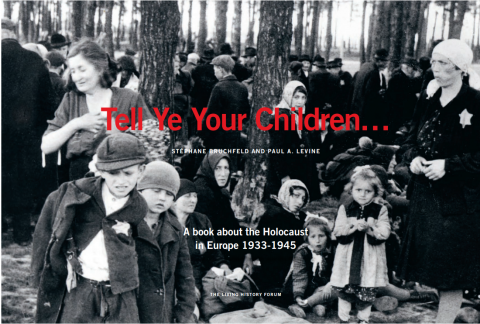 Tell Ye Your Children - A book about the Holocaust in Europe 1933-1945 Year of publication: 2012 Author: Stephane Bruchfeld, Paul. A. Levine This book is published by the Living History Forum. This Swedish public authority uses the teaching of the Holocaust and other crimes against humanity to promote tolerance, democracy and human rights. This booklet covers the rise of National Socialism until the end of the war, providing facts and information to encourage discussions.
  Enseigner la Shoah au college et au lycee - De la parole antisemite a la destruction des juifs d'Europe - Livret du Professeur Year of publication: 2009 Author: Joel Kotek, Iannis Roder This teacher booklet published by the Mémorial de la Shoah contains well-constructed lessons to use entirely or partially, based on photographs and literature extracts. This guideline offers pedagogical and scientific reflections on the Holocaust’s historical treatment.