
Ressources
Explorez une large gamme de ressources sur le GCED afin d’approfondir votre compréhension et de renforcer vos activités de recherche, de plaidoyer, d’enseignement et d’apprentissage.
8,354 résultats trouvés
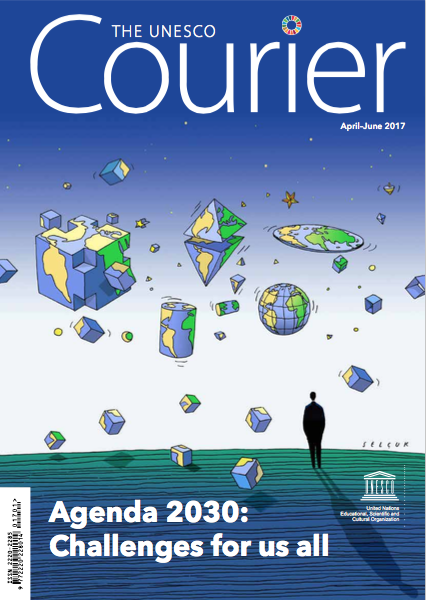 Défis 2030: un agenda pour tous Année de publication: 2017 Since 1948, the UNESCO Courier has served as a platform for international debates on issues that concern the entire planet. This first issue of 2017, which marks the Courier’s revival after
a five-year break, is no exception to the rule: experts, public figures, artists and journalists from around the world have come together to discuss topical issues.Climate change and sustainable energy (p. 23), the future of cities and Smart Cities (p. 15), access to water and the state of groundwater (p. 19), educational policies and the importance they give to girls (p. 8), new technologies and their role in establishing efficient democratic institutions (p. 27), alliances and partnerships that must be forged to advance towards a better world
(p. 31) — these are some of the subjects that constitute the main dossier,
Wide angle, of this issue dedicated to Sustainable Development Goals (SDGs).UNESCO is closely associated with the development and implementation of this international road map that aims
to achieve the seventeen objectives established by the UN, which is convinced that culture, though officially absent from the SDGs, is at the heart of sustainable development policies (p. 12). Elyx, the jovial character created by Yacine Ait Kaci (YAK) and designated virtual ambassador of the UN, supports the Courier in its mission to make palpable the different realities around the world. These are illustrated by a number of SDGs and highlight the players who participate in achieving this agenda for everyone. These include the international community, states, civil society, local communities and authorities, the private sector, and the partnerships that these players set up between each other.The Ideas section, which is dedicated
to another highly topical issue — the current perception of Islam — suggests considering a reinterpretation of the Koran (p. 42) and the sharia (p. 48).
This issue of the Courier also features a reference text on the Different Aspects of Islamic Culture. Launched in 1977, in the wake of a monumental work produced by UNESCO Publishing on general and regional histories, this comprehensive work was completed in November 2016, with the publication of two volumes that constitute an important contribution to the current debate on Islam.In the Current affairs section for the April-June 2017 quarter, the Courier
will celebrate the launch of the World Book Capital programme in Conakry
on 23 April (p. 70) and the International Jazz Day, with the Cuban pianist Chucho Valdés (p. 58) on 30 April in Havana.The Courier will also participate in the celebration of several other international days such as the World Press Freedom Day on 3 May (p. 62), the World Oceans Day on 8 June (p. 65), and the International Day for the Elimination of Sexual Violence in Conflict on 19 June (p. 61).This issue of the Courier also invites you to delve into the peculiar and largely unknown world of Jeju Island’s haenyeo, the women divers from the Republic of Korea. Discover, through the stunning images in the Zoom section, the exceptional destinies of these extraordinary women (p. 36).We hope you enjoy reading this issue!
Défis 2030: un agenda pour tous Année de publication: 2017 Since 1948, the UNESCO Courier has served as a platform for international debates on issues that concern the entire planet. This first issue of 2017, which marks the Courier’s revival after
a five-year break, is no exception to the rule: experts, public figures, artists and journalists from around the world have come together to discuss topical issues.Climate change and sustainable energy (p. 23), the future of cities and Smart Cities (p. 15), access to water and the state of groundwater (p. 19), educational policies and the importance they give to girls (p. 8), new technologies and their role in establishing efficient democratic institutions (p. 27), alliances and partnerships that must be forged to advance towards a better world
(p. 31) — these are some of the subjects that constitute the main dossier,
Wide angle, of this issue dedicated to Sustainable Development Goals (SDGs).UNESCO is closely associated with the development and implementation of this international road map that aims
to achieve the seventeen objectives established by the UN, which is convinced that culture, though officially absent from the SDGs, is at the heart of sustainable development policies (p. 12). Elyx, the jovial character created by Yacine Ait Kaci (YAK) and designated virtual ambassador of the UN, supports the Courier in its mission to make palpable the different realities around the world. These are illustrated by a number of SDGs and highlight the players who participate in achieving this agenda for everyone. These include the international community, states, civil society, local communities and authorities, the private sector, and the partnerships that these players set up between each other.The Ideas section, which is dedicated
to another highly topical issue — the current perception of Islam — suggests considering a reinterpretation of the Koran (p. 42) and the sharia (p. 48).
This issue of the Courier also features a reference text on the Different Aspects of Islamic Culture. Launched in 1977, in the wake of a monumental work produced by UNESCO Publishing on general and regional histories, this comprehensive work was completed in November 2016, with the publication of two volumes that constitute an important contribution to the current debate on Islam.In the Current affairs section for the April-June 2017 quarter, the Courier
will celebrate the launch of the World Book Capital programme in Conakry
on 23 April (p. 70) and the International Jazz Day, with the Cuban pianist Chucho Valdés (p. 58) on 30 April in Havana.The Courier will also participate in the celebration of several other international days such as the World Press Freedom Day on 3 May (p. 62), the World Oceans Day on 8 June (p. 65), and the International Day for the Elimination of Sexual Violence in Conflict on 19 June (p. 61).This issue of the Courier also invites you to delve into the peculiar and largely unknown world of Jeju Island’s haenyeo, the women divers from the Republic of Korea. Discover, through the stunning images in the Zoom section, the exceptional destinies of these extraordinary women (p. 36).We hope you enjoy reading this issue!  Combattre la violence et le harcèlement en milieu scolaire: action de l'UNESCO Année de publication: 2017 Auteur institutionnel: Organisation des Nations Unies pour l'éducation, la science et la culture (UNESCO) This item has been included in the provisional agenda of the 201st session of the Executive Board at the request of Morocco, with the support of Algeria, Cambodia, Côte d’Ivoire, Egypt, France, Italy, Lebanon, Qatar and Sudan.
  L'UNESCO et l'éducation Année de publication: 2017 Auteur institutionnel: Organisation des Nations Unies pour l'éducation, la science et la culture (UNESCO) Education is a fundamental human right and
a public good and, as such, has been at the core of UNESCO’s work since its inception.Education is also the path to sustainability – to poverty alleviation, better health, environmental protection and gender equality.As the only United Nations agency with a mandate to cover all aspects of education, UNESCO was entrusted in 2015 to lead the coordination and monitoring of Sustainable Development Goal 4, as part of the new Global Education 2030 Agenda.Goal 4 aims to “ensure inclusive and equitable quality education and promote lifelong learning opportunities for all,” and renewed UNESCO’s and Member States’ commitment to a vision of education that is holistic, inspirational and which leaves no one behind.This commitment is reflected in the size and scope of the Education Sector, the largest in UNESCO, with staff working at its Paris Headquarters and spread across a global network of field offices and specialized institutes and centres. With its close links with education ministries and other partners, UNESCO is strongly placed to press for action and change.UNESCO’s Education Sector supports Member States in developing education systems that foster high-quality and inclusive lifelong learning for all, empowering learners to be creative and responsible global citizens while leading the debate to help shape the future international education agenda.There is no stronger, no more lasting, investment a country can make than educating its citizens. The Education Sector exists to further this collective vision worldwide by transforming lives one by one.
L'UNESCO et l'éducation Année de publication: 2017 Auteur institutionnel: Organisation des Nations Unies pour l'éducation, la science et la culture (UNESCO) Education is a fundamental human right and
a public good and, as such, has been at the core of UNESCO’s work since its inception.Education is also the path to sustainability – to poverty alleviation, better health, environmental protection and gender equality.As the only United Nations agency with a mandate to cover all aspects of education, UNESCO was entrusted in 2015 to lead the coordination and monitoring of Sustainable Development Goal 4, as part of the new Global Education 2030 Agenda.Goal 4 aims to “ensure inclusive and equitable quality education and promote lifelong learning opportunities for all,” and renewed UNESCO’s and Member States’ commitment to a vision of education that is holistic, inspirational and which leaves no one behind.This commitment is reflected in the size and scope of the Education Sector, the largest in UNESCO, with staff working at its Paris Headquarters and spread across a global network of field offices and specialized institutes and centres. With its close links with education ministries and other partners, UNESCO is strongly placed to press for action and change.UNESCO’s Education Sector supports Member States in developing education systems that foster high-quality and inclusive lifelong learning for all, empowering learners to be creative and responsible global citizens while leading the debate to help shape the future international education agenda.There is no stronger, no more lasting, investment a country can make than educating its citizens. The Education Sector exists to further this collective vision worldwide by transforming lives one by one.  UNESCO Programme d'action global pour l'Éducation en vue du développement durable: dossier d'information Année de publication: 2017 Auteur institutionnel: Organisation des Nations Unies pour l'éducation, la science et la culture (UNESCO) This is a comprehensive folder containing 13 information sheets on different aspects of the Global Action Programme on ESD (GAP) and its key actors and partners. It aims to familiarize educators, learners and the general public with the GAP and advise them on how to spread the word.
 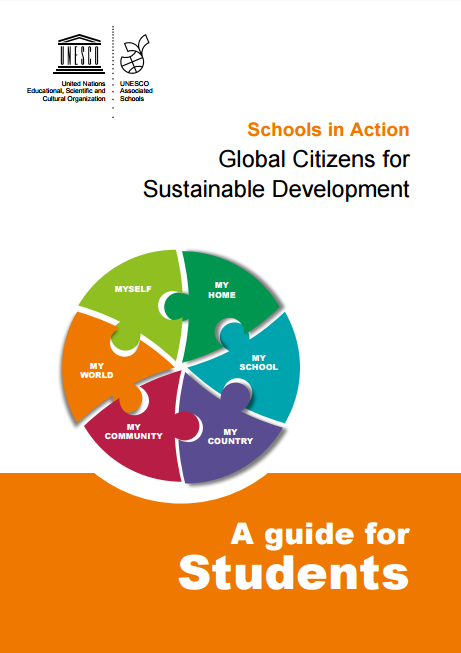 Le réSEAU en action: Citoyens du monde connectés pour le développement durable: guide à l'intention des enseignants Année de publication: 2016 Auteur institutionnel: Organisation des Nations Unies pour l'éducation, la science et la culture (UNESCO) The UNESCO Associated Schools Project Network (ASPnet) in Action: Global Citizens for Sustainable Development student guide aims to introduce secondary school students to Global Citizenship Education (GCED) and Education for Sustainable Development (ESD) and provide them with ideas and activities to contribute proactively to a more peaceful and sustainable world. The guide draws on the discussions and activities of almost 1,100 participants from 104 countries, including ASPnet National Coordinators, school principals, teachers, students and experts who contributed to the ASPnet Online Collaborative Platform: Global Citizens Connected for Sustainable Development in 2014 and 2015 [http://en.unesco.org/aspnet/globalcitizens]. You will find in this student guide: An overview of what it means to be a global citizen and of how you can contribute to sustainable development. Ideas for getting active yourself, as part of your home, school, community, country and globally. Selected activities on GCED and ESD from ASPnet schools around the world.
 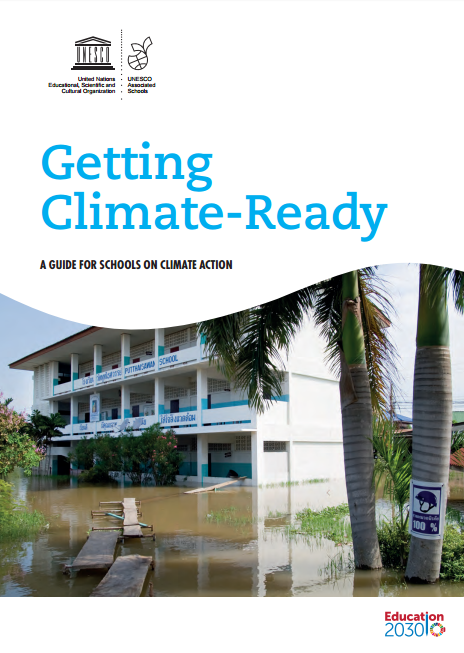 Faire face au changement climatique: guide sur l'action climat destiné aux établissements scolaires Année de publication: 2016 Auteur institutionnel: Organisation des Nations Unies pour l'éducation, la science et la culture (UNESCO) Do you want to help create a healthier, fairer, more environmentally sustainable society? Do you want to empower children and young people to do the same? Do you want to make your school more climate-friendly? If so, this guide is for you! The guidelines and examples are based on a survey looking at climate action projects at 55 schools in 12 countries. All schools in the survey are part of UNESCO’s Associated Schools Project Network (ASPnet). In addition, this guide draws on examples and research published in peer-reviewed journals, books, national and international guidelines and frameworks and programme websites.
  Principes directeurs à l'attention des éducateurs pour combattre l'intolérance et la discrimination à l'encontre des musulmans: aborder l'islamophobie à travers l'éducation Année de publication: 2013 Auteur institutionnel: Organisation des Nations Unies pour l'éducation, la science et la culture (UNESCO) | Conseil de l'Europe | OSCE. Office for Democratic Institutions and Human Rights (ODIHR) Intolerance and discrimination against Muslims are not new phenomena. However, they have evolved and gained momentum in recent years, particularly under conditions of the “war on terror”, the global economic crisis, anxieties about national identity and difficulties in coping with the increased diversity in many societies. Such developments have contributed to a growth in resentment and fear of Muslims and Islam that often been fuelled by sections of the media and by some political discourse. Muslims are often portrayed as extremists who threaten the security and well-being of others.These stereotypes have impact not only on young people but also on their parents, as well as on teachers and other education professionals. This presents a new challenge for educators. While teachers cannot be expected to resolve the political and social tensions among communities, they can play a central role in shaping the attitudes and behaviours of young people. The actions and approaches adopted by teachers and school administrators can be crucial in promoting respect for diversity and mutual understanding, both in schools and in society.Developed by OSCE/ODIHR, the Council of Europe and UNESCO, these Guidelines aim to support educators in countering intolerance and discrimination against Muslims. They are intended for a wide audience, including teachers, principals and head teachers, education policymakers and officials, teacher trainers, teacher unions and professional associations, and NGOs. The Guidelines are relevant for both primary and secondary education and can also be used in non-formal education settings.
 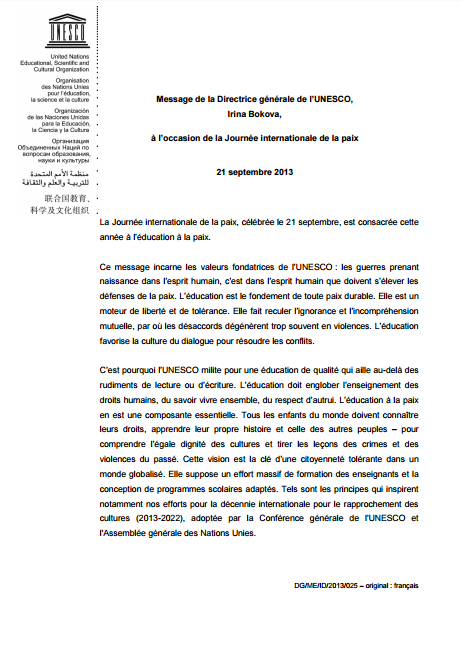 Message de la Directrice générale de l'UNESCO, Irina Bokova, à l'occasion de la Journée internationale de la paix, 21 septembre 2013 Année de publication: 2013 Auteur institutionnel: UNESCO. Director-General, 2009-2017 (Bokova, I.G.) This is the message from Irina Bokova, Director-General of UNESCO on the occasion of the International Day of Peace, 21 September 2013.
  Education aux valeurs par le sport (infographie) Année de publication: 2016 Auteur institutionnel: Organisation des Nations Unies pour l'éducation, la science et la culture (UNESCO)
 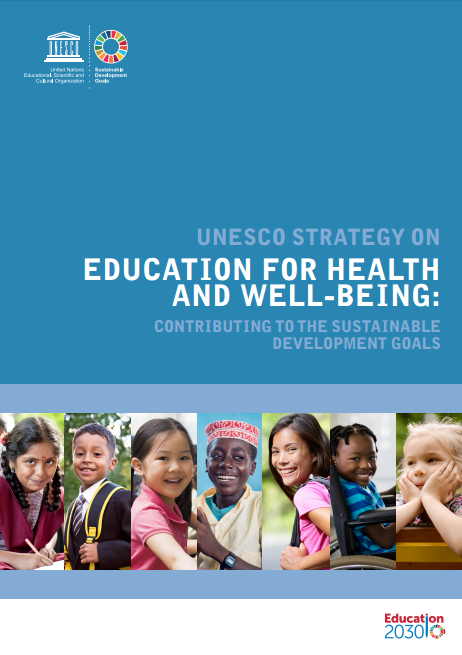 Stratégie de l'UNESCO sur l'éducation pour la santé et le bien-être: contribution aux Objectifs de développement durable Année de publication: 2016 Auteur institutionnel: Organisation des Nations Unies pour l'éducation, la science et la culture (UNESCO) This strategy builds on UNESCO’s longstanding commitment to strengthen the links between education and health, reflecting international recognition that a more comprehensive approach to school health and coordinated action across sectors is needed. As stated in the 2015 Incheon Declaration, education develops the skills, values and attitudes that enable citizens to lead healthy and fulfilled lives, make informed decisions, and respond to local and global challenges. It updates previous UNESCO strategies and expands on UNESCO’s work on HIV and on promoting comprehensive sexuality education and safe and inclusive learning environments, placing more emphasis on the role of schools in promoting health. More specifically, it reflects recent developments in the global education, HIV and health agendas, and is aligned with the new UNAIDS 2016-2021 Strategy and the Sustainable Development Goals, in particular SDG 3 Health, SDG 4 Education and SDG 5 Gender Equality.