
Ressources
Explorez une large gamme de ressources sur le GCED afin d’approfondir votre compréhension et de renforcer vos activités de recherche, de plaidoyer, d’enseignement et d’apprentissage.
8,354 résultats trouvés
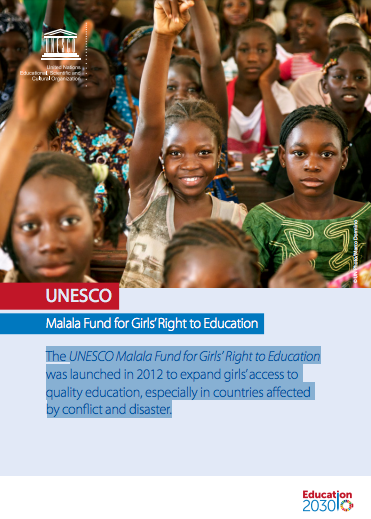 UNESCO Malala Fund for Girls' Right to Education Auteur institutionnel: Organisation des Nations Unies pour l'éducation, la science et la culture (UNESCO) The UNESCO Malala Fund for Girls’ Right to Education was launched in 2012 to expand girls’ access to quality education, especially in countries affected by conflict and disaster.
 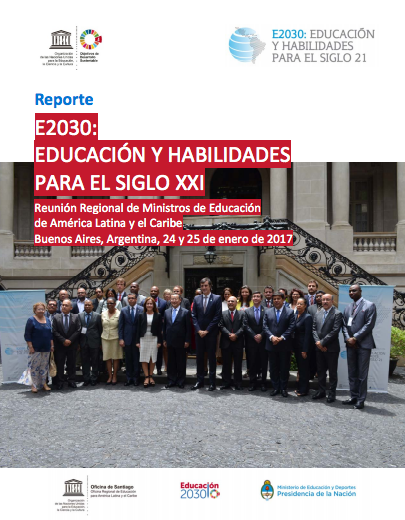 E2030: education and skills for the 21st century, report Année de publication: 2017 Auteur institutionnel: UNESCO Santiago The UNESCO Regional Bureau for Education in Latin America and the Caribbean, OREALC/UNESCO Santiago, in collaboration with the Ministry of Education and Sport of the Republic of Argentina, organized the Regional Meeting of Ministers of Education of Latin America and the Caribbean – “E2030: Education and skills for the 21st century”. Ministers of Education and high-level representatives of the education sector of the Member States of LAC; bilateral, regional and multilateral organizations; United Nations agencies; representatives of civil society; stakeholders and UNESCO experts participated in the meeting, which was held on 24-25 January 2017 in Buenos Aires, Argentina. This was the first ministerial meeting to be organized within the framework of the 2030 Agenda for Sustainable Development and its 17 Sustainable Development Goals (SDGs), in particular SDG 4 – “Ensure inclusive and quality education for all and promote lifelong learning”. It provided a space for dialogue between ministers of education and other stakeholders to debate SDG 4 in the context of the 2030 SDG Agenda. Discussions and information sharing on various topics related to the SDG 4 targets, and on the coordination mechanisms and monitoring instruments conducive to the achievement of E2030 enabled LAC Member States to reach a common vision and understanding of E2030 in the region. This joint approach on E2030 for the region is laid down in the Declaration of Buenos Aires, which ministers adopted at the end of the meeting.
 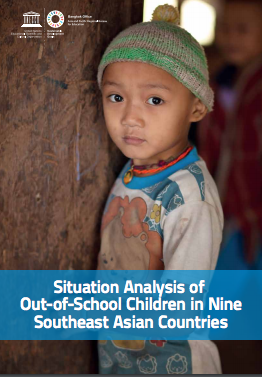 Situation analysis of out-of-school children in nine southeast Asian countries Année de publication: 2017 Auteur institutionnel: UNESCO Bangkok In a world that continually aspires for every child and youth to have access to education, there are still large numbers of out-of-school children (OOSC) who are yet to claim their right to basic education. In 2013, the number of children who are not in school, who have dropped out, and who have never been to school have risen to 124 million after seeing the numbers continuously drop for much of the first decade of the 21st century. In much of Southeast Asia, close to seven million children of both primary and lower secondary school-age find themselves in the same situation. In an effort to assist the countries in Southeast Asia to develop more robust policies and programmes for OOSC in their respective countries, this report was commissioned to map out the current legislations, policies, characteristics, and interventions on out-of-school children in nine countries across the region, which include Cambodia, Indonesia, Lao PDR, Malaysia, Myanmar, the Philippines, Thailand, Timor-Leste and Vietnam. Using a desk review of available and relevant secondary data, the study covered OOSC of primary and lower secondary school-age.
  Coordination mondiale/régionale et soutien de l'UNESCO pour la mise en oeuvre de l'ODD 4-Education 2030 Année de publication: 2017 Auteur institutionnel: Organisation des Nations Unies pour l'éducation, la science et la culture (UNESCO)
  UNESCO’s GLOBAL/REGIONAL COORDINATION OF AND SUPPORT FOR THE IMPLEMENTATION OF SDG 4 – EDUCATION 2030 Année de publication: 2017 Auteur institutionnel: Organisation des Nations Unies pour l'éducation, la science et la culture (UNESCO)
 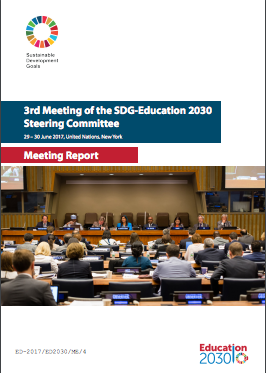 3rd Meeting of the SDG-Education 2030 Steering Committee, 29-30 June 2017, United Nations, New York: meeting report Année de publication: 2017 Auteur institutionnel: Organisation des Nations Unies pour l'éducation, la science et la culture (UNESCO) An inclusive high-level multi-stakeholder partnership, the SDG-Education 2030 Steering Committee (SC) provides a global forum for consultation and a mechanism to coordinate and harmonize global education efforts. It is mandated to provide strategic guidance to Member States and the education community, make recommendations for catalytic action, advocate for adequate financing, and monitor progress toward SDG4 targets through the UNESCO Institute for Statistics and the Global Educational Monitoring (GEM) Report. The 3 rd meeting of the SC was organized in New York on 29-30 June 2017 back to back with the HighLevel Action SDG Action Event on Education convened by the President of the UN General Assembly, Peter Thompson, in partnership with key SDG 4 stakeholders, to drive a new push for inclusive and equitable quality education and lifelong learning opportunities. At this meeting the SC examined successes and challenges in the implementation of SDG4 since the adoption of the 2030 Agenda. After highlighting the critical role of regional organizations as policy peer learning mechanisms in enhancing effective implementation of SDG4-Education 2030, the SC endorsed a set of recommendations for improved implementation in 2018 and 2019.
  A Decade of progress on education for sustainable development: reflections from the UNESCO Chairs Programme Année de publication: 2017 Auteur: Michelsen, Gerd | Wells, Peter J. Auteur institutionnel: Organisation des Nations Unies pour l'éducation, la science et la culture (UNESCO) The UNITWIN/UNESCO Chairs Programme, launched in 1992, today forms an extensive network of inter-university cooperation involving more than 700 higher education institutions in 128 countries worldwide. Through knowledge sharing and collaborative research in the priority areas of UNESCO’s work in education, the natural and social sciences, culture, communication and information, the Chairs provide a vital contribution to the Organization’s mission. The current volume focuses on the activities undertaken by UNESCO Chairs dedicated to the field of Education for Sustainable Development (ESD) within the context of the UN Decade of ESD which culminated in the UNESCO World Conference on ESD, held in AichiNagoya, Japan, 2014. The case studies included, showcase the good practices, applied research and curricula innovations pioneered by the individual UNESCO Chairs, as well as highlighting the challenges and lessons learned both for the new follow-up Global Action Programme (GAP) on ESD and the wider Education 2030 Agenda.
 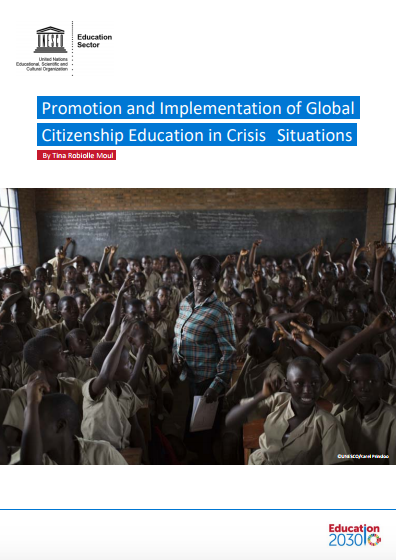 Promotion and implementation of global citizenship education in crisis situations Année de publication: 2017 Auteur: Robiolle Moul, Tina Auteur institutionnel: Organisation des Nations Unies pour l'éducation, la science et la culture (UNESCO) Crisis situations affect the realization of human rights of many people and communities across all regions of the world. Within UNESCO’s relevant areas of work, GCED is a powerful approach to education that can empower people to recover from crises and transform their communities into peaceful and sustainable societies. UNESCO commissioned a desk study that aimed at reviewing existing research on the promotion and implementation of GCED and related programs in countries affected by crisis situations, with particular attention to initiatives benefiting the refugee population. This study unveils the key challenges these programs encounter in such contexts, as well as promising practices that can guide the design and implementation of future GCED in crisis situations. This report is a synthesis of this desk study and supports the evidence that, after analyzing the context and the available means, GCED and related programs can and should be systematically adapted and implemented in crisis situations, including in response to refugee crises.
  Message de la Directrice générale de l'UNESCO, Irina Bokova, à l'occasion de la Journée internationale de la langue maternelle, 21 février 2017 Année de publication: 2017 Auteur institutionnel: UNESCO. Director-General, 2009-2017 (Bokova, I.G.) The Director-General of UNESCO, Irina Bokova gives messages on the occasion of International Mother Language Day.
  Pourquoi et comment l'Afrique doit investir dans les langues africaines et l'enseignement multilingue: note de sensibilisation et d'orientation étayée par les faits et fondée sur la pratique Année de publication: 2010 Auteur: Adama Ouane | Christine Glanz Auteur institutionnel: Institut de l’UNESCO pour l’apprentissage tout au long de la vie (UIL) | Association for the Development of Education in Africa (ADEA) This advocacy brief seeks to show the pivotal role of languages in achieving such learning. It aims in particular to dispel prejudice and confusion about African languages, and exposes the often hidden attempt to discredit them as being an obstacle to learning. It draws on research and practice to argue what kind of language policy in education would be most appropriate for Africa.